Listen closely, navigating the asm and gsm framework in stock market trading is mandatory if you trade high-momentum small caps or penny stocks on Dalal Street. In real trading desks, we constantly watch regulatory surveillance lists. When a stock enters SEBI surveillance, it signals that automated exchange surveillance algorithms have flagged abnormal price volatility, volume surges, or concentration risks.
Here is the fundamental difference between standard price bands and surveillance frameworks. While ordinary circuit limits apply to all cash equities, Additional Surveillance Measure (ASM) and Graded Surveillance Measure (GSM) impose severe progressive trading hurdles. Because these frameworks require 100% upfront cash margins and restrict intra-day leverage, they actively discourage speculative circular trading.
Traders keen on avoiding manipulated pump-and-dump counters should enroll in our Basics of Stock Market Course to master professional regulatory due diligence. Furthermore, studying our comprehensive trading manual Kaliyiri Share Market Book will teach you how to protect capital when speculative counters freeze.
Additional Surveillance Measure (ASM): Short-Term vs Long-Term Framework
The Securities and Exchange Board of India and major stock exchanges created the Additional Surveillance Measure to monitor equities exhibiting extreme volatility disconnected from underlying fundamentals. ASM operates under two distinct supervisory channels: Short-Term ASM and Long-Term ASM.
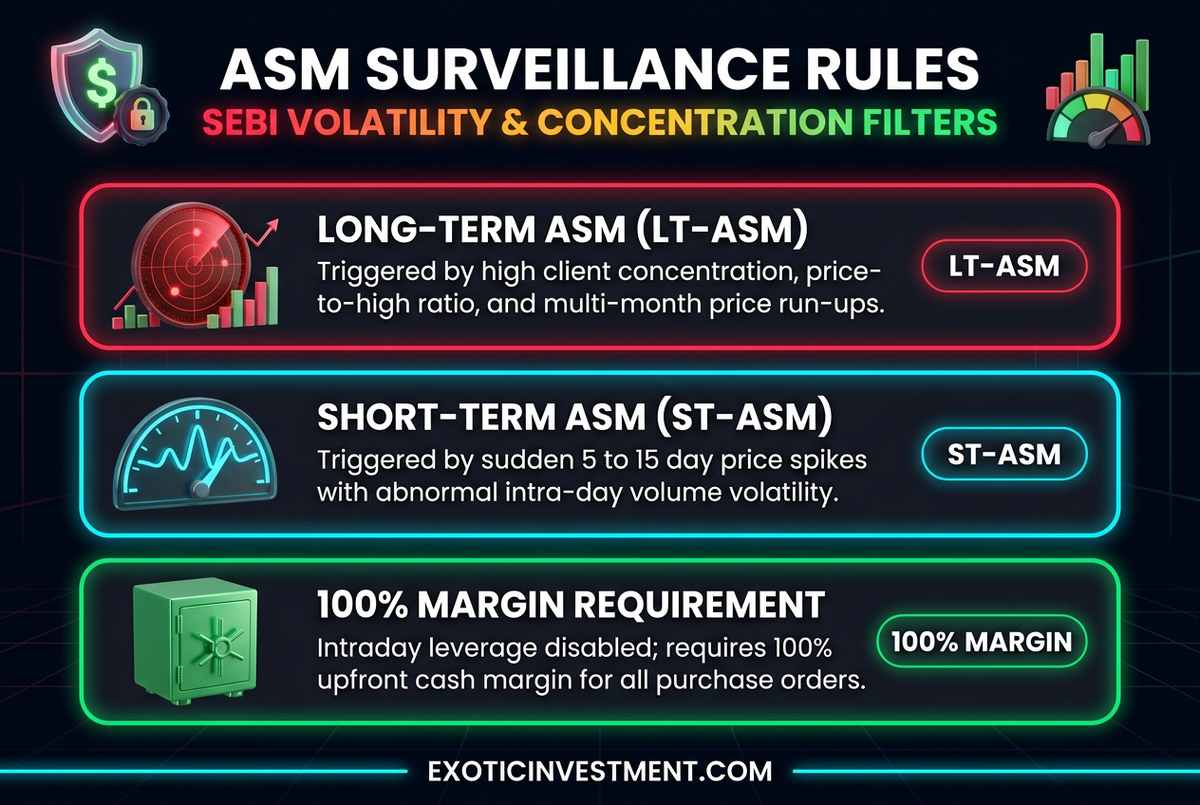
First, Short-Term ASM targets rapid price run-ups over 5 to 15 trading sessions. If a counter exhibits top client concentration, abnormal intraday price swings, and heavy delivery volume spikes without corresponding corporate announcements, it enters Short-Term ASM. Once included, the stock attracts an immediate 100% margin requirement or a reduced circuit filter of 5%.
Second, Long-Term ASM monitors persistent price distortions over 3-month, 6-month, and 365-day observation windows. Stocks with high promoter share pledging, elevated price-to-earnings multiples disconnected from peer benchmarks, and concentrated trading clusters are classified into Long-Term ASM Stage 1 through Stage 4.
Third, inclusion in Long-Term ASM enforces compulsory Trade-to-Trade (T2T) settlement. In T2T settlement, intraday squaring off is strictly prohibited, meaning every purchased share must be paid for in full and taken into demat custody. Periodic reviews take place every two months, where counters meeting normalized volatility criteria are progressively excluded.
Before purchasing speculative momentum stocks on margin, calculate your exact transaction expenses with our free Indian stock brokerage calculator. Sophisticated investors also benchmark macroeconomic liquidity conditions using eMintage portfolio tracker to track risk-on capital flows.
Graded Surveillance Measure (GSM): Progressive Stages 1 to 4 Explained
While ASM monitors general volatility, the Graded Surveillance Measure targets micro-cap companies with poor financial fundamentals, low institutional ownership, and signs of shell company characteristics. GSM follows a strict four-stage disciplinary ladder that escalates penalties if speculative activity persists.
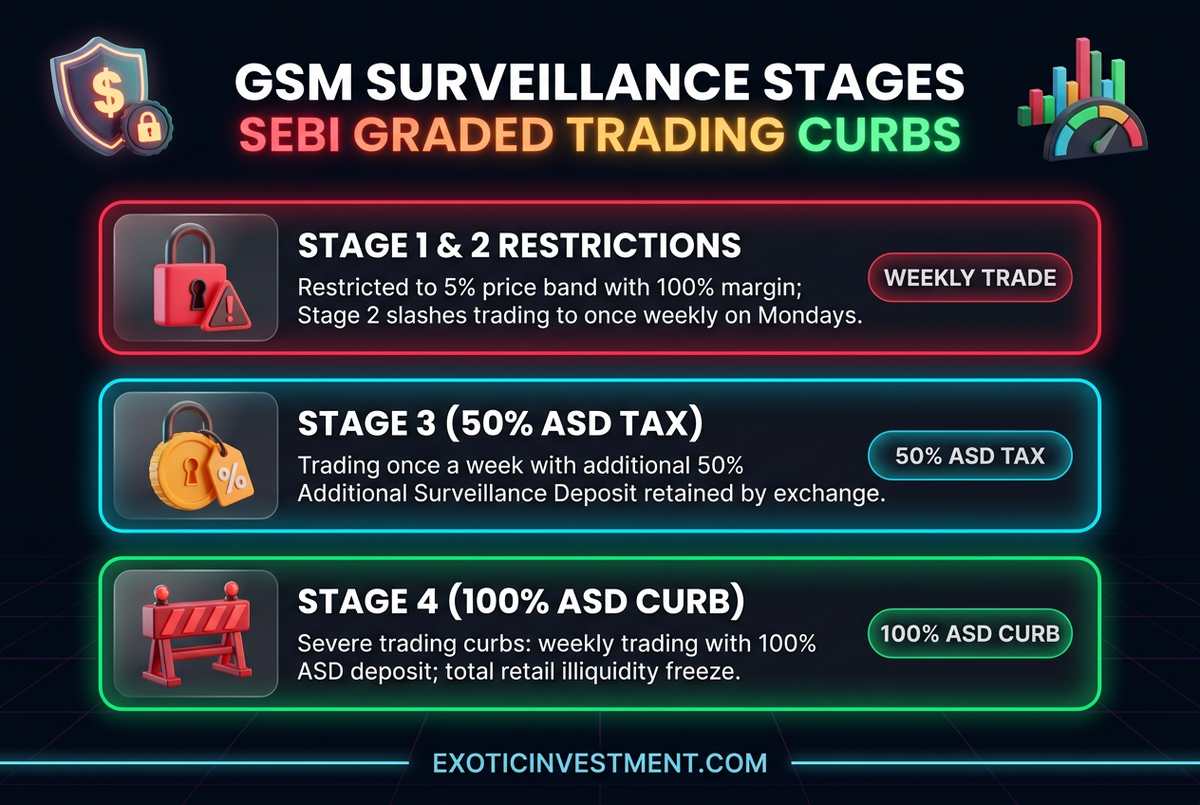
In Stage 1, the stock is transferred to Trade-to-Trade settlement with a strict 5% price band. In addition, buyers must deposit 100% upfront cash margin, preventing brokers from extending margin trading facility (MTF) leverage on the counter.
In Stage 2, regulatory restrictions intensify sharply. Besides the 5% price collar and T2T status, buyers must deposit an Additional Surveillance Deposit (ASD) equal to 50% of the gross trade value. This ASD is held by the exchange clearing corporation for two months without earning interest.
In Stage 3, the Additional Surveillance Deposit surges to 100% of the trade value. In simple terms, buying ₹1,00,000 worth of shares requires ₹2,00,000 of liquid cash upfront, with ₹1,00,000 locked as regulatory deposit.
Finally, Stage 4 represents near-total trading freeze. Trading is restricted exclusively to once a week on the first trading day of the week (typically Mondays). Furthermore, the 100% ASD remains mandatory, completely eliminating speculative retail turnover.
Core Differences: ASM Framework vs GSM Framework
Understanding which regulatory regime governs your target counter enables precise risk management. The following audit table outlines the critical parameters separating ASM from GSM:
| Surveillance Feature | Additional Surveillance Measure (ASM) | Graded Surveillance Measure (GSM) |
|---|---|---|
| Target Company Type | High-beta mid/small caps with price volatility | Micro-caps with abnormal price vs fundamentals |
| Margin Requirements | 100% upfront cash margin | 100% margin + up to 100% additional ASD |
| Trading Frequency | Daily continuous trading | Daily in Stages 1-3; Once a week in Stage 4 |
| Intraday Square-Off | Prohibited in T2T category | Strictly prohibited across all stages |
Rather than risking capital in speculative surveillance counters, conservative wealth builders prefer systematic compounding through our free SIP return calculator. Consistent investments in blue-chip indices eliminate surveillance risks entirely.
Surveillance Trading Checklist: How Retail Traders Can Protect Capital
When an existing holding enters ASM or GSM, sudden panic can lead to costly mistakes. Following a systematic trading desk checklist ensures that you preserve your capital and manage liquidity rationally.
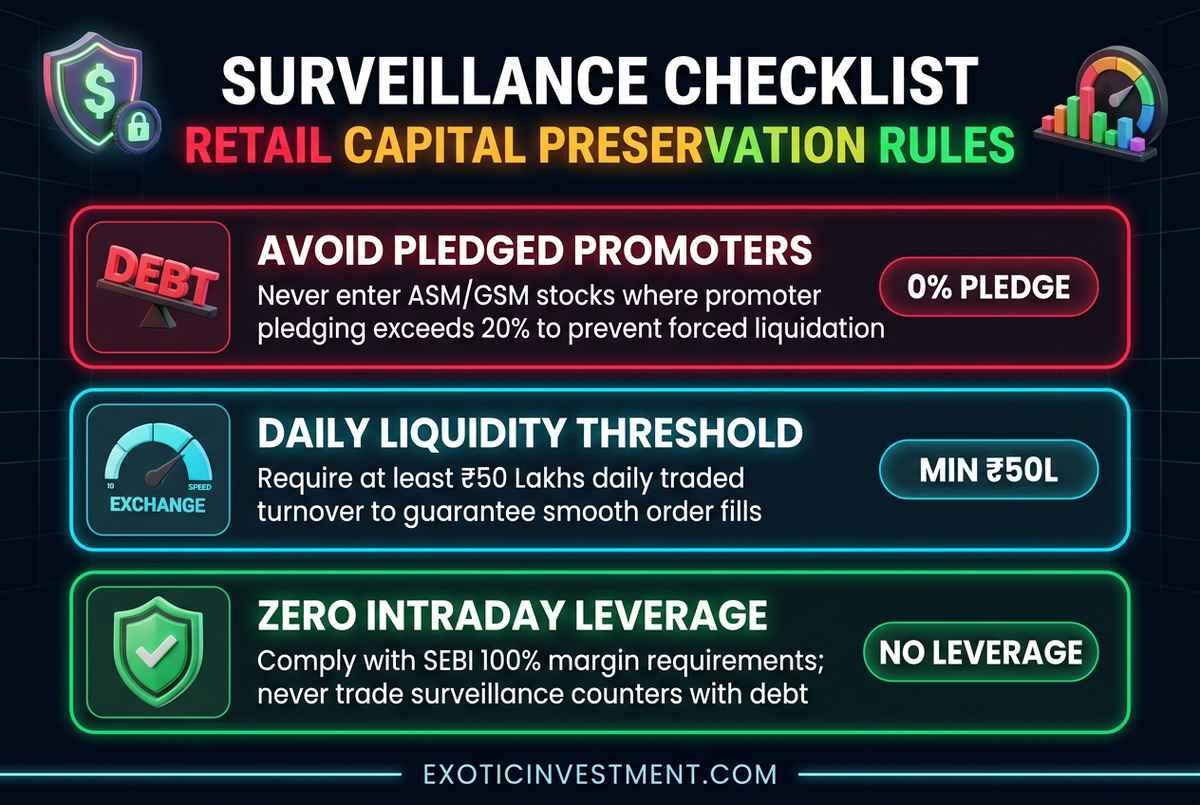
First, verify corporate pledge status and financial health. Check quarterly BSE filings to determine whether promoters have pledged more than 20% of their equity stake. High pledge ratios combined with ASM inclusion frequently trigger margin call liquidation cascades by institutional lenders.
Second, plan your cash allocation with precision. Because brokers cannot provide margin funding on surveillance securities, keep 100% liquid bank balance available if you intend to take delivery. Never attempt intra-day scalping in ASM counters, as unclosed positions will result in mandatory delivery debits.
Third, execute exits during early liquidity windows. If a speculative counter shows worsening fundamentals and begins sliding into GSM Stage 2 or 3, place limit sell orders in the pre-open auction window between 9:00 AM and 9:07 AM. Waiting until Stage 4 will trap your capital in illiquid weekly auctions for months.
Before entering any volatile small-cap trade, always calculate net take-home returns and risk-to-reward parameters with our free stock profit calculator. Proper risk controls guarantee long-term market longevity.
Actionable Takeaways for Smart Dalal Street Investors
To keep your portfolio resilient against regulatory shocks, apply these proven trading desk guidelines:
- Download Daily NSE Surveillance Circulars: Check the official NSE and BSE surveillance updates published every evening before initiating fresh cash trades.
- Never Average Down in GSM Stocks: Allocating fresh capital to a company in GSM Stage 2 or Stage 3 is purely speculative and risks complete capital lock-in.
- Beware of SMS and Social Media Tips: Pump-and-dump operators heavily target micro-caps right before exchange surveillance measures are imposed.
- Prioritize High-Governance Equities: Focus on companies with clean audited balance sheets, strong institutional mutual fund backing, and zero promoter share pledges.
Frequently Asked Questions About ASM and GSM Frameworks
Does entering ASM mean a company is fraudulent or illegal?
Not necessarily. Additional Surveillance Measure (ASM) is a proactive regulatory filter triggered by objective market parameters like price volatility, client concentration, and high volume. Many fundamentally sound mid-caps temporarily enter ASM during rapid breakout phases.
How long does a stock remain inside the GSM framework?
Stocks remain in their respective GSM stages for a minimum quarterly review period. If the company shows sustained operational improvements and normalized trading metrics, the exchange progressively downgrades the stage before full exit.
What happens to my Additional Surveillance Deposit (ASD) in GSM trades?
The Additional Surveillance Deposit (50% or 100%) collected from the buyer is transferred by your broker to the exchange clearing corporation. It is retained for a mandatory two-month period and refunded automatically upon completion of the holding duration.
Can existing investors sell shares of a stock placed in GSM Stage 4?
Yes, existing shareholders can sell their holdings. However, trading only opens on Mondays during a special call auction session, and the 100% ASD imposed on buyers often causes a lack of counterpart bids, leading to severe execution delays.