Nippon India SIP Calculator — Small Cap Returns (24%+ CAGR)
Calculate Nippon India Small Cap Fund SIP compounding based on its industry-leading 24.2% historical 10-year track record and multi-cap growth.
NIPPON INDIA MUTUAL FUND SIP CALCULATOR
Stepping up monthly SIP by 10% annually generates an extra ₹11.2 Lakh compared to a flat SIP!
Direct vs Regular Fee Drag & Overlap Scanner
Discover the exact wealth lost to regular plan commissions over 20 years, analyze multi-scheme stock overlap, and download tax-optimized SWP cash flow roadmaps.
🚀 UNLOCK PRO SUITE — INSTANT ACCESS
How to Calculate & Plan Your SIP in 4 Steps
Set Monthly SIP
Choose your monthly investment amount from ₹500 up to ₹1,00,000 per month.
Define Horizon
Select your wealth-building horizon from 1 to 30 years for long-term compounding.
Select Step-Up %
Add an annual top-up percentage (default 10%) to increase contributions with salary hikes.
View Maturity Wealth
Instantly evaluate total invested capital, wealth gain, and inflation-adjusted corpus.
Mastering High-Alpha Small Cap Compounding with Nippon India
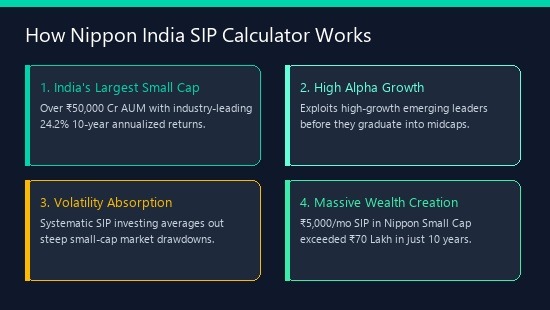
Nippon India Small Cap Fund is India’s largest small-cap mutual fund with over ₹50,000 Crore in AUM. Despite its massive size, the fund has generated an extraordinary 24.2% annualized return over the past decade.
Small-cap stocks experience sharp cyclical swings. However, systematic monthly SIP investing neutralizes volatility by purchasing aggressively during market drawdowns, positioning investors for explosive upside during economic expansions.
Key Benefits of Disciplined Systematic Compounding
1. Rupee Cost Averaging: SIPs eliminate the psychological stress of market timing. When stock valuations decline, your fixed installment automatically accumulates more fund units at discounted NAVs.
2. The Magic of Step-Up Compounding: Stepping up your monthly SIP by just 10% each year can nearly double your final wealth accumulation over a 15-year period compared to a flat monthly installment.
3. Long-Term Equity Alpha: High-conviction actively managed mutual funds have historically outpaced inflation and bank fixed deposits, building substantial multi-crore wealth for disciplined Indian households.
📋 Regulatory References & Data Sources
- AMFI (Association of Mutual Funds in India) — SIP return methodology
- SEBI (Mutual Funds) Regulations 1996, as amended
- Historical Nifty 50 CAGR data: NSE India, FY 1994-2026 (12% avg)
Disclaimer: This calculator is for educational and planning purposes only. It does not constitute financial advice. Consult a SEBI-registered investment advisor for personalised guidance. Tax rules are updated as per the latest Finance Act — verify with a qualified CA before filing.
Explore Related Wealth & SIP Engines
📊 SIP Calculator Groww
Project long-term mutual fund wealth creation across standard equity schemes.
📈 Step-Up SIP Calculator
Model annual top-up percentages to accelerate client retirement corpus.
💼 SIP Commission Calculator
Model MFD trail fee recurring income and 10-year AUM compounding projections.
Frequently Asked Questions — Nippon India SIP Calculator — Small Cap Returns (24%+ CAGR)