Listen closely, understanding the true dynamics of stop loss vs trailing stop loss orders is the definitive difference between professional longevity and account blowup on Dalal Street. In real trading desks, we never place a live order without an ironclad exit strategy pre-calculated down to the exact rupee tick. Capital preservation always precedes profit maximization.
Here is why so many retail traders struggle despite picking winning stocks. An investor might enter a stellar breakout trade that immediately surges 20% in value. However, without a systematic trailing order in place, a sudden market reversal turns that massive paper gain into an agonizing realized loss.
Traders looking to build professional execution discipline should enroll in our structured Basics of Stock Market Course to understand order types and risk control frameworks. In addition, reading our authoritative trading book Kaliyiri Share Market Book provides essential psychological rules for cutting losses without hesitation.
Fixed Stop Loss vs Trailing Stop Loss: The Architectural Core Difference
Let us break down the mechanical differences between a standard fixed stop loss and a dynamic trailing stop loss. Both order mechanisms serve vital roles in your trading arsenal, but they address entirely different phases of a trade lifecycle.
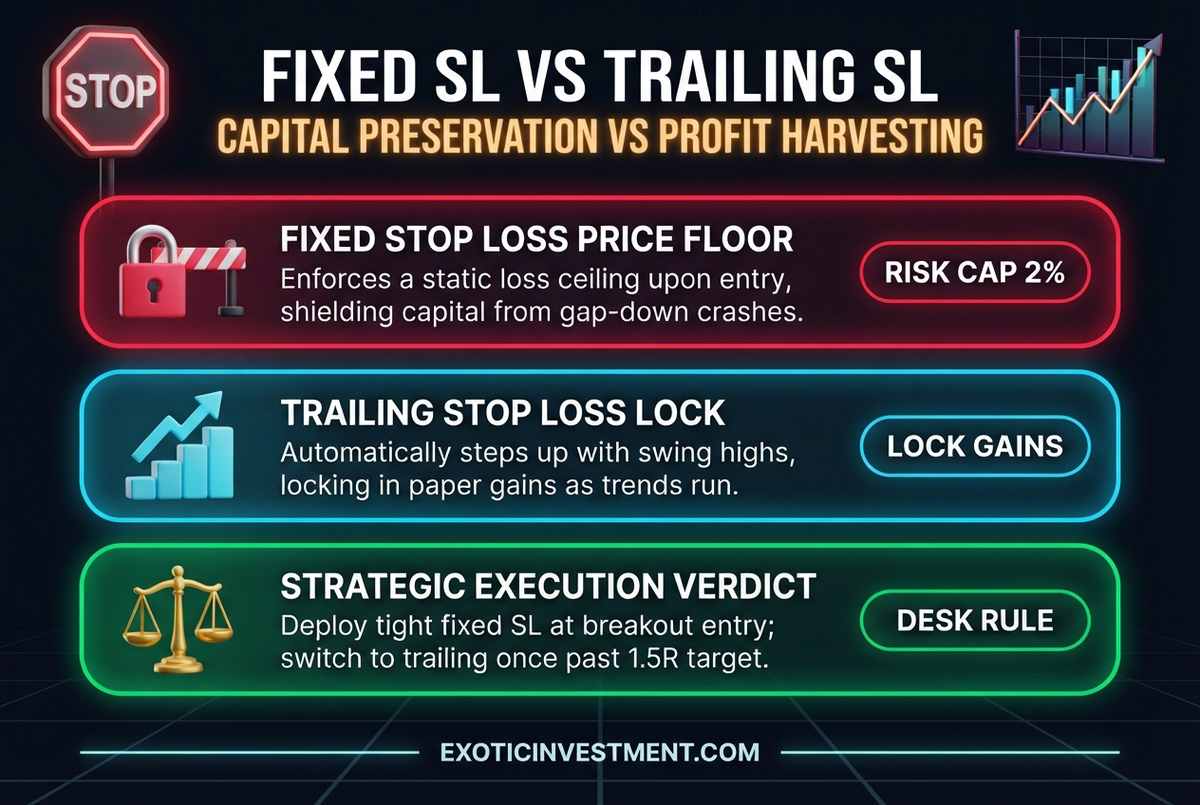
First, a fixed stop loss order anchors at a static price point immediately upon trade entry. If you purchase an equity at ₹200 with a fixed stop loss at ₹190, your maximum risk is capped strictly at ₹10 per share. Regardless of how high the stock travels, that order level remains completely static until you manually intervene.
Second, a Trailing Stop Loss (TSL) functions as a dynamic ascending price peg. As the underlying stock climbs to higher swing highs, the stop-loss price automatically ratchets upward by a pre-set point interval or percentage. Crucially, the trailing stop never moves downward; it only rises as the market advances.
Third, this dynamic mechanism protects accumulated paper profits while giving your winning trade room to breathe. When the trend eventually exhausts and retraces by your specified trailing buffer, the system automatically triggers an exit, locking in hard-earned gains without emotional second-guessing.
Before entering high-frequency intraday trades, always budget statutory exchange fees and brokerage costs using our free Indian stock brokerage calculator. Professional swing traders also benchmark global risk appetite and crypto asset momentum on eMintage portfolio tracker to gauge macro liquidity flows.
Step-by-Step Execution: How Trailing Stop Loss Locks In Paper Profits
To grasp the compounding power of dynamic trailing orders, examine a real Dalal Street scenario where disciplined order adjustments transform risk into guaranteed profit.
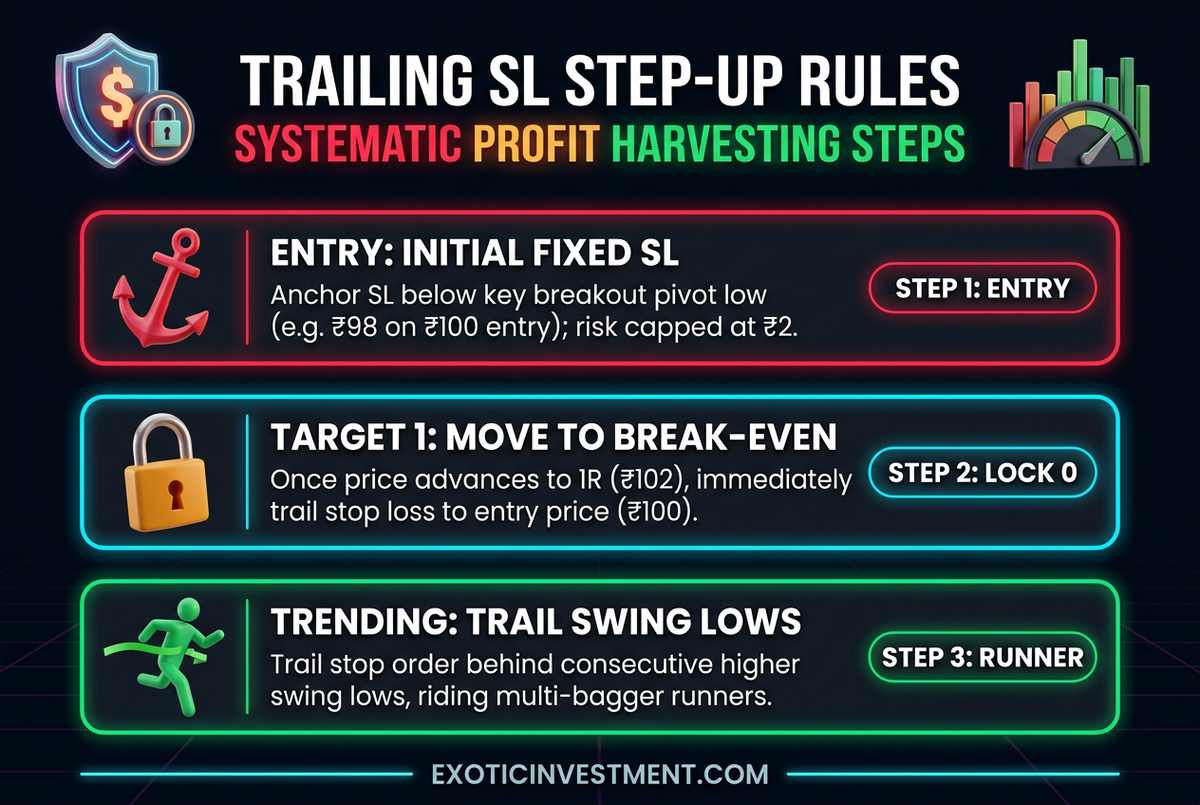
In Step 1, you initiate a trade buying a high-volume breakout counter at ₹100. Based on structural chart support, you place your initial fixed stop loss at ₹95, defining an absolute risk of ₹5 per share. Because proper risk management dictates allocating no more than 1% of total account capital to this trade, your position size is mathematically locked.
In Step 2, institutional buying surges and pushes the stock price upward to ₹120. Rather than watching anxiously, you activate a 5% trailing stop loss. The stop order automatically jumps from ₹95 up to ₹114. Instantly, your trade transitions from an active risk into a completely risk-free position with ₹14 per share in guaranteed profit.
In Step 3, the stock reaches a blow-off peak at ₹135 before short-term profit booking emerges. As the price pulls back, it triggers your trailing floor at ₹128. You walk away with ₹28 profit per share—capturing more than 5.6 times your original initial risk without experiencing exit paralysis.
Systematic Comparison: Fixed Stop Loss vs Trailing Stop Loss Parameters
To assist your order selection at the trading terminal, our desk has organized the core parameters into this comparative matrix:
| Order Feature | Fixed Stop Loss Order | Trailing Stop Loss (TSL) Order |
|---|---|---|
| Primary Purpose | Downside capital preservation at initial entry | Profit harvesting and letting winners compound |
| Price Adjustment | Static price level until manually updated | Ascends dynamically with favorable price action |
| Execution Trigger | Hits exact predetermined stop price trigger | Triggers on fixed retracement from highest peak |
| Best Trading Environment | Range-bound markets & initial trade entry | High-momentum trends & multi-day breakouts |
When engineering long-term wealth compounding independent of active intraday trading stress, smart investors utilize systematic mutual fund plans. Forecast your multi-year financial freedom milestones using our free SIP return calculator.
Stop Loss Placement Matrix: ATR Buffers, Swing Pivots, and Capital Risk
Placing your stop order too close leads to premature whipsaws, while placing it too far exposes your capital to severe drawdowns. Follow our institutional placement matrix to calibrate optimal exit boundaries.
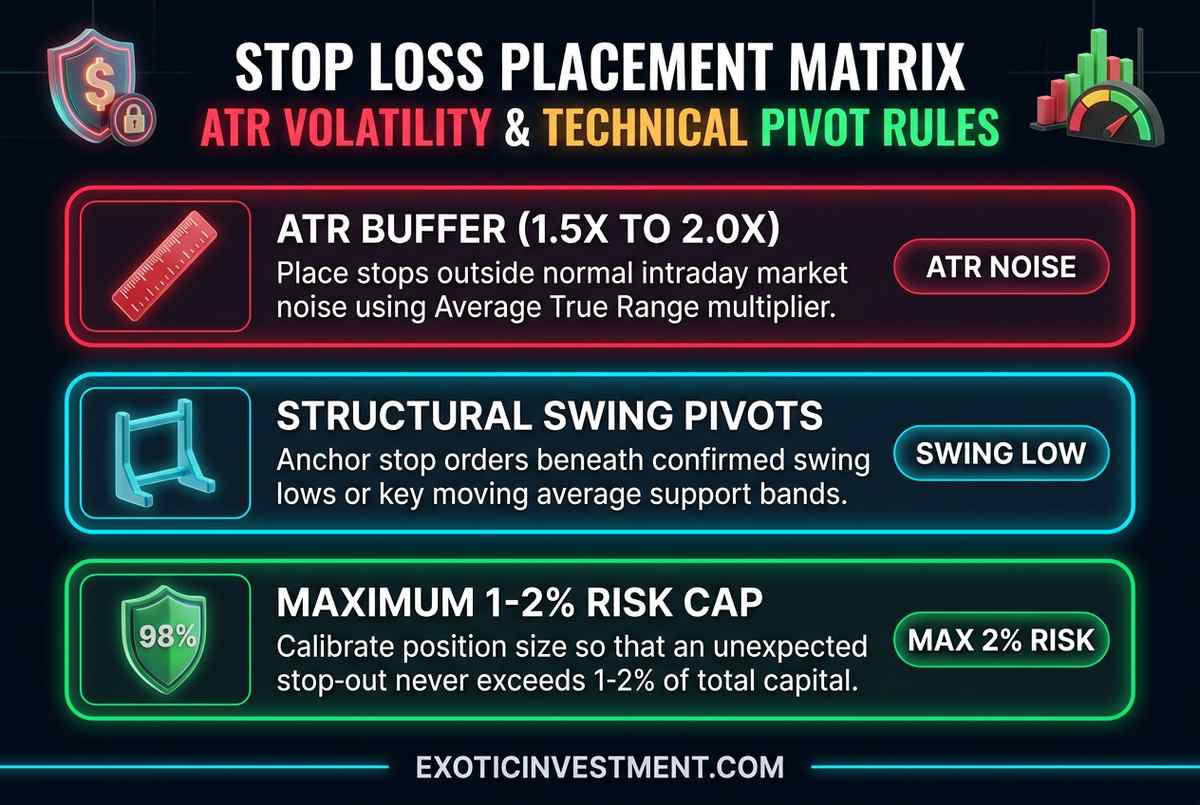
First, utilize the Average True Range (ATR) indicator to accommodate market noise. For swing trading on daily charts, calculate the 14-period ATR and place your stop loss between 1.5x and 2x ATR distance below your entry. This dynamic buffer expands during volatile regimes and contracts during narrow consolidations.
Second, anchor your exit to structural swing pivots. Identify the most recent confirmed swing low on your chart and place your stop trigger 2 to 3 price ticks beneath that level. Because institutional order blocks congregate around structural support, an exit triggers only when the underlying technical hypothesis is truly invalidated.
Third, enforce the golden 1% account risk rule. Regardless of how attractive a chart pattern appears, the total cash loss if your stop triggers must never exceed 1% to 2% of your total trading capital. By dividing your allowable 1% rupee risk by the distance to your stop loss, you determine your exact position size automatically.
Before committing trading capital to volatile setups, calculate your exact risk-reward ratio and net payout using our stock profit calculator. Strict mathematical discipline is your most dependable trading edge.
Actionable Trading Desk Takeaways for Indian Market Participants
To preserve your capital and build compounding consistency across Indian equities, integrate these rules into your daily trading plan:
- Never Move a Stop Loss Downward: Lowering a stop loss when a trade moves against you is a fatal discipline breach that leads to catastrophic losses.
- Switch to Trailing SL at 1.5R: When a position gains 1.5 times your original risk, shift your stop to breakeven and activate dynamic trailing rules.
- Account for Market Opening Gaps: During earnings season or major election events, wide opening gaps can skip your stop order; reduce position sizing accordingly.
- Use Stop-Loss Limit Orders: In fast-moving or illiquid counters, use Stop-Loss Limit (SL-L) orders rather than Stop-Loss Market (SL-M) to prevent extreme execution slippage.
Frequently Asked Questions About Stop Loss and Trailing Orders
Can a stop loss order fail to execute during market circuit freezes?
Yes. If a stock opens directly at a lower circuit limit with zero buyers in the market depth, your stop loss order will remain pending because there are no matching counterpart bids to execute the trade.
What is the difference between SL-M (Market) and SL-L (Limit) orders on Zerodha/Groww?
An SL-M order triggers a market order once your stop price is touched, executing immediately at the best available market price. An SL-L order triggers a limit order, ensuring execution only at your specified limit price or better.
Do trailing stop loss orders stay active overnight for delivery trades?
Standard intraday trailing orders expire at the 3:30 PM market close. For multi-day delivery holdings, use Good-Till-Triggered (GTT) trailing orders supported by modern Indian discount brokers.
How tight should a trailing stop loss be set for momentum trading?
For high-beta momentum stocks, setting your trailing stop at 1.5x to 2x daily ATR or between 5% and 7% below swing highs prevents getting shaken out by normal intra-day market volatility.