Listen closely, understanding circuit breakers in stock market trading is the single most vital survival skill when extreme volatility grips Dalal Street. In real trading desks, we never treat sudden halts as unexpected glitches. Instead, we recognize them as automated regulatory firewalls engineered by SEBI to prevent runaway panic, flash crashes, and irrational speculative frenzy.
Here is how the regulatory mechanism functions on Indian bourses. Whenever major benchmark indices or individual shares experience rapid price movements beyond pre-established mathematical thresholds, trading halts automatically across all equity and derivative segments. Because these trading pauses grant market participants a cooling period, they allow institutional order books to absorb sudden global shocks rationally.
Traders eager to build strong technical foundations should explore our structured Basics of Stock Market Course to understand exchange mechanics with confidence. In addition, reading our authoritative handbook Kaliyiri Share Market Book provides essential rules for managing risk during volatile circuit-breaker events.
Market-Wide Circuit Breakers in Stock Market: 10%, 15%, and 20% Thresholds
Let us examine the exact market-wide circuit breaker framework enforced by the Securities and Exchange Board of India across the National Stock Exchange and Bombay Stock Exchange. Unlike individual stock circuit filters, a market-wide breaker triggers when either the Nifty 50 or the BSE Sensex moves sharply in either direction.
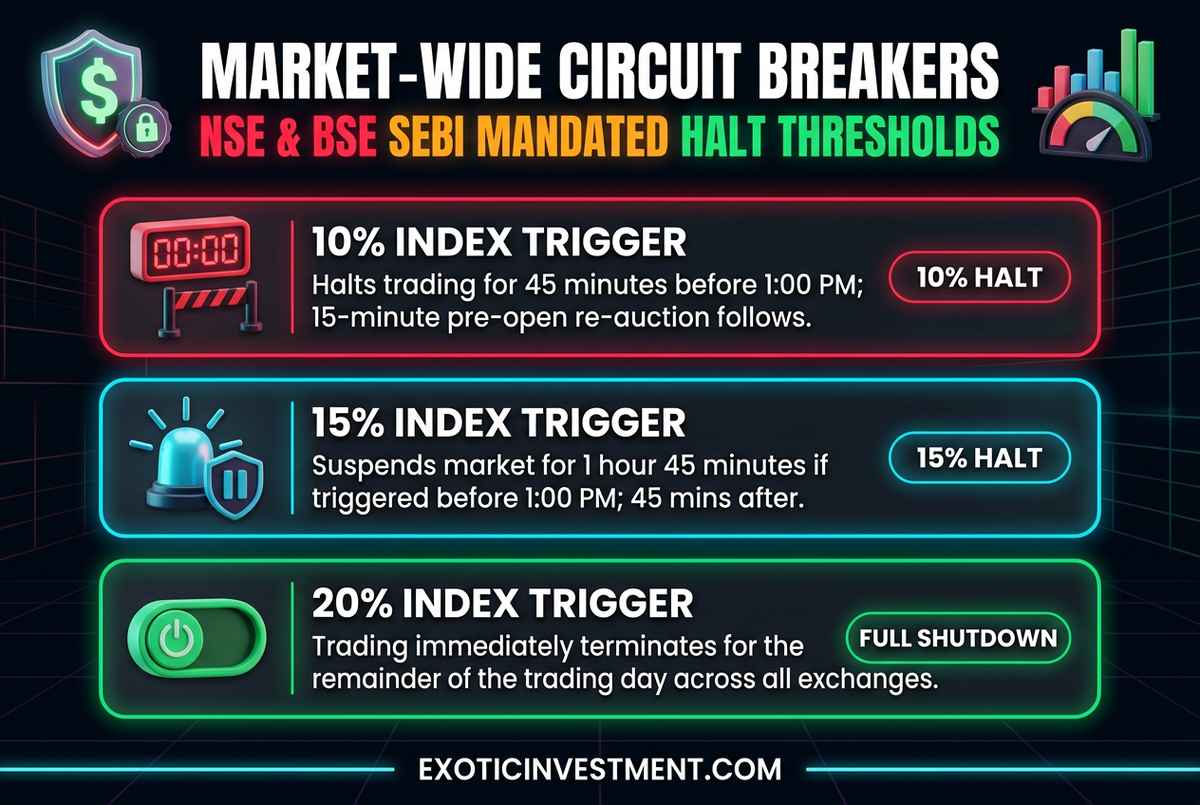
First, the 10% index trigger initiates a graded response based on the time of day. If the benchmark drops or surges by 10% before 1:00 PM, trading halts completely across all equity and equity derivative segments for 45 minutes. Following the halt, exchanges conduct a 15-minute pre-open call auction session to discover clean equilibrium prices before continuous matching resumes.
Second, if the 10% breach occurs between 1:00 PM and 2:30 PM, trading halts for 15 minutes followed by a 15-minute pre-open session. However, if the 10% movement occurs at or after 2:30 PM, continuous trading continues uninterrupted without any trading suspension.
Third, the 15% index trigger imposes stricter cooling periods to safeguard systemic liquidity. A 15% move before 1:00 PM halts trading for 1 hour and 45 minutes. When triggered between 1:00 PM and 2:00 PM, the market halts for 45 minutes, while any trigger after 2:00 PM suspends trading for the remainder of the session.
Finally, the 20% index trigger represents the absolute emergency breaker. If either the Nifty 50 or Sensex moves by 20% at any time during the trading day, the entire cash and derivatives market shuts down immediately for the rest of the day.
Before taking aggressive leveraged positions during volatile macro swings, smart market participants calculate total transaction costs using our free Indian stock brokerage calculator. Serious investors also monitor global risk sentiment and digital asset liquidity on eMintage portfolio tracker to evaluate emerging market capital flows.
Individual Stock Circuit Limits: Upper Circuit and Lower Circuit Mechanics
Beyond market-wide index triggers, exchanges apply specific price bands to individual equities to curb artificial manipulation. These price collars, widely known as upper circuits and lower circuits, establish the maximum and minimum price boundaries within which a share can trade during a single session.
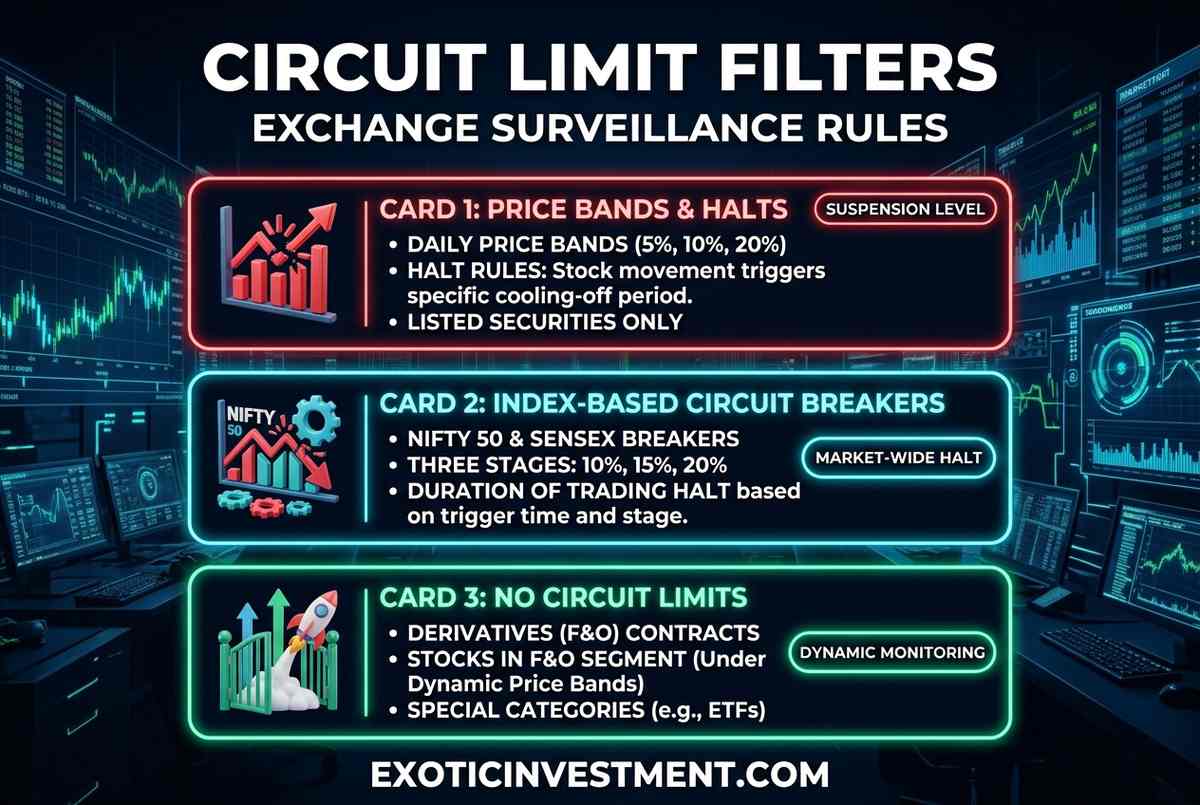
In the cash segment, non-derivatives stocks are placed into standard daily price bands of 2%, 5%, 10%, or 20% based on their historical volatility and liquidity profiles. For instance, high-beta penny stocks and speculative small caps are frequently restricted to tight 2% or 5% circuit limits. Once a stock hits its limit price, continuous trading freezes, and orders can only match at that boundary price.
Conversely, stocks included in the Futures and Options (F&O) segment do not have fixed circuit limits. Instead, exchanges enforce dynamic price bands, initially set at 10%. When an F&O counter reaches this preliminary threshold, trading enters a 15-minute cooling-off period, after which the band flexes and widens by an additional 5% progressively.
Therefore, retail participants must understand that heavy blue-chip stocks like Reliance or HDFC Bank cannot get permanently locked in a hard 5% circuit. In contrast, illiquid micro-caps can easily spend weeks locked in continuous circuits without offering any exit liquidity.
Detailed Comparison of Circuit Breaker Categories on NSE and BSE
To help you navigate these regulatory boundaries effectively, our trading desk has summarized the core parameters governing circuit filters in the comparative table below.
| Segment Category | Standard Circuit Filter | Trading Halt Action | Re-Opening Auction |
|---|---|---|---|
| Market-Wide Index (10%) | 10% move in Nifty/Sensex | 45-min or 15-min suspension | 15-minute pre-open call auction |
| Market-Wide Index (20%) | 20% move in Nifty/Sensex | Full day market closure | Resumes next trading day |
| Standard Cash Equities | Fixed 2%, 5%, 10%, 20% | Orders freeze at limit price | Matches only if opposing orders arrive |
| F&O Underlying Stocks | Dynamic 10% flexible bands | 15-minute cooling period | Expands to 15%, then 20% dynamically |
When planning multi-year equity wealth creation, disciplined investors regularly estimate compounding milestones using our SIP return calculator. Consistent long-term accumulation across diversified funds protects families from single-stock volatility shocks.
Retail Risk Management: The Upper Circuit Trap and Lower Circuit Panic
Trading around locked circuit filters requires exceptional psychological discipline and strict execution awareness. Uninformed retail investors frequently misunderstand how order matching functions when market depth collapses to zero on either side.
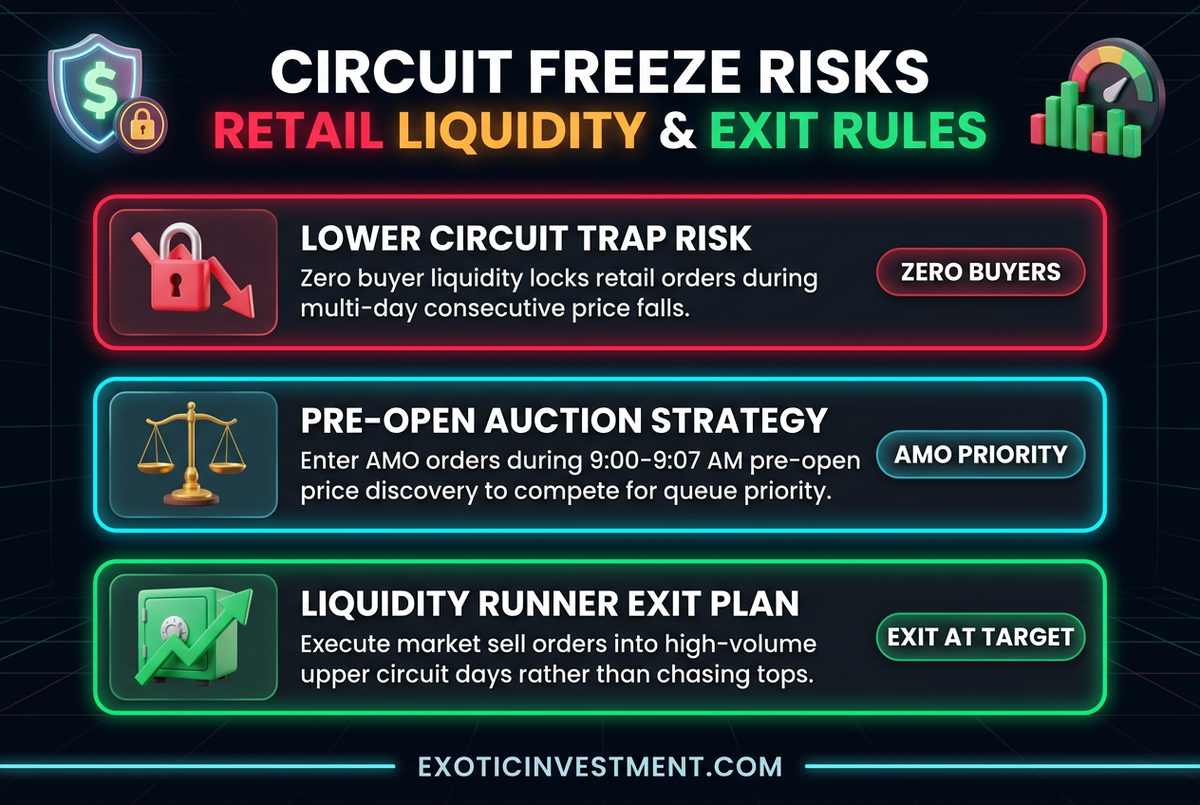
Consider the upper circuit trap. When a speculative penny stock surges into an upper circuit, the order book displays millions of buy orders and zero sell orders. Retail participants, driven by FOMO, rush to place market orders hoping to catch the rally. However, if the momentum reverses, those buyers are trapped at peak prices, and the stock can instantly plunge into consecutive lower circuits.
Conversely, the lower circuit panic creates severe liquidity entrapment. When panic selling locks a counter at its lower circuit, the order book shows millions of sell bids and zero buy bids. In this scenario, standard stop-loss market orders fail completely because there are no buyers available to absorb the volume.
Specifically, traders trapped in a lower circuit must utilize After Market Orders (AMO) placed the previous evening at the exact circuit tick price. Because exchange matching engines execute orders based on price-time priority, placing AMOs at the earliest possible millisecond offers the only realistic chance of liquidation.
Before entering high-volatility momentum setups, always verify potential returns and exit slippage using our stock profit calculator. Proper position sizing ensures that an illiquid circuit freeze will never wipe out your portfolio.
Actionable Trading Desk Takeaways for Indian Investors
Surviving and thriving in volatile markets requires following proven risk management protocols. Here are the core guidelines every Dalal Street participant should implement immediately:
- Avoid Chasing Upper Circuit Penny Stocks: Buying into counters locked in consecutive upper circuits exposes your capital to devastating gap-down reversal risk once speculative operators exit.
- Cap Position Sizing on Fixed-Band Counters: Never allocate more than 2% to 3% of your active trading capital to any stock restricted to 2% or 5% circuit limits.
- Respect Market-Wide Halts: During 10% or 15% index halt periods, cancel open intraday leverage orders and wait for the pre-open auction to establish equilibrium prices.
- Focus on High-Liquidity F&O Equities: Trade large-cap liquid counters where dynamic flexing bands ensure continuous exit liquidity even during intense market stress.
Frequently Asked Questions About Circuit Breakers in Indian Stock Markets
What triggers a market-wide circuit breaker on NSE and BSE?
A market-wide circuit breaker triggers when either the Nifty 50 or Sensex index moves by 10%, 15%, or 20% relative to the previous day’s closing level. Depending on the time of day, trading is halted for durations ranging from 15 minutes to the remainder of the session.
Why do Futures & Options (F&O) stocks not have fixed circuit limits?
To maintain international price discovery and prevent derivative settlement disruptions, SEBI does not apply fixed circuit filters to F&O stocks. Instead, exchanges use dynamic 10% flexing bands with 15-minute cooling periods that expand progressively as volatility warrants.
Can you sell a stock that is locked in a lower circuit?
You can place a sell order, but execution only occurs if a willing buyer places an order at that lower circuit price. If there are zero buyers in the market depth, your sell order will remain pending until fresh demand enters the counter.
How are circuit limits determined for new IPO listings on day one?
On the day of listing, IPO shares undergo a 60-minute pre-open call auction session to discover their equilibrium opening price without price band restrictions. Once continuous trading begins, standard circuit bands (typically 5% or 20%) apply based on listing issue size.