Conducting an institutional lic share analysis requires looking far beyond short-term speculative noise and focusing directly on structural insurance fundamentals. Life Insurance Corporation of India (NSE: LICI) remains the undisputed sovereign pillar of the Indian financial ecosystem, managing over ₹53 Lakh Crore in assets. Understanding its true investment merit requires evaluating Indian Embedded Value (IEV), Value of New Business (VNB) expansion, and balance sheet solvency.
Following its landmark listing on Dalal Street, institutional asset managers transitioned from traditional earnings-per-share ratios to specialized actuarial valuation yardsticks. Because life insurance contracts span multiple decades, standard accounting metrics fail to capture the long-term cash generation of active policies. In this guide, we break down LIC’s underlying valuation, margin transformation, and competitive moat.
The Sovereign Foundation and Scale of LIC of India
Established under the Life Insurance Corporation Act of 1956, LIC commands a level of domestic trust that private competitors spend decades attempting to replicate. Specifically, the corporation commands roughly 58% to 60% market share in First Year Premium (FYP) income across the Indian life insurance industry. In fact, over 70% of all individual life insurance policies issued in India originate through LIC’s vast distribution network.
This unmatched market dominance is powered by an unmatched agency army consisting of over 1.3 million active tied insurance agents. While private insurers rely heavily on bank branch networks, LIC’s feet-on-the-ground presence penetrates deep into Tier-2, Tier-3, and rural Indian districts. As a result, this massive retail collection engine delivers steady premium inflows across economic cycles.
In addition, LIC manages an investment asset base exceeding ₹53 Lakh Crore ($630+ Billion), making it the single largest institutional domestic investor in Indian equities and government securities. To understand how domestic institutional capital flows influence broad Dalal Street market trends, explore our research on FII vs DII institutional market dynamics.
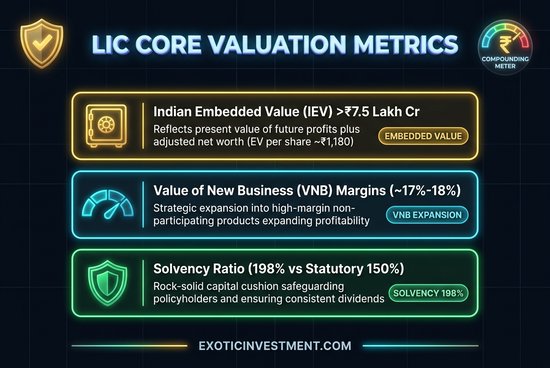
Illustration 1: LIC Core Valuation Metrics: Embedded Value, VNB Margins, and Solvency
Indian Embedded Value (IEV) and the Deep Valuation Moat
The primary actuarial benchmark used by global institutional analysts to value life insurance companies is the Embedded Value (EV). In simple terms, Embedded Value represents the sum of the company’s adjusted net asset value and the present value of all future profits locked within its existing policy book. Therefore, Embedded Value provides a dependable picture of shareholder wealth created by existing business.
As of recent fiscal reporting, LIC’s Indian Embedded Value stands at over ₹7.5 Lakh Crore (₹7,50,000+ Crore). When divided across roughly 632.5 Crore outstanding equity shares, LIC’s Embedded Value per share works out to approximately ₹1,180 to ₹1,200. Consequently, whenever the stock trades in the market below this intrinsic threshold, investors receive a substantial margin of safety.
In contrast, private life insurers such as HDFC Life, SBI Life, and ICICI Prudential Life historically trade at valuations between 2.0x and 3.2x their respective Embedded Values. Meanwhile, LIC frequently trades at a valuation discount between 0.7x and 0.9x Price-to-EV.
Thus, this structural discount provides conservative value investors with an attractive asymmetric risk-to-reward buffer. You can compute exact entry risk and position limits using our free position size calculator.
| Valuation Metric | LIC of India (Reported) | Private Industry Average | Strategic Implication |
|---|---|---|---|
| Indian Embedded Value (IEV) | >₹7.5 Lakh Crore | ₹35,000 Cr – ₹60,000 Cr | Unmatched balance sheet scale |
| Embedded Value Per Share | ~₹1,180 – ₹1,200 | Stock specific | Provides fundamental valuation anchor |
| Price to Embedded Value (P/EV) | 0.7x – 0.9x | 2.0x – 3.2x | Substantial deep-value valuation discount |
| VNB Margin Trajectory | Expanding ~17% – 18% | 22% – 27% | Narrowing the profitability gap |
| Solvency Ratio | ~198% | 180% – 210% | Comfortably above 150% statutory norm |
| Assets Under Management (AUM) | >₹53 Lakh Crore | ₹3 Lakh Cr – ₹5 Lakh Cr | Generates steady corporate dividend income |
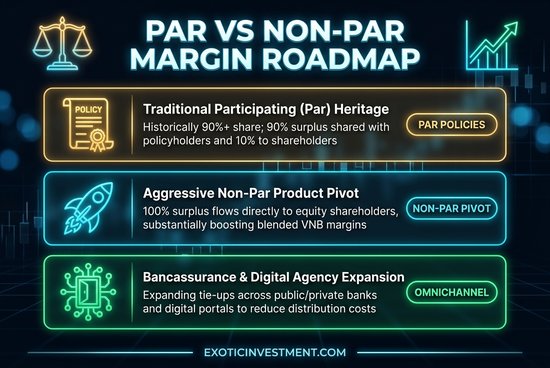
Illustration 2: The Strategic Pivot: Par Policies vs High-Margin Non-Par Products
The Strategic Margin Transformation: Par vs Non-Par Pivot
Historically, the biggest criticism levied against LIC by institutional analysts was its low Value of New Business (VNB) margin. During its initial public offering, LIC’s VNB margin stood at roughly 9%, whereas private competitors enjoyed margins exceeding 25%. However, understanding the source of this disparity reveals the massive profit expansion underway.
Historically, over 90% of LIC’s business came from Participating (Par) policies like Jeevan Labh and Jeevan Anand. Under Indian insurance law, 90% of the surplus profit generated by Par policies is distributed directly to policyholders as annual bonuses, leaving only 10% for equity shareholders. In contrast, Non-Participating (Non-Par) policies, term insurance, and ULIPs allow 100% of the underwriting surplus to flow straight to equity shareholders.
In response, LIC management initiated an aggressive product restructuring to expand Non-Par offerings through its agency network. As a result, LIC’s blended VNB margin has steadily expanded toward 17% to 18%, substantially lifting shareholder profitability. You can evaluate long-term equity compounding trajectories using our free Groww SIP calculator.
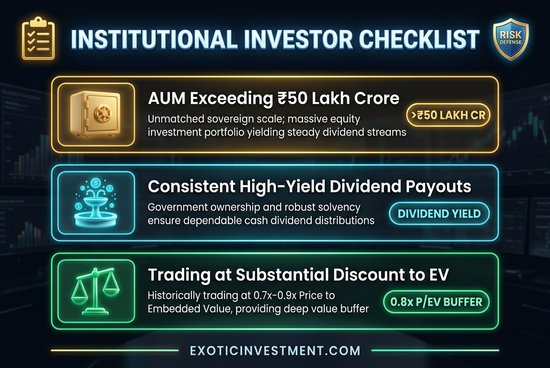
Illustration 3: Institutional Investment Analysis and Capital Allocation Framework
Solvency Margin, Capital Buffer & Dividend Compounding
Financial strength in insurance is measured by the Solvency Ratio, which evaluates an insurer’s capital reserves against potential catastrophic liabilities. Specifically, the Insurance Regulatory and Development Authority of India (IRDAI) mandates a minimum statutory solvency ratio of 150%. In fact, LIC maintains a solid solvency ratio near 198%, demonstrating rock-solid balance sheet security.
Because LIC operates with such a comfortable solvency cushion, it does not need to dilute shareholders to raise regulatory growth capital. In addition, this fortress balance sheet supports generous cash dividend distributions to public shareholders and the Government of India. As a result, long-term investors benefit from steady dividend income that buffers market volatility.
In addition, when evaluating equity delivery trades and long-term portfolio holding costs, understanding transaction charges ensures optimal capital retention. Therefore, you can estimate net purchase and sale expenses with precision using our free Indian stock brokerage calculator.
🚀 Master Fundamental Equity Valuation & Wealth Compounding
Stop chasing unverified speculative price targets on social media. Learn how to read balance sheets, evaluate Embedded Value, and build institutional multi-bagger portfolios with mathematical risk management. Join our flagship MultiBagger Plus Courses & Pro Tools (Plan 5268) to access live market blueprints, automated calculators, and personal mentorship from Dr. Ashok Kumar N Rao.
Institutional Risks and Factors to Monitor
A classic Kannada proverb provides timeless wisdom for stock investors: “ಬುಡ ಗಟ್ಟಿಯಾದರೆ ಮರಕ್ಕೆ ಗಾಳಿಯ ಭಯವಿಲ್ಲ” (Buda gattiyaadare marakke gaaliya bhayavilla — when the roots are anchored deep, the tree fears no raging storm). While LIC’s sovereign scale and Embedded Value anchor its long-term stability, disciplined investors must monitor three operational risks:
First, monitor ongoing regulatory shifts regarding policy surrender values and distributor commission guidelines from IRDAI. Because revisions to surrender charges can alter product economics, life insurers must adapt product pricing swiftly. In fact, LIC’s vast product catalog allows it to rebalance policy features without losing retail distribution momentum.
Second, remember that LIC holds massive equity stakes across Dalal Street blue-chips such as Reliance Industries, TCS, ITC, and L&T. Consequently, broad stock market volatility directly impacts LIC’s reported quarterly investment income and unrealized capital gains. Meanwhile, you can track your combined multi-asset portfolios and dividend cash flows seamlessly using the eMintage portfolio tracker.
Finally, begin with structured financial education before taking concentrated equity positions in large public sector undertakings. Explore our foundational lessons at the Basics of Stock Market Course, study our bestselling Kaliyiri Share Market Book, and master systematic equity compounding through the MultiBagger Plus Annual Subscription.
💡 Frequently Asked Questions on LIC Share Valuation
1. What is the Indian Embedded Value (IEV) of LIC of India?
LIC’s Indian Embedded Value stands at over ₹7.5 Lakh Crore, representing the present value of future profits plus adjusted net worth. On a per-share basis, this translates to an Embedded Value of approximately ₹1,180 to ₹1,200 per share.
2. Why does LIC trade at a discount to private life insurers?
Historically, LIC traded at a discount because of lower historical VNB margins and heavy exposure to traditional participating policies. However, as LIC expands higher-margin non-participating products, its margin profile is steadily closing the gap with private peers.
3. What is the significance of the Value of New Business (VNB) margin?
The VNB margin reflects the expected profitability generated by new policies sold during a financial year. As LIC expands its Non-Par portfolio, its VNB margins have expanded from 9% to roughly 17%–18%, enhancing shareholder returns.
4. Does LIC offer a regular dividend payout to shareholders?
Yes, absolutely. Because LIC generates substantial underwriting surpluses and holds a solvency ratio near 198%, it consistently distributes cash dividends to equity shareholders and the Government of India.
5. Is LIC share suitable for long-term conservative wealth creation?
Yes, for conservative investors seeking deep valuation support, sovereign brand equity, and consistent dividend yield, LIC offers substantial downside protection. However, investors must monitor surrender value regulations and equity market fluctuations.