
Understanding what a stock reserve means on corporate balance sheets prevents tricky accounting surprises during annual audits! Depending on context, this phrase labels either inventory valuation trims across branches or equity reserves inside Shareholders’ Funds. Check related balance sheet entries cleanly via our share balance sheet accounting guide today.
Wait — why do experienced Dalal Street analysts always check reserve footnotes before cheering flashy Net Profit numbers? Simply because artificial inventory markups or paper asset write-ups can disguise weak cash generation! Meanwhile, solid retained earnings actually shield dividends and fund debt-free factory growth.
Let us separate both accounting meanings cleanly without heavy textbook jargon! First, unpack inventory Stock Reserve adjustments used in multi-branch manufacturing accounts. Next, compare Capital Reserves against Revenue Reserves across NSE-listed balance sheets cleanly.
Dual Meaning of Stock Reserve: Accounting Provision vs Corporate Surplus
Across Indian finance, readers meet the term stock reserve in two completely distinct contexts! First, inside Branch Accounting, “Stock Reserve” strips out fake internal profit whenever factories bill unsold goods to branches above cost. Because one company cannot make real profits selling stock to itself, accountants lower Closing Inventory cleanly at year-end!
Second, across stock market commentary, investors loosely say “stock reserves” to mean corporate Reserves & Surplus inside Shareholders’ Equity! Specifically, these retained buffers accumulate past profits inside the business for future growth or bonus payouts. Track how net income flows into reserves annually via our Profit After Tax (PAT) guide cleanly.
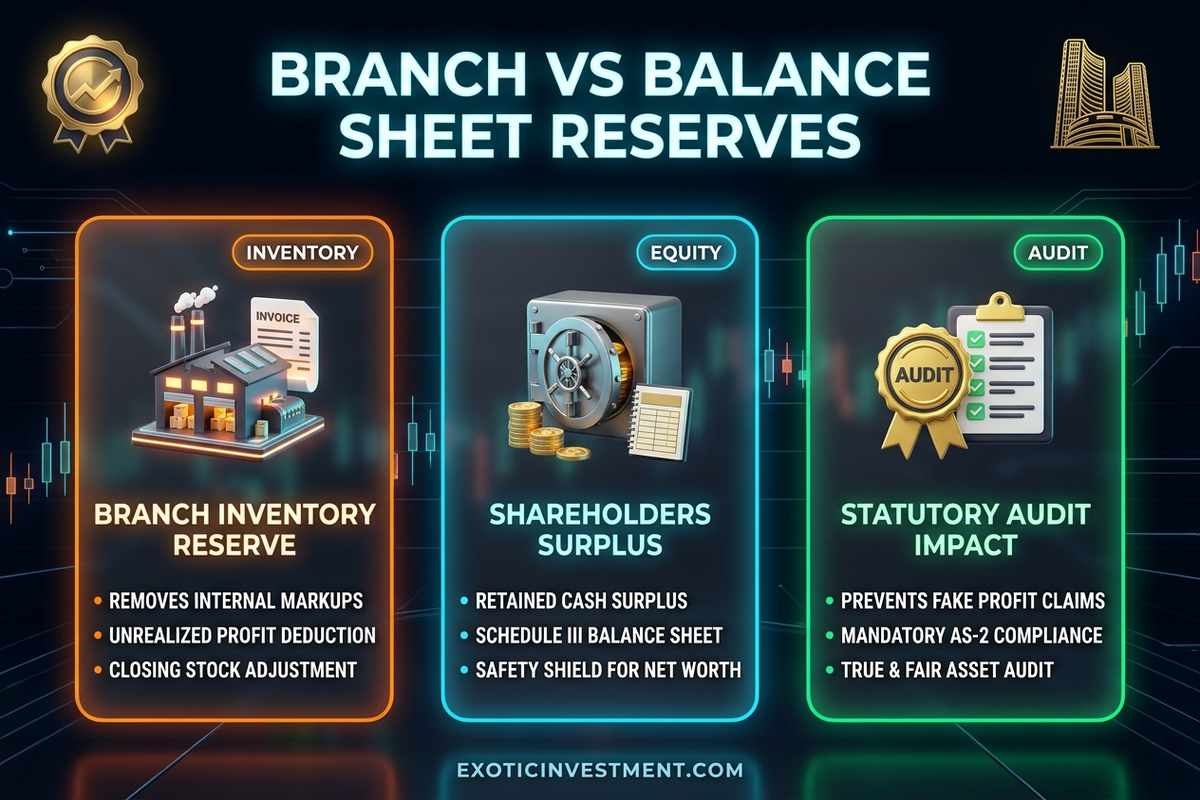
Illustration: Splitting the term across Branch Inventory Stock Reserves (removing internal profit) versus Corporate Capital and Free Revenue Reserves.
Capital Reserve vs Revenue Reserve in Listed Balance Sheets
When reviewing NSE annual reports under Schedule III of the Companies Act 2013, audit Reserves & Surplus across two tight buckets! Mixing up which reserve permits cash payouts regularly fools beginners chasing dividend yields.
Capital Reserves — Locked Non-Operating Windfalls
Capital Reserves come strictly from non-operating gains rather than selling everyday core goods! Typical sources include IPO Securities Premium, factory land sale profits, or forfeited share transfers. Importantly, corporate law strictly bans cash dividends out of Capital Reserves—though Securities Premium can legally fund bonus shares or share buybacks.
Revenue Reserves — Genuine Operating Strength
Conversely, Revenue Reserves and General Reserves accumulate steadily from recurring after-tax profits year after year! Stronger Revenue Reserves build a durable cash buffer keeping dividends safe during short recessions. Confirm operating margin durability beforehand inside our operating margin explainer cleanly.
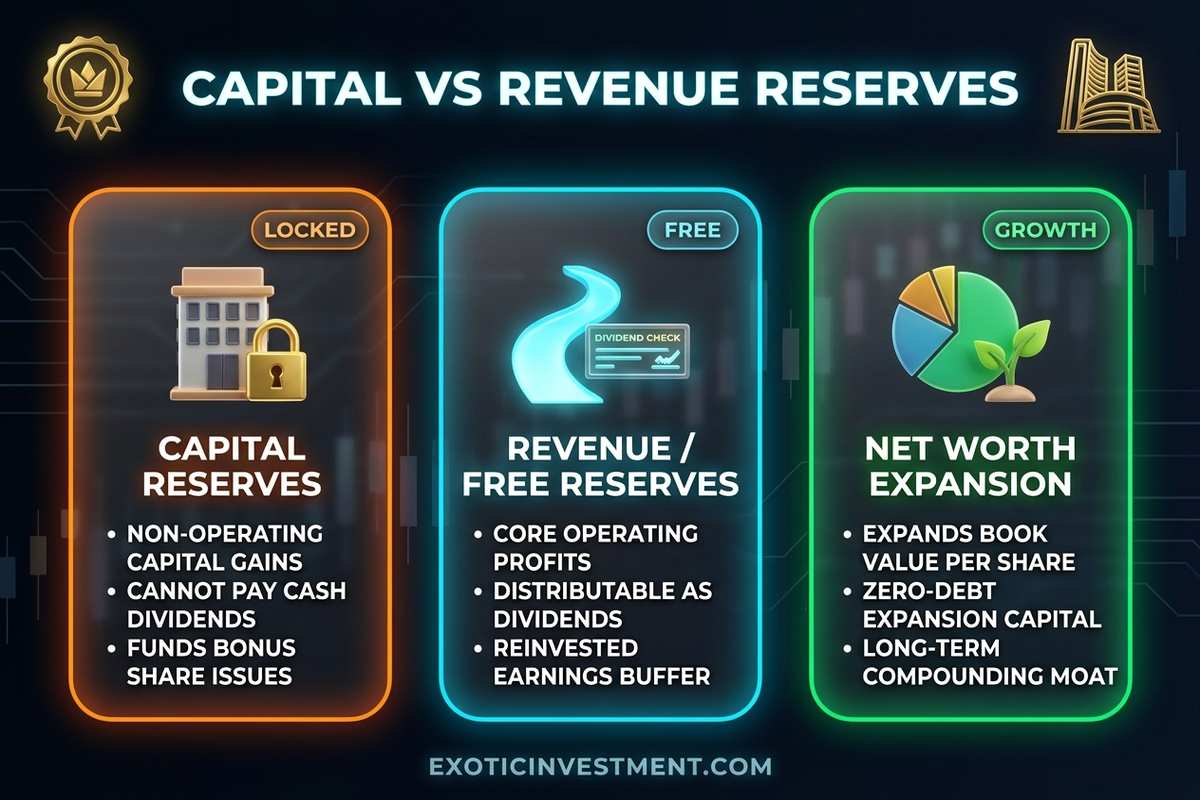
Illustration: Comparing locked Capital Reserves (securities premium, asset sales) against spendable Free Revenue Reserves backing dividends and expansion.
Balance Sheet Comparison Table: Every Reserve Bucket Explained
Bookmark this quick accounting guide whenever auditing listed company balance sheets or IPO filings! Spotting true spendable earnings vs locked revaluation paper strengthens intrinsic stock checks fast.
| Reserve Category | Where It Comes From | Cash Dividend Allowed? | Investor Interpretation |
|---|---|---|---|
| Branch Stock Reserve | Unrealized inter-branch invoice markup | No (Valuation deduction) | Prevents fake inventory profit bloat |
| Free Revenue Reserves | Recurring net business profits retained | Yes — primary dividend pool | Signals real multi-year cash compounding |
| Securities Premium Reserve | Cash raised above ₹10 face value in IPOs | No (Bonus & buyback OK) | Reflects past equity fundraising price |
| Capital & Revaluation Reserve | Asset write-ups or capital windfalls | Strictly Prohibited | Exclude paper revaluations from book value! |
Worked Example: Stripping Fake Profit via Branch Stock Reserve Math
Let us inspect clear rupee math showing why **Branch Stock Reserve** stops artificial profit inflation! Suppose a Surat mill ships ₹10,00,000 of shirts to its Mumbai store billed at 25% markup—meaning ₹12,50,000 invoice value. By March 31, Mumbai sells 80% cleanly, leaving ₹2,50,000 unsold inventory on showroom racks.
Wait — how much unrealized markup sits inside that ₹2,50,000 closing stock? Simply multiply ₹2,50,000 by `25 / 125` (20% of invoice price) to isolate **₹50,000**! Immediately, auditors deduct ₹50,000 from Profit & Loss via Stock Reserve, restoring inventory cleanly to true ₹2,00,000 factory cost.
Meanwhile, genuine cash reserves drive long-term intrinsic stock values cleanly upward! Test intrinsic cash values inside our DCF valuation calculator and relative valuation tool today.
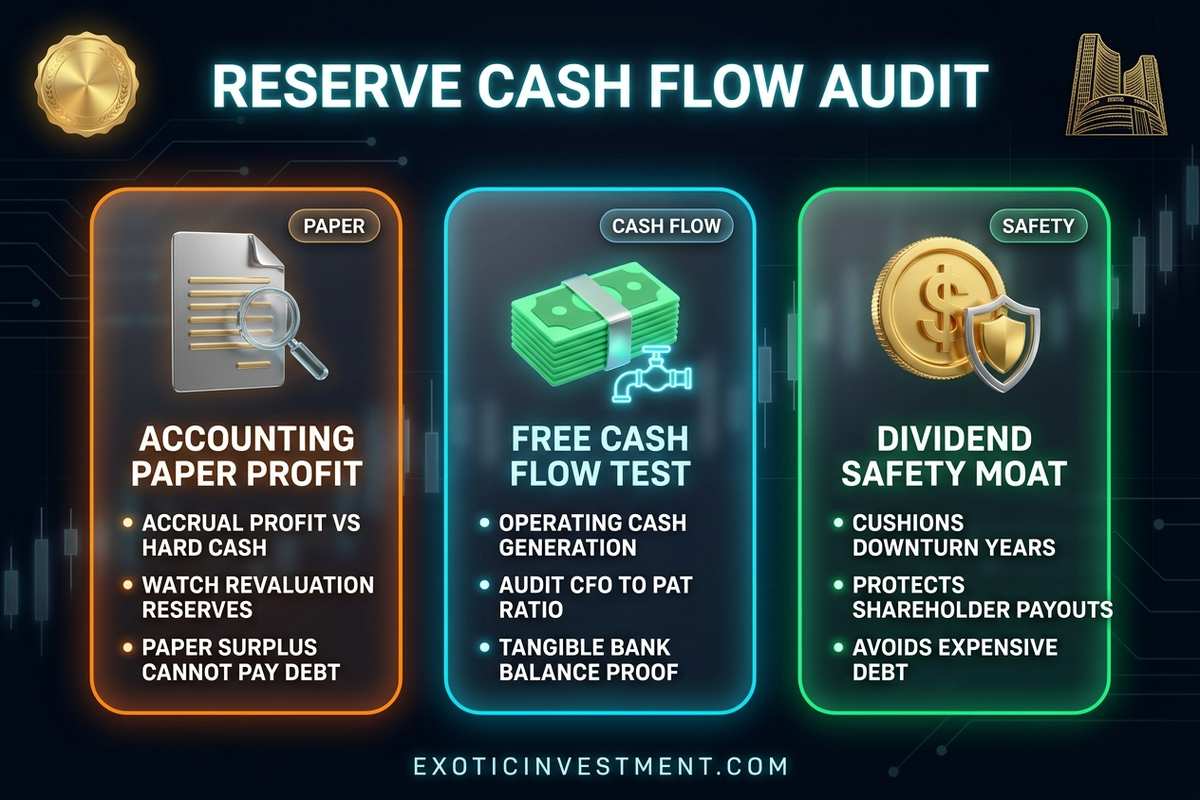
Illustration: Three-step fundamental reserve audit checking cash-to-reserves backing, excluding revaluation bloat, and verifying free bonus reserves.
How Sharp Investors Audit Corporate Reserves Before Buying Any Stock
Wait — spot a giant rookie mistake when reading “Reserves = ₹2,000 crore” on stock screeners! High Reserves inside equity liabilities never mean ₹2,000 crore sits idle in liquid bank accounts! Often, past profits already bought aging plants, unpaid receivables, or slow warehouse inventory years ago.
Therefore, always check **Cash & Liquid Investments** against Debt and Retained Earnings simultaneously! If high reserves sit beside rising inventory days and heavy loans, study deeper via our book entry guide and dividend payout calculator first.
In addition, verify whether management distributes surplus reserves sensibly or hoards cash into stagnant low-yield subsidiaries! Check capital return quality calmly using our PE ratio calculator beforehand.
Specifically, strong corporate boards balance expansion spending cleanly alongside regular dividends and selective share buybacks! Therefore, tracking reserve deployment yearly reveals honest management capital discipline fast.
Five Practical Questions Every Investor Should Ask About Balance Sheet Reserves
Auditing any stock reserve figure accurately saves value investors from mistaking paper book equity for real liquidity! First, check whether Reserves grew steadily from core operating profits rather than one-off land sales or asset revaluations. Next, verify whether free cash flow matches reported annual profit growth cleanly across five straight years.
Third, inspect short-term borrowings beside cash balances to make sure the firm is not borrowing costly debt just to sustain payouts! Fourth, compare dividend payout ratios against free reserves to judge future payout stability during industry slowdowns. Finally, trace how efficiently leadership reinvests retained capital back into expansion projects cleanly.
Specifically, healthy compounders consistently convert retained earnings into 18%+ incremental Return on Equity over multi-year cycles! Conversely, stagnant firms hoarding low-yield cash without expanding per-share earnings often trade as cheap value traps forever. Verify capital compounding health directly inside our EPS online calculator and stock return calculator today.
How Reserve Transfers Impact Equity Valuations Over Market Cycles
During sudden economic slowdowns, companies carrying strong Free Revenue Reserves handle working capital storms smoothly without costly emergency borrowing! For instance, cyclical manufacturers backed by debt-free retained cushions rarely dilute shareholders through distressed rights issues at depressed valuations. In addition, steady reserve buffers enable uninterrupted dividends even through brief one-quarter profit dips.
However, watch out closely whenever corporate auditors reclassify questionable intangible write-ups across annual report footnotes between consecutive quarters! Instead, insist on clean cash-backed retained earnings growing smoothly alongside low total debt ratios. Always pair clean balance sheet inspection with sensible trade sizing using our position size calculator and verify valuation discounts cleanly inside our DCF valuation calculator first.
🚀 Trade Clean Dalal Street Setups With Institutional Discipline
Stop getting fooled by creative accounting entries. Read real corporate balance sheets cleanly alongside Dr. Ashok Kumar N Rao and our 1,300+ active trading community.
- Master financial statements via our Kaliyiri Share Market Book and English bestseller Basics of Indian Stock Market Book.
- Access institutional screeners and pro research via the MultiBagger Plus Courses & Pro Tools Annual Subscription.
- Pair fundamental health with clean charts in our Technical Analysis Course in Kannada or Options Buying Course in Kannada.
💡 Frequently Asked Questions (FAQ): Stock Reserve
1. What is a stock reserve in corporate and branch accounting?
In branch accounting, a stock reserve removes unrealized invoice markup inside unsold branch stock! Across markets, it loosely indicates balance sheet surplus—read more in our balance sheet share guide cleanly.
2. Is stock reserve an asset or liability on a financial statement?
In branch ledgers, Stock Reserve acts as a deduction lowering inflated Closing Inventory under Assets! Conversely, corporate Reserves sit inside Equity—verify profit flows cleanly via our PAT profit guide.
3. Can an Indian company pay cash dividends out of Capital Reserves?
No — Companies Act 2013 restricts cash dividends solely to Free Revenue Reserves and realized profits! However, Securities Premium can legally fund bonus share issues cleanly.
4. Do huge corporate reserves guarantee a stock will announce bonus shares?
Wait — large reserves make bonus shares legally possible, yet boards weigh liquidity, share prices, and cash needs first! Check fair intrinsic stock value cleanly via our DCF valuation calculator anytime.
5. Why should investors subtract Revaluation Reserves when computing Book Value?
Revaluation reserves mark asset prices higher on paper without adding one rupee of operating cash! Removing revaluations improves Price-to-Book peer comparisons inside our relative valuation calculator cleanly.
6. What does negative Retained Earnings (debit balance) indicate for a stock?
Negative reserves prove multi-year business losses have steadily eroded shareholder equity! Stay deeply cautious around troubled firms flagged inside exchange ASM watchlists beforehand.