DCF Calculator for Indian Stocks

DCF Calculator for Indian Stocks — Intrinsic Value & Fair Price

Calculate the intrinsic value of Indian stocks using the Discounted Cash Flow (DCF) model and establish your margin of safety.

⚡ INTRINSIC CASH FLOW ENGINE
📊 Two-Stage Discounted Cash Flow • Terminal Multiple • Margin of Safety

📊 Valuation Parameters & Cash Flow

Input trailing cash flows and growth assumptions in Crores (₹ Cr).

Intrinsic Value (Fair Price)
₹0.00
Calculating...
Current Market Price: ₹150.00
Margin of Safety / Difference: +0.00%
10-Yr PV of Cash Flows: ₹0 Cr
PV of Terminal Value: ₹0 Cr
Enterprise Value (EV): ₹0 Cr
Net Debt Adjustment: 🔒 PRO UNLOCK
10-Year Projected FCF Stream (₹ Cr)
×
👑

Unlock MultiBagger Pro

Unlock advanced multi-stage growth forecasting (Years 6-10), cash & debt balance sheet offsets, Graham formula metrics, and contract note CSV exports.

⚡ Upgrade to Pro (₹2,739 / Year)

How the Tool Works ⚙️

1

Configure financial parameters

Set current stock price and FCF in our dcf calculator indian stocks to start.

2

Estimate growth rates

Choose growth rates to calculate intrinsic value online of indian stocks safely.

3

Apply discount rate

Input WACC to understand how to calculate intrinsic value of indian stock values.

4

Check fair value

Compare results on this indian stock fair value calculator and find the margin of safety.

How DCF Valuation Works for Indian Equities

Discounted Cash Flow (DCF) valuation determines the true intrinsic worth of an enterprise by projecting its future Free Cash Flows (FCF) and discounting them back to today’s rupee value using the company’s Weighted Average Cost of Capital (WACC).
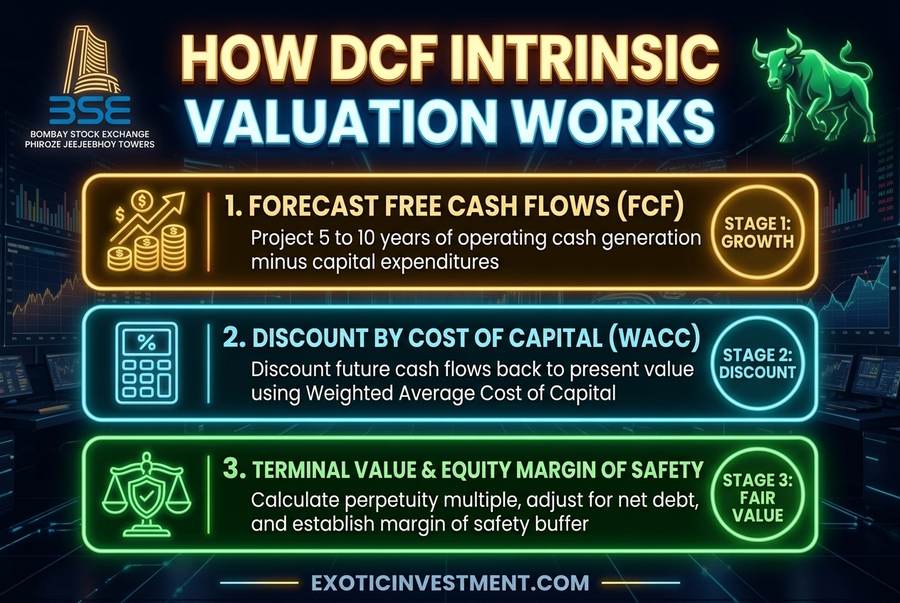
dcf valuation model intrinsic value

3-Stage Intrinsic Valuation Framework: FCF Projection, WACC Discounting & Margin of Safety

1. Projecting Trailing Free Cash Flows (FCF)

Operating cash flows minus capital expenditures (CapEx) define the actual surplus cash generated by the business. In Stage 1, cash flows are projected for Years 1 to 5 based on historical compounding rates and industry expansion.

2. Discounting via Weighted Average Cost of Capital (WACC)

A rupee earned 5 years from now is worth less than a rupee in hand today due to inflation, opportunity cost, and equity risk premium. Discount factors reduce each year’s expected cash flows to present value.

3. Terminal Value and the Margin of Safety

Since companies continue operating indefinitely beyond Year 10, the Gordon Growth terminal formula captures long-term perpetuity value. Subtracting net debt yields equity intrinsic value per share. Buying when market prices trade 15% to 30% below intrinsic fair value establishes Benjamin Graham’s indispensable margin of safety buffer.

📋 Regulatory References & Data Sources
  • SEBI risk management framework guidelines
  • Reserve Bank of India (RBI) financial market benchmark data
  • Income Tax Department of India rules & circulars

Disclaimer: This calculator is for educational and planning purposes only. It does not constitute financial advice. Consult a SEBI-registered investment advisor for personalised guidance. Tax rules are updated as per the latest Finance Act — verify with a qualified CA before filing.

Frequently Asked Questions (No BS Edition) 💡

Why should I use a dcf calculator for indian stocks when I can just ask Dalal Street tip groups? 📈
Because tip groups are great for losing money, whereas a dcf calculator for indian stocks relies on actual corporate finance math! By forecasting future cash flows and discounting them back to the present day, you find a company’s true value. (Looking to tracking whales in crypto instead? Visit the eMintage Whale Wallet Tracker Crypto).

Is there an indian stocks dfc calculator or is that just a spelling mistake? 🤷‍♂️
It is just a classic typo for “DCF” (Discounted Cash Flow)! So if you searched for an indian stocks dfc calculator, you are in the right place—our tool will run the DCF valuation perfectly.

Can I download this as an intrinsic value calculator excel for indian stocks? 📊
Yes! Pro users gain access to our custom intrinsic value calculator excel for indian stocks template. It allows you to run offline calculations with the exact same formulas used by top analysts.

How do I find out how to use buffett intrinsic value calculate for indian stocks? 🍔
Warren Buffett uses a modified free cash flow method called “Owner Earnings.” To learn how to use buffett intrinsic value calculate for indian stocks, toggle our Warren Buffett formula mode (available in Pro), which adjusts cash flows for capital expenditures automatically!

Does this tool also help with how to calculate book value of indian stocks? 📚
Absolutely. Book value represents the net asset value of a company. While the indian stock’s intrinsic value calculator focuses on cash generation, comparing it to the book value gives you a complete dual perspective on valuation. Check out our Zerodha Brokerage Calculator to estimate your transaction costs.

How do I configure a custom intrinsic value of stocks calculator in excel in indian rupees? 🇮🇳
You have to format the cells for lakhs and crores and link a live pricing feed. Or, you can just use our online indian stock calculator which is already pre-configured for Indian units, outstanding shares, and debt adjustments!

Can this intrinsic value calculator for indian stocks guarantee that I will beat the index? 🤑
We wish we could guarantee that! While our intrinsic value calculator for indian stocks gives you the theoretical true price, the market can remain irrational longer than you can remain solvent. (By the way, if you are struggling to calculate your tax on high-risk investments, check out the Crypto Tax Calculator or general tax tools to keep the taxman happy). You can also plan your systematic investing with our Groww SIP Calculator.

Why should I calculate intrinsic value online of indian stocks instead of using a standard Excel sheet? 💻
Standard sheets are great until you write over a formula cell and break the laws of arithmetic. When you calculate intrinsic value online of indian stocks, our servers handle the WACC discounting and terminal values flawlessly. If you still prefer offline sheets, you can download a premium free intrinsic value calculator excel sheet for indian stocks inside our Pro members area!

How does this tool help me understand how to calculate intrinsic value of indian stock? 🎓
It simplifies the complex process! Our engine guides you on how to calculate intrinsic value of indian stock by asking for current cash flow, outstanding shares, and growth assumptions. It then automatically discounts them back to the present day. That is how to calculate intrinsic value of shares of indian stocks in seconds!

What are historical pe of indian stocks calculations? 📉
These calculations help you look at historical price-to-earnings ratios of Indian indices like Nifty or specific stocks over 10-15 years. They help verify if the current valuation is stretched. Compare it with the growth rate in our Upstox Brokerage Calculator to trade efficiently.

How to calculate intrinsic value of shares of indian stocks? 🪙
To do this, forecast the cash flows for the next 10 years, apply a discount rate based on risk, calculate the terminal value, add cash and subtract debt, then divide by outstanding shares. That is how to calculate intrinsic value of indian stocks!

Can I use how to calculate intrinsic value of indian stocks for crypto? 💸
Not really, because crypto projects rarely have consistent free cash flows to discount! For crypto, traders use tokenomics and wallet indexers instead. Check out the Crypto Profit Calculator to run estimations on crypto returns.

What is the indian stock fair value calculator? ⚖️
It is a tool that computes the mathematical fair price of an equity asset. It removes human emotion and market hype to tell you whether the stock is undervalued or overvalued.


AR
Written & Verified By

Dr.Ashok Kumar N Rao

Stock Market Educator & Author | 3,500+ Students Trained

Alternative Investments advisor and author of 'Basics of Stock Market for Beginners' and 'ಕಲಿಯಿರಿ ಶೇರ್ ಮಾರ್ಕೆಟ್'. All financial tools and content on this site are reviewed personally before publication.