
Knowing the exact difference between bonus share and stock split shields retail investors from false hype on Dalal Street. Both corporate actions credit extra shares into your demat account at zero added cash cost. Yet, their impact on face value, company reserves, and dividend income differs sharply, as explained in our face value of shares guide.
Wait — many new buyers confuse getting “free” shares with instant wealth creation on the ex-date! In reality, neither event increases a firm’s total market value on day one. Instead, exchanges adjust the market share price downward proportionally to keep total value steady.
Let us map every accounting, tax, and strategic difference between stock split and bonus shares clearly today. First, study how bonus issues distribute accumulated profits from corporate reserves. Next, see how stock splits slice nominal face value to attract smaller retail orders.
What Is a Bonus Share Issue on NSE and BSE?
A bonus share issue awards free additional shares to current owners purely from a firm’s free profit reserves. Specifically, zero cash leaves the company bank balance during a bonus allotment. Therefore, accounting teams simply shift surplus reserves into paid-up share capital using ratios like 1:1 or 2:1.
Importantly, the share’s official face value never changes during a bonus allotment! For example, suppose a ₹10 face value company approves a 1:1 bonus issue. Immediately, every owner doubles their share count while each share keeps the exact ₹10 par value, and market price halves on the ex-date.
Boards generally issue bonus shares when future cash flow visibility feels rock steady. Above all, maintaining steady dividend rates afterward delivers higher total cash dividends to patient owners. Track your cost adjustments using our share average price guide and bonus debentures taxation explainer today.
What Is a Stock Split in the Indian Share Market?
A stock split cuts one costly share into multiple smaller units by trimming its nominal face value. Specifically, companies approve splits like 1:5 or 1:10 after strong rallies lift share prices out of small-ticket affordability. Consequently, slicing face value from ₹10 to ₹2 multiplies share counts fivefold without touching reserves.
Picture cutting one ₹1,000 family pizza into ten neat ₹100 slices for friends! Clearly, total pizza weight never grows even though smaller pieces turn easy to trade quickly. Similarly, tighter bid-ask spreads boost daily NSE turnover once pricey shares split into lighter lots.
Wait — can a firm split its equity shares endlessly over multiple bull runs? No! Indian corporate rules halt standard equity splits at the ₹1 face value floor.
Consequently, ₹1 face-value shares cannot subdivide further into smaller nominal slices. Instead, cash-rich companies reward shareholders later using fresh bonus allotments or direct share buybacks. Compare share splits with formal share buyback mechanics and test valuations in our PE ratio calculator first.
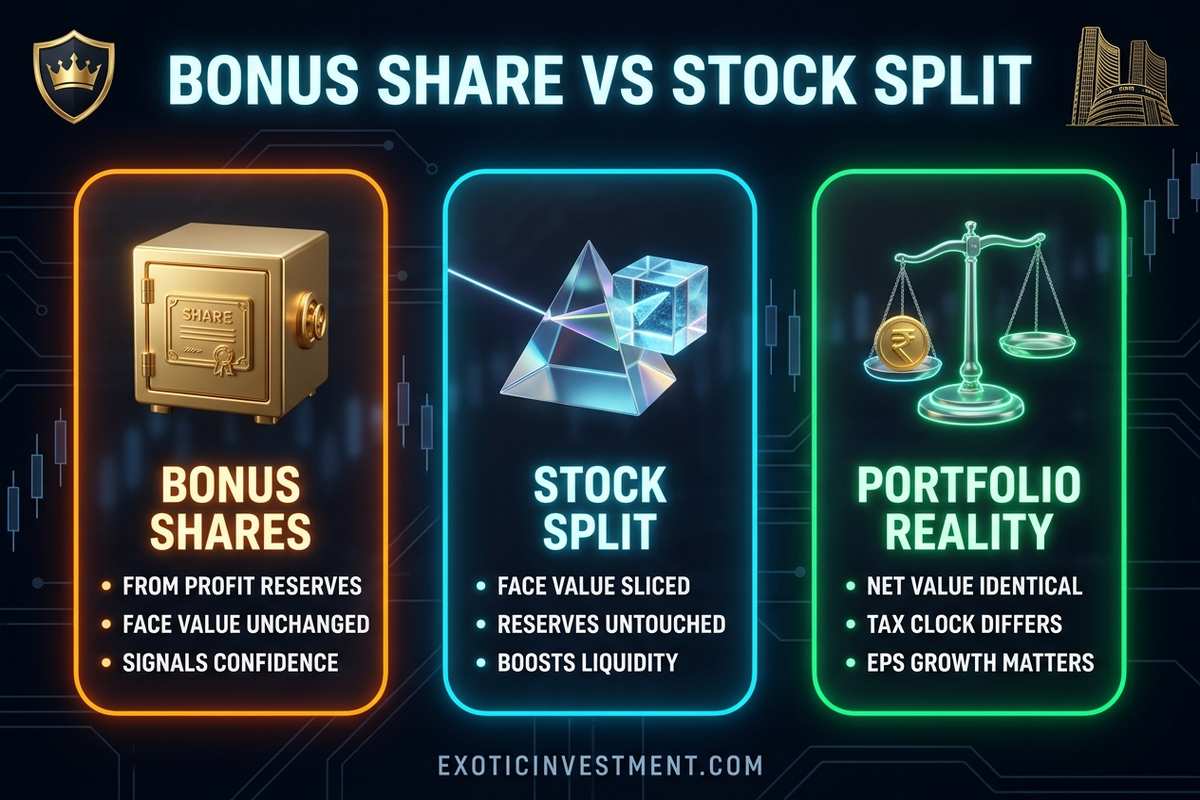
Illustration: Core structural difference between bonus share allotments (from corporate reserves) and face-value slicing in a stock split.
Core Accounting and Structural Difference Between Bonus Share and Stock Split
To grasp the real difference between bonus share and stock split, check the audited liabilities column. Corporate teams update three exact ledger entries whenever boards pass either proposal. Namely, these figures cover face value, paid-up capital, and accumulated free surplus.
Face Value Transformation vs Preservation
During a stock split, slicing face value from ₹10 down to ₹1 subdivides every existing share unit legally. Conversely, a bonus issue locks original face value at ₹10 while minting fresh shares out of reserves. Thus, spotting unchanged face value confirms an investor received bonus stock cleanly!
Balance Sheet Reserves and Paid-Up Capital
Bonus allotments convert retained profit reserves directly into permanent paid-up share capital. As a result, free reserves drop while issued equity capital expands by par value multiplied by new units. In contrast, stock splits alter zero rupees in reserves or total equity capital—only the unit denominator shifts.
Future Dividend Multiplier Effect
Indian firms declare annual dividends either as a percentage of face value or fixed rupees per share. Wait — look closely at what happens once each corporate event finishes! Because a 1:1 bonus keeps face value at ₹10 while doubling share units, steady per-share dividends double investor cash.
Meanwhile, a 1:10 split trims face value down to ₹1, keeping absolute dividend rupees unchanged at identical percentage rates. Compare cash reinvestment outcomes easily inside our DRIP dividend payout calculator and dividend valuation tool cleanly.
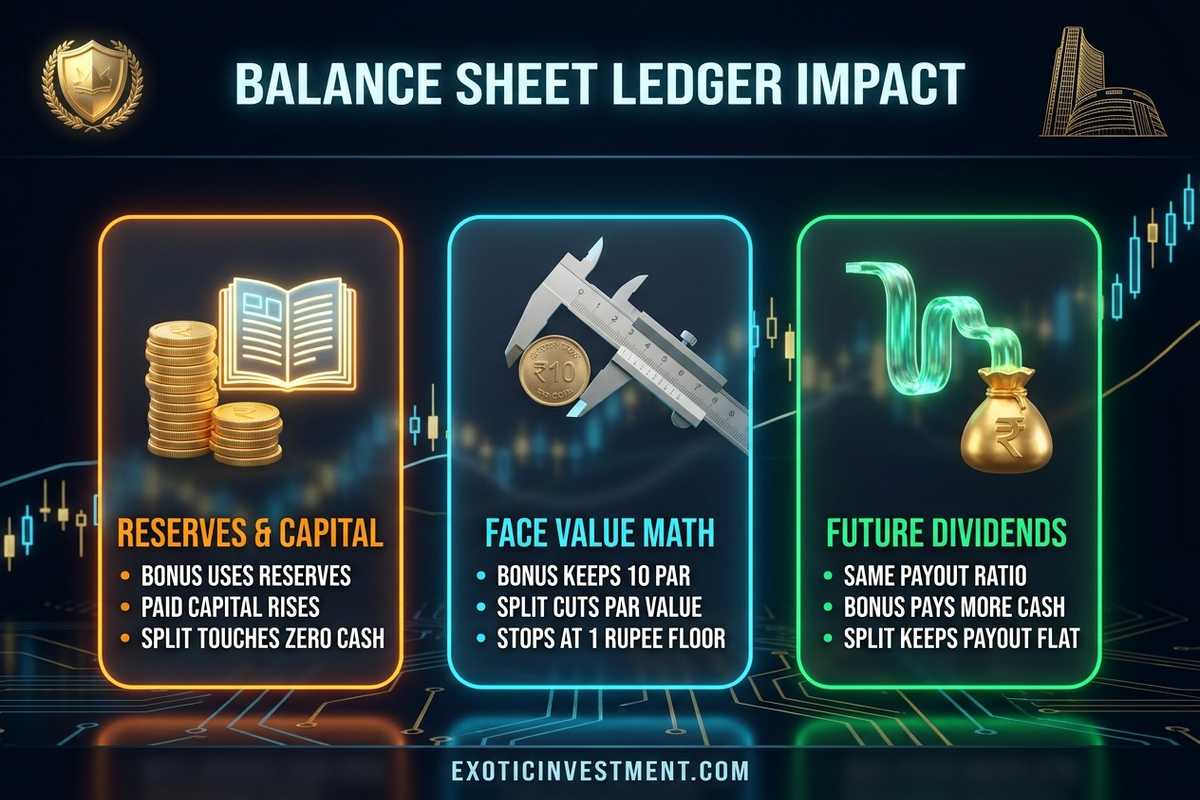
Illustration: Balance sheet comparison showing reserve transfers in bonus shares versus zero-reserve accounting during stock splits.
Complete Comparison Table: Difference Between Stock Split and Bonus Shares
Bookmark this institutional checklist comparing every accounting, tax, and liquidity angle of the difference between stock split and bonus shares. Reviewing these checkpoints upfront prevents painful surprises around record dates and annual taxes.
| Comparison Parameter | Bonus Share Issue | Stock Split Action | Investor Takeaway |
|---|---|---|---|
| Face Value Change | Remains completely unchanged (e.g., stays ₹10) | Reduces proportionally (e.g., ₹10 → ₹2) | Quickest way to spot split vs bonus |
| Source of Extra Shares | Capitalized from free reserves & surplus | Sub-division of existing share certificates | Bonus signals strong past reserves |
| Paid-Up Share Capital | Increases proportionally as reserves drop | Total rupee equity capital stays identical | Zero net worth gain on day one |
| Tax Holding Date (FIFO) | Cost ₹0; new 12-mo clock starts on allotment | Keeps original purchase date & split cost | Major STCG vs LTCG tax difference |
| Primary Management Motive | Reward existing owners & signal confidence | Improve daily volume & affordability | Both attract fresh retail liquidity |
| Repeat Frequency Limit | Can repeat whenever fresh reserves accumulate | Effectively stops once face value hits ₹1 | Bonus can compound repeatedly |
| Impact on Portfolio Value | Unchanged on ex-bonus adjustment | Unchanged on ex-split adjustment | Focus on EPS & ROE growth! |
Worked Numerical Example: ₹1,00,000 Investment Across Bonus vs Split
Numbers strip away confusion fast! Imagine an Indian investor buys 100 shares at ₹1,000 each, holding ₹1,00,000 total value at ₹10 face value. Let us compare both scenarios cleanly on the ex-date morning.
Scenario A: 1:1 Bonus Share Issue
First, the investor retains 100 original shares and receives 100 free bonus units. Consequently, total demat quantity climbs to 200 shares while every unit keeps its ₹10 face value. Meanwhile, NSE halves the price to ₹500, keeping total portfolio worth steady at ₹1,00,000.
Scenario B: 1:5 Stock Split (₹10 Face Value to ₹2)
Next, picture a 1:5 stock split instead of a bonus issue on that same ₹1,000 stock. Immediately, 100 original shares split cleanly into 500 shares holding a ₹2 face value each. On the ex-split morning, market price adjusts down to ₹200 while net worth stays ₹1,00,000.
Wait — check how both actions change your reported per-share average buy cost too! Run instant buy-cost updates using our stock average calculator and verify EPS adjustments today.
Key Indian Income Tax Difference: FIFO Cost and Holding Period
Most retail investors overlook Indian capital gains tax rules until filing annual returns! Specifically, tax law treats the difference between bonus share and stock split sharply across acquisition cost and holding dates. Ignoring these details often creates surprise short-term tax bills.
For bonus allotments, original shares keep their true buy cost and original buy date under FIFO rules. However, new bonus shares carry a strict ₹0 acquisition cost and start a brand-new 12-month tax clock! Therefore, selling new bonus units under 12 months triggers 20% STCG tax on 100% of sale proceeds.
By contrast, a stock split keeps the exact original purchase date across all subdivided shares! For instance, if you bought 100 shares five years ago and received 500 split units, all 500 qualify as long-term holdings immediately. Calculate exact liabilities safely using our STCG & LTCG tax calculator and stock taxation guide.
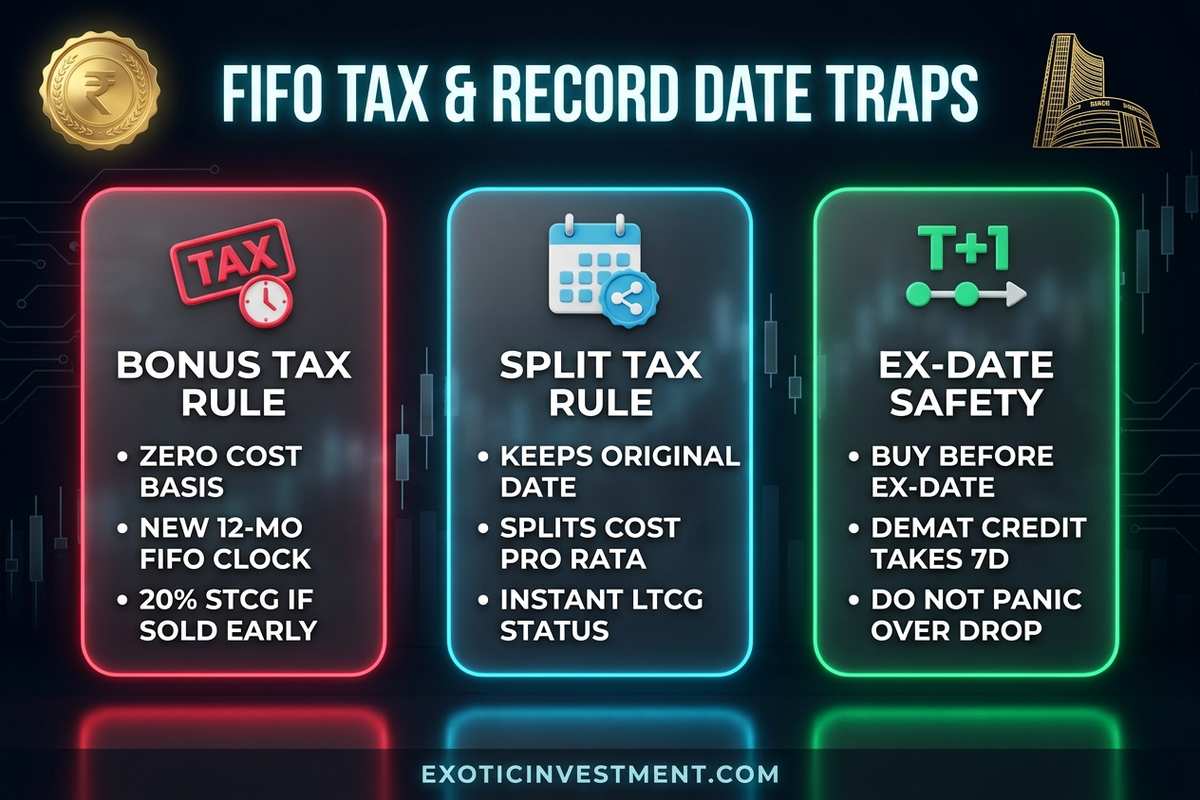
Illustration: Indian Income Tax FIFO rules showing ₹0 cost basis and fresh holding period on bonus shares versus continuity on stock splits.
Record Date, Ex-Date, and T+1 Demat Settlement Traps
Watch calendar deadlines carefully whenever companies set a record date on NSE and BSE! Under India’s rapid T+1 settlement cycle, shares purchased on the ex-date miss record-date eligibility. Therefore, you must buy at least one full session before the ex-date to qualify cleanly.
In addition, remember a temporary display glitch hits broker apps during bonus issues frequently! Specifically, original shares drop in price on the ex-bonus morning while newly allotted bonus units take 2 to 10 working days to settle. Do not panic over temporary paper losses—check corporate event mechanics inside our corporate action guide and rupee profit calculator.
Do Bonus Shares or Stock Splits Create Long-Term Multibaggers?
Never buy a weak business blindly simply because management teased an upcoming bonus or split headline! In fact, troubled microcaps occasionally announce stock splits solely to attract retail buyers near promoter distribution tops. Smart traders therefore inspect earnings growth, free cash flow, and institutional volume upfront.
However, when cash-rich companies pair 18%+ Return on Equity with sensible splits or bonuses, broader affordability often improves price discovery. Check intrinsic valuation safety using our PE valuation framework and relative valuation calculator before deploying savings.
How Institutional Funds React to Splits and Bonus Announcements
Large domestic funds treat sudden bonus announcements much more calmly than retail traders do! Specifically, institutional analysts examine free cash flow coverage before cheering extra bonus certificates. Above all, they verify that promoter pledges stay near zero during corporate restructuring.
Conversely, sudden stock splits attract smaller retail tickets and lift daily exchange turnover quickly. Therefore, tighter order spreads help swing traders enter and exit large positions with lower price slippage. Study corporate reserve strength further via our Profit After Tax explainer and order slippage calculator cleanly.
🚀 Trade Clean Dalal Street Setups With Institutional Discipline
Stop chasing corporate action hype blindly. Master real balance sheet analysis and price action alongside Dr. Ashok Kumar N Rao and our 1,300+ active trading community.
- Strengthen equity basics with our Kaliyiri Share Market Book and English bestseller Basics of Indian Stock Market Book.
- Access institutional screeners and pro research via the MultiBagger Plus Courses & Pro Tools Annual Subscription.
- Master chart timing in our Technical Analysis Course in Kannada or index strategies in our Options Buying Course in Kannada.
💡 Frequently Asked Questions (FAQ): Difference Between Bonus Share and Stock Split
1. What is the main difference between bonus share and stock split in India?
A bonus share issues free units from reserves while keeping face value unchanged. Conversely, a stock split divides shares by cutting face value; explore full rules inside our face value guide today.
2. Are bonus shares or stock splits better for long-term investors?
Bonus issues often signal healthy accumulated reserves and can lift future cash dividends if per-share payout stays unchanged. However, genuine earnings compounding always drives returns—check intrinsic fair pricing via our DCF valuation calculator first.
3. How are bonus shares and stock splits taxed in India?
Bonus units carry ₹0 cost basis and begin a fresh 12-month holding clock upon allotment. Meanwhile, split shares keep original purchase dates; verify exact tax bills cleanly inside our capital gains tax calculator today.
4. Why does my portfolio show a big red loss on the ex-bonus date?
Exchanges drop share market price immediately on the ex-bonus morning while depositories take several days to credit bonus shares. Understand settlement timelines safely inside our settlement guide cleanly.
5. Do stock splits or bonus issues change a company’s P/E ratio or market cap?
No! Because per-share earnings fall proportionally alongside market share price on the ex-date, both P/E multiples and market cap stay unchanged. Test multi-share math easily inside our PE ratio calculator now.
6. When must I buy a stock to receive bonus shares or split shares?
Under T+1 settlement rules, you must purchase equity on NSE or BSE at least one trading session prior to the ex-date. Also check any trading curbs inside our ASM and GSM guide beforehand.