
Knowing when stock market started in india connects modern smartphone trading apps straight back to Bombay’s historic 1875 banyan tree circle. Long before live mobile charts existed, resilient Indian brokers invented structured equity fundraising under harsh colonial monopolies. Today, trace this remarkable journey alongside our SEBI, NSE, and BSE regulation guide for full context.
Wait — informal share trading actually flickered in Mumbai almost twenty years prior to official 1875 exchange registration! Specifically, a handful of Gujarati and Parsi brokers traded cotton textile shares and East India Company debt beside Town Hall banyan trees during the 1850s. As a result, Premchand Roychand and 318 peers formally organized the Bombay Stock Exchange on July 9, 1875.
Let us walk cleanly through every major milestone shaping Dalal Street over 150+ years. First, examine how cotton booms gave birth to Asia’s oldest exchange. Next, discover how major scams created SEBI in 1992, NSE automation in 1994, and today’s digital T+1 wealth engine.
The 1850s Banyan Tree Roots and July 9, 1875 Official Start
Informal share broking surfaced along Bombay’s Horniman Circle during the 1850s when four or five traders met quietly beneath sprawling banyan shade. Soon, America’s Civil War disrupted global cotton shipments dramatically during the early 1860s, flooding Mumbai cotton merchants with sudden cash. Speculation around new spinning mills multiplied broker crowds exponentially within just four years.
Immediately, the 1865 cotton crash ruined countless over-extended speculators overnight when American supplies resumed quickly. Out of that painful collapse, therefore, leader Premchand Roychand united brokers inside an accountable trade association with strict membership rules. Thus, on July 9, 1875, The Native Share & Stock Brokers Association officially formed—known globally today as BSE Limited!
Soon afterward, brokers shifted operations to Dalal Street (“Broker Street”), cementing Mumbai permanently as India’s financial heartbeat. Clearly, every surviving historical Dalal Street crash pushed exchanges steadily toward stronger collateral safeguards over future decades.
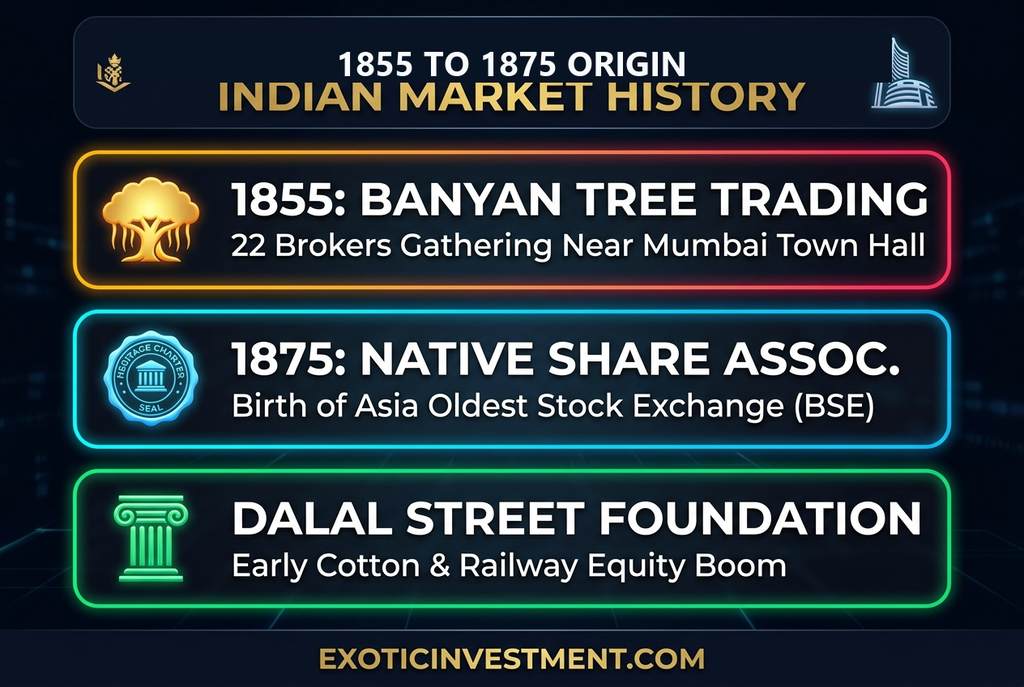
Illustration: Early origin timeline tracing 1855 banyan tree gatherings through the 1875 birth of Asia’s oldest bourse on Dalal Street.
Post-Independence Milestones: SCRA 1956, Sensex 1979, and Economic Reforms
Following Independence in 1947, newly formed central governments needed clean nationwide laws governing private capital markets safely. Consequently, Parliament enacted the Securities Contracts (Regulation) Act (SCRA) in 1956, officially granting BSE statutory national exchange recognition. Meanwhile, regional exchanges popped up across Ahmedabad, Calcutta, Madras, and Delhi to raise local factory capital.
Next came a landmark statistical breakthrough during the late 1970s and 1980s. Previously, newspapers struggled to summarize overall daily Indian market direction in one crisp number cleanly. Therefore, BSE unveiled the iconic S&P BSE Sensex index in 1986 using April 1979 as its base index value of 100!
Just picture that compounding power over four decades from base 100 past 75,000+ points today. Even modest monthly disciplined investing captured extraordinary wealth across India’s economic liberalization after 1991. Check long-term index projections cleanly using our reverse CAGR calculator and SIP return calculator anytime.
1992–2026 Transformation: SEBI, NSE, NSDL Demat, and T+1 Settlement
India’s financial architecture transformed more between 1992 and 2000 than during the entire prior century combined. When the 1992 Harshad Mehta banking-receipt scam exposed glaring oversight loopholes, New Delhi responded decisively with tough market reforms.
SEBI Statutory Powers (1992)
Although created loosely in 1988, however, the Securities and Exchange Board of India gained enforcement teeth via the SEBI Act of 1992. Immediately, SEBI forced listed companies to publish honest disclosures, audited promoter pledges, and strict IPO grading norms. Today, active retail traders see SEBI safety rules daily inside our ASM and GSM watchlist framework and margin norms.
NSE Electronic Screen Trading (1994)
To break Mumbai’s floor-broker cartel forever, consequently India incorporated the National Stock Exchange in 1992 and went live online in 1994. Specifically, VSAT satellite links democratized instantaneous order matching for small towns thousands of kilometers away. Explore how screen-based matching powers cash trading today inside our equity market segment guide too.
NSDL & CDSL Demat + T+1 Settlement (1996–2023)
Next, electronic depositories NSDL (1996) and CDSL (1999) abolished risky paper certificates and forged share signatures permanently. Ultimately, rolling settlements sped up aggressively from sluggish 14-day payouts all the way to global-leading T+1 delivery by January 2023! Verify exact holding terms in our demat depository guide and T+1 settlement calendar.
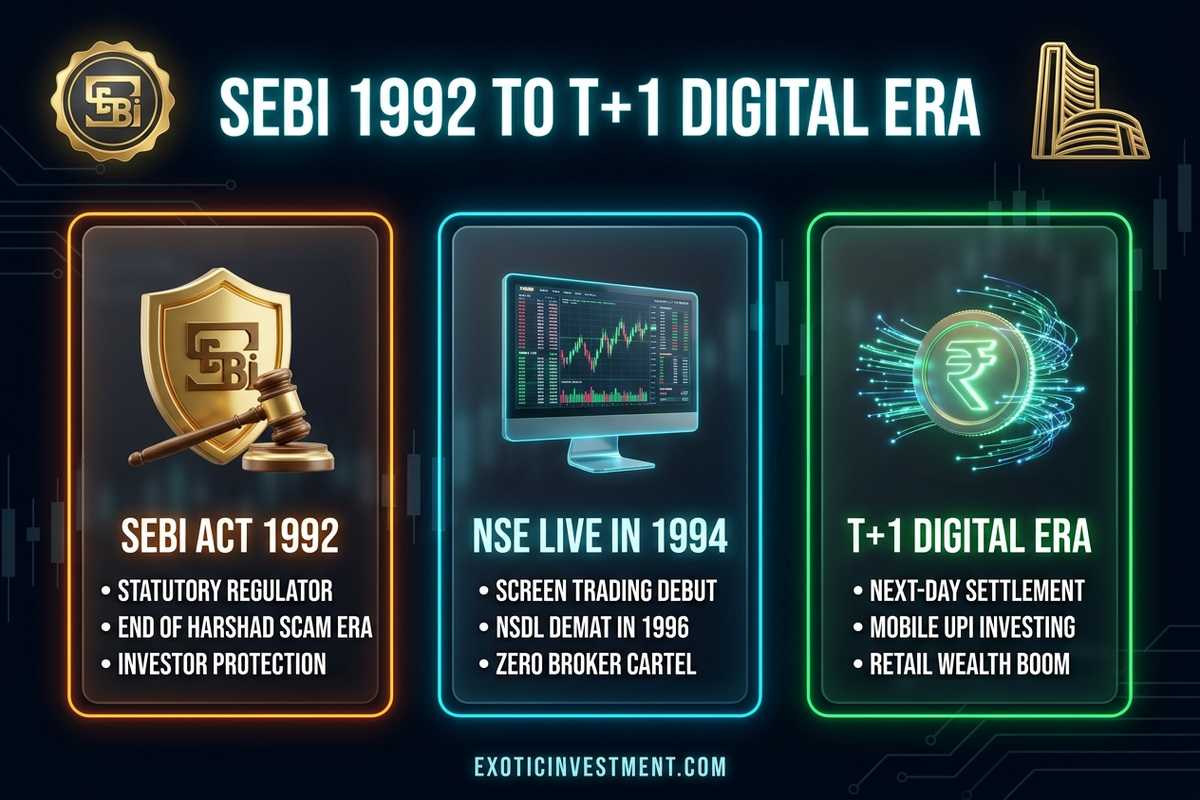
Illustration: Modern market evolution spanning SEBI statutory powers (1992), NSE screen matching (1994), and T+1 digital settlement.
Chronological Timeline Table: Indian Stock Market Evolution (1855–2026)
Save this neat chronological reference matrix whether you study commerce history or mentor beginner Indian savers. Notice clearly how every historical crisis sparked stronger protection and faster digital rails afterward.
| Historical Era / Year | Defining Institution / Event | What Changed for Trading | Lasting Legacy Today |
|---|---|---|---|
| 1855 – 1875 | Banyan Tree Circle → BSE Born | Formalized 318 brokers into rules | Asia’s oldest exchange (Dalal Street) |
| 1956 & 1986 | SCRA Recognition & BSE Sensex | National law + 30-stock index | Flagship Indian market barometer |
| 1992 | SEBI Statutory Act Enacted | Strict regulator policing fraud | Transparent investor safeguards |
| 1994 – 1999 | NSE Screen Launch, NSDL & CDSL | Electronic matching + demat custody | Zero paper share forgery risk |
| 2020 – 2026 | UPI-ASBA, T+1 & 17 Cr+ Demats | Mobile investing & next-day cash | Fastest global settlement ecosystem |
Worked Compounding Reality: ₹10,000 Invested Across Decades of Market History
History lessons turn truly inspiring when converted into honest household compounding numbers across Indian equities. Specifically, recall BSE Sensex’s official base level of 100 points back in April 1979. Consequently, forty-five years later near 75,000+ levels, long-term index holders multiplied capital over 750 times even before dividends!
For example, a patient ₹10,000 equity allocation mirroring broad market returns at 15% annualized compounding grows beyond ₹6,62,000 across thirty years. Even over shorter ten-year cycles, in fact, monthly systematic contributions smooth painful macro crises into wealth builders cleanly. Measure realistic brokerage friction using our Indian stock brokerage calculator and check long-term compounding via our CAGR stock guide today.
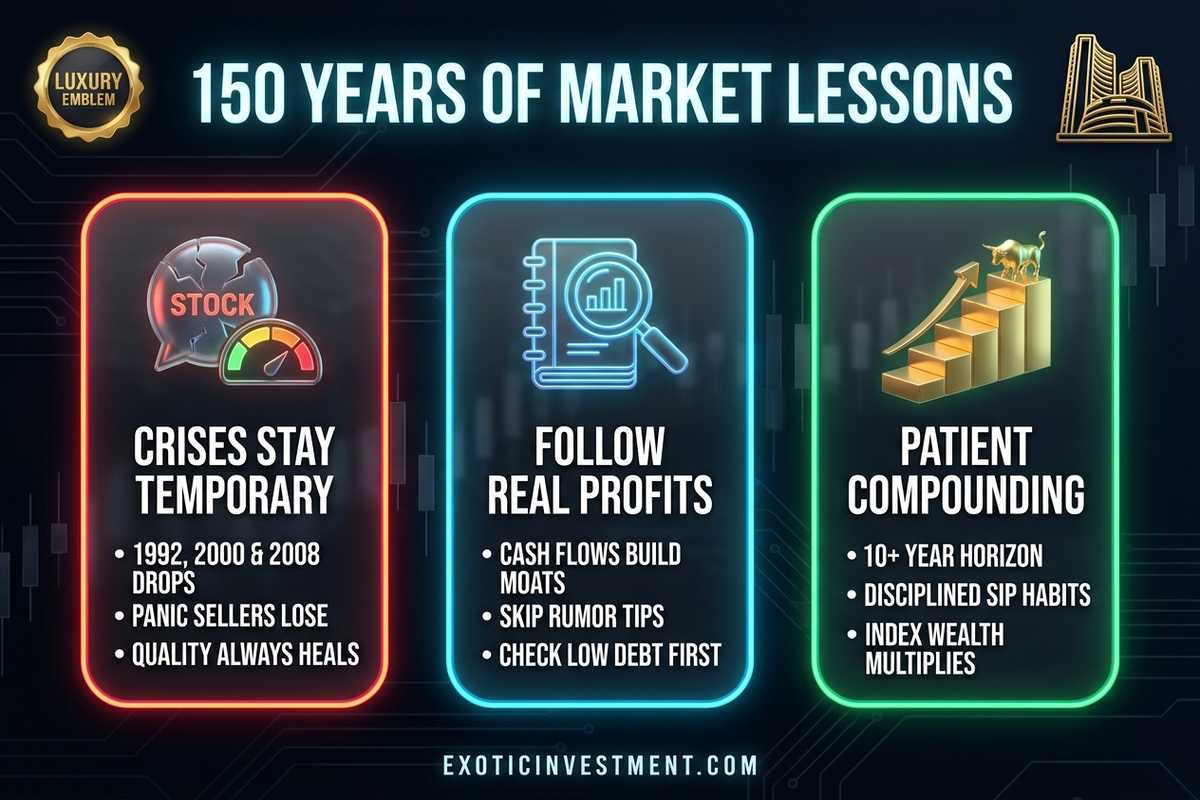
Illustration: Enduring wealth takeaways spanning 150 years of Indian equity regulation, crashes, and long-term compounding.
Three Timeless Dalal Street Lessons From 150+ Years of Market History
Studying historical bubbles from 1865 cotton speculation to 2001 tech euphoria teaches priceless modern discipline. Apply these three grounded principles before committing fresh family capital today.
Lesson 1 — Regulation Follows Every Bubble: Every painful Indian market crisis ultimately made rules tighter and cleaner for future retail households. Always trade strictly through registered brokers listed safely inside our Indian retail demat report rather than grey-market hawala apps.
Lesson 2 — Patience Beats Speculative Churn: Speculators betting borrowed capital in 1865, 1992, and 2008 lost homes overnight when sudden liquidity vanished. Instead, steady investors holding quality Nifty 50 index allocations through storms compounded wealth quietly across generations.
Lesson 3 — Understand Structure Before Chasing Tips: Whether you pick individual largecaps or monthly equity funds, learn basic custody, circuit limits, and risk allocation upfront. Pair steady education with our position size calculator and technical indicator checklists before risking real savings.
🚀 Trade Clean Dalal Street Setups With Institutional Discipline
Stop guessing chart moves on Dalal Street. Learn structured market cycles alongside Dr. Ashok Kumar N Rao and our 1,300+ active trading community.
- Build strong equity foundations with our Kaliyiri Share Market Book and English bestseller Basics of Indian Stock Market Book.
- Access institutional screeners and pro research via the MultiBagger Plus Courses & Pro Tools Annual Subscription.
- Master price structure in our Technical Analysis Course in Kannada or index strategies in our Options Buying Course in Kannada.
💡 Frequently Asked Questions (FAQ): When Stock Market Started in India
1. Exactly when stock market started in India officially?
India’s formal stock market started on July 9, 1875, when brokers founded The Native Share & Stock Brokers Association, today’s BSE. Learn how BSE and NSE co-exist under regulators inside our SEBI NSE and BSE guide today.
2. Why did early Mumbai brokers meet under a banyan tree in the 1850s?
Before owning any formal building, early brokers lacked organized trading floors and gathered outdoors near Bombay Town Hall. Read how cotton speculation and past collapses shaped safer rules in our market crash history guide today.
3. Who is considered the founding father of the Bombay Stock Exchange?
Nineteenth-century financier Premchand Roychand united displaced cotton-crash brokers in 1875 to establish formal membership standards and fair settlement rules. Today, modern investor protection operates under automated surveillance detailed in our ASM and GSM guide safely.
4. Which is the oldest stock exchange in Asia?
Bombay Stock Exchange (BSE), established officially in July 1875, stands proudly as Asia’s oldest active stock exchange. Compare how Indian equity segments operate smoothly today inside our NSE equity segment guide too.
5. When did the BSE Sensex start and what was its base year?
BSE launched Sensex on January 1, 1986, using fiscal year 1978–79 as its base period equal to 100 index points. Compute historical annualized growth rates cleanly using our reverse CAGR calculator anytime.
6. How easy is it to start investing in Indian equities today compared to 1990?
Today you can open a digital demat account with PAN and Aadhaar in minutes and pay zero delivery fees on top brokers. Verify clear account custody terms inside our demat depository guide before funding trades.