
When you place an order on your mobile screen, where does your hard-earned money actually go? Every beginner trader asks the same critical question: who regulates the indian stock market to keep your trading capital safe? Understanding the watchdog framework gives you peace of mind before you explore swing trading in India or long-term wealth building.
👨🏫 Real Market Experience & SEBI Disclosure: Written by Dr.Ashok Kumar N Rao and the Exotic Investment research desk based on 12+ years of active market trading. All insights follow SEBI investor education guidelines. Exotic Investment does not provide unsolicited tips or PMS services. Always protect your trading capital with disciplined position sizing before risking live funds.
Who Regulates the Indian Stock Market? SEBI, NSE & BSE Explained
India’s financial market operates under one primary statutory authority. That apex body is the Securities and Exchange Board of India (SEBI). Established in Mumbai, SEBI holds complete judicial, legislative, and executive authority over every market participant.
SEBI was established as a non-statutory body in 1988. Soon after, Parliament passed the SEBI Act of 1992, granting it legal statutory powers. Consequently, SEBI regulations carry the full weight of Indian law. Anyone violating these directives faces severe financial penalties and criminal prosecution.
However, market regulation is not a one-man show. SEBI operates at the top of a coordinated institutional framework. Two premier stock exchanges work under its direct supervision: the Bombay Stock Exchange (BSE) and the National Stock Exchange (NSE). Let us break down how each entity functions.
The Bombay Stock Exchange is Asia’s oldest exchange, established in 1875. BSE created the benchmark Sensex index, tracking 30 bellwether blue-chip companies. On the other hand, the National Stock Exchange was established in 1992. NSE revolutionized Indian trading by introducing electronic order matching and launching the flagship Nifty 50 index.
In addition, licensed stockbrokers handle retail access. Modern platforms like Zerodha, Upstox, and Groww operate as registered intermediaries. You can compare broker features and account charges in our in-depth breakdown of stock broker apps in India.
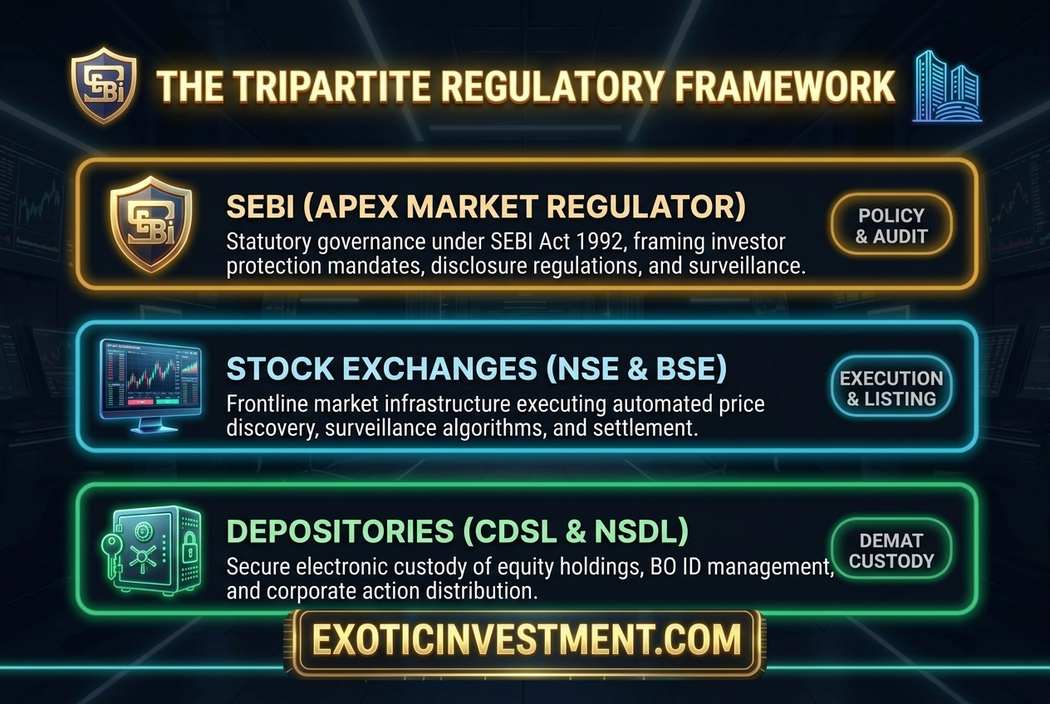
Illustration: The Tripartite Regulatory Framework linking SEBI policy, frontline stock exchanges, and electronic Demat depositories
The Tripartite Market Ecosystem: SEBI, Exchanges, and Depositories
To navigate the market safely, you must grasp how three key layers work together. Each layer performs a specialized function to protect your money:
- The Apex Watchdog (SEBI): Drafts market policies, licenses intermediaries, conducts audits, and prosecutes illegal price manipulation.
- Frontline Exchanges (NSE & BSE): Operate transparent electronic order books, run real-time surveillance algorithms, and enforce listing rules on publicly traded corporations.
- Central Depositories (CDSL & NSDL): Act as digital vaults that safeguard your shares electronically. Learn how depository accounts work in our breakdown of Demat account terms and BO ID formats.
Because shares sit in independent depositories, your holdings remain secure even if your stockbroker goes bankrupt. This vital segregation of client funds and securities forms the backbone of Indian retail investor safety.
Why Stock Market Regulation Matters for Indian Retail Traders
Market regulation is not boring bureaucracy. Instead, it directly shields your hard-earned capital from predatory operators and systemic fraud. I have witnessed dozens of undisciplined traders get misled by pump-and-dump operators on social media.
First, SEBI prevents illegal price rigging. Sophisticated surveillance software flags unusual order volumes instantly. As a result, bad actors cannot easily manipulate stock prices without alerting exchange surveillance desks.
Second, strict margin rules protect traders from excessive borrowed risk. In volatile futures and options segments, brokers must collect upfront margin before executing trades. You can calculate exact statutory levies and turnover taxes with our free brokerage calculator.
Third, circuit filters protect markets from sudden liquidity collapse. When unexpected global events occur, nationwide index circuit breakers pause trading. This mandatory cooldown period stops panic selling from wiping out retail accounts in minutes.
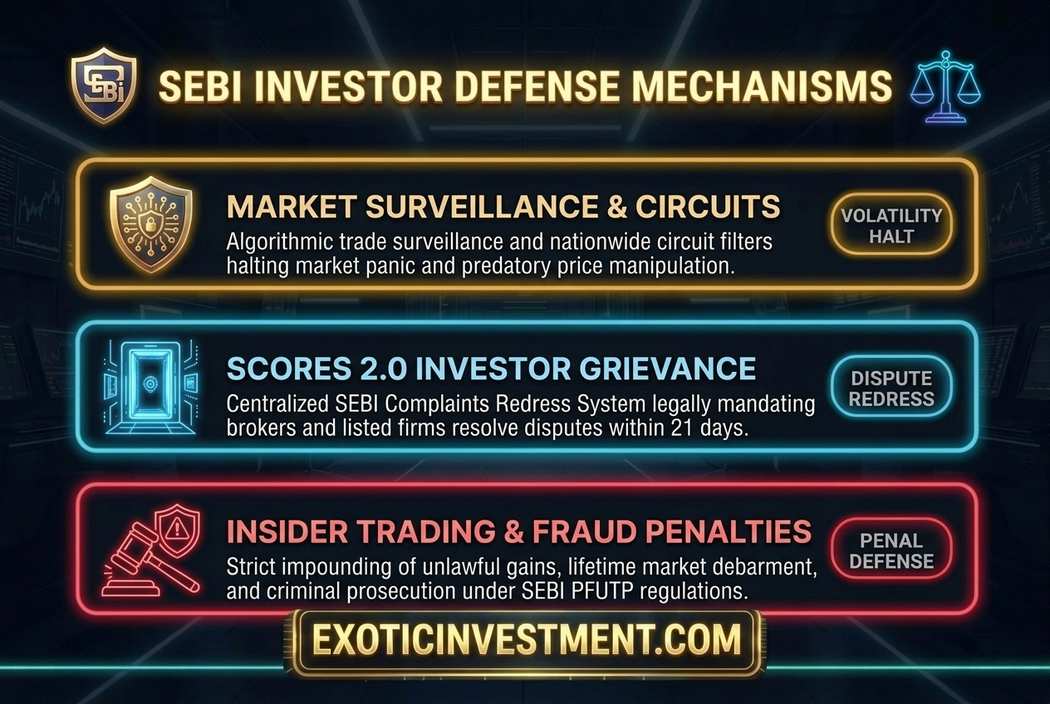
Illustration: Key SEBI investor defense mechanisms including algorithmic surveillance, SCORES 2.0 redressal, and penal enforcement
Core Regulatory Safekeeping Norms Every Trader Must Know
Before putting live money into the market, memorize these five core statutory rules:
- Mandatory Digital KYC: Every investor must verify their PAN card, Aadhaar number, and active bank account before opening a trading account. This traceability keeps black money out of equity markets.
- Client Asset Segregation: Brokers cannot mix client funds with their proprietary trading accounts. Daily reporting ensures your idle cash remains untouched in clearing corporation pools.
- Strict Circuit Limits: Individual equities trade within price bands of 5%, 10%, or 20%. These boundaries prevent runaway speculation in small-cap companies.
- Takeover Code Disclosures: Any entity acquiring 5% or more in a listed company must disclose holdings publicly within two working days. This rule prevents hostile stealth acquisitions.
- Prohibition of Insider Trading (PIT): Company promoters and directors cannot trade shares using unpublished price-sensitive information. SEBI monitors executive Demat accounts with forensic scrutiny.
To avoid buying overhyped penny stocks near upper circuits, always assess fundamental business value using our PE ratio calculator before taking entry positions.
Practical Rules to Protect Your Trading Capital
While SEBI enforces the law, you must enforce personal risk discipline. Regulatory bodies build the safety barrier, but you control the accelerator pedal.
First, never enter a trade without a predefined exit price. Market volatility moves fast during corporate earnings announcements. Use our free stop loss calculator to determine your exact risk-to-reward ratio before clicking the buy button.
Second, avoid taking unhedged overnight derivative positions. If you trade options, understand the Greeks and time decay thoroughly. Discover practical derivative strategies through our specialized Options Buying Course in Kannada.
Third, combine technical chart levels with regulatory awareness. Identify institutional supply and demand zones using our pivot point calculator. This keeps you aligned with institutional order flow rather than trading against big money.
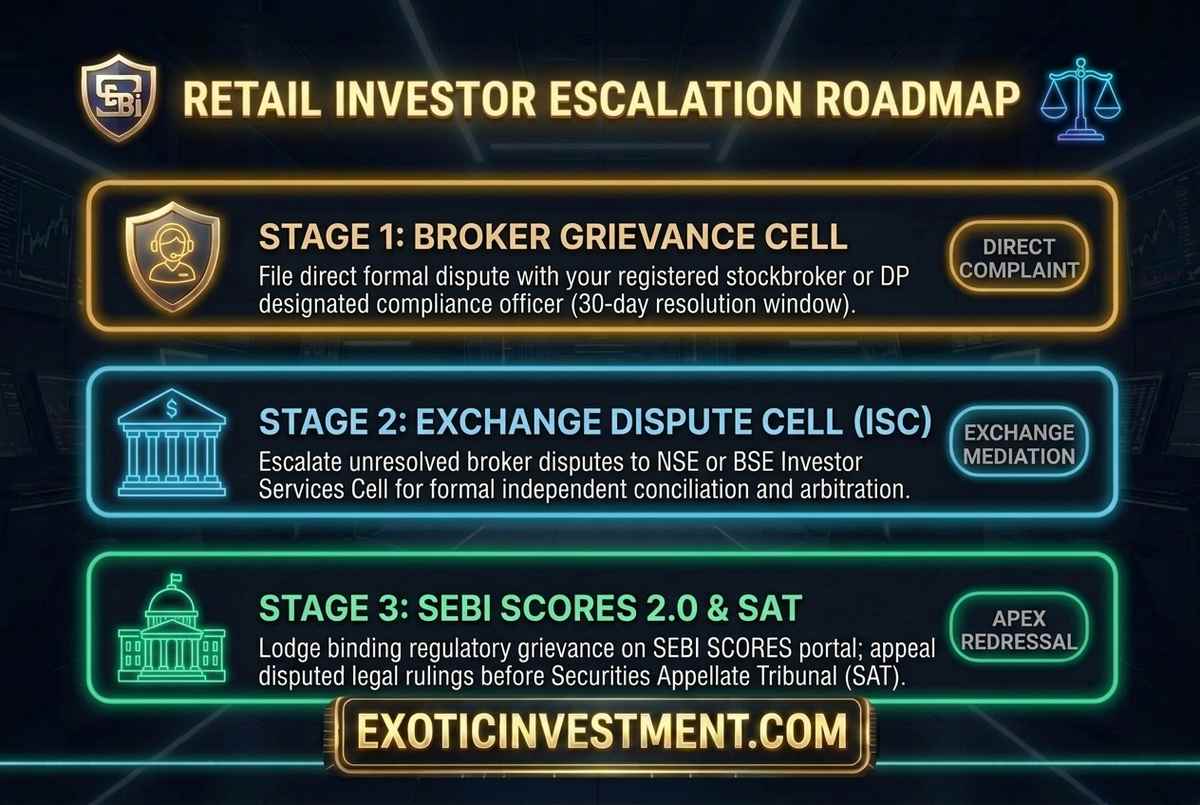
Illustration: Step-by-step investor dispute resolution roadmap from stockbroker grievance desk to SEBI SCORES 2.0 and SAT tribunal
How to File Complaints on SEBI SCORES 2.0
If you face unfair trade execution, unauthorized transactions, or delayed payout from a broker, you do not have to suffer in silence. Follow this three-step escalation roadmap:
Stage 1: Contact Your Broker’s Compliance Officer. Submit a formal written complaint with transaction logs and order confirmations. Stockbrokers have 30 days to resolve client disputes internally.
Stage 2: Escalate to Exchange Investor Services Cell (ISC). If your broker ignores you, file a claim through the NSE or BSE grievance cell. Exchange mediation committees provide neutral dispute resolution and free arbitration for claims up to statutory limits.
Stage 3: Lodge a Formal Grievance on SEBI SCORES 2.0. Visit the official SEBI SCORES web portal. Upload your evidence and submit your complaint online. Listed entities and registered intermediaries must resolve SCORES complaints within 21 calendar days or face regulatory penalties.
Recommended Trading Courses & Premium Subscriptions:
- Options Buying Course in Kannada: Options Buying Course in Kannada.
- Technical Analysis in Kannada Course: Technical Analysis in Kannada Course.
- Kaliyiri Share Market Book: Kaliyiri Share Market Book.
- Basics of Stock Market Course: Basics of Stock Market Course.
- Multibagger Stocks Pro Subscription: MultiBagger Plus Courses & Pro Tools Annual Subscription.
💡 Frequently Asked Questions (FAQ)
1. Who is the apex statutory regulator of the Indian stock market?
The Securities and Exchange Board of India (SEBI) is the sole apex statutory regulator of the Indian stock market under the SEBI Act of 1992. SEBI oversees exchanges, registered brokers, depositories, and listed companies. To discover institutional stock ideas picked under rigorous regulatory compliance, explore our MultiBagger Plus Courses & Pro Tools Annual Subscription.
2. What is the key difference between NSE and BSE?
The Bombay Stock Exchange (BSE) was established in 1875 and tracks the benchmark Sensex index across 30 blue-chip stocks. The National Stock Exchange (NSE) was founded in 1992 and tracks the flagship Nifty 50 index with higher liquidity in equity derivatives. You can trade seamlessly on both exchanges using licensed platforms reviewed in our guide to stock broker apps in India.
3. Are my shares safe if my stockbroker shuts down or goes bankrupt?
Yes, your shares remain 100% safe because they are not held by your broker. Instead, your equities reside in electronic form within government-regulated depositories (CDSL or NSDL) under your unique Beneficial Owner (BO) account. Before executing delivery trades, calculate your statutory transaction costs with our free brokerage calculator.
4. How does SEBI handle retail investor grievances against brokers?
Retail investors can file complaints directly through SEBI’s automated SCORES 2.0 online portal if their broker fails to resolve an issue within 30 days. SEBI legally mandates that intermediaries address disputes within 21 days. In addition, you can manage day-to-day risk and calculate your precise trade parameters using our free stop loss calculator.
5. How does SEBI protect retail traders from runaway market crashes?
SEBI implements nationwide market-wide circuit breakers that halt trading across NSE and BSE for 45 minutes to several hours during severe panic sell-offs. In addition, individual equities have 5% to 20% price bands. To time support reversals and avoid buying near circuit breakdown zones, use our free pivot point calculator.