Learning how to invest in nifty 50 index funds and exchange-traded funds (ETFs) is the most reliable strategy for building long-term wealth in Indian equities. Dalal Street can feel overwhelming for beginners trying to pick individual winning stocks from thousands of listed companies. However, investing directly into India’s premier benchmark index instantly grants you ownership in the 50 largest, most profitable corporate giants powering the nation’s economic expansion.
Listen, boss, legendary investor Warren Buffett consistently advises retail investors to put their savings into low-cost index funds rather than trying to outsmart professional fund managers. Over rolling 15-year holding horizons, the Nifty 50 has delivered a compounding annual growth rate (CAGR) of over 12% to 14%, outperforming more than 75% of actively managed equity mutual funds after fees. Specifically, you do not need lakhs of rupees or advanced financial degrees to begin compounding wealth.
In this definitive blueprint, our research desk explains how the Nifty 50 is calculated, compares index mutual funds versus ETFs, and provides a clear step-by-step roadmap to purchase index units on Zerodha and Groww. Before allocating capital, reviewing basic stock market terms gives you the foundational vocabulary required to operate trading platforms with ease. In addition, understanding index mechanics ensures your hard-earned savings compound without unnecessary friction.
What is Nifty 50 and How is it Calculated?
The Nifty 50 is the flagship benchmark index of the National Stock Exchange of India (NSE), managed by NSE Indices Limited. It tracks the collective performance of 50 blue-chip companies spanning 13 key economic sectors, including financial services, information technology, energy, consumer goods, and automobiles. Consequently, when people on Dalal Street state that “the market is up today,” they are primarily referring to the movement of the Nifty 50.
Crucially, the index does not calculate company weights based on simple total market capitalization. Instead, it uses the Free-Float Market Capitalization methodology, which counts only shares available for active public trading while excluding promoter locked-in holdings and government quotas. Therefore, index weights reflect true market liquidity and institutional ownership dynamics.
A timeless Kannada proverb wisely reminds us: “ಆನೆ ಸತ್ತರೂ ಸಾವಿರ, ಬದುಕಿದ್ದರೂ ಸಾವಿರ” (Aane sattharoo saavira, badukiddaroo saavira — an elephant is worth a thousand gold coins whether living or dead). Similarly, India’s top 50 blue-chip titans represent the bedrock of the national economy; individual quarters may fluctuate, but their institutional enterprise value endures. In addition, semi-annual index reconstitution in March and September automatically eliminates struggling businesses and replaces them with rising market leaders.
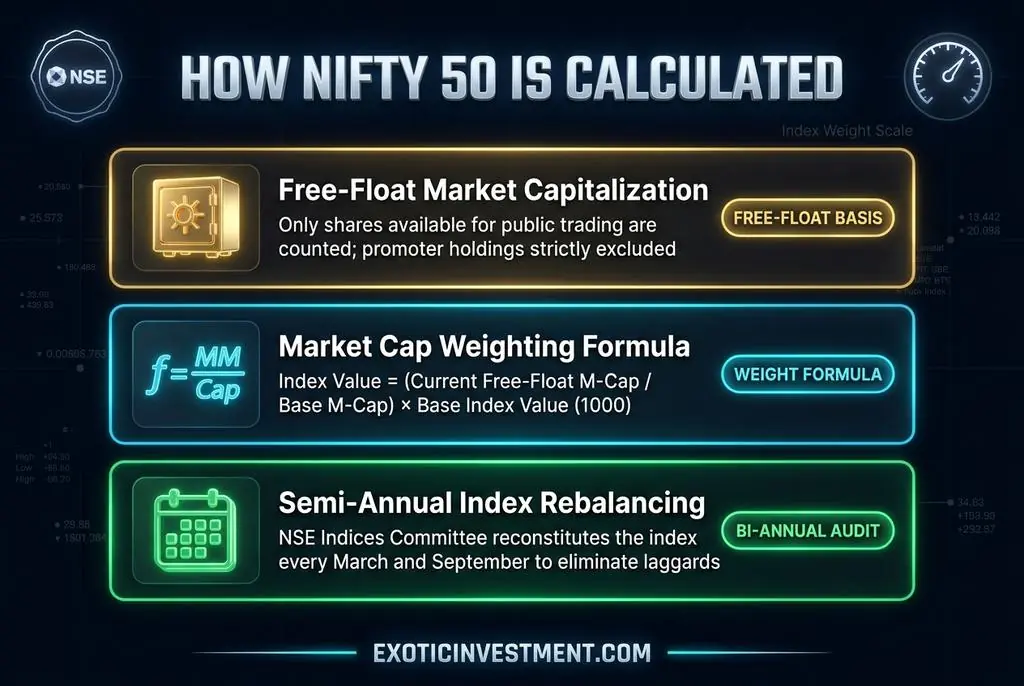
Illustration: Free-Float Market Capitalization and Semi-Annual Rebalancing Architecture of Nifty 50
How to Invest in Nifty 50: 3 Practical Methods
Retail investors cannot buy the numerical index figure directly from the exchange screen like a share of Reliance. Instead, market participants access index returns through three practical, SEBI-regulated investment routes:
1. Nifty 50 Index Mutual Funds
An index mutual fund is a passive scheme managed by Asset Management Companies (AMCs) that buys all 50 underlying stocks in their exact index weightings. Specifically, you do not require a Demat account to invest in index funds; you can setup automated monthly auto-debit SIPs directly through AMC portals or platforms like Groww and Coin. To maximize compounding gains, review the immense cost advantages of direct plans in our guide to direct vs regular mutual funds.
2. Nifty 50 Exchange Traded Funds (ETFs)
Nifty ETFs, such as Nippon India ETF Nifty BeES (NIFTYBEES), trade on the stock exchange throughout market hours just like ordinary company shares. For instance, you can buy or sell ETF units in real time at live market prices with your Demat account, enjoying rock-bottom annual expense ratios as low as 0.04%. In addition, you can compare discount broker transaction charges using our zerodha brokerage calculator.
3. Direct 50 Stock Custom Basket
Sophisticated investors who prefer holding underlying company shares directly can create a custom basket on modern broker terminals. However, this approach requires substantial capital to purchase fractional lot equivalents and demands manual rebalancing every six months. Therefore, index mutual funds and ETFs remain the gold standard for 99% of retail investors.
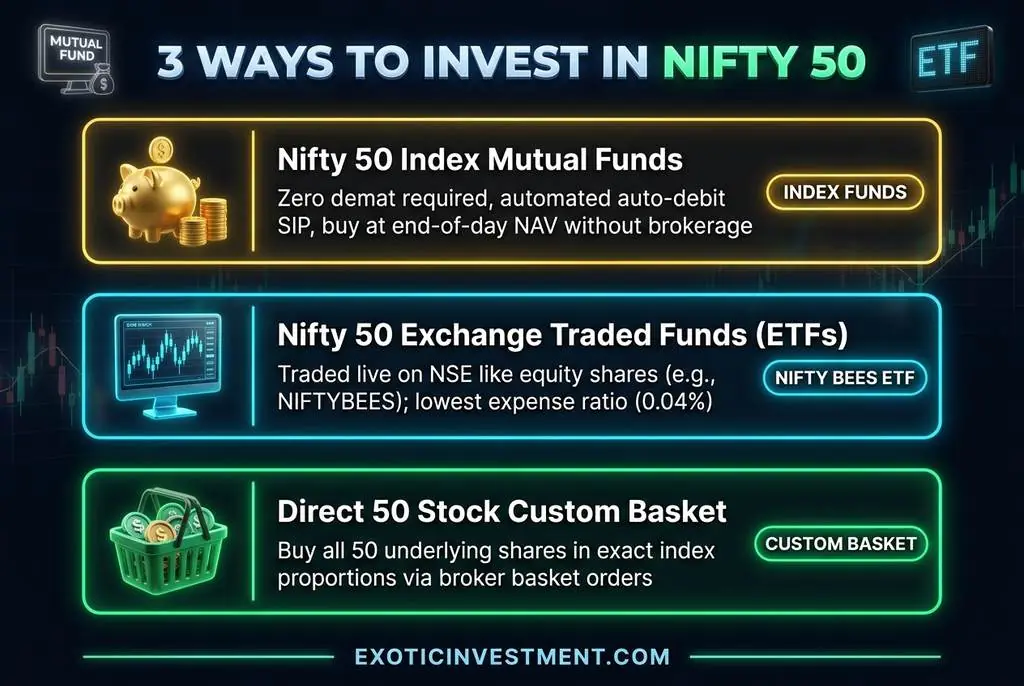
Illustration: 3 Practical Routes to Invest in Nifty 50: Index Funds vs ETFs vs Custom Baskets
Top Nifty 50 Index Funds in India Compared
When selecting a Nifty 50 index fund, you should evaluate two critical metrics: the Total Expense Ratio (TER) and the Tracking Error. Specifically, tracking error measures how closely the fund manager matches the exact percentage returns of the underlying index:
| Fund Scheme Name | Type | Direct Expense Ratio (TER) | 1-Year Tracking Error | AUM Size |
|---|---|---|---|---|
| UTI Nifty 50 Index Fund | Index Mutual Fund (Direct) | 0.18% – 0.21% | 0.03% | > ₹18,000 Cr |
| HDFC Nifty 50 Index Fund | Index Mutual Fund (Direct) | 0.20% | 0.04% | > ₹14,000 Cr |
| Nippon India ETF Nifty BeES | Exchange Traded Fund (ETF) | 0.04% | 0.02% | > ₹26,000 Cr |
| SBI Nifty 50 ETF | Exchange Traded Fund (ETF) | 0.04% | 0.03% | > ₹1,80,000 Cr |
In addition, investors can accelerate long-term corpus growth by stepping up their monthly contributions systematically. For example, explore how a simple 10% annual top-up dramatically doubles your maturity wealth in our guide on step up sip vs regular sip. In addition, you can simulate compound interest projections using our interactive sip calculator.
🚀 Master Index Investing & Long-Term Wealth Compounding
Stop losing money chasing speculative penny tips. Learn how to construct an all-weather portfolio, optimize asset allocation across index funds and blue chips, and compound wealth with institutional discipline. Join over 1,300+ successful investors who learn directly from Dr. Ashok Kumar N Rao.
- Master wealth compounding and share market foundations with our bestselling book Kaliyiri Share Market Book and our English handbook Basics of Indian Stock Market Book.
- Accelerate your portfolio returns with institutional stock screeners and quantitative analytics through the MultiBagger Plus Courses & Pro Tools Annual Subscription.
- Master chart analysis and breakout triggers by studying our structured Technical Analysis Course in Kannada or options mechanics in our Options Buying Course in Kannada.
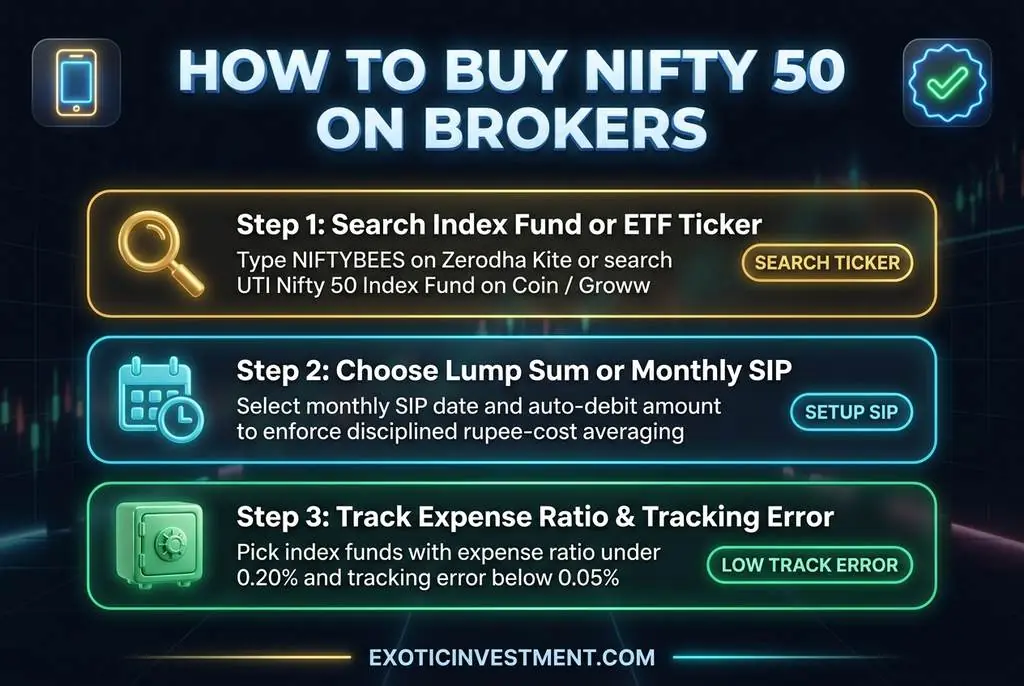
Illustration: 3 Step Execution Roadmap to Buy Nifty 50 on Zerodha Kite and Coin
Step-by-Step: How to Buy Nifty 50 on Zerodha / Groww
Executing an index investment on Indian broker platforms takes less than two minutes. Follow this operational execution checklist:
- Log into Your Trading Terminal: Open Zerodha Kite or Groww on your desktop browser or mobile application. Ensure your linked bank account has cleared funds ready for transfer.
- Search for Index Securities: If you want an ETF, type
NIFTYBEESinto your watchlist search bar and click ‘Buy’ during active trading hours (9:15 AM to 3:30 PM). If you want an index mutual fund, open Zerodha Coin or the Groww Mutual Fund tab and search forUTI Nifty 50 Index Fund Direct Growth. - Select Investment Mode: Choose between a one-time Lump Sum order or set up a recurring Monthly SIP. Enter your installment amount (starting from as little as ₹500 per month) and approve the automated UPI mandate.
- Track True Portfolio Returns: Avoid confusing simple percentage returns with annual compounding. Check your multi-year geometric performance using our guide on how to calculate cagr in stocks.
Nifty 50 vs Nifty Next 50: Which Index Fund Should You Pick?
While the Nifty 50 represents the mega-cap stalwarts (ranks 1 to 50), the Nifty Next 50 tracks the emerging blue chips ranked 51 to 100 on the National Stock Exchange. In fact, many historical market leaders like Titan and Bajaj Finance originally graduated from the Nifty Next 50 before entering the main index.
Historically, the Nifty Next 50 has generated 2% to 3% higher annual CAGR than the Nifty 50, but it experiences sharper drawdowns during broad market sell-offs. Therefore, smart asset allocators often blend both indices: placing 70% of index capital into the stability of Nifty 50 and 30% into the higher growth engine of Nifty Next 50. In addition, you can model trade risk allocations with our position size calculator.
Similarly, remember that capital gains from equity index funds are taxed under revised budget rules. Specifically, holdings sold within 12 months incur 20% Short-Term Capital Gains (STCG), while units held over 12 months qualify for 12.5% Long-Term Capital Gains (LTCG) with an annual ₹1.25 Lakh exemption limit. Review complete filing requirements in our guide to stock market profit taxation in india.
💡 Frequently Asked Questions
1. Can beginners start investing in Nifty 50 with just ₹500?
Yes, most direct Nifty 50 index mutual funds permit systematic monthly SIP investments starting from ₹500. In addition, buying a single unit of Nifty BeES ETF requires only around ₹250 to ₹270, depending on live index levels. Review proper risk structuring with our risk to reward ratio guide.
2. Which is better: Nifty 50 Index Mutual Fund or Nifty ETF?
If you prefer automated monthly auto-debit deductions without worrying about market timing or intraday bid-ask spreads, an index mutual fund is ideal. In contrast, if you hold a Demat account and wish to trade at live intraday prices with the lowest possible expense ratio, an ETF is superior. Compare discount brokerage charges with our upstox brokerage calculator.
3. Do Nifty 50 index funds pay dividends?
If you choose the ‘Dividend’ (IDCW) option, the fund distributes dividend payouts received from underlying companies. However, seasoned investors overwhelmingly recommend the ‘Growth’ option, where dividends are automatically reinvested to trigger compound interest compounding. Explore high-yielding companies in our guide to dividend yield stocks in india.
4. Can the Nifty 50 index ever go to zero?
No, because the Nifty 50 is a self-cleansing basket of 50 diverse corporate behemoths across 13 different industries. If an individual company falters, NSE index committees replace it during semi-annual rebalancing with a stronger growing corporation. In addition, learn how regulatory circuits defend markets in our guide on upper and lower circuit limits.
5. How do algorithmic traders interact with the Nifty 50?
Quantitative desks deploy automated Python strategies to capture intraday index momentum and arbitrage price differences between Nifty futures and spot index baskets. Explore retail trading bot guidelines in our guide to algorithmic trading in india.