
The first computerised online stock exchange in India was the National Stock Exchange of India Limited (NSE), which launched automated screen trading in 1994. Before that historic shift, Indian buyers depended entirely on noisy floor brokers in Mumbai. Today, however, millions of investors understand SEBI, NSE, and BSE regulation transparently from their smartphones.
Many finance quiz takers and young Dalal Street investors confuse NSE with the Bombay Stock Exchange (BSE). Specifically, BSE remains Asia’s oldest exchange founded back in 1875 under a Mumbai banyan tree. However, NSE arrived specifically to break broker monopolies using anonymous satellite networks.
Let us trace the complete transformation clearly from noisy chalkboards to modern high-speed matching engines. First, we explain how NSE’s NEAT software and VSAT dishes worked in 1994. In addition, you will compare NSE versus BSE side by side and discover what changed for ordinary savers.
Quick Exam Answer: Why NSE Became India’s First Computerised Exchange
Whenever a competitive commerce exam asks about digital automation in Mumbai finance, remember three exact facts cleanly. NSE incorporated in November 1992 after the Pherwani Committee called for transparent national market reforms. Then in June 1994, NSE started its wholesale debt segment before opening equity trading on November 3, 1994.
Immediately, screens replaced hand gestures across Indian cities outside Maharashtra for the first time ever. Instead of telephoning Mumbai floor members and guessing real execution prices, brokers across Delhi, Chennai, Bengaluru, and Kolkata saw live bids simultaneously. As a result, concealed commission markups shrank drastically within months.
Wait — where did the older Bombay Stock Exchange stand during 1994? Because BSE brokers initially resisted electronic transparency, BSE launched its automated BOLT platform only later on March 14, 1995. Consequently, NSE locked in early institutional equity volumes alongside tighter stock brokerage charges across India.
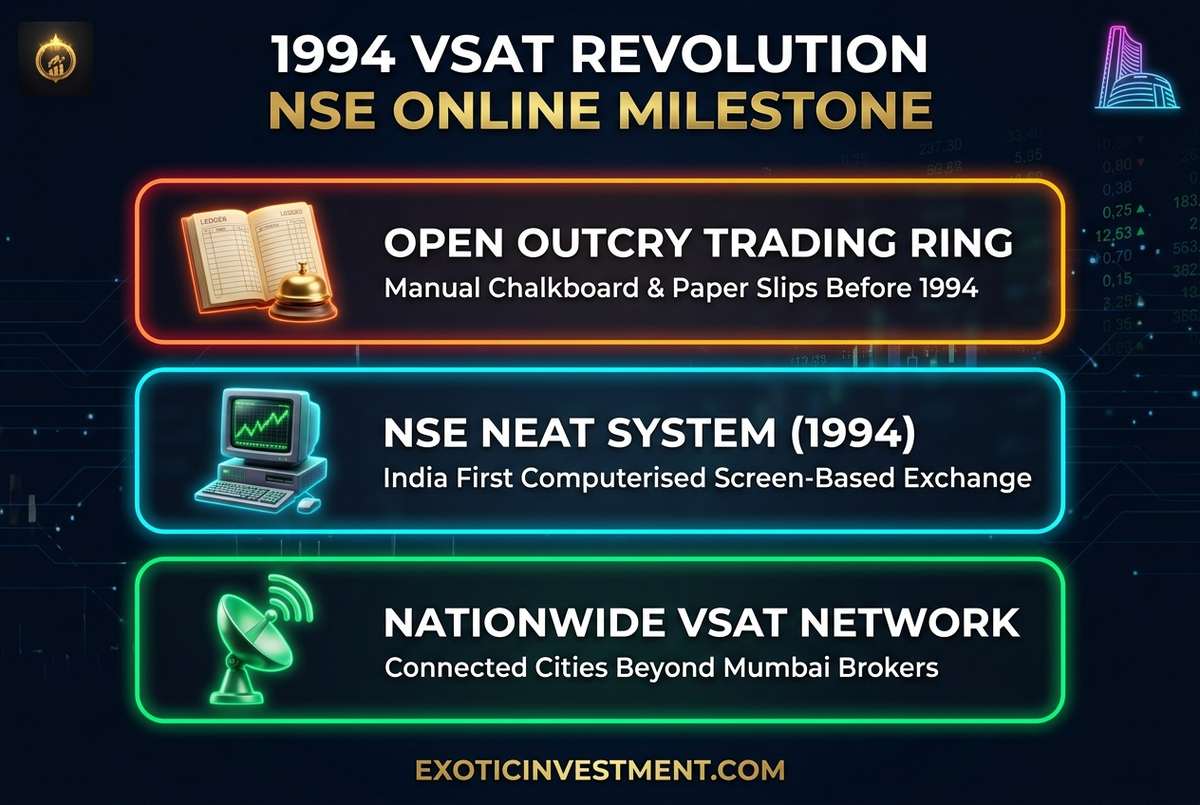
Illustration: Transition from manual paper trading rings to NSE NEAT and nationwide VSAT satellite terminals in 1994.
Before 1994: How Indian Stock Trading Operated Without Screens
Understanding why online automation transformed household investing requires picturing pre-1994 Dalal Street chaos. Hundreds of licensed floor brokers and jobbers crowded inside the BSE trading ring between fixed noon hours. Every buy or sell quote traveled by shouting, finger codes, and hastily scribbled paper chits.
Naturally, small investors living outside Mumbai stayed completely blind during live execution. Suppose an investor in Mysuru instructed a sub-broker to buy shares around ₹200 that morning. Days later, the buyer often received an inflated contract note claiming execution near ₹212 without verifiable proof.
More worryingly, physical share certificates traveled by courier over weeks before reaching buyer hands. Bad deliveries, forged signatures, and settlement defaults plagued every bull rally back then. You can trace similar early market risks in our Indian market crash history guide today.
Inside NEAT & VSAT: How NSE Built Screen-Based Trading in 1994
NSE architects designed the National Exchange for Automated Trading (NEAT) around strict price-time priority rules. Rather than matching buyers selectively by personal friendships, central computers paired every incoming order automatically. Consequently, an investor entering 10 shares in Guwahati received equal treatment beside huge Mumbai funds.
Specifically, reliable terrestrial fiber cables barely existed across Indian towns during 1994. Therefore, NSE partnered with telecom providers to deploy thousands of Very Small Aperture Terminal (VSAT) rooftop satellite dishes nationwide. Within two years, brokers in over 300 Indian towns connected live to central matching servers.
Meanwhile, clearing safety improved dramatically through the National Securities Clearing Corporation (NSCCL) created in 1995. Because NSCCL acted as the legal counterparty between every buyer and seller, counterparty default fears vanished quickly. Explore how modern exchange order types work on top of this electronic matching core.
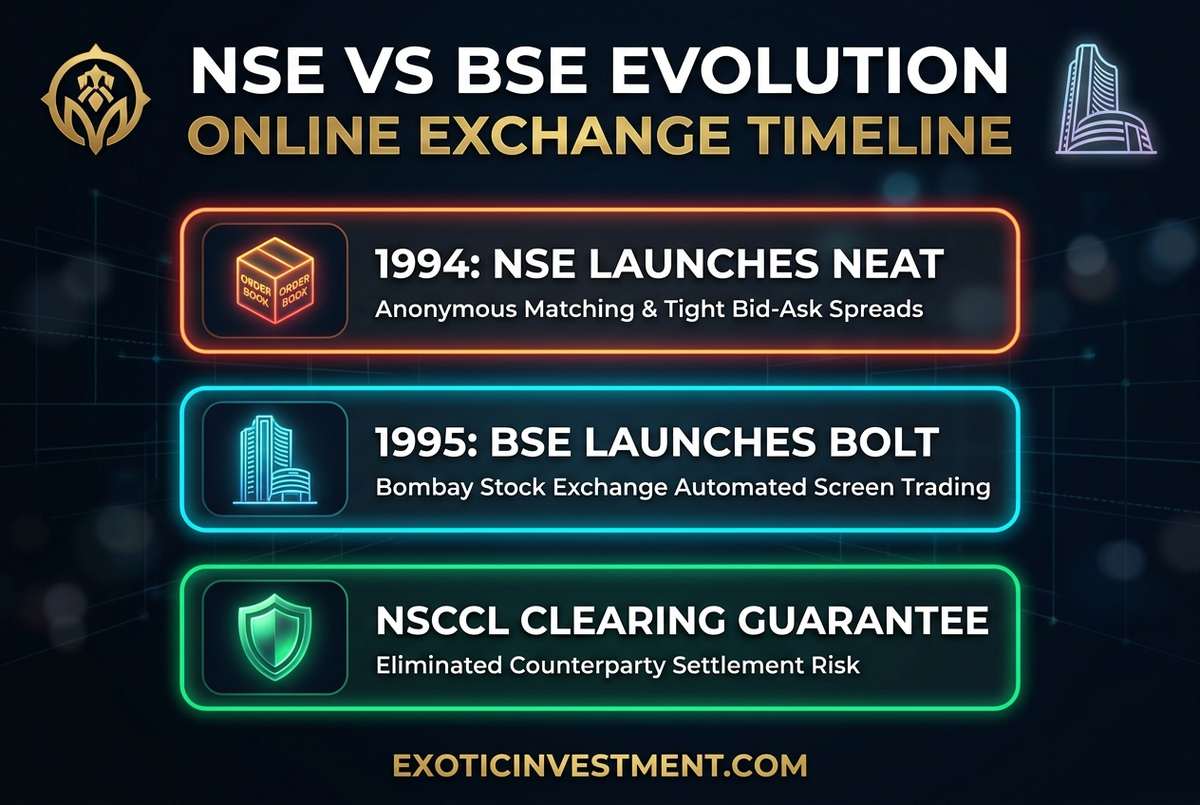
Illustration: Chronological milestones comparing NSE NEAT (1994), BSE BOLT (1995), and NSCCL clearing guarantees.
NSE NEAT vs BSE BOLT vs Old Open Outcry Comparison Matrix
Competitive exams and new traders frequently ask how NSE automation differed practically from older trading rings and BSE BOLT. Review this institutional comparison table below to spot exact differences across transparency, speed, and settlement safety.
| Market Feature | Pre-1994 Open Outcry | NSE NEAT (1994) | BSE BOLT (1995) |
|---|---|---|---|
| Launch Year | 1875 onwards (BSE Ring) | November 1994 (Equities) | March 1995 (BOLT Screen) |
| Order Matching | Face-to-face shouting & slips | Anonymous order-book engine | Hybrid screen & dealer system |
| Geographic Reach | Mumbai trading ring only | Pan-India VSAT network | Expanded gradually nationwide |
| Custody & Risk | Paper shares, fake certificates | Sparked NSDL demat in 1996 | Later added CDSL in 1999 |
| Flagship Benchmark | BSE Sensex (30 stocks) | Nifty 50 (launched 1996) | BSE Sensex & Midcap indices |
How NSDL Demat (1996) and T+1 Settlement Completed the Digital Shift
Electronic screen trading solved price transparency quickly, yet physical paper certificates still choked back-office settlement rooms. Because trucks moved millions of fragile certificates between cities every Friday, paperwork piled up quickly. Therefore, NSE co-promoted the National Securities Depository Limited (NSDL) alongside IDBI and UTI in November 1996.
Dematerialisation converted clunky stamped share certificates into secure digital book entries overnight. Instead of checking signatures physically with magnifying lenses, brokers transferred ownership safely in seconds. Learn every custody acronym cleanly inside our demat depository DP and BO ID guide today.
Next, electronic settlement cycles compressed rapidly from fortnightly T+14 payouts down to T+5, T+3, T+2, and T+1 by 2023. India actually pioneered major-market T+1 equity settlement globally ahead of Wall Street exchanges. Always check updated settlement holidays and clearing rules before planning urgent withdrawals.
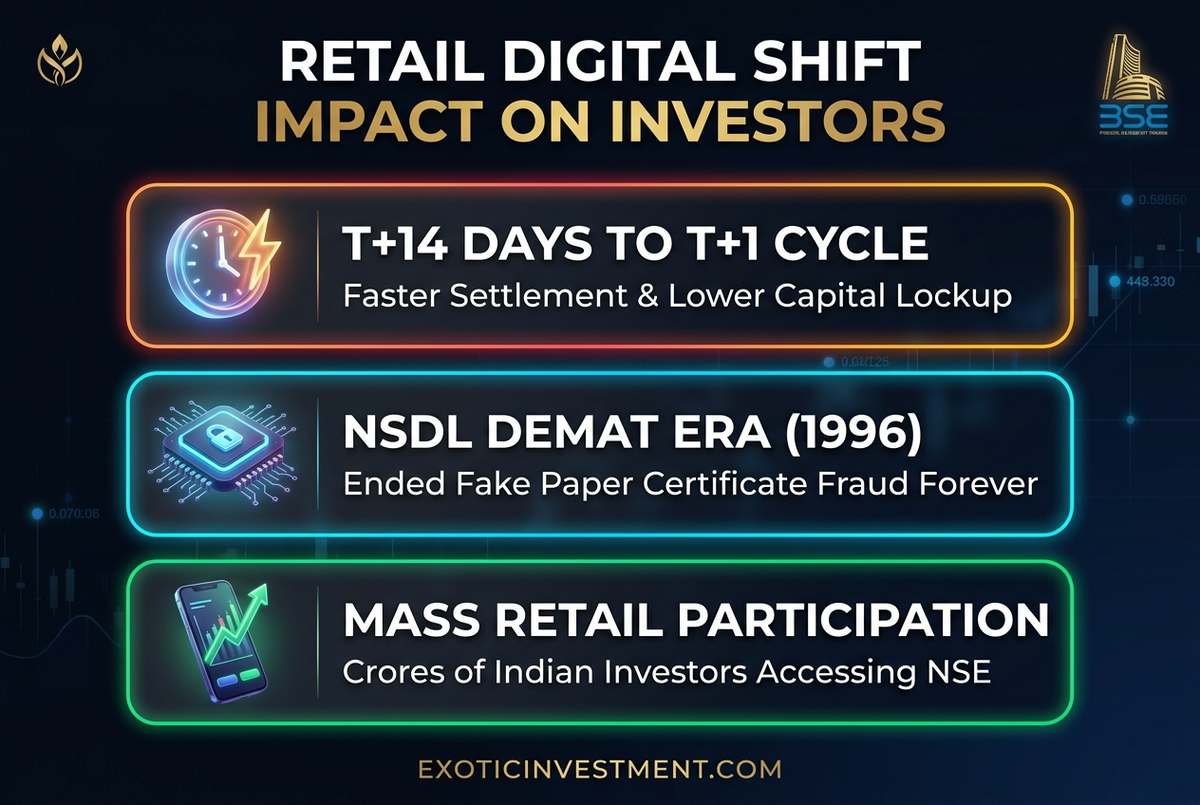
Illustration: Retail benefits driven by electronic matching, NSDL dematerialisation, and India’s T+1 settlement transformation.
Worked Cost Example: Pre-1994 Broker Fees vs Modern Digital Execution
Numbers prove how deeply computerised exchange automation changed ordinary family savings in India. Consider a retail saver purchasing ₹1,00,000 worth of blue-chip equities back in 1991 versus executing on NSE today. Notice how total transaction friction dropped dramatically alongside delivery speed.
In 1991, physical floor brokerage frequently cost 1.5% to 2.5% per side alongside hidden bid-ask padding and courier stamps. Simply buying and selling ₹1,00,000 of stock often wiped out ₹5,000 instantly before earning a rupee. Meanwhile, settlement dragged over two weeks with zero guarantee against counterfeit certificates.
Today on NSE or BSE, transparent electronic routing costs flat ₹0 to ₹20 delivery brokerage plus tiny statutory taxes. You can measure exact rupee savings instantly using our Indian stock brokerage calculator before sending a single limit order. Plus, passive savers deploy monthly cash automatically through our Nifty 50 index investing guide and SIP return calculator.
What Modern Traders Must Know About NSE Today
Thirty-plus years after that 1994 VSAT launch, NSE ranks globally among top derivatives and cash-market venues by contract volume. Over 17 crore demat accounts now participate across cities and small towns nationwide. Explore exact retail growth milestones inside our Indian demat investor statistics report today.
In addition, institutional fiber colocation and SEBI-regulated APIs execute orders in microseconds across equity and option chains. Retail traders can study regulated automation safely inside our Indian algo trading rules guide before writing any script. Remember also to keep your equity charts focused using reliable stock market indicators and strict risk sizing.
In short, whether preparing for banking exams or starting real cash-market investments, remember 1994 fondly. Anonymous screen matching gave every middle-class Indian household honest price discovery on Dalal Street. Protect that structural advantage with disciplined position sizing rules on every trade.
🚀 Trade Clean Dalal Street Setups With Institutional Discipline
Stop chasing guesswork tips on Dalal Street. Build structured market habits alongside Dr. Ashok Kumar N Rao and our 1,300+ active trading community.
- Build strong equity foundations with our Kaliyiri Share Market Book and English bestseller Basics of Indian Stock Market Book.
- Access institutional screeners and pro research via the MultiBagger Plus Courses & Pro Tools Annual Subscription.
- Master price structure in our Technical Analysis Course in Kannada or index strategies in our Options Buying Course in Kannada.
💡 Frequently Asked Questions (FAQ): First Computerised Stock Exchange in India
1. Which exchange became the first computerised online stock exchange in India?
The National Stock Exchange of India Limited (NSE) became the first fully computerised screen-based stock exchange in India during 1994. Learn more about how NSE works alongside BSE in our SEBI, NSE, and BSE guide today.
2. Did BSE start before NSE, and when did BSE go electronic?
Yes, the Bombay Stock Exchange started much earlier in 1875 as Asia’s oldest exchange using manual open outcry rings. However, BSE switched to electronic screen trading through BOLT on March 14, 1995, months after checking equity market segment liquidity shifts to NSE.
3. What did NSE’s NEAT trading software stand for?
NEAT stood for National Exchange for Automated Trading, a centralized anonymous order-matching engine engineered specifically for Indian markets. Check how modern limit and market orders route cleanly through NEAT inside our stock market order types guide today.
4. Why was VSAT technology so important for NSE in 1994?
Indian cities lacked dependable optical fiber cables during 1994, so VSAT satellite dishes linked non-Mumbai brokers directly to Mumbai servers. As a result, tiny towns joined electronic delivery share trading immediately with live nationwide price parity.
5. Which company launched India’s first electronic depository after NSE?
NSE, IDBI, and UTI co-founded National Securities Depository Limited (NSDL) in 1996 to replace risky paper share certificates cleanly. Explore how electronic holdings protect retail shares safely inside our demat account depository guide anytime.
6. How fast do Indian online stock exchange trades settle today?
Indian equity delivery trades now settle cleanly on a T+1 rolling cycle, delivering shares and funds one working day later. Verify exact payout timings and calendar exceptions via our stock settlement holiday guide before withdrawing cash.