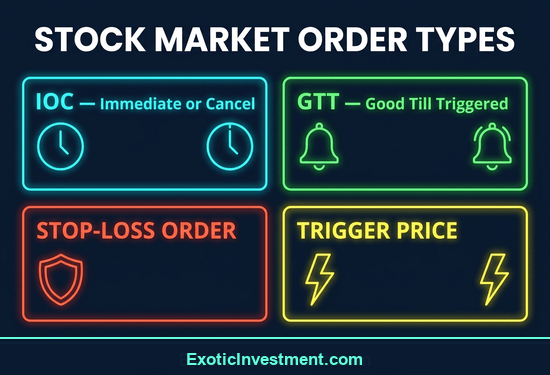
Okay, so you’re staring at your broker app and you see all these order types — IOC, GTT, Stop-Loss, Trigger Price — and honestly, it feels like the market is speaking a different language, right? Don’t worry. Aah, we’ve all been there! Understanding what is ioc in stock market and how it fits with the other order types is one of those things that genuinely changes how you trade. So let’s break it all down in plain English.
What is IOC in Stock Market? — The Basics
IOC stands for Immediate or Cancel. When you place an IOC order, you’re basically telling your broker: “Hey, fill this order right now at the price I’ve set. If you can’t fill it immediately — or even partially — then just cancel it.” No waiting around. No keeping your order in the queue. It either happens instantly or it doesn’t happen at all.
This is incredibly useful when you’re trading in stocks that move fast. Think Nifty 50 stocks during high-volatility sessions. You don’t want your order just floating there in the market while the price runs away from you. That’s what is ioc in stock market in the simplest possible terms — speed and precision, no hanging around.
Before you even get to placing orders like this, you should have a solid foundation. Go through our guide on how to get into the Indian stock market and understand how volume and price action work so you know why timing matters so much.
GTT Orders — Your Set-It-and-Forget-It Tool
GTT stands for Good Till Triggered. Unlike IOC which is all about instant action, GTT is the patient investor’s best friend. You set a target price, and your broker keeps that order active until the stock hits that price — could be days, could be weeks. The order just sits there waiting.
Say you’re watching Infosys at ₹1,800 and you believe it’s worth buying only if it drops to ₹1,650. With GTT, you set that trigger and forget about it. When the stock hits ₹1,650, boom — your order fires automatically. No need to babysit the screen all day.
📚 Recommended Trading Courses & Premium Subscriptions
- Options Buying Course in Kannada: Options Buying Course in Kannada
- Technical Analysis in Kannada: Technical Analysis in Kannada Course
- Kaliyiri Share Market Book: Kaliyiri Share Market Book
- Basics of Stock Market Course: Basics of Stock Market Course
- Multibagger Stocks Pro Subscription: MultiBagger Plus Courses & Pro Tools Annual Subscription
Stop-Loss Orders — Your Financial Safety Net
Ah, the stop-loss. If you’ve ever watched a trade go wrong and felt that sick feeling in your stomach, you’ll understand why this exists. A stop-loss order is a pre-set exit point. You basically tell your broker: “If this stock falls to ₹X, sell it automatically — don’t ask me, just do it.”
It’s pure risk management. And trust me, every serious trader uses stop-losses. It removes emotion from the equation. You can use our Stop Loss Calculator to figure out exactly where to place your stop-loss based on your capital and risk tolerance. This is especially important before you ever touch options — check our guide on introduction to Futures and Options too.
Trigger Price — The Magic Switch
Okay so here’s where people get confused. A trigger price is the price at which your stop-loss order gets activated. It’s not the same as the limit price — it’s the switch that says “Now! Start the order!”
Let’s say you buy a stock at ₹500. You set a trigger price of ₹480 and a limit price of ₹475. When the stock falls to ₹480, the system wakes up and places a sell order at ₹475. So technically, trigger price = the alarm; limit price = the actual sell price. Super important distinction!
This mechanism protects you against sudden crashes. Paired with the understanding of support and resistance levels, you can set your trigger prices at genuinely strategic spots, not just random numbers.
What is IOC in Stock Market Compared to Normal Orders?
Normal (day) orders sit in the order book waiting to be matched throughout the trading session. IOC orders? Nope. They either get matched instantly or they’re cancelled. This makes IOC the go-to choice for algorithmic traders, high-frequency traders, and anyone who’s buying large quantities where partial fills at different prices would mess things up.
For example, if you want to buy 10,000 shares of a stock and there are only 6,000 available at your price — a normal order would buy 6,000 and keep hunting for the remaining 4,000. An IOC order would buy the 6,000 and immediately cancel the rest. Clean, decisive, no mess.
When Should You Actually Use IOC Orders?
Here’s the honest answer — most retail traders don’t need IOC orders for everyday investing. IOC is really for:
- Intraday high-frequency situations where price can move dramatically in seconds
- Large block purchases where partial fills would be disruptive
- Arbitrage trading where execution speed matters more than anything else
If you’re doing a simple SIP or buying Nifty 50 stocks for the long term, you don’t need IOC. Use market orders or limit orders. Save IOC for when you’re actively trading and need absolute precision.
Also, if you’re calculating the cost of all these trades, don’t forget to run your numbers through the Zerodha Brokerage Calculator or the Upstox Brokerage Calculator. Every trade has a cost, and it adds up!
Common Mistakes When Using What is IOC in Stock Market Setups
One of the biggest mistakes beginners make is confusing IOC with a market order. They’re not the same! A market order will execute at whatever the current market price is — IOC has to match your specified price or it dies.
Another mistake? Using IOC orders in illiquid stocks. If you’re trading a penny stock with barely any volume, an IOC order will almost always get cancelled because there simply isn’t enough liquidity to fill it instantly. Save IOC for liquid stocks — the Nifty 50, large-cap F&O stocks, and highly traded ETFs.
Want to understand how volume affects all of this? Read our detailed guide on volume and price action in trading.
Practical Examples: IOC, GTT & Stop-Loss Working Together
Let’s say you’ve done your analysis using RSI (Relative Strength Index) and moving averages and spotted a breakout setup in TCS. Here’s how you might use all three order types:
- Set a GTT order to buy TCS at ₹3,800 if the stock is currently at ₹4,000
- Once your GTT fires and you own the stock, immediately set a Stop-Loss at ₹3,720 (trigger) / ₹3,710 (limit)
- If TCS suddenly gaps up and you want to book profits instantly, use an IOC order to sell at ₹3,900 — if the price is there, you’re out immediately. If not, your order gets cancelled and you try again
That’s the full toolkit working in harmony. It’s not complicated once you see it laid out like this.
How Market Orders Differ from IOC Orders
Quick summary because this trips people up constantly: A market order says “buy at whatever price is available right now.” An IOC order says “buy at this specific price right now, or cancel.” The difference is that market orders will slippage through different prices to fill your quantity, while IOC orders are price-disciplined but time-aggressive.
For long-term investors who also hold digital assets alongside stocks, don’t forget to track your overall portfolio using the crypto portfolio tracker on Emintage. And if you’ve made profits from crypto trades, estimate your tax outgo with the crypto tax calculator.
How IOC Orders Work in F&O (Futures and Options)
In the world of Futures and Options, IOC orders are used quite differently compared to equity delivery trades. When you’re trading Nifty options during high-volatility events — like RBI policy announcements or Budget day — prices can swing by ₹10 to ₹50 in seconds. Placing a limit order that sits in the queue for even 5 seconds can result in a totally different fill price than what you intended.
This is exactly where IOC shines in the F&O world. You specify your price, the exchange tries to fill it instantly, and if liquidity isn’t there at that price, the order is simply cancelled. No partial fills at bad prices, no queue hangover. To understand how options pricing works more deeply, read our introduction to Futures and Options guide and our detailed breakdown of options buying vs selling.
Using GTT Orders for Long-Term Investing
GTT orders are massively underutilised by Indian retail investors. Most people simply set price alerts on their phones and hope they remember to act when an alert fires. GTT automates this completely. You can set a GTT at a price 20% below the current market price for a quality stock — and then literally forget about it for months. If the stock corrects and hits your buy level during a broader market fall, your order fires and you accumulate at a great price without needing to babysit the screen.
This is particularly powerful during market corrections and Bear phases, when great stocks go on sale and most retail investors are too scared to buy. Pair your GTT strategy with deep fundamental research using our guide on how to read a balance sheet and P/E ratio valuation to identify the right target buy prices.
Trigger Price vs Stop-Loss Price: The Exact Mechanism
Let’s do a super clear example of how trigger price and stop-loss price interact. You buy Infosys at ₹1,800. You want a stop-loss if it drops to around ₹1,740. You set: Trigger Price = ₹1,745, Stop-Loss Limit Price = ₹1,740. When Infosys falls to ₹1,745, the exchange activates your stop-loss sell order. That sell order then tries to execute at ₹1,740 or better. The ₹5 gap between trigger and limit gives the system a small buffer to find liquidity.
If you set trigger and limit at the same price (₹1,740 = ₹1,740), there’s a risk the order never fills if the stock gaps down through ₹1,740 in a single tick. So always keep a small gap between trigger and limit price. For high-volatility stocks, a gap of ₹5 to ₹10 is prudent. Use the Stop Loss Calculator to determine appropriate stop levels based on your position size and risk tolerance.
Final Thoughts
Understanding what is ioc in stock market isn’t just about memorising definitions — it’s about knowing exactly which tool to pick for which situation. IOC for speed, GTT for patience, Stop-Loss for protection, Trigger Price for precision. Use them right and you’re already trading smarter than most people who’ve been in the market for years.
Next up, dig into how options buying vs selling works, and check our full stock selection checklist to make sure you’re picking the right stocks before placing any order type.
Want premium stock research and multibagger alerts? Subscribe to our MultiBagger Plus Courses & Pro Tools Annual Subscription.