
Introduction to Futures and Options (F&O) in India
Welcome to the complete beginner’s guide on futures and options F&O India. Derivatives trading is one of the most powerful yet misunderstood areas of the Indian stock market. In fact, the NSE F&O segment is the largest single-stock derivatives market in the world by contract volume.
Before exploring F&O, it is important to understand why you need a strong foundation. Specifically, read our previous guides on technical analysis basics and support and resistance levels. Without chart reading skills, trading derivatives becomes extremely risky.
What is a Derivative Contract?
A derivative is a financial contract whose value is derived from an underlying asset, such as a stock or index. For instance, Nifty 50 futures and Bank Nifty futures derive their value from the respective underlying index. In India, all F&O contracts are traded on the NSE and settled in cash.
Unlike buying shares outright in the cash market, derivatives give you leveraged exposure. Consequently, a small price move in the underlying can lead to amplified gains — or amplified losses. Therefore, proper risk management is non-negotiable before entering any F&O trade. Use our Stop Loss Calculator to pre-define your maximum loss on every derivative trade.
Futures Contracts Explained
A futures contract is an agreement to buy or sell an underlying asset at a fixed price on a predetermined expiry date. In fact, both the buyer and the seller are obligated to honour the contract at expiry. This is the key difference from options, as we will see shortly.
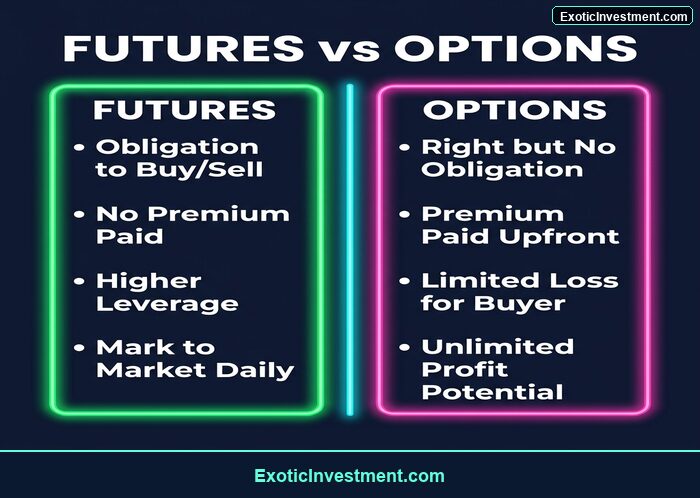
Illustration 1: Futures vs Options — Key Differences at a Glance
Key characteristics of a futures contract:
- Lot Size: You cannot buy just one share. For instance, Nifty 50 futures currently have a lot size of 25 units. Consequently, one Nifty lot controls a notional value of roughly ₹5–6 lakh.
- Mark-to-Market (MTM): Every day, your unrealised profit or loss is settled to your trading account. Therefore, you must maintain a sufficient margin balance to avoid forced square-off.
- Leverage: Futures require only 10–20% margin of the contract’s full value. However, leverage amplifies both profits and losses equally.
For a deeper look at margin calculation, use our Zerodha Brokerage Calculator which also shows required margins for F&O positions. Similarly, the Upstox Brokerage Calculator provides margin estimates for Upstox F&O traders.
Options Contracts Explained
An options contract gives the buyer the right — but not the obligation — to buy or sell an underlying asset at a fixed strike price before or on the expiry date. In fact, this “right without obligation” is the most powerful feature of options for retail traders.
There are two types of options:
- Call Option (CE): Firstly, a Call gives the buyer the right to buy the underlying at the strike price. Therefore, Call buyers profit when the stock or index rises above the strike price. If you expect Nifty to rise, you buy a Call option.
- Put Option (PE): Secondly, a Put gives the buyer the right to sell the underlying at the strike price. Consequently, Put buyers profit when the stock or index falls below the strike price. If you expect Nifty to fall, you buy a Put option.
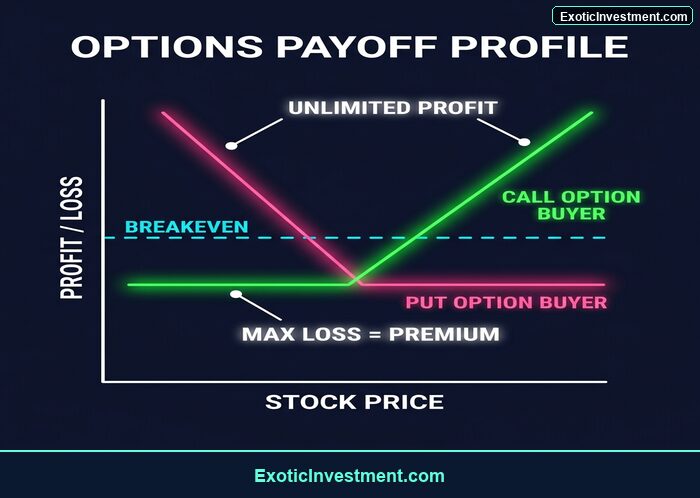
Illustration 2: Call & Put Option Buyer Payoff Curves
The price paid to buy an option is called the premium. Specifically, for option buyers, the maximum loss is limited to the premium paid. However, the profit potential is theoretically unlimited. This asymmetric risk-reward is why options are extremely attractive for directional trading in Nifty and Bank Nifty. After reading this, check our upcoming guide on Options Buying vs. Options Selling for a deeper comparison of risk profiles.
Understanding the F&O Expiry Cycle in India
All F&O contracts in India expire on specific dates. Specifically, weekly Nifty and Bank Nifty options expire every Thursday. Monthly contracts expire on the last Thursday of each month. In fact, managing positions around expiry is one of the most critical skills in F&O trading.
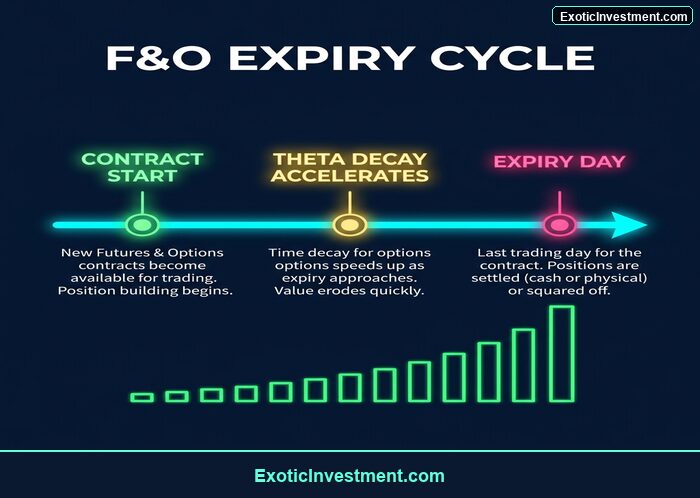
Illustration 3: F&O Weekly Expiry Cycle and Theta Decay Timeline
As expiry approaches, a critical concept called Theta decay accelerates. Specifically, Theta is the rate at which an option loses its time value each day. Therefore, option buyers must be right quickly. Conversely, option sellers benefit from Theta decay as each passing day erodes the option’s premium value. To understand open interest patterns that reveal expiry levels, read our upcoming guide on reading the option chain.
Master F&O Trading: Recommended Courses & Books
Recommended F&O Courses & Resources:
- Options Buying Course in Kannada: Master Nifty and Bank Nifty option buying strategies in Kannada: Options Buying Course in Kannada.
- Technical Analysis in Kannada Course: Learn the chart patterns and indicators needed before trading F&O: Technical Analysis in Kannada Course.
- Kaliyiri Share Market Book: Understand the broader wealth-building journey including derivatives: Kaliyiri Share Market Book.
- Multibagger Stocks & Pro Subscription: Access premium stock research and F&O trade setups: MultiBagger Plus Courses & Pro Tools Annual Subscription (Direct checkout: Buy Pro Subscription Product 2739).
Real-World F&O Examples: Nifty and Bank Nifty
Let us walk through a concrete example. Suppose Nifty is trading at 25,000 on Monday. You expect it to rise to 25,300 by Thursday expiry. Therefore, you buy one lot (25 units) of the 25,100 Call option at ₹80 premium per unit, costing ₹2,000 total.
Scenario A: Nifty rises to 25,350 at expiry. Consequently, your 25,100 Call is now ₹250 in-the-money. Your profit is (₹250 − ₹80) × 25 = ₹4,250. That is a 212% return on your ₹2,000 investment.
Scenario B: Nifty stays flat or falls. Therefore, the option expires worthless. Your maximum loss is the ₹2,000 premium paid — nothing more. This limited-loss feature is why option buying suits beginners far better than futures trading.
Calculate your actual net profit after brokerage using our Stock Profit Calculator. If you also track crypto assets alongside your F&O portfolio, use the Emintage crypto portfolio tracker to monitor your overall investment net worth in one place.
Key Risks of F&O Trading Beginners Must Know
Before placing your first derivative trade, understand these critical risks:
- Leverage Can Wipe Out Capital Fast: Futures losses are unlimited on both sides. Therefore, always use a strict stop loss. Read our dedicated guide on volume and price action to confirm strong trend direction before entering any futures position.
- Theta Decay Hurts Option Buyers: If you buy options and the stock does not move quickly, time decay erodes your premium daily. Consequently, avoid buying options with more than 5–7 days to expiry unless you have a very strong directional view.
- Liquidity Risk on OTM Strikes: Deep out-of-the-money (OTM) strikes have wide bid-ask spreads. In fact, exiting these positions at a fair price can be difficult on illiquid stocks. Therefore, stick to Nifty and Bank Nifty options, which have the deepest liquidity on the NSE.
For multi-asset investors who trade crypto alongside Indian equities, manage your tax liability smartly with a crypto tax calculator from Emintage.
How to Select the Right Strike Price in Futures and Options F&O India
One of the most common questions among beginners in futures and options F&O India is: which strike price should I buy? Specifically, there are three categories of strikes to understand:
- In-the-Money (ITM): Firstly, ITM options have intrinsic value. For instance, if Nifty is at 25,000 and you buy a 24,800 Call, it is already ₹200 in-the-money. Therefore, ITM options are more expensive but move more predictably with the underlying.
- At-the-Money (ATM): Secondly, ATM options are closest to the current market price. Consequently, they have the highest time value and the highest Theta decay. However, ATM strikes offer the best balance of cost and sensitivity.
- Out-of-the-Money (OTM): Finally, OTM options are cheap but require a large move in the underlying to become profitable. In fact, most OTM weekly options expire worthless — which is why option sellers love selling them. Use our Momentum Stock Screener to identify stocks with strong directional momentum before buying OTM options.
Greeks in Futures and Options F&O India: A Quick Overview
Options pricing in futures and options F&O India is driven by five “Greeks” — mathematical measures that describe how an option’s premium reacts to changing market conditions. Specifically, beginners should understand at least three:
- Delta: Delta measures how much an option’s premium changes for every ₹1 move in the underlying. For instance, a Delta of 0.5 means the option moves ₹0.50 for every ₹1 move in Nifty. Therefore, ATM options have a Delta near 0.5, while deep ITM options approach 1.0.
- Theta: As discussed earlier, Theta represents daily time decay. Consequently, if your option has a Theta of −₹5, you lose ₹5 per lot per day purely from time passing — even if the underlying does not move.
- Implied Volatility (IV): Finally, IV reflects market expectations of future price swings. In fact, options become more expensive when IV rises (e.g., before budget announcements or election results). Similarly, when IV crashes after the event, option premiums collapse rapidly — this is called an IV crush. Learn how to read these signals alongside chart patterns in our chart patterns guide.
F&O vs Long-Term Investing: Which Suits You?
F&O trading is not for everyone. Specifically, derivatives suit active traders who can monitor positions daily. However, if you prefer a more relaxed wealth-building approach, long-term equity investing may be a better fit. In fact, our guide on why stock market investment is better than other investments compares annualised equity returns against fixed deposits and gold. Furthermore, systematic investment through SIPs compounds wealth steadily over decades — calculate your SIP returns using the Groww SIP Calculator.
Frequently Asked Questions
Q: What is the minimum capital needed to trade F&O in India?
A: A typical Nifty options trade costs ₹1,000–₹5,000 in premium. However, futures require ₹1–2 lakh in margin. Therefore, start with options buying if you have limited capital.
Q: Are F&O profits taxable in India?
A: Yes. F&O profits are treated as business income and taxed at your applicable income tax slab rate, not at capital gains tax rates. Furthermore, losses can be carried forward for up to 8 years against future F&O profits.
Q: Where can I learn F&O trading in Kannada?
A: Enroll in our Options Buying Course in Kannada — it covers Nifty and Bank Nifty option buying setups step by step.

Trackbacks/Pingbacks