Introduction to Options Markets
When you enter the NSE derivative segment, understanding options buying vs selling India dynamics is critical. Options trading provides tremendous flexibility. You can profit from bullish, bearish, or sideways market conditions. However, many beginners dive straight into buying options. They do this without fully grasping the associated risks. Consequently, this leads to massive capital erosion. Therefore, before executing your first trade, you must understand the fundamental differences. By mastering these core concepts, you can select the appropriate strategy. Furthermore, a solid foundation will prevent costly mistakes.
In this guide, we break down the mechanics. Specifically, we explore why institutional investors prefer selling options. Moreover, we explain why retail traders gravitate toward buying them. Whether you trade intraday or hold positional trades, this knowledge is your edge. In fact, we will touch upon essential concepts like theta decay and delta. For a broader overview, refer to our introduction to F&O.
Before proceeding, you should be familiar with basic technical analysis concepts. Identifying the right trend using charts is a prerequisite. If you cannot read a chart, you are gambling. Consequently, mastering price action is your first step. Now, let us decode the options buying vs selling India debate.
Understanding Options Buying vs Selling India
To grasp the options buying vs selling India landscape, you must understand core rights. An option contract involves two parties. Firstly, the buyer pays the premium. Secondly, the seller collects the premium. The option buyer purchases the right to buy or sell the asset. Conversely, the option seller takes on the obligation. This fundamental asymmetry drives the entire pricing model.
Because the buyer assumes no obligation, their maximum loss is limited. However, their potential profit is theoretically unlimited. On the other hand, the option seller faces a different risk profile. The seller receives the premium upfront. Yet, if the market moves aggressively against them, losses are unlimited. Therefore, selling options requires a higher margin. This acts as a barrier to entry for small traders.
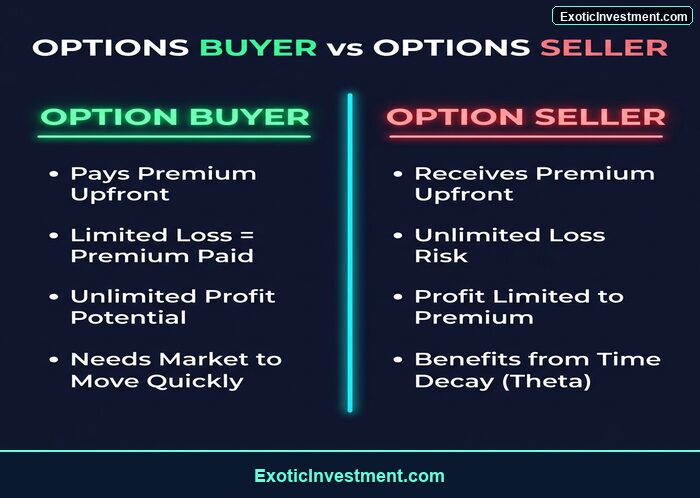
In the Indian market, Nifty and Bank Nifty weekly options expire frequently. This short cycle amplifies the impact of time decay. For instance, if you buy a call option and the market is flat, the value drops. In contrast, the option seller benefits directly from this. They pocket the decaying premium as profit. This is exactly why options selling is compared to insurance.
To build a robust trading system, you must align your strategy with the market. In fact, relying on a single approach is a disaster. You need a versatile toolkit. Therefore, recognizing basic chart patterns can dramatically improve your strike rate.
Master the Markets with Our Premium Courses
If you want to become profitable, check out our learning resources:
- Technical Analysis Course in Kannada: Learn to read charts like a pro.
- Options Buying Course in Kannada: Master high-probability setups.
- Share Market Basics Course: The perfect starting point for beginners.
- Multibagger Pro Subscription: Get exclusive access to wealth creators.
- Kaliyiri Book: Our best-selling Kannada book on financial freedom.
Option Buying Deep Dive
Option buying is attractive because of its low capital requirements. You can buy an option for very little money. However, this is one of the biggest traps. When you buy an option, you predict the direction of the market. Furthermore, you predict the exact timing and magnitude. If any of these fail, you will lose money. Specifically, if the market moves too slowly, time decay eats your profits.
This brings us to the biggest enemy of an option buyer. Theta measures the rate at which an option loses value. Every single day, the time value shrinks. Consequently, option buyers must seek fast-moving momentum setups. Therefore, buying options during a sideways market is mathematically flawed.
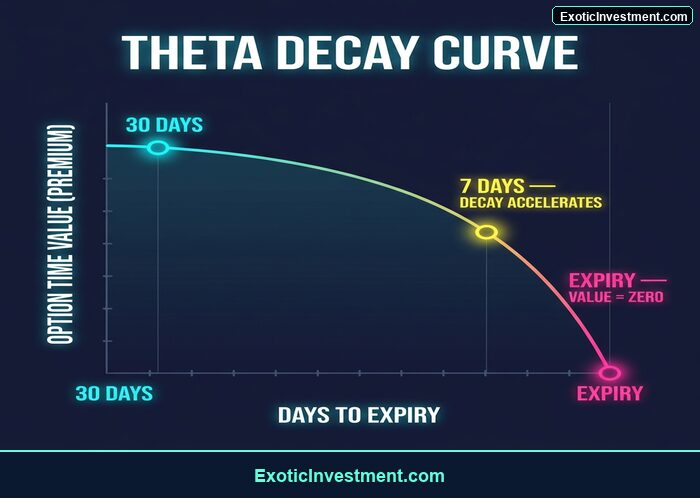
To succeed as an option buyer, you need strict entry criteria. For example, combining momentum indicators with price action is highly effective. You can learn more by reading our guide on the RSI indicator. When RSI shows a strong breakout, that is the exact moment to strike. Furthermore, you must maintain ruthless discipline with stop losses. Options can easily lose half their value in a dip. Therefore, holding on to losing trades will wipe out your account.
In addition to timing, strike selection is vital. Beginners often buy deep OTM options. However, these options have a low probability of expiring ITM. Instead, successful buyers prefer ATM strikes. These strikes possess a higher delta. Consequently, they mirror the index’s movement much more closely. They provide a realistic chance of generating consistent profits.
Option Selling Deep Dive
Option selling is the preferred playground for professionals. The primary reason is the statistical edge it provides. Markets spend roughly 70 percent of their time trading in ranges. Therefore, option sellers have a built-in advantage. They profit from time decay and a drop in implied volatility. Specifically, an option seller does not need to accurately predict the direction. They only need to predict where the market will not go.
However, this high probability comes at a significant cost. The maximum profit is strictly capped at the premium received. Conversely, the potential risk is theoretically unlimited. To mitigate this risk, exchanges demand a high initial margin. For instance, selling a single lot requires a huge margin. This requirement automatically weeds out small retail traders.
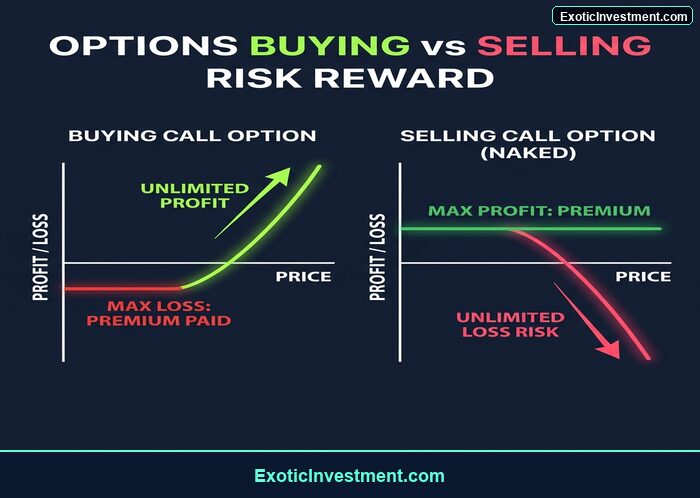
To safely navigate option selling, professionals employ strict risk management. One effective way is analyzing key technical levels. By identifying major zones using our support and resistance guide, a seller can write safely. For example, if Nifty has strong resistance, an option seller writes calls confidently. Consequently, the probability of breaching that level is extremely low.
Furthermore, professional sellers rarely sell naked options. Instead, they deploy hedged strategies like Bull Put Spreads. By buying a further OTM option, they cap their maximum loss. In addition, they significantly reduce the margin required. This structural advantage is why selling outperforms buying over time.
When to Buy vs When to Sell Options
The ultimate question is: should I buy or sell today? The answer depends entirely on the market environment. When implied volatility is low, options premiums are cheap. Therefore, it is an ideal environment for option buyers. Conversely, when IV is high, option premiums are inflated. This creates a perfect scenario for option sellers.
Therefore, you must adapt your strategy dynamically. If you spot a tight consolidation, prepare for a breakout. This is the time to deploy option buying strategies. You can confirm these setups by understanding volume and price action. On the other hand, if the market has made a massive move, switch to selling. You can collect inflated premiums as the market cools down.
Ultimately, to master these transitions, learn to read the option chain. The option chain provides real-time data on Open Interest. By combining chart reading with option chain analysis, you can pinpoint smart money activity. Furthermore, understanding the options buying vs selling India dynamic is crucial.
Real-world Nifty Bank Nifty Examples
Let us contextualize these concepts with a practical example. Suppose Bank Nifty is trading at a specific level. It has been consolidating in a tight range for days. Suddenly, a major banking sector news breaks. The index blasts past its resistance level with massive volume. This is an excellent setup for an option buyer. By quickly purchasing a call option, the buyer rides the momentum.
Now, consider a different scenario altogether. Bank Nifty has rallied significantly over the last five days. It is now approaching a massive historical resistance zone. The momentum is visibly slowing down. In fact, this indicates clear exhaustion. This is a perfect setup for an option seller. Even if Bank Nifty stays flat, the seller captures the premium. Furthermore, understanding moving averages can help you spot these conditions.
In both scenarios, having an exit plan is non-negotiable. Whether you are buying or selling, you must know your risk. To mathematically define your risk, always use a proper stop-loss calculator. Consequently, never risk more than 2 percent of your capital.
Risk Management for Options Traders
Risk management is the holy grail of options trading. No strategy can save you if you fail to manage risk. For option buyers, the most common mistake is averaging down. Options are depreciating assets. Therefore, averaging a losing position accelerates capital destruction. Instead, you must accept small losses quickly. For option sellers, the biggest mistake is refusing to hedge.
You can manage your risk efficiently by utilizing tools. Always use margin calculators before initiating complex strategies. Furthermore, options trading should only form one part of a portfolio. For instance, if you invest heavily in cryptocurrencies, tracking your net worth is vital. You can streamline this process by using a crypto portfolio tracker to monitor your assets. Additionally, generating accurate profit statements is crucial. Therefore, leverage a smart crypto tax calculator to ensure you stay fully compliant. Moreover, mastering options buying vs selling India will make you a better trader overall.
Frequently Asked Questions
Q: Is option selling riskier than option buying for beginners?
A: Technically, naked option selling has unlimited risk. Therefore, it is highly dangerous for beginners. However, when executed with proper hedging, option selling has a higher probability of profit. Consequently, beginners should learn hedged selling strategies.
Q: How much capital do I need to start options trading in India?
A: You can start option buying with as little as 10k. However, a safer approach requires at least 50k. For option selling, you need a minimum of 1 Lakh per lot. Therefore, capital requirements vary widely.
Q: Why do my bought options lose value even when the market moves in my direction?
A: This frustrating phenomenon is caused by Theta and Vega. If the market moves too slowly, the daily time decay will outpace gains. Similarly, if you bought when IV was high, a sudden drop will crush your premium. Therefore, timing is everything.
Advanced Strategies and Market Psychology
Moving beyond the basics of options buying vs selling India, market psychology plays a massive role. The Indian stock market is highly volatile. Therefore, maintaining emotional control is just as important as technical analysis. When you trade options, the rapid fluctuations in premium can cause panic. For instance, a sudden spike in implied volatility can temporarily inflate option prices. Consequently, amateur traders often make rash decisions based on fear or greed.
To succeed consistently, you must treat trading as a disciplined business. Specifically, you need a well-defined trading plan. Your plan should explicitly state your entry criteria, exit strategy, and maximum risk per trade. Furthermore, keeping a detailed trading journal is essential. By reviewing your past trades, you can identify recurring mistakes. In fact, most successful traders spend more time analyzing their past performance than looking for new setups.
Another crucial aspect is understanding market cycles. Markets transition between periods of low volatility and high volatility. Therefore, your options strategy must adapt accordingly. During low volatility phases, option buying strategies like long straddles can be highly profitable. Conversely, during high volatility phases, option selling strategies like iron condors offer an excellent statistical edge. By aligning your strategy with the prevailing market cycle, you significantly improve your odds of success.
Moreover, continuous learning is the key to longevity in the markets. The financial markets are constantly evolving. New trading instruments and algorithmic strategies are introduced regularly. Therefore, staying updated with the latest market trends is non-negotiable. Whether you prefer reading books, attending seminars, or joining trading communities, investing in your education yields the highest returns. Ultimately, mastering the art of options trading requires patience, discipline, and an unwavering commitment to continuous improvement. Consequently, the journey is challenging but highly rewarding.
Conclusion: The Ultimate Decision
In conclusion, the options buying vs selling India debate does not have a single correct answer. Both approaches have their unique advantages and inherent risks. Option buying offers limited risk and high potential rewards, but requires impeccable timing. On the other hand, option selling provides a high probability of profit, but demands significant capital and strict risk management. Therefore, the optimal choice depends entirely on your personality, capital base, and risk tolerance.
As you progress in your trading journey, you may find that a hybrid approach works best. By combining both buying and selling strategies, you can navigate various market conditions effectively. For example, you might buy options during explosive breakouts and sell options during sideways consolidations. In fact, this dynamic approach is exactly what professional traders do to generate consistent returns year after year.
Remember, the stock market is a marathon, not a sprint. Focus on preserving your capital first. Profits will follow naturally as you refine your skills and execute your trading plan with discipline. We hope this comprehensive guide has provided you with clarity on the intricacies of options trading in India. Now, it is time to apply this knowledge and take your trading to the next level. Good luck on your journey!