
Seeing a red banner warning that a stock is under watch by exchange regulators should immediately slow down your buy finger. Whenever NSE or BSE flags unusual price volatility, your broker app triggers strict margin freezes. Today, check our ASM and GSM surveillance guide and learn exactly what follows next.
Here is why Dr. Ashok always tells community members to treat surveillance alerts as serious amber traffic lights. Unsuspecting beginners frequently jump into booming smallcaps just as operators dump inflated holdings silently. Consequently, exchange watchlists exist specifically to cool artificial hype before households get trapped.
First, you will learn the clear difference between Additional Surveillance Measure (ASM), Graded Surveillance Measure (GSM), and Enhanced Surveillance Measure (ESM). Next, we examine real liquidity penalties like 100% margin blocks and Trade-for-Trade settlement. Finally, follow our four-step exit and inspection checklist before clicking buy on flagged counters.
What Does It Mean When a Stock Is Under Watch by Exchange?
When your broker screen shows a stock is under watch by exchange officials, NSE or BSE placed that ticker inside special market surveillance. SEBI and the exchanges run daily automated filters scanning sharp price surges, low free float, and abnormal trading volumes. Notice immediately that exchange surveillance serves strictly as a preventive warning rather than an outright guilt verdict.
Sometimes, a genuine growth microcap hits surveillance simply because quarterly earnings tripled unexpectedly within sixty days. In other cases, dishonest operators run circular trades and SMS pump schemes to lure retail buyers blindly. Read how exchanges police extreme swings cleanly inside our market circuit breakers guide as well.
Crucially, flagged stocks lose normal intraday trading privileges rapidly as surveillance tightens step by step. Traders who ignore these broker popups wake up suddenly unable to exit positions during consecutive lower circuits. Always verify overall regulatory oversight inside our SEBI NSE and BSE framework guide first.
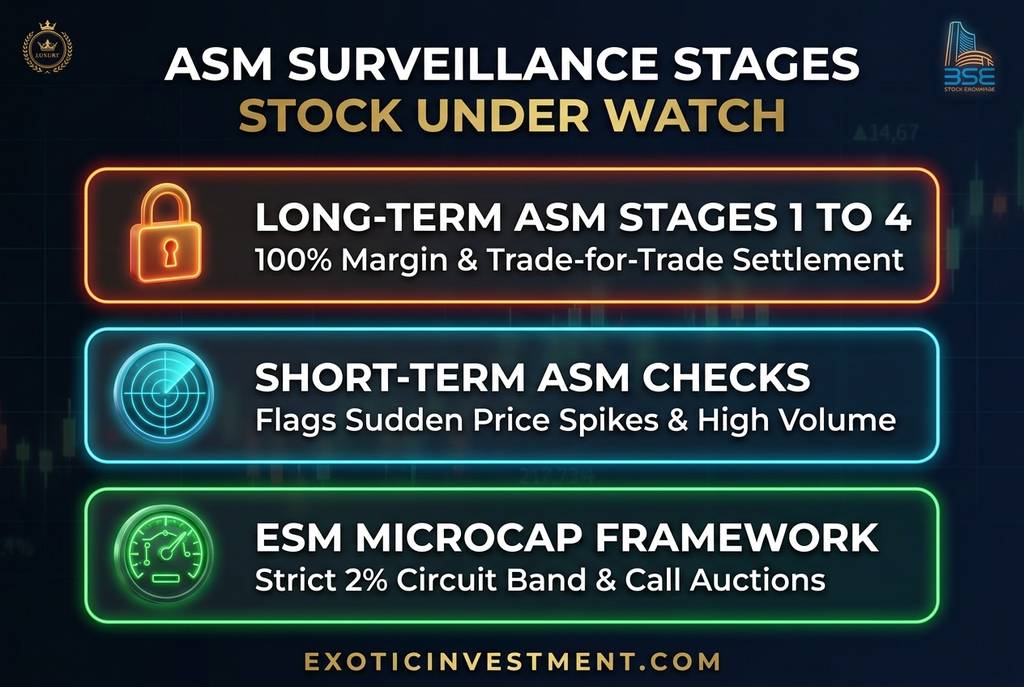
Illustration: Long-Term ASM, Short-Term ASM, and ESM microcap surveillance mechanisms protecting retail traders from traps.
Understanding ASM, GSM, and ESM Watchlist Categories Clearly
Indian stock exchanges deploy three distinct surveillance baskets depending on company size and severity of abnormal activity. Specifically, knowing which exact bucket holds your ticker determines margin requirements and daily exit liquidity immediately.
Additional Surveillance Measure (Long-Term & Short-Term ASM)
NSE and BSE jointly introduced ASM in 2018 to monitor high volatility and sudden price-volume divergence across liquid stocks. First, Short-Term ASM lasts five to fifteen days across Stages I and II when prices jump unexpectedly over brief windows. In contrast, Long-Term ASM spans four escalating stages tracking sustained rallies, high close-to-close variation, and client concentration.
Practically, Stage I Long-Term ASM enforces 100% margin on every buy and sell order alongside narrower price bands. Once a stock climbs into Stage II through Stage IV, therefore, Trade-for-Trade (T2T) settlement removes intraday buying and selling entirely. You can review strict T2T rules inside our delivery and CNC rules guide before risking fresh orders.
Graded Surveillance Measure (GSM Stages 0 to VI)
Unlike ASM, GSM targets smaller companies whose sky-high market prices disconnect dangerously from weak underlying earnings, net worth, or asset quality. Clearly, exchanges track six progressive stages under GSM whenever share values keep climbing despite tiny book equity. Stage 0 merely posts a mild information alert before trading turns noticeably tougher.
At GSM Stage I, consequently, exchanges shift shares strictly into the Trade-for-Trade segment with tight 5% circuit limits. By Stage II and III, however, buyers must deposit an extra 100% Additional Surveillance Deposit (ASD) locked silently with the exchange for months! Ultimately, higher GSM stages restrict trading exclusively to once a week or Mondays only.
Enhanced Surveillance Measure (ESM for Microcaps Under ₹500 Crore)
Introduced by SEBI in 2023, ESM focuses tightly on high-risk microcap companies valued below ₹500 crore market capitalization. Because tiny floats get rigged effortlessly by small trading syndicates, ESM triggers strict controls fast across Stages I and II. Specifically, ESM restricts stocks directly into Trade-for-Trade settlement with 5% or ultra-tight 2% daily circuit bands.
In addition, Stage II ESM stocks trade strictly under Periodic Call Auction sessions throughout the day rather than continuous order matching. Consequently, trapped retail investors often wait days for buyers to show up on thin order books. Always verify basic upper and lower circuit limits before trading any microcap name.
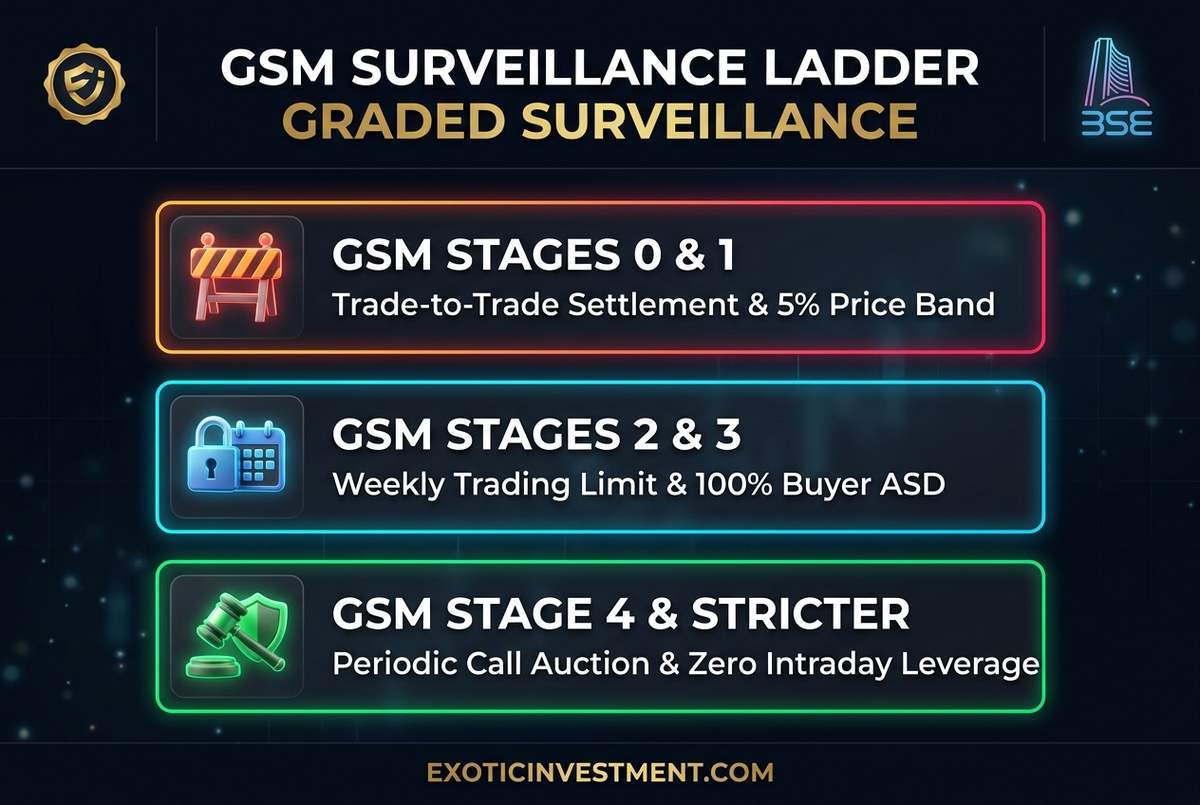
Illustration: GSM surveillance ladder escalating from 5% T2T restrictions to 100% Additional Surveillance Deposits and call auctions.
ASM vs GSM vs ESM Restrictions Comparison Matrix
Compare all three exchange surveillance baskets side by side before taking positions in volatile smallcaps or momentum flyers. Notice sharply how collateral haircuts, BTST bans, and settlement delays escalate across categories.
| Surveillance Type | Trigger Condition | Trading & Margin Impact | Minimum Review Exit |
|---|---|---|---|
| Short-Term ASM | Sudden 5–15 day price/volume jump | Up to 100% margin; no MTF pledge | 5 to 15 trading days |
| Long-Term ASM (1–4) | Multi-month high-low & concentration | 100% margin + T2T in higher stages | Minimum 90 calendar days |
| ESM (Microcap) | Mcap < ₹500 Cr + sharp swing | T2T mandatory + 2%–5% circuit + Auction | Monthly & quarterly review |
| GSM Stages 0–1 | High PE, weak book value, shell flags | T2T settlement + 5% band limit | Quarterly exchange review |
| GSM Stages 2–6 | Sustained abnormal rally in junk equity | 100% Buyer ASD lockup + weekly trading | Quarterly (strict exit criteria) |
Why Do NSE and BSE Put Certain Stocks Under Surveillance?
Exchange computers continuously score thousands of listed tickers against strict quantitative thresholds every single evening. First, explosive three-month price gains far above benchmark indices raise immediate red flags. Second, unusually high close-to-close volatility paired with thin promoter float triggers surveillance reviews quickly.
Third, regulators inspect client concentration closely using your PAN-mapped order trails across brokers. When the top 25 accounts control over half of monthly trading volume, manipulation probability climbs sharply. Also verify BTST restrictions carefully via our BTST trading rules guide before chasing sharp gap-ups.
Fourth, unsolicited Telegram tips and bulk SMS campaigns often spark emergency exchange watch notices. Whenever scammers push dubious tickers onto innocent newcomers, SEBI coordinates fast surveillance lockouts cleanly. Stay equally alert to margin trading facility MTF rules because watched stocks instantly lose margin funding.
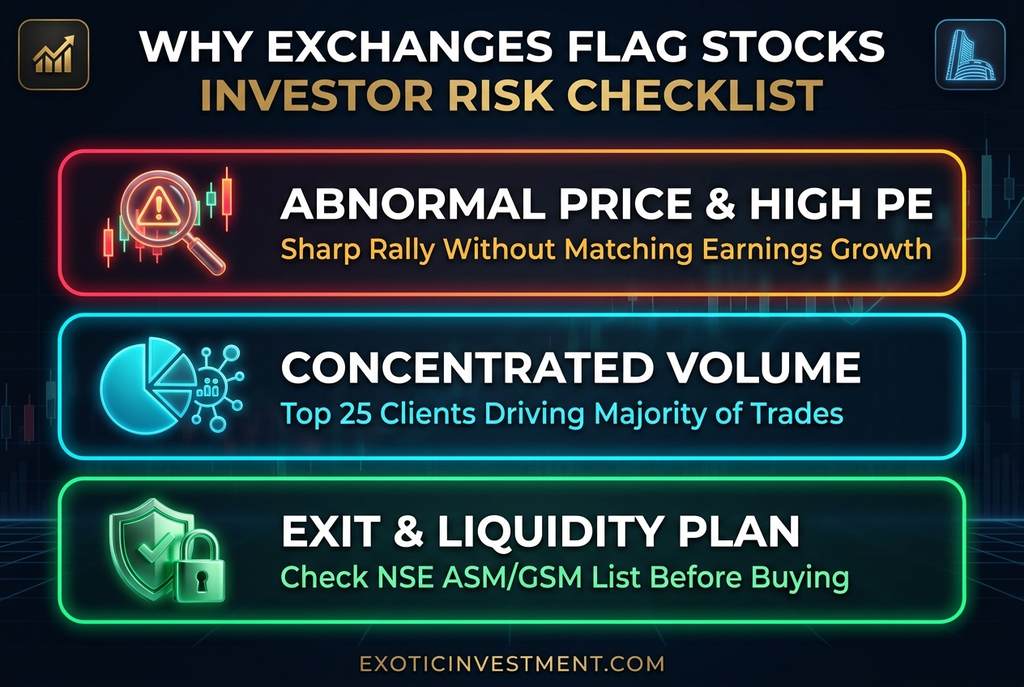
Illustration: Key warning causes behind NSE/BSE surveillance flags and practical retail protection checkpoints.
Worked Cash Impact: What Happens When Your Holding Enters GSM Stage II?
Real rupee numbers reveal how quickly surveillance status locks up ordinary household cash flow. Suppose a retail buyer purchases ₹1,00,000 worth of a tiny smallcap stock after reading social media hype. Days later, NSE moves the stock cleanly into Long-Term ASM Stage III or GSM Stage II.
Immediately, any MTF funding or collateral pledge attached to those shares drops to zero value. Because broker haircuts climb instantly to 100%, your margin shortfall triggers forced F&O square-off warnings elsewhere! Study collateral risks cleanly inside our SEBI F&O margin guide ahead of time.
As a result, selling shares inside a strict 2% or 5% lower-circuit lock becomes brutally difficult for days. If you attempt fresh buying at GSM Stage II, your broker blocks an extra ₹1,00,000 cash deposit silently! Track net realized outcomes carefully with our stock profit calculator and protect small portfolios via our position size calculator.
What Should Retail Investors Do If a Holding Is Flagged?
Never panic blindly into market sell orders the moment you spot an exchange watch alert. Instead, follow a calm four-step fundamental audit to separate healthy winners from operator-driven traps.
Audit 1 — Read the Exact NSE/BSE Circular: First, visit the official NSE or BSE surveillance notice page and identify whether your ticker sits in ASM, GSM, or ESM. Next, check the exact entry date, stage number, and whether 100% ASD cash blocks apply.
Audit 2 — Inspect Quarterly Cash Flows & Pledging: Specifically, verify whether genuine revenue growth and institutional holdings drove the price rally rather than shell accounting tricks. Consequently, review promoter pledging and balance sheet red flags before averaging down blindly.
Audit 3 — Respect Trade-for-Trade Execution Rules: Inside T2T segments, therefore, never expect intraday square-off flexibility or same-day BTST exits cleanly. Learn proper limit execution via our order types and trigger guide alongside trailing stop-loss rules.
Audit 4 — Trim Speculative Exposure Cleanly: Instead, if you entered solely on Telegram rumors or sudden green candles without earnings support, exit patiently into liquid bids. Read our practical stock market loss recovery guide rather than holding doomed traps forever.
🚀 Trade Clean Dalal Street Setups With Institutional Discipline
Stop chasing guesswork tips on Dalal Street. Build structured market habits alongside Dr. Ashok Kumar N Rao and our 1,300+ active trading community.
- Build strong equity foundations with our Kaliyiri Share Market Book and English bestseller Basics of Indian Stock Market Book.
- Access institutional screeners and pro research via the MultiBagger Plus Courses & Pro Tools Annual Subscription.
- Master price structure in our Technical Analysis Course in Kannada or index strategies in our Options Buying Course in Kannada.
💡 Frequently Asked Questions (FAQ): Stock Is Under Watch by Exchange
1. Should I sell immediately if a stock is under watch by exchange regulators?
Do not panic sell blindly without reading the specific ASM, GSM, or ESM circular and reviewing company earnings first. Check our full ASM and GSM framework guide to evaluate fundamental quality calmly.
2. Can I do intraday or BTST trading on stocks in ASM Stage 2 or GSM?
No, higher ASM stages, ESM tiers, and GSM Stages I–VI mandate Trade-for-Trade (T2T) delivery settlement, blocking intraday and BTST trades. Review strict T2T rules in our BTST delivery restriction guide before placing orders.
3. What is the 100% Additional Surveillance Deposit (ASD) under GSM?
Starting from GSM Stage II onward, buyers must deposit extra cash equal to 100% of trade value with the exchange. Because this deposit stays locked for months, avoid unverified microcaps and manage cash cleanly using our position size calculator first.
4. How long does a company stay in Long-Term ASM or ESM?
Exchanges keep tickers inside Long-Term ASM for at least 90 calendar days before reviewing quantitative exit metrics. Read how periodic review schedules interact with exchange circuit limits so liquidity never surprises you.
5. Do MTF margin and collateral pledge benefits work for watched stocks?
No, broker MTF funding and F&O pledge haircuts normally stop immediately once a ticker enters ASM or ESM lists. Verify collateral impact calmly using our MTF margin facility guide today.
6. Does exchange surveillance mean the company will get delisted?
Not necessarily, because healthy fast-growing stocks frequently enter Short-Term ASM simply after steep legitimate earnings rallies. However, higher GSM stages carry severe compliance warnings, so always prioritize trailing stop-loss protection on weak tickers.