
Why is recovery from stock market loss required?
The human mind always has a tendency to survive, not to thrive. So we always look for fast satisfaction in any work.
Like olden days, when you get food, feed to the fullest as you dont get it for many days.
Like the olden stone age, our tongue craves for sugar and salt as our brains haven’t changed in 50, 000 years.
So you tend to make stock market investments for fast gains, which may show some fast gains called beginner’s luck. But I am 100% sure that your beginner’s luck fades and gradually dwindles away.
Without this, SEBI doesn’t force trading accounts to mention that 90% of traders lose money.
Warren Buffett clearly say: 99% of the traders, become investors on the 2nd day.
Because intraday trade goes against the buy, and they hold for the 2nd day. I have to explain this, because many of you may not get this 🙂
So you start investing without knowing how to invest and get into fast-paced gambling instead of investing.
In our great Kannada language, there is a saying: Ketta Mele Buddhi Bantu
Meaning, after you are Barbad, you get to learn how not to be Barbad 🙂
So my friends, recovery in stock market is as important as eating, and sleeping daily.
Those who say money is not important always have Fuck You Money, so dont do the mistake of not trying to recover the loss, because I always say, in the word LEARN, there is EARN.. If you dont learn in stock market, you can never earn in stock market.
Having said that, if you havent read my “Basics of Stock Market for Beginners“ book in English or “Kaliyiri Share Market, Hattiri Hanada Rocket“ in Kannada, it’s your time to LEARN TO EARN in the stock market. Time to shine Babyyy.. Lez Rock n Roll…
What does recover your losses in stock market mean for YOU?
👨🏫 Real Market Experience & SEBI Disclosure: Written by Dr.Ashok Kumar N Rao and the Exotic Investment research desk based on 12+ years of active market trading. All insights follow SEBI investor education guidelines. Exotic Investment does not provide unsolicited tips or PMS services. Always test trading setups with disciplined position sizing before risking live capital.
Listen, boss. Losing money in the stock market feels terrible. It really does. You see your portfolio turn red, and it hits hard emotionally.
Recovering from a stock market loss simply means getting back on track after taking a hit. It’s not about quickly winning back every rupee you lost. That is a dangerous mindset.
Instead, recovery is a step-by-step process. You analyze what went wrong. You fix your strategy. And then you trade again, but smarter this time.
Here’s the thing. Most Indian traders lose focus during this phase. They either panic sell everything or chase revenge trades. Both are wrong moves.
The right approach takes patience. It takes discipline. And honestly speaking, it takes a clear plan written down on paper.
A loss is just a number on your screen. But the emotion behind it can wreck your career if you let it. So first, calm down. Breathe. Then read this guide slowly.
Why recover from stock market loss Matters for Indian Stock Traders?
Let me tell you something straight. Over 70 percent of individual retail traders in India lose money in intraday and F&O trading. That is a SEBI data-backed fact.
So recovering from loss is not some fancy concept. It is a survival skill. If you cannot handle losses properly, you will keep losing over and over again.
Think about it this way. An investor who never faces a loss is an investor who never takes any risk. Risk and reward go together like chai and biscuits.
When you know how to recover, you stop fearing the market. Fear makes bad traders. A recovered trader stays calm even when the Nifty gives a sharp downside move.
Also, recovery builds real confidence. Not fake overconfidence from a few lucky trades. Real, grounded confidence that comes from knowing your process works.
Many new traders quit after one bad week. That means they never learned the most important lesson. The market does not care about your feelings. It only respects discipline.
If you want long-term success in NSE or BSE, you must learn to bounce back. Period. There is no shortcut around this.
Key Concepts Related to recover from stock market loss
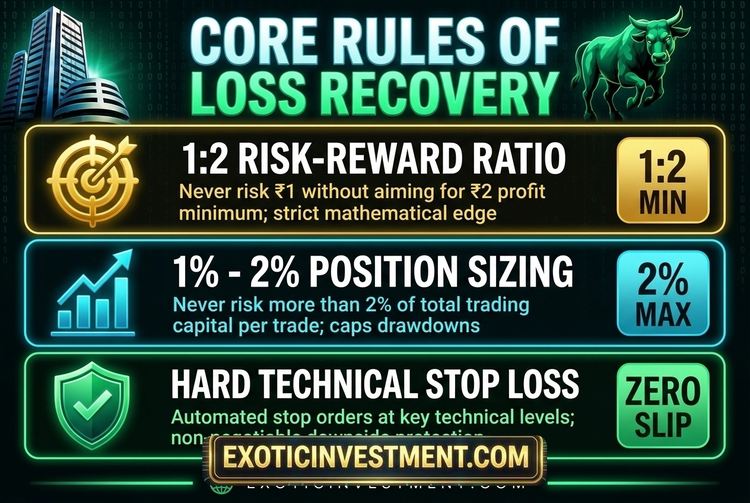
Infographic: Core Mathematical & Risk Rules for Recovering from Stock Market Losses
Before we go into the steps, let’s cover the key ideas you need to understand. These concepts separate winners from losers in the Indian markets.
Risk-Reward Ratio: This is the backbone of every good trade. If you risk Rs 5,000, you should aim to make at least Rs 10,000. A 1:2 ratio minimum. Nothing less. Use our stock profit calculator to check your expected returns before entering any trade.
Stop Loss Placement: A proper stop loss saves you from a small loss turning into a big disaster. Never trade without one. Always set it at a logical technical level, not at a random price. Check out our stop loss guide for detailed methods.
Position Sizing: Never put all your capital in one stock. If you have Rs 5 lakhs, do not put more than 5 percent in a single equity trade. This is rule number one of survival.
Emotional Control: Your brain releases cortisol when you lose money. That chemical makes you want to gamble. Recognize this feeling. When you feel it, step away from the screen for 30 minutes.
Cost of Trading: Brokerage, STT, GST, exchange charges, stamp duty. These add up fast. A ₹10,000 loss becomes ₹11,500 once costs are included. Use our Zerodha brokerage calculator or Upstox brokerage calculator to understand your actual costs.
Pivot Points and Support-Resistance: Understanding where price might reverse helps you place better entries and exits. Our pivot point calculator makes this easy for NSE stocks.
SIP for Long-Term Stability: While you recover from trading losses, keeping some money in disciplined equity mutual fund SIPs ensures your wealth keeps growing. Use our Groww SIP calculator to plan your monthly investments.
How to Apply This Knowledge Step by Step
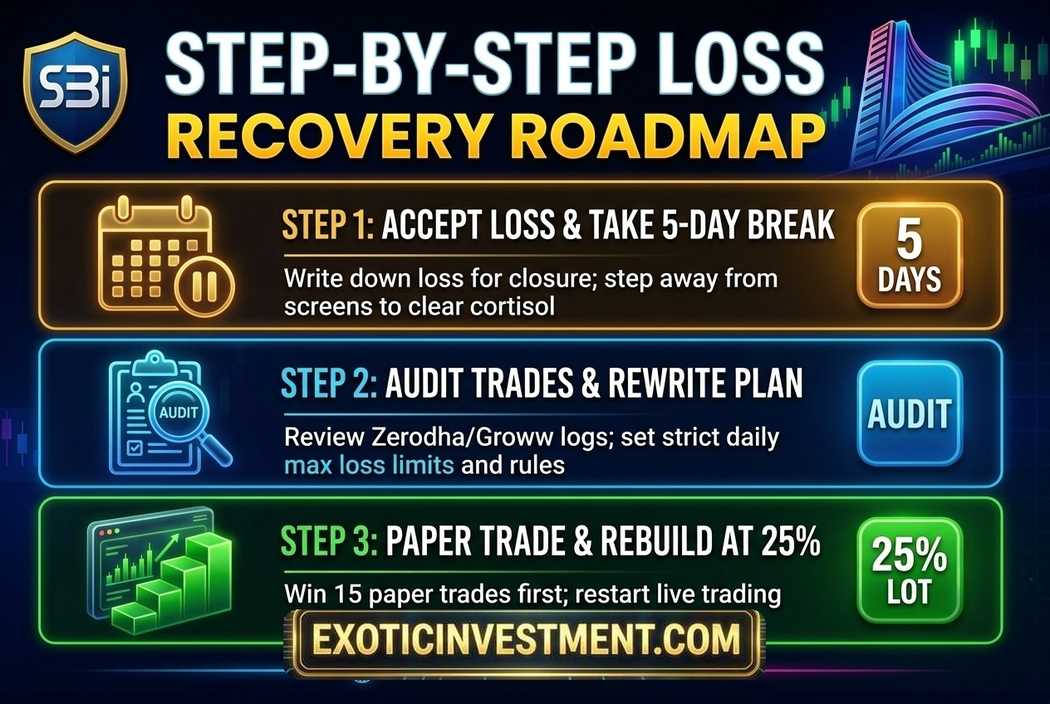
Infographic: 3-Phase Practical Roadmap to Rebuild Trading Capital and Confidence
Alright, now let’s get practical. Here is your step-by-step action plan for recovering from a stock market loss.
Step 1: Accept the Loss First
This sounds simple, but most traders fail here. You lost money. It is gone. Do not try to justify it or pretend it never happened. Write down the exact amount you lost. Yes, literally write it on a piece of paper. This creates psychological closure.
Step 2: Review Every Trade You Made
Open your broker app. Whether it is Zerodha, Groww, Angel One, or Upstox, pull your trade history. Look at each losing trade one by one. Ask yourself three questions: Did I have a stop loss? Was my entry based on a setup or just a tip? Did I overtrade that day?
You will find patterns. Maybe you always lose on Tuesday intraday trades. Maybe you lose heavily when you chase Bank Nifty above 49,000. This self-audit is gold. It shows you exactly where the bleeding is happening.
Step 3: Take a Break
Do not jump back into trading the next day. Give yourself at least 3 to 7 days off. Let your emotions settle. In the meantime, study. Watch price action videos. Read about candlestick patterns. Keep it light but educational.
Step 4: Rewrite Your Trading Plan
A trading plan is non-negotiable. Write down: maximum capital per trade, which segments you will trade, your daily loss limit, and your profit target. For example, say your daily stop loss is Rs 3,000. Once you hit it, you close the terminal. Done. No second trade.
Also decide your position size using the 1 to 2 percent rule. Never risk more than 2 percent of your total capital on a single trade. This keeps you in the game even during a bad streak.
Step 5: Start with Paper Trading
Before putting real money back, trade on paper for two weeks. Use virtual portfolios to test your new plan. Only when you are consistently green for 10 to 15 paper trades, switch to live trading with small quantities.
Step 6: Trade Small, Build Slowly
Start with 25 percent of your normal position size. Rebuild your confidence first. Then gradually increase. Recovery is a marathon, not a sprint. If you rush, the market will punish you again.
Recommended Trading Courses & Premium Subscriptions:
- Options Buying Course in Kannada: Options Buying Course in Kannada.
- Technical Analysis in Kannada Course: Technical Analysis in Kannada Course.
- Kaliyiri Share Market Book: Kaliyiri Share Market Book.
- Basics of Stock Market Course: Basics of Stock Market Course.
- Multibagger Stocks Pro Subscription: MultiBagger Plus Courses & Pro Tools Annual Subscription (Checkout link: MultiBagger Plus Courses & Pro Tools Annual Subscription).
Common Mistakes and How to Avoid Them
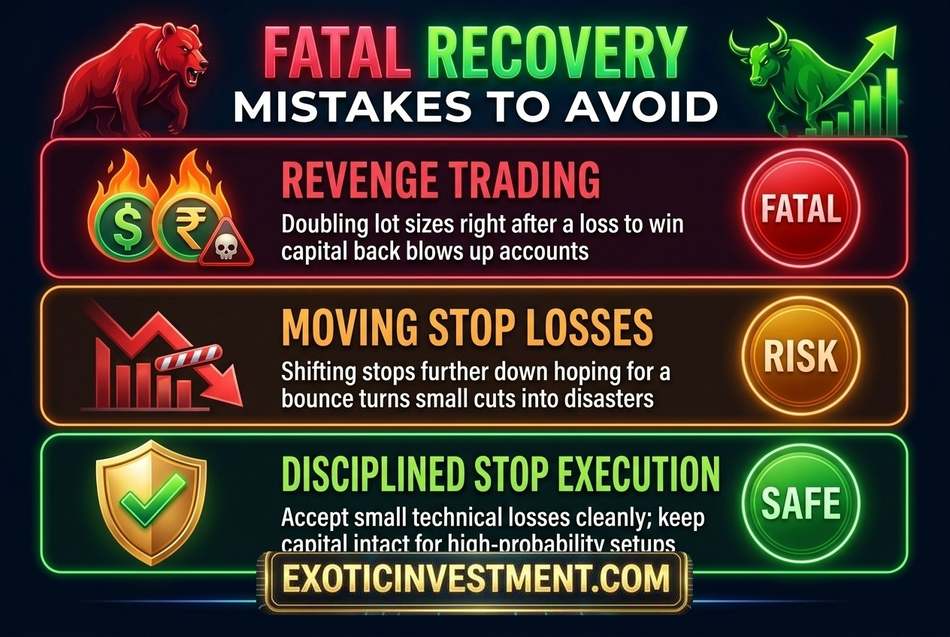
Infographic: Critical Trading Psychological Traps and Disciplined Execution Protocol
Let’s keep it simple. Here are the biggest mistakes Indian traders make when recovering from losses.
Mistake 1: Revenge Trading
You lose Rs 8,000 on HDFC Bank intraday. So you immediately buy Adani Enterprises thinking you will win it back. You lose another Rs 12,000. This is called revenge trading and it is the fastest way to blow up your account. When you feel anger after a loss, close your trading app and walk away.
Mistake 2: Moving Stop Loss
You set a stop loss at Rs 450 on a stock bought at Rs 460. Price falls to Rs 455, and you move the SL to Rs 452 hoping it bounces back. The stock drops further to Rs 440. Your small loss becomes a big loss. Never move a stop loss away from the market. Only tighten it toward the current price.
Mistake 3: Averaging Down on Losing Positions
Buying more of a falling stock to reduce your average cost sounds smart. In reality, it usually makes things worse. This is especially true in F&O where time decay destroys you. SEBI has also warned retail investors about this practice. If a trade is going against you, exit cleanly and move on.
Mistake 4: Trading Without a Plan
Jumping into trades based on Telegram tips, YouTube recommendations, or friends’ advice is gambling, not trading. Every trade must have a pre-decided entry, stop loss, and target. Write them down before you press the buy button.
Mistake 5: Ignoring Costs
Many traders forget that brokerage, exchange charges, and GST eat into profits. On frequent intraday trades, costs can be 15 to 20 percent of your gross profit. Factor this in. Also consider long-term investing through mutual funds for stable returns while you build your trading skills.
Advanced Trading Tips to Master This Topic
Once you have the basics down, here are some pro-level strategies to strengthen your recovery game.
Use Multiple Time Frame Analysis: Never look at only the 5-minute chart. Check the daily chart first. If the daily trend is bearish, do not take a bullish intraday trade. Aligning multiple time frames increases your win rate significantly.
Keep a Trading Journal: This is the single most powerful tool for long-term improvement. Record every trade: date, stock, direction, entry, exit, stop loss, P&L, and what you felt emotionally. Review this journal every Sunday. You will spot recurring mistakes within weeks.
Learn Options Greeks if You Trade F&O: Theta decay kills more Indian retail traders than anything else. Understand how time value erodes your option premium as expiry approaches. A good Options Buying Course in Kannada explains this in simple terms.
Diversify Across Segments: Do not put all your money in one segment. Allocate portions to equities, F&O, and mutual funds. This way, a bad week in options does not destroy your entire portfolio.
Use Position Sizing with Volatility: High volatility stocks need wider stop losses. That means smaller quantity. Low volatility stocks allow tighter stops and slightly larger positions. Adjust your lot size based on the stock’s average true range, not your ego.
Set Weekly and Monthly Loss Limits: Beyond the daily stop loss, set a weekly limit. If you lose 5 percent of your capital in a week, stop trading for the remaining days. This prevents a bad week from becoming a bad month. Similarly, set a monthly cap on total losses.
Stay Updated on SEBI Regulations: SEBI frequently updates margin requirements, circuit filters, and F&O rules. Stay informed. A regulatory change can affect your strategy overnight. Follow official SEBI notifications and trusted financial news sources.
Build an Emergency Fund Outside Markets: Never trade with money you need for rent, EMI, or medical expenses. Keep at least 6 months of living expenses in a fixed deposit or savings account. This mental safety net keeps you from making desperate trades.
Final Summary
Recovering from a stock market loss is not about quick fixes. It is about building a stronger, smarter version of yourself as a trader. Here is what you should remember:
Accept the loss. Review your trades honestly. Take a break. Rewrite your plan. Start small. Avoid revenge trading at all costs. Keep a journal. Protect your capital with strict risk management.
Every successful trader in India has faced big losses at some point. The difference is that they did not quit. They learned, adapted, and came back stronger.
The stock market will always have ups and downs. But if you follow these steps consistently, you will not just recover. You will come back better than before. Stay disciplined, stay patient, and keep learning. That is the real secret to long-term success in the Indian stock market.