
Understanding what is bonus debentures and how corporate boards structure these unique hybrid debt instruments protects retail shareholders from unexpected tax liabilities. When cash-rich corporations accumulate massive general reserves, they seek creative mechanisms to reward long-term equity owners. Specifically, issuing bonus debentures delivers guaranteed fixed interest income without diluting existing shareholding percentages.
Listen, boss, retail investors frequently celebrate corporate announcements without distinguishing between equity expansion and debt issuance. While traditional bonus issues simply split the equity pie into smaller pieces, bonus debentures create an enforceable fixed-income asset directly inside your Demat account. Before exploring advanced corporate actions, reviewing foundational concepts in our guide to basic stock market terms keeps your fundamentals rock solid.
Here is the real deal: companies like Hindustan Unilever, Britannia, and Dr Reddy’s have effectively used bonus debentures to optimize their balance sheets. However, understanding statutory deemed dividend rules and secondary market listing rules requires careful analysis. In addition, modeling multi-year compounding trajectories using our interactive lumpsum investment calculator helps you evaluate total shareholder returns.
What is Bonus Debentures in Share Market? Structure & Key Terms
Bonus debentures are fully paid-up, unsecured, redeemable non-convertible debt securities issued by a company to its existing equity shareholders for zero cash consideration. Specifically, the issuing corporation capitalizes its accumulated general reserves or retained earnings to fund the nominal face value of the debentures. Consequently, shareholders receive tradable debt securities proportional to their existing equity ownership.
Unlike equity shares, bonus debentures carry a fixed maturity tenure, typically ranging between three and five years from the allotment date. During this holding period, the company pays a fixed periodic coupon rate, such as 7.5% or 8.0% per annum, directly to the investor’s verified bank account. In addition, you can evaluate equity valuation metrics across cash-rich companies using our pe ratio calculator.
A venerable Kannada proverb reminds us: “ಮಾಡಿದಷ್ಟು ಮಹಾರಾಯ, ಬೆಳೆದಷ್ಟು ಪ್ರತಿಫಲ” (Maadidashthu maharaaya, beledashthu pratiphala — as much effort you invest, so great is the harvest). Similarly, companies with pristine capital allocation records reward patient shareholders through reliable debt cashflows rather than volatile speculation. Therefore, understanding debt covenant terms strengthens your long-term investing strategy.
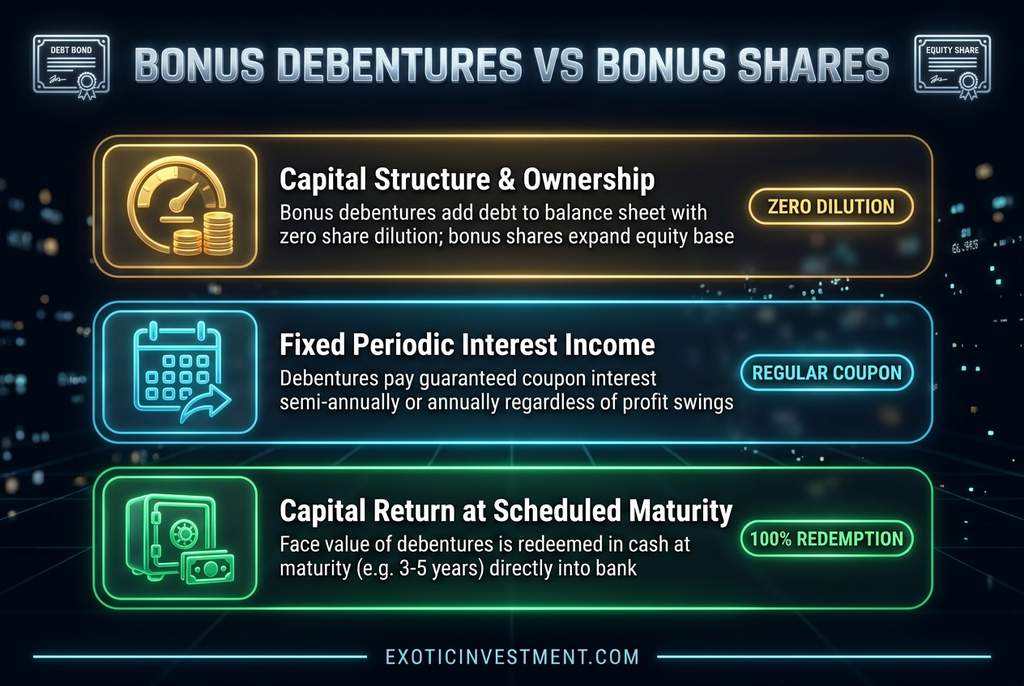
Illustration: Comparing Bonus Debentures vs Regular Bonus Shares Across Capital Structure
Bonus Debentures vs Bonus Shares vs Special Cash Dividend
Corporate management teams have three primary routes to return surplus capital to shareholders: special cash dividends, bonus equity shares, and bonus debentures. Each mechanism impacts corporate financial statements and shareholder taxation in distinctly different ways.
Let’s keep it simple: special cash dividends cause an immediate, heavy cash drain from corporate bank reserves. In contrast, traditional bonus shares create zero cash drainage but expand the total equity share base, which naturally dilutes future Earnings Per Share (EPS). Meanwhile, bonus debentures preserve current corporate liquidity while guaranteeing an annual income stream to investors.
To evaluate the long-term wealth compounding effects across differing payout methods, explore our reverse cagr calculator. In addition, studying balance sheet reserves with our guide on how to read a balance sheet reveals hidden debt capacity.
| Comparison Feature | Bonus Debentures | Bonus Equity Shares | Special Cash Dividend |
|---|---|---|---|
| Immediate Cash Outflow | Zero (Deferred to Maturity) | Zero Cash Outflow | Immediate Large Cash Drain |
| Impact on Equity Base | Zero Equity Dilution | Expands Share Count & Dilutes EPS | Zero Equity Dilution |
| Ongoing Income Stream | Fixed Guaranteed Annual Coupon | Variable (Depends on Dividends) | One-Time Cash Credit |
| Principal Repayment | 100% Face Value at Maturity | No Redemption (Perpetual Equity) | Not Applicable |
First, holding bonus debentures provides steady cashflows identical to corporate fixed deposits. Second, equity investors retain their full voting rights and ownership percentages without sacrificing upside participation. Therefore, bonus debentures offer the ideal synthesis of equity ownership and debt stability.
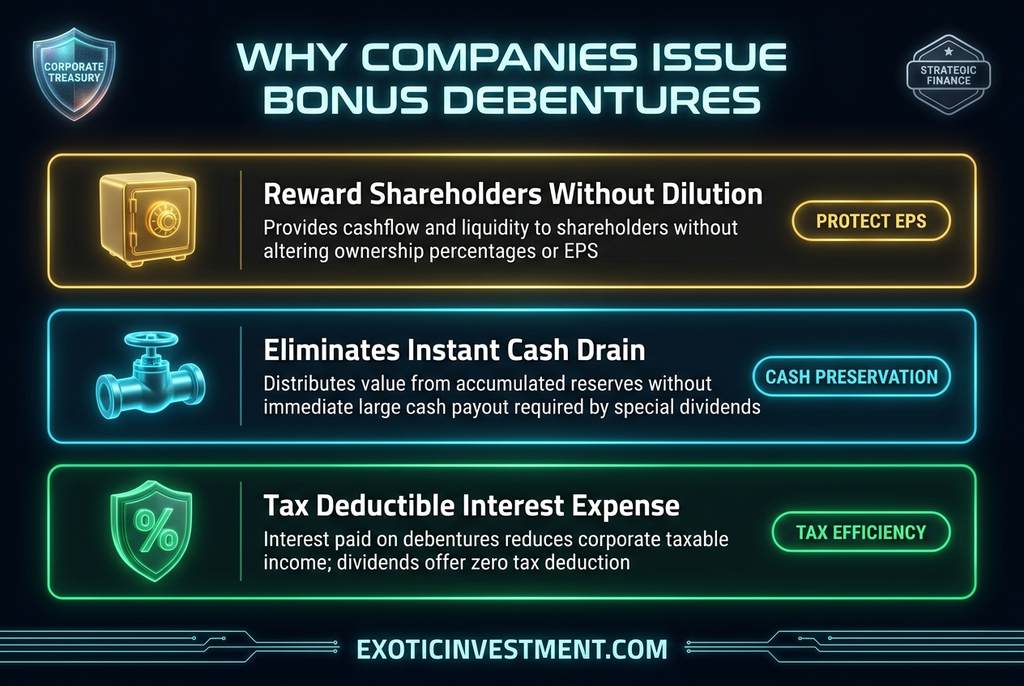
Illustration: 3 Strategic Reasons Blue-Chip Companies Issue Bonus Debentures
Why Companies Issue Bonus Debentures: Strategic Rationale
Corporate financial managers evaluate several balance sheet incentives before proposing a bonus debenture scheme to the National Company Law Tribunal (NCLT). Specifically, the strategy accomplishes three major corporate financial objectives:
- Rewarding Shareholders Without Equity Dilution: Companies reward equity owners without printing new shares that suppress future EPS growth. In fact, keeping the equity capital base compact maintains high Return on Equity (ROE) ratios.
- Preserving Operating Liquidity: Unlike paying a massive one-time special dividend, issuing debentures defers principal cash outflows by 36 to 60 months. Consequently, corporate treasuries retain sufficient working capital for ongoing plant expansions and acquisitions.
- Corporate Tax Shield Efficiency: Under Indian tax laws, interest paid on debentures is treated as a tax-deductible business expense. In contrast, dividend distributions provide zero corporate tax deductions.
In addition, investors who seek regular passive income from their portfolios can review systematic withdrawal plans in our guide on swp in mutual funds. In addition, high-dividend blue chips offer complementary cashflows, as covered in our analysis of dividend yield stocks in india. Therefore, capital structure optimization benefits both corporate treasuries and individual investors.
🚀 Master Fundamental Analysis & Corporate Restructuring
Learn how elite institutional analysts evaluate corporate debt schemes, buybacks, and special dividends. Master stock picking with Dr. Ashok Kumar N Rao.
Real Case Studies: How Indian Blue-Chips Utilized Bonus Debentures
Studying historical corporate precedents in Dalal Street illustrates how bonus debentures function in practice. Several prominent consumer and industrial giants have deployed this structure to distribute idle reserves effectively:
- Hindustan Unilever Limited (HUL): In 2001, HUL pioneered the bonus debenture framework in India. Specifically, HUL issued 9% unsecured bonus debentures with a face value of ₹6 each to its shareholders out of accumulated general reserves. Shareholders enjoyed quarterly interest income before receiving the full face value redemption at maturity.
- Britannia Industries Limited: In 2010 and again in 2019, FMCG giant Britannia issued bonus debentures to optimize its balance sheet efficiency. Specifically, Britannia issued 8% redeemable non-convertible debentures with a face value of ₹30 and ₹60 respectively. Consequently, investors enjoyed reliable annual coupon income without relinquishing their underlying equity ownership.
- Dr Reddy’s Laboratories: In 2011, Dr Reddy’s issued bonus debentures with a face value of ₹5 each. Therefore, the pharmaceutical leader rewarded retail investors while retaining vital operational liquidity for international clinical trials and research pipelines.
In addition, investors managing monthly savings can explore structured compounding frameworks in our guide on step up sip vs regular sip. Similarly, you can verify historical compound annual growth rates using our interactive sip calculator. Consequently, corporate history proves that disciplined capital allocators treat shareholders with immense respect.

Illustration: 3 Stage Taxation Framework for Bonus Debentures Under Indian Tax Laws
Taxation Rules for Bonus Debentures: Section 2(22)(b) Explained
The taxation of bonus debentures is complex and surprises many unsuspecting retail investors. Specifically, the Indian Income Tax Act treats the transaction under a three-stage taxation regime:
- Stage 1: Allotment Date (Deemed Dividend under Section 2(22)(b)): The nominal face value of the bonus debentures is treated as a deemed dividend in the hands of the shareholder. Consequently, it is added to your total income and taxed at your applicable personal income tax slab rate in the financial year of receipt. In addition, the issuing company deducts 10% TDS under Section 194 if the payout exceeds ₹5,000.
- Stage 2: Holding Period (Annual Coupon Interest): The annual or semi-annual interest coupon credited to your bank account is fully taxable. Specifically, it is categorized under “Income from Other Sources” and taxed at your individual income tax slab rates.
- Stage 3: Secondary Market Sale or Final Redemption: Because the face value was already taxed as deemed dividend at allotment, the cost of acquisition of the debentures is equal to their face value. If you sell the listed debentures on the NSE/BSE before maturity, holding them for more than 12 months attracts 12.5% Long-Term Capital Gains (LTCG) tax. Conversely, selling within 12 months triggers Short-Term Capital Gains (STCG) taxed at your regular slab rates.
To project your overall annual tax obligations accurately, use our free stock market tax calculator. In addition, calculating net profits after brokerage fees using our stock profit calculator prevents unexpected tax shortfalls. Therefore, keeping meticulous tax records ensures compliance during annual ITR filings.
Trading, Liquidity, and Redemption Mechanics on NSE and BSE
Following regulatory approval and court sanctions, bonus debentures are credited directly to your Demat account in electronic form. Review depository transfer mechanics in our educational guide on demat account terms. In fact, having an active Demat account is mandatory for receiving non-convertible debt allotments.
In addition, the issuing company lists these debentures on national exchanges under the debt market segment. Consequently, shareholders can trade their debentures during regular trading hours, just like equity shares. To learn about delivery trade settlement rules, review our guide on delivery and CNC trading rules.
Finally, upon reaching the scheduled maturity date, the issuing corporation automatically redeems the debentures at full face value. Specifically, the redemption capital credits directly into your primary bank account linked to your Demat profile. Therefore, you do not need to submit physical redemption certificates or contact the registrar.
💡 Frequently Asked Questions (FAQ)
Do shareholders have to pay any cash to receive bonus debentures?
No, bonus debentures are allotted completely free of cost to existing equity shareholders out of accumulated corporate general reserves. However, investors must prepare for deemed dividend tax obligations by calculating liabilities using our stock market tax calculator.
Can I sell my bonus debentures in the share market before maturity?
Yes, bonus debentures are listed on the NSE and BSE debt segments, allowing investors to sell their holdings before scheduled maturity. In addition, you can evaluate your net sale profits after brokerage charges using our interactive stock profit calculator.
What happens to bonus debentures if the company faces financial distress?
Debentures hold higher legal priority over ordinary equity shares during corporate liquidation proceedings, making them substantially safer than equity capital. Before purchasing shares of indebted firms, evaluate fundamental solvency ratios using our guide on how to read a balance sheet.
How is the cost of acquisition determined for capital gains on bonus debentures?
Because the face value of the debentures is taxed as deemed dividend upon initial allotment, the statutory cost of acquisition equals its nominal face value. Consequently, any selling price above face value on the exchange triggers capital gains, which you can evaluate via our pe ratio calculator.
How are coupon interest payments credited to investors?
Periodic coupon interest payments are credited electronically via NACH or direct bank transfer into the investor’s primary registered bank account. In addition, verifying your depository details following our guide on demat account terms guarantees prompt payouts without administrative delays.