Knowing why registration of joint stock company is compulsory shows how Indian law guards shareholders from fake schemes. Informal family partnerships start easily without paperwork, whereas corporate share issuers need Ministry of Corporate Affairs approval. Learn how incorporated companies enter public markets via our Indian IPO process guide cleanly.
Wait — why can small grocery partners run legally without compulsory registration while stock issuers cannot? Simply because pooling money from strangers demands strict legal identity, limited owner liability, and open audits! Thus, the Companies Act 2013 locks firm accountability upfront.
Whether you study commerce papers or audit unlisted pre-IPO shares, mastering these rules shields your capital! First, inspect Section 7 and Section 464 clauses making incorporation mandatory. Next, trace how Certificate of Incorporation (CIN) creates perpetual life and transferable shares on Dalal Street.
Statutory Basis: Why Registration of Joint Stock Company Is Compulsory in India
Under the Companies Act 2013, a company earns legal life solely through its Certificate of Incorporation from the ROC. Without MCA registration, founders possess zero authority to allot stock, buy corporate assets, or open demat pools! Specifically, two bedrock legal rules enforce this strict boundary.
Section 7 Incorporation and Separate Legal Identity
First, Section 7 mandates filing MoA, AoA, and director KYC paperwork through the digital SPICe+ portal. Immediately upon approval, the Registrar issues a permanent 21-character **Corporate Identity Number (CIN)**! Consequently, the corporation turns into a distinct legal entity separate from its human shareholders—read unlisted rules in our pre-IPO shares guide.
Section 464 Cap on Unregistered Associations
In addition, Section 464 bans any unregistered profit-seeking association exceeding **50 members**! Running an unregistered venture past 50 investors constitutes an illegal body whose contracts courts refuse to uphold. Every member inside illegal schemes risks unlimited personal debt liability!

Illustration: Three statutory pillars enforcing compulsory MCA registration—Section 7 legal birth, Section 464 50-member limit, and mandatory ROC audit filings.
Five Legal Protections Created Only by Compulsory Registration
Why do millions of Indians confidently buy shares in distant factories without meeting founders personally? Because compulsory registration builds five solid legal protections straight into statutory company structure!
First stands **Limited Liability**: if a listed joint stock firm collapses owing crores, your maximum loss stops at your stock purchase value. Creditors can never seize your personal house or salary savings! Second stands **Perpetual Succession**: founders retire while equity ownership endures smoothly inside NSDL and CDSL ledgers—check custody rules in our demat depository guide.
Third, registered shares enjoy seamless **Transferability** across NSE and BSE order books on T+1 settlement! Fourth, mandatory statutory balance sheets force public disclosure of loans, revenue, and cash flows. Finally, independent boards and SEBI stock oversight defend small buyers daily.
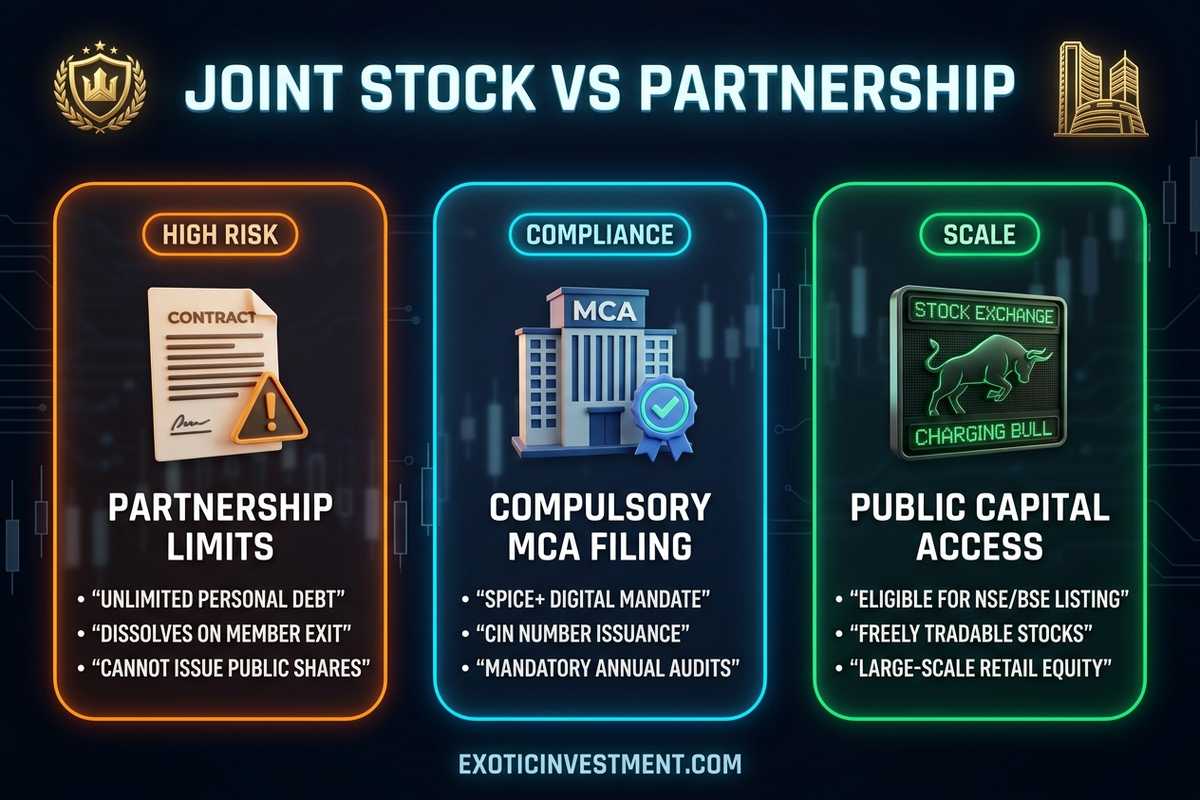
Illustration: Structural contrast highlighting compulsory company registration, limited shareholder liability, perpetual life, and NSE share transferability versus partnerships.
Comparison Table: Partnership Firm vs Joint Stock Company
Keep this crisp legal comparison table handy for exam revision or angel-investment vetting! Notice immediately why scaling toward stock listings always demands registered company incorporation first.
| Legal Feature | Partnership Firm | Private Limited Company | Public Joint Stock Company |
|---|---|---|---|
| Registration Mandate | Optional under 1932 Act | Strictly Compulsory (MCA) | Strictly Compulsory (MCA + SEBI IPO) |
| Member Limit | 2 to 50 partners maximum | 2 to 200 shareholders | Min 7, Unlimited public holders |
| Owner Liability | Unlimited (personal home at risk) | Limited to unpaid share value | Limited strictly to equity paid |
| NSE / BSE Stock Listing | Impossible legally | Restricted private transfers | Eligible via DRHP & SEBI approval |
| Statutory Audits | Tax audit only past thresholds | Mandatory annual ROC audit | Quarterly results + annual AGM |
Step-by-Step Journey: From MCA Registration to NSE/BSE IPO
How does a growing private firm turn into a listed public corporation? First, promoters incorporate via MCA to secure a verified CIN, PAN, and TAN. Next, expanding firms convert into Public Limited companies once shareholders surpass private limits.
Finally, merchant bankers submit a formal DRHP detailing audited statements for SEBI review! Trace every institutional step clearly via our IPO distribution guide and score issues inside our IPO scorecard tool cleanly.

Illustration: Corporate verification lifecycle moving from MCA Certificate of Incorporation (CIN) through statutory audits toward SEBI DRHP listing.
Worked Verification Check: Auditing Any Pre-IPO Share Pitch
Wait — unscrupulous WhatsApp groups occasionally sell fake unlisted shares in unregistered entities claiming imminent IPO riches! Before paying ₹50,000 toward private equity, run two rapid checks immediately. First, search the entity’s exact 21-digit CIN inside MCA Master Data to confirm active legal compliance!
Second, verify real electronic ISIN credit into NSDL or CDSL instead of trusting paper receipts! Review safety rules carefully inside our pre-IPO safety guide and check exit delays in our SME IPO liquidity explainer beforehand.
MOA vs AOA: The Constitutional Rulebook Behind Every Registered Company
Knowing why registration of joint stock company is compulsory also means understanding two founding legal charters filed on day one! First stands the **Memorandum of Association (MOA)**, defining the firm’s core business mission and authorized capital ceiling cleanly. Consequently, management cannot suddenly divert shareholder equity into unrelated unauthorized ventures outside that charter.
Second stands the **Articles of Association (AOA)**, governing internal voting rules, board elections, dividend policies, and share transfers! Whenever retail investors review new DRHP filings, checking unusual AOA clauses uncovers hidden promoter vetoes early. Compare listed share rights cleanly inside our equity and preference shares guide anytime.
Meanwhile, active ROC filings ensure corporate debt charges, pledged assets, and annual financial audits stay transparent online! In addition, investors can spot shell scams quickly by flagging companies carrying overdue statutory audit defaults. Verify corporate governance health alongside our ASM surveillance guide and test equity value cleanly via our PE ratio calculator today.
Public Disclosures Every Incorporated Company Must Publish Annually
Because public investors rely entirely on open data, compulsory company registration enforces continuous transparency long after launch day! First, every registered corporation files audited profit statements and balance sheets with the Registrar of Companies annually. Consequently, analysts can verify multi-year revenue growth, debt schedules, and executive payouts effortlessly online.
Second, listed joint stock corporations publish quarterly financial numbers and material board alerts within strict statutory exchange deadlines! Whenever promoter pledges change or major factory contracts sign, public shareholders read uniform updates simultaneously across NSE feeds. Consequently, orderly corporate filings deter hidden fraud across large Indian companies cleanly.
Above all, transparent corporate disclosures protect minority investors reliably over multi-decade market cycles. Track corporate profit quality cleanly via our Profit After Tax guide and check ratios in our relative valuation tool. In addition, regular statutory audits help long-term investors compare peer profit stability fairly.
🚀 Trade Clean Dalal Street Setups With Institutional Discipline
Never trust unverified equity schemes blindly. Master market basics, IPO audits, and price structure cleanly alongside Dr. Ashok Kumar N Rao and our 1,300+ active trading community.
- Build rock-solid basics via our Kaliyiri Share Market Book and English bestseller Basics of Indian Stock Market Book.
- Access institutional screeners and pro research via the MultiBagger Plus Courses & Pro Tools Annual Subscription.
- Master chart timing in our Technical Analysis Course in Kannada or options setups in our Options Buying Course in Kannada.
💡 Frequently Asked Questions (FAQ): Registration of Joint Stock Company
1. Why is registration of joint stock company is compulsory in India?
Under the Companies Act 2013, incorporation builds legal identity, caps owner debt risk, and stops unregistered 50+ partner fundraising! Trace regulated IPO issuances inside our Indian IPO process guide today.
2. Contrast partnership registration with joint stock company registration briefly?
Partnership registration stays optional under 1932 laws, whereas corporations cannot legally sell stock without MCA incorporation! Compare corporate equity classes carefully inside our equity and share guide cleanly.
3. What happens if an unregistered business group accepts money from over 50 people?
Section 464 treats any unregistered business collective past 50 partners as illegal, exposing members to personal debt and fines! Guard capital carefully via our pre-IPO verification guide first.
4. What is the single most important birth document proving registration?
The ROC Certificate of Incorporation carrying a permanent 21-digit CIN proves official corporate existence! Inspect share par values inside our face value of shares explainer today.
5. Does compulsory MCA registration automatically let a company trade on NSE?
No — MCA registration only births the company; public exchange listing demands Public Limited conversion plus SEBI DRHP scrutiny! Evaluate upcoming IPOs calmly using our IPO scorecard tool cleanly.
6. How many minimum directors and members does a public joint stock firm require?
A public joint stock company mandates at least seven shareholders and three directors versus two each for Private Limited firms. Check regulator mandates inside our SEBI regulation guide right now.