Evaluate upcoming Indian mainline and SME IPOs using institutional 4-pillar composite scoring (0-100), Grey Market Premium (GMP) listing gain projections, and anchor book quality.
Select registrar to verify PAN-based allotment status directly on their official portal:
| Issuer Company | Segment | Listing Date | Issue Price | Listing Price | Listing Day Gain / Loss | EI Desk Score | Pre-Listing Bias | Validation Verdict |
|---|---|---|---|---|---|---|---|---|
| Jindal Supreme (India) Ltd (SME) | SME | 08 Oct 2026 | ₹93.00 | ₹115.00 | +23.66% | 72/100 | Moderate Speculative Demand | 🎯 Target Hit (Listed at +23.66% Premium) |
| A-One Steels India Ltd | Mainline | 05 Oct 2026 | ₹165.00 | ₹189.00 | +14.55% | 64/100 | Caution / High OFS Trap | 🎯 Target Hit (Listed at Premium) |
| Moneyview Ltd (Whizdm Innovations) | Mainline | 01 Oct 2026 | ₹380.00 | ₹661.20 | +74.00% | 93/100 | Highest Institutional Conviction | 🎯 Target Hit (Listed at +74% Multibagger Gain) |
| ArMee Infotech Ltd | SME | 30 Sep 2026 | ₹135.00 | ₹163.00 | +20.74% | 72/100 | Moderate Speculative Demand | 🎯 Target Hit (Listed at +20.74% Premium) |
| Adroit Industries (India) Ltd | SME | 30 Sep 2026 | ₹110.00 | ₹128.00 | +16.36% | 64/100 | Moderate Speculative Demand | 🎯 Target Hit (Listed at +16.36% Premium) |
| Elevate Campuses Ltd | Mainline | 30 Sep 2026 | ₹245.00 | ₹290.00 | +18.37% | 79/100 | Strong Institutional Conviction | 🎯 Target Hit (Listed at +18.37% Premium) |
| SS Retail Ltd | Mainline | 23 Sep 2026 | ₹424.00 | ₹624.00 | +47.17% | 72/100 | Above Median Score / Solid Mainline Demand | 🎯 Target Hit (Listed at +47.17% Premium) |
| National Stock Exchange of India (NSE) | Mainline | 24 Sep 2026 | ₹1,785.00 | ₹1,845.00 | +3.36% | 100/100 | Highest Institutional Conviction (Monopoly Asset) | 🎯 Target Hit (Listed at +3.36% Premium) |
| Hero Motors Ltd | Mainline | 23 Sep 2026 | ₹84.00 | ₹82.50 | -1.79% | 46/100 | Caution / Avoid Hype | 🎯 Model Validated (Avoided Listing Discount) |
| Quanto Agroworld Ltd | SME | 21 Sep 2026 | ₹67.00 | ₹63.65 | -5.00% | 38/100 | High OFS Drag / Weak Anchor | 🎯 Model Validated (Predicted Discount) |
| Shakti Polytarp Ltd | SME | 21 Sep 2026 | ₹59.00 | ₹57.08 | -3.25% | 45/100 | Below Median Fundamentals | 🎯 Model Validated (Avoided Loss) |
| Maharaja & Speedex India Ltd | Mainline | 17 Sep 2026 | ₹186.00 | ₹262.50 | +41.13% | 88/100 | Strong Conviction / High Anchor Demand | 🎯 Target Hit (+41.1% Gain Realized) |
| Amtech Esters Ltd | SME | 16 Sep 2026 | ₹75.00 | ₹105.00 | +40.00% | 82/100 | Attractive Valuation Discount | 🎯 Target Hit (+40.0% Gain Realized) |
| Karamtara Engineering Ltd | Mainline | 16 Sep 2026 | ₹254.00 | ₹352.00 | +38.58% | 85/100 | Marquee Anchor Backed | 🎯 Target Hit (+38.6% Gain Realized) |
Upgrade to Multibagger Pro
Access live daily Grey Market Premium (GMP) audit sheets, institutional QIB subscription momentum alerts, custom unbranded PDF audit exports, and 55+ institutional scanners for ₹2,739/year.
How to Evaluate an IPO in 4 Steps
Select Curated Preset or Type
First, pick a live upcoming IPO preset like NSE IPO or enter your custom issue price, lot size, and current GMP.
Benchmark Valuation Multiple
Next, compare the asking price multiple against listed industry peers. Always verify if the promoter left money on the table.
Audit Promoters & Anchors
Then, examine top mutual funds in the anchor book. Check whether the issue brings fresh growth cash or just OFS selling.
Review Composite Score
Finally, inspect your final 0-100 score and projected lot profit. Apply with clear discipline rather than blind emotion.
Why Retail Traders Get Trapped by IPO Listing Hype
Look boss, let us be completely honest about Dalal Street. Whenever a hot company announces an IPO, financial television and WhatsApp groups scream exciting stories. Everyone dreams of instant listing day gains and doubling their money.
Here is the cold ground reality. Promoters and private equity funds price public issues when market sentiment hits peak optimism. They hire clever investment bankers to extract every single rupee from retail pockets.
When the market hits a sudden speed bump, overvalued IPOs crash 30% to 50% below issue price. Retail investors end up holding worthless paper for years. Math never lies. That is why professional desks follow a disciplined framework.
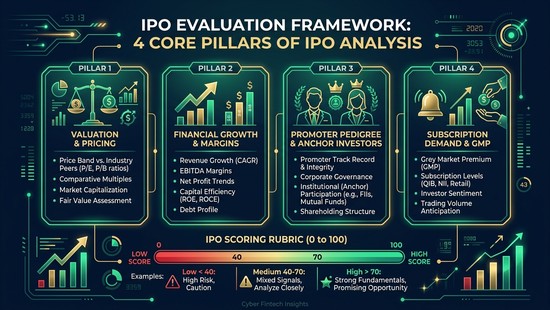
Pillar 1: Valuation Multiple vs Listed Industry Peers
First, always check if the promoter leaves money on the table for you. Suppose top listed sector peers trade at 25x earnings. If a new unproven issuer demands 50x earnings, ask yourself why you should pay double.
A sensible discount gives you an immediate safety cushion on listing morning. Conversely, paying peak valuations leaves you exposed to immediate losses.
Pillar 2: Fresh Capital vs Offer for Sale (OFS)
Second, follow where the IPO subscription money actually goes. Fresh issue cash lands directly inside company bank accounts to build new factories, buy machinery, or eliminate high-interest bank debt.
In contrast, Offer for Sale (OFS) flows straight into the pockets of exiting venture capitalists. Pure OFS issues create zero operational expansion for the underlying company.
Pillar 3: Anchor Book Pedigree and QIB Institutional Demand
Third, examine the anchor book allocation closely. Marquee domestic mutual funds and global sovereign wealth funds employ armies of qualified analysts. They scrutinize plant operations before writing hundred-crore cheques.
When institutional desks commit heavy funds before public bidding opens, retail investors gain strong confirmation. However, if anchors avoid an issue, stay alert.
Pillar 4: Grey Market Premium (GMP) Limitations
Fourth, treat Grey Market Premium numbers with extreme caution. The grey market operates as an informal, unregulated cash market where circular trades create false buying euphoria.
Operators frequently inflate grey market figures to lure retail applications, only to vanish before listing bell. Therefore, always pair GMP numbers with balance sheet metrics.
📋 Regulatory References & Data Sources
- SEBI (Issue of Capital and Disclosure Requirements) Regulations 2018 — IPO prospectus disclosure norms
- SEBI Circular SEBI/HO/CFD/DIL2/CIR/2022 — SME IPO lot size and bidding parameters
- Finance (No. 2) Act 2024 — STCG at 20%, LTCG at 12.5% on listed equity shares
- NSE & BSE India — Day-wise QIB, NII, and Retail subscription bidding feeds (public exchange source)
- Grey Market Premium (GMP): Unofficial OTC sentiment data — not regulated by SEBI or recognized stock exchanges
Disclaimer: This calculator is for educational and planning purposes only. It does not constitute financial advice. Consult a SEBI-registered investment advisor for personalised guidance. Tax rules are updated as per the latest Finance Act — verify with a qualified CA before filing.
Frequently Asked Questions — IPO Scorecard
What does an institutional IPO composite score above 75 indicate?
First, an institutional score above 75 highlights attractive valuation discounts, strong revenue growth, and marquee anchor backing. Consequently, these metrics indicate superior risk-adjusted listing safety. In addition, investors can track long-term annualized returns on their allotted shares using the Stock Portfolio XIRR Calculator.
How accurate is Grey Market Premium (GMP) for predicting listing day prices?
However, remember that GMP reflects informal forward cash sentiment before listing day, where sudden mood swings occur frequently. Therefore, traders should not rely solely on unofficial premiums. In contrast, comparing post-issue P/E against listed industry valuations on our PE Ratio Comparison Tool provides a far more dependable fundamental check.
Why is a high OFS (Offer for Sale) proportion considered a valuation drag?
Specifically, a 100% OFS issue provides zero fresh capital to company reserves. Instead, all incoming funds solely cash out existing venture investors. As a result, the company gains no operational runway. Furthermore, you can evaluate underlying corporate cash flows using the DCF Calculator for Indian Stocks.
How do token listings, IDOs, and crypto airdrops differ from equity IPOs?
In contrast to SEBI-regulated public issues, decentralized token sales carry no statutory disclosure rules. Furthermore, crypto vesting unlocks can flood secondary liquidity without warning. Consequently, investors can review lockup schedules and market impacts on the Crypto Holding Period Return Calculator on Emintage.
How is post-listing capital gains tax computed on equity IPO shares?
Under Finance Act 2024, selling shares within twelve months triggers Short-Term Capital Gains tax at 20%. Conversely, selling after twelve months triggers 12.5% Long-Term Capital Gains tax above ₹1.25 Lakh. Therefore, you can calculate your exact liability on the STCG vs LTCG Tax Calculator, or verify digital asset rules on the Crypto Tax Calculator on Emintage.
How do peer multiples benchmark fair pricing before an IPO?
For example, traders compare upper price bands against industry EBITDA and price-to-book ratios using our Relative Valuation Screener. Because an issuer must justify premium pricing with superior margins, listing gains evaporate quickly if valuations stretch beyond reason.
What role does QIB subscription demand play on Day 3 of an IPO?
Then, Qualified Institutional Buyers bid heavily on the final day after conducting plant visits and forensic audits. As a result, institutional demand offers retail investors a vital validation signal. In addition, active traders can track options hedging and derivative positioning post-listing through our Put Call Ratio Live Tracker.
How does portfolio risk budgeting protect against IPO listing drawdowns?
Moreover, allocating excessive capital to volatile newly listed securities can cause sudden portfolio damage. Consequently, disciplined traders evaluate worst-case drawdown probabilities using the Value at Risk (VaR) Calculator to preserve trading capital.
How do investors rebalance capital allocation after an IPO listing surge?
When an allotment doubles on listing morning, it skews your target portfolio weight. Therefore, investors use our Portfolio Rebalancing Calculator to restore balance, or manage digital tokens on the Crypto Portfolio Tracker on Emintage.
How does brokerage and statutory turnover impact listing day scalping?
Finally, frequent listing morning scalping incurs STT, exchange charges, and broker commissions. Therefore, to calculate your net profit breakeven levels, evaluate fees on the Indian Stock Brokerage Calculator, and model compounding returns on the Crypto Compounding Calculator on Emintage.