[CALC] XIRR Calculator India — SIP & MF Real Returns

Stock Portfolio XIRR Calculator

Calculate your real personal annualized returns across monthly SIPs, lump-sum purchases, redemptions, and cash dividends.

Statutory Disclaimer: This tool displays mathematical computations and publicly available data for educational purposes only. It is not a SEBI-registered research report or investment recommendation. Consult a SEBI-registered investment advisor before making financial decisions.
📊 Quantitative XIRR Engine Stock & SIP Portfolio XIRR Calculator 🔒 PRO LOCKED
🔹 Method: Newton-Raphson Numerical Iteration 🔹 Standard: SEBI PMR Reporting Framework 🔹 Tax Basis: Finance Act 2024 (LTCG 12.5% > ₹1.25L)
📊 Sample calculation — enter your portfolio details below to compute your personalized XIRR.
Select Cash Flow Mode
Monthly Investment Amount
Investment Timeline & Portfolio Valuation
Tax Profile & Asset Classification
📈 Portfolio Wealth Projection Timeline
Current Portfolio
Invested Capital
Personalized Annualized Return
14.32%
🟢 Solid — Outpacing broad domestic equity benchmarks
Total Capital Invested ₹1,80,000
Current Portfolio Value ₹2,45,000
Net Absolute Return +36.1%
Compounding Duration 3y 0m
🏆 Benchmark Comparison (Same Period)
Nifty 50 TRI (SIP Equivalent) ~13.2% p.a.
Public Provident Fund (PPF) 7.1% p.a.
Bank Fixed Deposit (FD) ~6.8% p.a.
Portfolio Alpha vs Nifty TRI +1.12% p.a.
Simple CAGR Rate 10.82%
💡 Why the difference? CAGR assumes your entire capital was invested on Day 1. XIRR accurately factors that later SIP installments compounded for fewer days.
💎 Multibagger Pro Suite
Post-Tax XIRR (Finance Act 2024) PRO 🔒 Pro Access
Broker CSV Importer (Zerodha/CAMS) PRO 🔒 Pro Access
Multi-Fund Portfolio Blend (5 Funds) PRO 🔒 Pro Access

Activate Multibagger Pro Engine

Get institutional-grade portfolio diagnostics, post-tax returns under Finance Act 2024, broker CSV statement imports, unbranded PDF export, and multi-fund tracking.

Broker Statement Importer (Zerodha, Groww, CAMS CSV)
Tax-Adjusted XIRR (12.5% LTCG & 20% STCG impact)
Unrestricted PDF & WhatsApp Export (Zero-pitch clean reports)
Multi-Fund Portfolio Blend (Up to 5 concurrent accounts)
55+ Institutional Calculators & Scanners
₹4,999/yr ₹2,739 / year
Just ₹228/month (Billed annually) — Instant Activation
🚀 Activate Multibagger Pro Now
Secure checkout via PhonePe / UPI. 100% money-back guarantee.

How It Works in 4 Steps

1

Enter Cash Inflows

First, pick your monthly SIP amount or enter custom buy dates. You can also add an annual step-up percentage.

2

Record Cash Outflows

Next, list any money you pulled out. Also include cash dividends that hit your savings account.

3

Set Current Value

Then, type in your portfolio value today. The math engine treats this number as your final payout.

4

Analyze Your Alpha

Finally, check your true personal return against the Nifty 50 TRI benchmark. Review your post-tax returns clearly.

👨‍🏫 Dalal Street Desk Reality & SEBI Disclosure: Written by Dr. Ashok Kumar N Rao based on 12+ years of active market trading and mentoring 3,500+ Indian retail investors. We evaluate real cash flows using pure mathematical truth.

Why Your Mutual Fund App Shows Misleading Return Numbers

Look boss, let us be honest. Most retail folks look at mutual fund apps and feel happy seeing a big green percentage. But here is the catch. That number is often simple CAGR or point-to-point absolute return.

That math assumes you invested all your cash on Day 1. In reality, you never dump your entire life savings at once. Instead, you invest monthly through a SIP. Sometimes you buy extra units during a steep market fall.

Other times, you withdraw money for Diwali expenses or family needs. Because your money entered the market at different dates, simple CAGR fails completely. You need an exact tool to measure your real compounding rate.
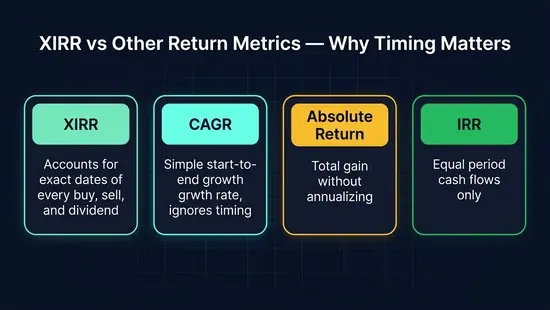
XIRR vs CAGR vs Absolute Return vs IRR Comparison

CAGR vs XIRR: A Dalal Street Reality Check

So how does XIRR solve this problem? Simple. Extended Internal Rate of Return (XIRR) assigns an exact day count to every single rupee you invest.

Think about it. A ₹10,000 installment invested three years ago worked hard for over 1,000 days. However, your latest ₹10,000 installment entered just thirty days ago. Why should both installments get the same compound weight? They should not.

XIRR runs a smart numerical method called Newton-Raphson. It balances all your deposits against your current portfolio value. As a result, you get your exact personal annualized return down to the decimal.

The 3-Year SIP Math: What Actually Happened to Your Money

Let us look at real numbers from a typical retail desk scenario. Suppose you started a ₹10,000 monthly SIP three years ago. Over 36 months, you deposited exactly ₹3,60,000.

Now, your broker screen shows a valuation of ₹4,70,000. Look at how different metrics tell completely different stories:

  • Absolute Return (+30.56%): This looks great on paper. But it completely ignores the three-year timeline and your staggered deposits.
  • Simple CAGR (9.29% p.a.): This heavily understates your performance. It falsely assumes all ₹3,60,000 sat invested for the full three years.
  • True Personal XIRR (17.84% p.a.): This reflects reality. Your early installments compounded for years, while your recent installments just started working.

Clearly, XIRR shows you beat fixed deposits and broad equity indices by a huge margin. That is the power of accurate accounting.

TWRR vs XIRR: Fund Manager Skill vs Your Personal Timing

Now, why does your fund factsheet show 15% when your personal return is only 11%? Here is the secret.

Fund houses report Time-Weighted Rate of Return (TWRR). This measures fund manager skill without caring when investors deposit cash. In contrast, XIRR measures your personal discipline.

If you stop your SIP during market panic or buy heavily at market tops, your personal XIRR drops fast. Therefore, tracking XIRR keeps you disciplined across market cycles.

How Taxes Eat Your Net Wealth Under Finance Act 2024

Never ignore the tax bite, boss. The new Finance Act 2024 changed capital gains rules significantly for Indian investors.

Today, Long-Term Capital Gains on equity mutual funds face a 12.5% tax on gains above ₹1.25 Lakh per financial year. Plus, you pay a mandatory 4% cess. As a result, your effective tax rate is 13%.

That tax drag reduces your net compounding rate by 1% to 2% each year. Always factor in post-tax net XIRR before planning long-term retirement milestones.

📋 Regulatory References & Data Sources
  • Income Tax Act 1961, Section 112A — LTCG on listed equity units (Finance Act 2024)
  • Income Tax Act 1961, Section 111A — STCG on listed equity units (Finance Act 2024)
  • Finance (No. 2) Act 2024 — revised LTCG rate to 12.5% (> ₹1.25L exemption) and STCG to 20%
  • AMFI (Association of Mutual Funds in India) — XIRR performance reporting standards
  • SEBI (Portfolio Managers) Regulations 2020 — Time-weighted and money-weighted return methodologies

Disclaimer: This calculator is for educational and planning purposes only. It does not constitute financial advice. Consult a SEBI-registered investment advisor for personalised guidance. Tax rules are updated as per the latest Finance Act — verify with a qualified CA before filing.

Frequently Asked Questions — XIRR Calculator

What is XIRR in mutual fund and stock investing?
XIRR means Extended Internal Rate of Return. In simple words, it measures your true annualized return across multiple cash transactions. It handles every purchase, sale, top-up, and dividend at its exact calendar date. Active investors balance their overall holdings using our Portfolio Rebalancing Calculator.
How does XIRR differ from simple CAGR?
CAGR assumes you put all your money in on Day 1 and never touched it. In contrast, XIRR tracks every single deposit on its exact day. Therefore, XIRR gives you the true picture for SIPs and dip-buying. You can test your required compound growth rates using our Reverse CAGR Calculator.
What is a good XIRR return for a stock or mutual fund SIP in India?
Over a five to ten year period, a mutual fund XIRR between 12% and 15% is solid. That range comfortably matches the Nifty 50 Total Return Index. If you clock above 16%, you are generating serious alpha. You can also evaluate token yields across Web3 assets on the Crypto Portfolio Tracker on Emintage.
Can I calculate XIRR for an active SIP that I have not redeemed?
Yes, absolutely. You enter all your past installments as negative cash outflows. Then, you enter today’s portfolio value as a positive cash inflow with today’s date. As a result, the tool calculates your exact running return. You can also model dividend reinvestment growth using our DRIP vs Dividend Payout Calculator.
How do I enter stock dividends in an XIRR calculation?
If cash dividends reached your bank account, enter them as positive cash inflows on their payment dates. But if your mutual fund reinvested dividends into more units, you do not need separate entries. Those reinvested units already boost your closing portfolio value. For digital staking yields, track your payouts on the Crypto Staking Calculator on Emintage.
Why does Excel show #NUM! or error when calculating XIRR?
Excel uses an iterative math loop that often crashes. If you forget to enter a positive ending value, the formula fails immediately. Also, out-of-order dates cause Excel to choke. Our web engine sorts dates automatically and uses stable numerical boundaries. You can check extreme portfolio drawdown risk on our Value at Risk (VaR) Calculator.
What is the difference between XIRR and TWRR?
TWRR measures fund manager skill without penalizing them for investor timing. In contrast, XIRR measures your personal investor timing and entry discipline. If you pour heavy money right before a market crash, your XIRR suffers. You can examine equity valuations before making big deposits using the PE Ratio Comparison Tool.
How does taxation impact net XIRR under Finance Act 2024?
Under Finance Act 2024, equity LTCG above ₹1.25 Lakh attracts 12.5% tax plus 4% cess. Short-term gains under twelve months face a flat 20% tax. This tax drag lowers your net wealth accumulation over time. You can compute your exact tax bill on our STCG vs LTCG Tax Calculator, or review crypto tax rules on the Crypto Tax Calculator on Emintage.
Can I calculate XIRR for cryptocurrency holdings and decentralized tokens?
Yes, indeed. XIRR works on any irregular cash flow stream, including Bitcoin and altcoins. You can track irregular buy orders and spot sales easily. For specialized Web3 profit tracking, explore the Crypto Profit Calculator on Emintage and project compounding returns using the Crypto Compounding Calculator on Emintage.
How does an annual step-up boost my SIP wealth accumulation?
Stepping up your monthly SIP by just 10% each year can increase your final wealth by over 45% across fifteen years. That extra discipline matches your annual salary hikes. You can test your step-up targets on our dedicated Step-Up SIP Return Calculator, or find optimal portfolio weights on the Markowitz Efficient Frontier Calculator.
AR
Written & Verified By

Dr.Ashok Kumar N Rao

Stock Market Educator & Author | 3,500+ Students Trained

Alternative Investments advisor and author of 'Basics of Stock Market for Beginners' and 'ಕಲಿಯಿರಿ ಶೇರ್ ಮಾರ್ಕೆಟ್'. All financial tools and content on this site are reviewed personally before publication.