Tracking the impact of rbi on stock market trends helps Indian investors spot major sector swings cleanly. Every two months, Dalal Street pauses at 10:00 AM awaiting the Monetary Policy Committee’s interest rate verdict. Connect sovereign bond yields directly to stock pricing inside our Indian government bonds guide cleanly.
Wait — why does a tiny 0.25% Repo Rate shift move billions across NSE order books in seconds? Because RBI manages both corporate borrowing costs and rupee liquidity flowing through Indian banks! Consequently, every MPC announcement alters discount rates used by institutions to value future earnings.
Let us map RBI’s monetary levers into clear, simple chains any beginner can follow easily! First, decode Repo Rate, CRR liquidity injections, and policy stance without textbook jargon. Next, explore which sectors rally or cool during rate cuts versus tightening cycles.
Four Core RBI Policy Levers Moving Dalal Street Every Quarter
Unlike day traders glued to five-minute candles, RBI’s Monetary Policy Committee balances inflation control against steady economic growth. Specifically, the central bank guides rupee credit liquidity cleanly using four primary policy instruments.
Repo Rate — The Benchmark Cost of Capital
The Repo Rate sets the interest cost banks pay when borrowing short-term cash overnight from RBI. When RBI trims the Repo Rate, home loans, auto EMIs, and corporate factory loans turn cheaper fast. Conversely, sharp Repo hikes squeeze corporate profits while lifting safe yields on Indian government securities cleanly.
Cash Reserve Ratio (CRR) — Direct Banking Liquidity Switch
CRR forces commercial banks to lock fixed customer deposit fractions idle in cash inside RBI earning zero return. Therefore, cutting CRR by 0.50% frees over ₹1 lakh crore directly into commercial bank lending pools overnight! As a result, surprise CRR cuts regularly spark fast rallies across Nifty Bank futures.
Policy Stance — Accommodative, Neutral, or Hawkish
Forward guidance moves institutional markets almost as fiercely as headline rate cuts! Even when MPC pauses rates, shifting stance toward “neutral” hints clearly at rate cuts ahead. Institutional buyers monitor every speech phrase alongside daily FII and DII data flows cleanly.
Banking Credit Rules and Unsecured Risk Weights
Beyond interest rates, RBI directly supervises commercial banks and NBFCs across capital adequacy and loan risk weights! For instance, raising unsecured personal-loan risk weights slows aggressive fintech lending immediately without raising Repo rates. Review broad market shock cycles inside our Dalal Street crash guide cleanly.
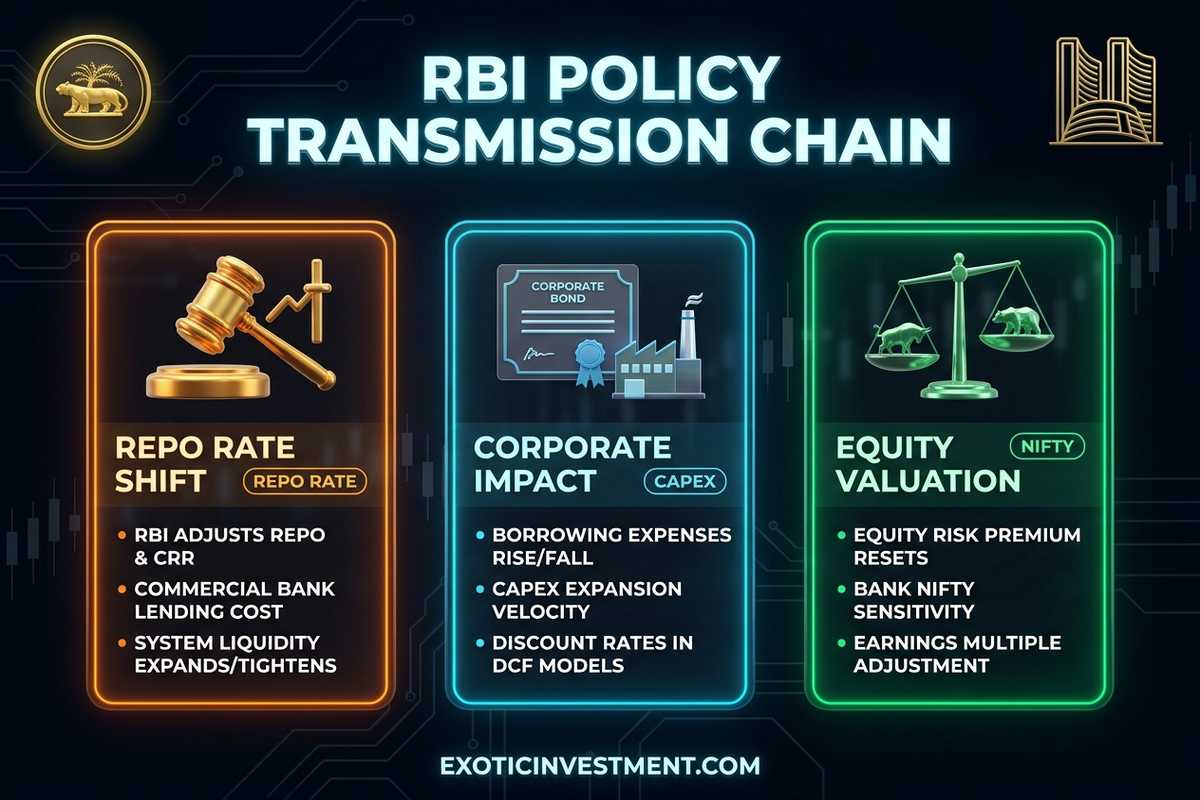
Illustration: Transmission chain showing how RBI Repo Rate, CRR liquidity, and MPC stance reshape corporate borrowing costs and stock valuations.
Sector Sensitivity Table: Rate Cuts vs Tightening Cycles
Not every NSE industry reacts identically when RBI changes interest policy! Save this institutional reaction matrix to anticipate fundamental tailwinds versus margin pressures cleanly across rate cycles.
| NSE Sector | RBI Rate Cut Impact | RBI Rate Hike Impact | Key Financial Driver |
|---|---|---|---|
| Banks & NBFCs | Strong credit volume & treasury gains | Higher funding cost (NIM pressure) | Net Interest Margin & credit quality |
| Real Estate & Autos | Cheaper EMIs boost buyer demand | Slower loan approvals cool bookings | Household EMI affordability |
| Capital Goods & Infra | Lower project debt speeds capex | Debt interest eats project margins | Corporate project IRRs |
| FMCG & IT Services | Mild positive (higher multiples) | Defensive cash piles hold steady | Zero debt & export USD sensitivity |
Worked Discount Rate Example: How a 1% Yield Drop Lifts Fair Valuation
Let us inspect institutional math proving why equity multiples expand when RBI cuts rates cleanly! Imagine a debt-free firm earns ₹100 crore yearly surplus forever while bond yields sit near 7.25%. Suppose funds demand an 11% equity return—giving Fair Value of ₹100 crore divided by 11% = ₹909 crore.
Now see what happens once falling inflation lets RBI lower policy rates, pulling 10-year yields toward 6.25%! Because bond competition drops 1%, required equity yield lowers smoothly to 10%, jumping fair value instantly to ₹1,000 crore! Test discount-rate shifts directly inside our DCF valuation calculator and explore P/E valuation effects today.

Illustration: Rate-sensitive sector reaction map comparing Banking, Auto, Real Estate, and defensive low-debt exporters across RBI policy cycles.
Foreign Institutional Flows, USD-INR Stability, and Bond Yields
Notice another major transmission bridge linking rbi on stock market swings with global capital! Specifically, when Indian Repo rates stay healthy relative to US Treasury yields, the Indian Rupee remains steadier against dollar spikes. Consequently, Foreign Portfolio Investors feel safer keeping long-term equity allocations anchored across Mumbai largecaps.
Conversely, sudden global inflation spikes or rupee weakness force RBI to hold tight liquidity longer than stock bulls wish. Track weekly foreign versus domestic institutional flows cleanly via our sectoral momentum tracker and FII DII data desk beforehand.
Why Markets Sometimes Fall Right After a Positive RBI Rate Cut
Beginners get trapped repeatedly on RBI policy mornings when Bank Nifty drops right after a widely expected rate cut! First, smart funds routinely accumulate banking futures weeks ahead and take profits into morning retail headlines. Second, emergency cuts triggered by weak GDP growth signal corporate earnings slowdowns despite cheaper EMIs!
Therefore, never gamble recklessly on 10:00 AM MPC events using naked weekly options! Check implied option volatility beforehand via our NSE option chain tracker and control trade size via our position size calculator cleanly.
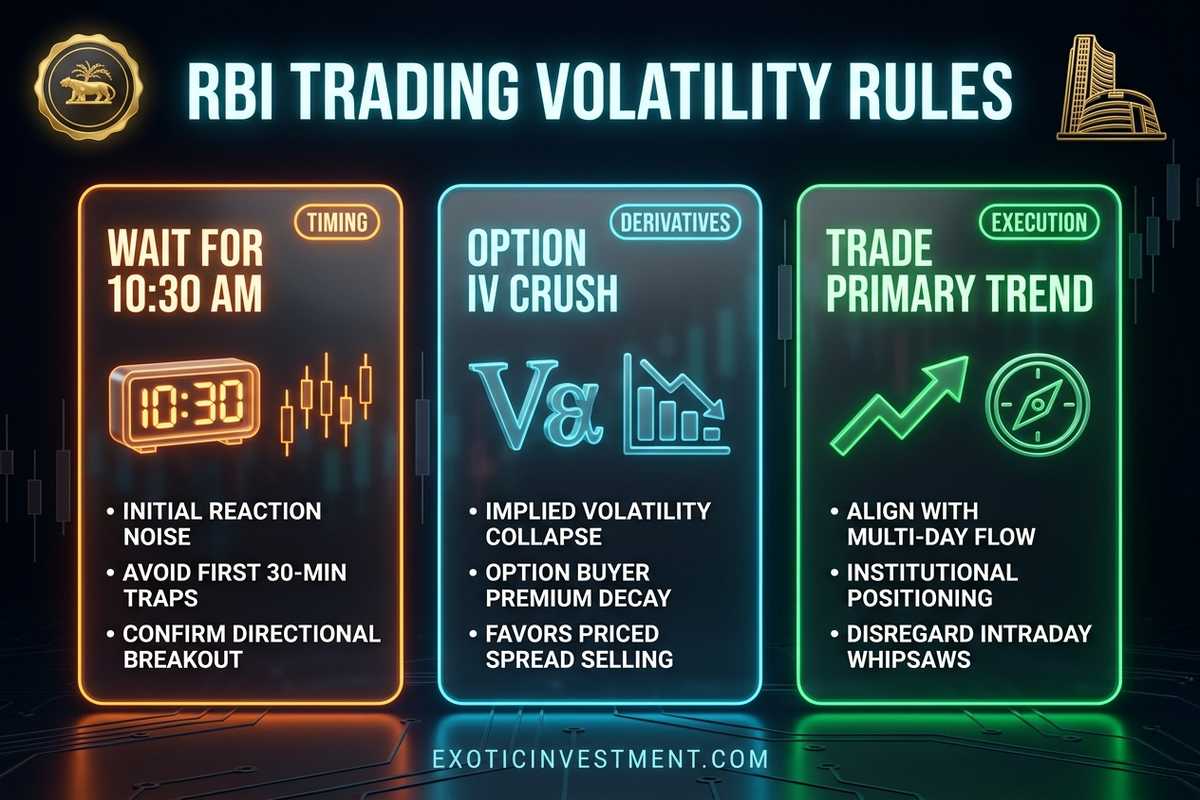
Illustration: Avoiding RBI announcement whipsaws—wait for post-10:30 AM trend confirmation, control option IV risk, and stay aligned with primary trend structure.
Reading the MPC Press Statement Without Falling for Headline Traps
Tracking rbi on stock market cycles goes far beyond watching one headline Repo Rate percentage number! Specifically, smart analysts read three critical lines inside every bi-monthly RBI governor statement carefully. First, check whether RBI raised or lowered full-year GDP growth estimates alongside core retail CPI inflation targets.
Next, monitor Open Market Operations (OMO) and variable repo auctions controlling daily banking liquidity directly! For example, tight overnight call money rates squeeze small non-bank lenders fast even when headline Repo stays flat. Meanwhile, comfortable surplus banking liquidity usually softens corporate bond spreads and lifts bank credit growth cleanly.
Finally, never confuse temporary morning volatility spikes on MPC days with permanent quarterly trend reversals! Specifically, wait for closing daily candles across banking indices before deploying fresh swing capital. Check broad market rotation clearly inside our live EMA crossover screener and track technical market indicators calmly.
In addition, long-term SIP savers should ignore noisy bi-monthly policy headlines completely! Therefore, steady monthly investments capture both higher rate dips and cheaper liquidity expansions effortlessly over ten-year horizons. Compare long-term wealth curves inside our SIP calculator and check our lumpsum calculator anytime.
🚀 Trade Clean Dalal Street Setups With Institutional Discipline
Handle major central bank events calmly without painful whipsaws. Learn structured risk trading alongside Dr. Ashok Kumar N Rao and our 1,300+ active community.
- Strengthen core market wisdom via our Kaliyiri Share Market Book and English bestseller Basics of Indian Stock Market Book.
- Access institutional screeners and pro research via the MultiBagger Plus Courses & Pro Tools Annual Subscription.
- Master event-day setups in our Technical Analysis Course in Kannada or index plays in our Options Buying Course in Kannada.
💡 Frequently Asked Questions (FAQ): RBI on Stock Market
1. How does the RBI affect the Indian stock market directly?
RBI steers equities by adjusting the Repo Rate, banking CRR reserves, policy stance, and lending regulations across banks! Track resulting sovereign bond yield moves cleanly inside our government bonds guide today.
2. Why do RBI rate hikes usually pressure Bank Nifty and growth stocks?
Higher Repo rates push deposit funding costs upward while slowing consumer loans and raising equity discount hurdles! Test how rising rates compress fair stock pricing inside our DCF valuation calculator anytime.
3. How often does the RBI Monetary Policy Committee meet each year?
Under statutory guidelines, the six-member RBI committee meets bi-monthly six times yearly, releasing decisions typically at 10:00 AM IST. Mark major exchange calendar dates early via our NSE BSE holiday list cleanly.
4. Which NSE sectors benefit most when RBI starts cutting interest rates?
Rate-sensitive sectors like Banks, NBFCs, Real Estate, Autos, and Infrastructure gain early demand and cheaper debt relief! Spot rotating sector winners smoothly via our sectoral momentum tracker today.
5. What is CRR and why does cutting it trigger quick market rallies?
CRR forces banks to lock fixed cash shares inside RBI earning zero interest, so cutting it releases instant lending liquidity! Track big institutional moves afterward inside our FII DII data tracker cleanly.
6. Should retail traders hold heavy intraday option bets across RBI announcements?
No — sharp 10:00 AM whipsaws and sudden implied volatility crush after MPC speeches routinely trap hasty option buyers! Wait for clean post-event structure and check NSE option chain positioning before risking cash.