Understanding how a stock algorithm places orders in microseconds explains why human emotion struggles on modern NSE books. Automated software now drives over half of daily Indian equity and F&O turnover! Study SEBI’s digital trading rules alongside our Indian retail algo trading guide cleanly.
Wait — forget movie myths about secret artificial intelligence robots printing effortless daily jackpots! At its heart, a stock algorithm is just a strict list of pre-written mathematical rules executed via broker APIs. As a result, software fires trades cleanly without greed, fear, or afternoon exhaustion.
Yet coding flashy Python scripts never rescues a losing idea on live Dalal Street order books! First, separate execution slicing tools from directional quant strategies and high-frequency arbitrage desks. Next, examine backtest overfitting traps, order slippage math, and SEBI’s mandatory 2025 API registration framework.
What Exactly Is a Stock Algorithm and How Does It Operate on NSE?
Clicking buy buttons manually on mobile apps adds messy delays between chart signals and final execution. By contrast, automated software links directly to broker APIs or co-location servers to execute preset rules instantly. Clearly, automation removes human hesitation whenever sudden price spikes hit critical levels.
Every functional trading system operates neatly across four clear software stages! First, a data feed streams live NSE price ticks, traded volumes, and order depth continuously. Next, the signal module evaluates strict rules like moving-average crossovers or option skew—compare indicators inside our technical indicator guide.
Third, the risk-guard layer checks position caps, available cash margins, and hard daily loss limits BEFORE routing packets! Finally, the smart execution engine submits limit slices onto exchange matching queues. Verify execution friction upfront using our order cost slippage calculator cleanly.
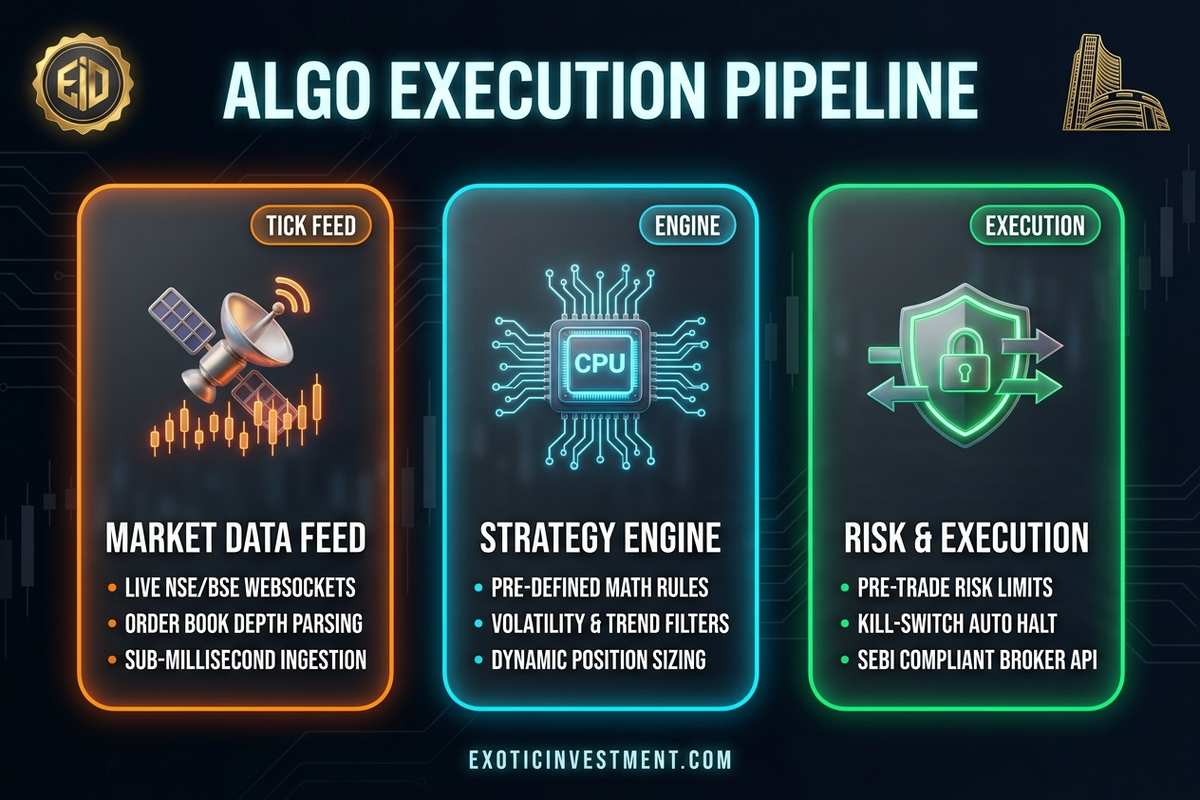
Illustration: Four-stage automated execution pipeline linking live market tick feeds, rule logic, risk caps, and SEBI-tagged API order routing.
Major Families of Stock Market Algorithms Used Today
Not every stock algorithm chases quick breakouts or blasts rapid microsecond bursts! Institutional funds and proprietary desks run completely separate software models built for distinct liquidity needs. Knowing these four core families clarifies who sits opposite your everyday limit orders.
Institutional Execution Algorithms — TWAP and VWAP
Mutual funds and foreign institutions cannot buy ₹500 crore in one click without jumping stock prices sharply! Instead, execution algos split huge orders cleanly into tiny pieces using Time-Weighted (TWAP) or Volume-Weighted (VWAP) pacing. Track broad institutional activity daily via our FII DII data tracker cleanly.
Trend-Following and Systematic Momentum Bots
Popular among quantitative swing traders, trend algorithms buy clean upside breakouts while trailing hard stop-losses upward. Conversely, they hold cash calmly whenever sideways chop shrinks market volatility below filter norms. Screen manual momentum setups first using our live EMA crossover screener and momentum screener!
Mean Reversion and Statistical Pairs Engines
Instead of chasing fast moves, pairs algorithms watch normal price spreads linking two close banking or IT peers. Whenever one stock stretches temporarily far above its twin, software shorts the pricier name while buying the laggard! Consequently, balanced long-short spreads shrink sudden market-crash shocks cleanly.
Index Arbitrage and High-Frequency Market Making
Sitting inside physical exchange co-location racks, HFT bots quote tight bid and ask prices across Nifty options continuously. Whenever cash index values drift even two points from futures parity, fast bots lock riskless spreads instantaneously. Retail broadband connections can never race co-located institutional hardware in pure latency arbitrage!
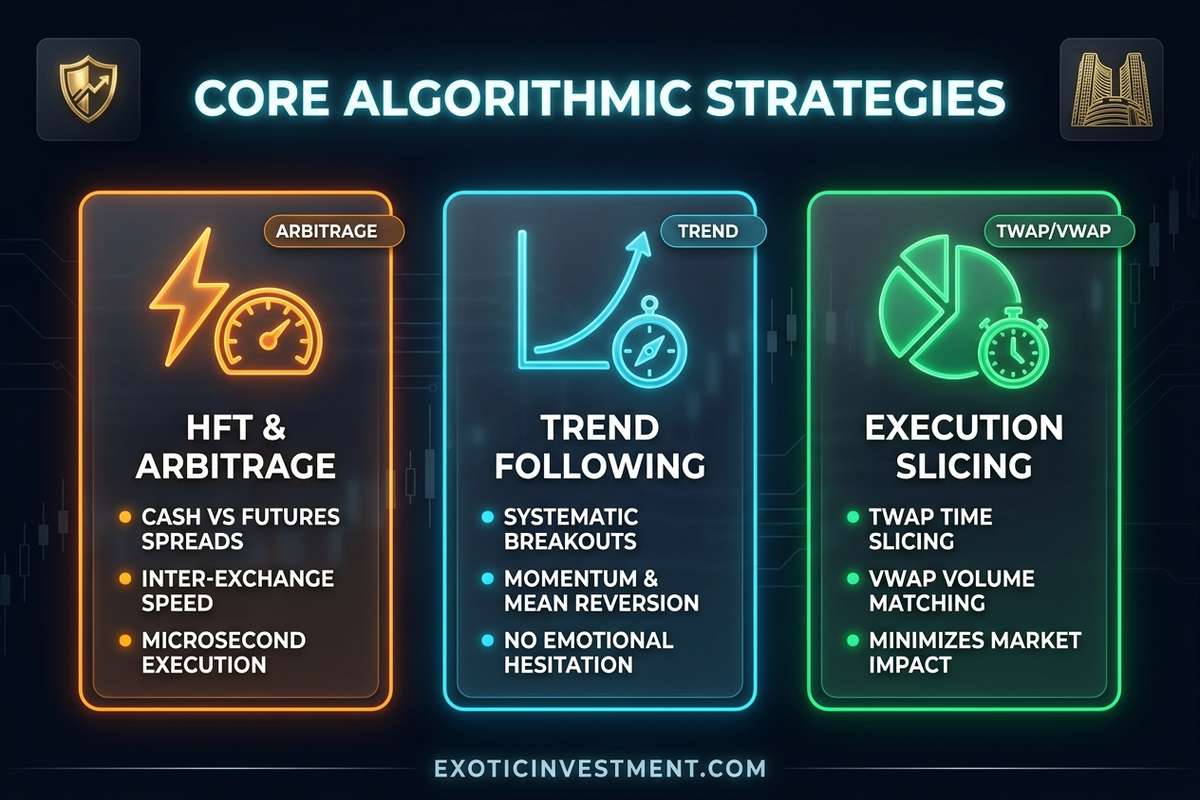
Illustration: Key algorithmic strategy classes contrasting institutional VWAP slicing, trend systems, pairs trading, and co-located HFT engines.
Comparison Table: Retail Rule Bots vs Institutional Co-Location Algos
Examine this honest capability comparison before paying monthly rent for unverified bot software! Knowing clear infrastructure gaps shields retail traders against false “automated income” sales pitches.
| Feature | Institutional / Co-Location Desk | Retail Broker API / Rule Bot | Practical Edge Source |
|---|---|---|---|
| Execution Latency | Microseconds inside exchange servers | 50 to 300 milliseconds over internet | Retail must trade slower timeframes |
| SEBI Regulation | Exchange-audited algo IDs & kill switches | SEBI 2025 retail API order tagging | White-box approval required |
| Infrastructure Cost | Lakhs monthly for colo racks & feeds | Low monthly cloud VPS or broker plan | Keep fixed fee < 2% of capital |
| Strategy Capacity | Hundreds of crores split smoothly | Nimble ₹2L to ₹50L accounts | Zero market-impact advantage |
| Primary Failure Risk | Hardware glitch or liquidity drought | Overfitting backtests & slippage | Always paper-trade first! |
SEBI Retail Algo Rules and Realistic Overfitting Math
SEBI stepped in sharply during 2024 and 2025 to block rogue algo marketers pitching fake returns! Under current retail API mandates, automated scripts demand static IP registration, unique exchange algo IDs, and strict per-second rate caps. Check official broker guidelines carefully inside our SEBI retail algo rules guide before launching automated orders.
Even more critically, beginners ignore two deadly math flaws inside flashy historical backtests! First, tweaking twenty magic indicator settings fits random historical noise cleanly while failing completely tomorrow. Second, naive simulations skip real option slippage, brokerage, STT, and sudden gap openings!
Let us inspect hard rupee math on a ₹5,00,000 automated Nifty bot taking four daily trades across 240 sessions! Suppose ideal backtests promise ₹450 average gross profit per round trip—claiming ₹4,32,000 yearly gross gain. Now deduct ₹120 per trade for combined brokerage, STT, GST, and realistic one-tick bid-ask slippage!
Across 960 round trips, real friction steals ₹1,15,200 automatically—over 26% of gross gains—before a single API freeze hits! Stress-test expectancy and worst-case streaks honestly beforehand using our Monte Carlo portfolio simulator and Indian brokerage calculator cleanly.
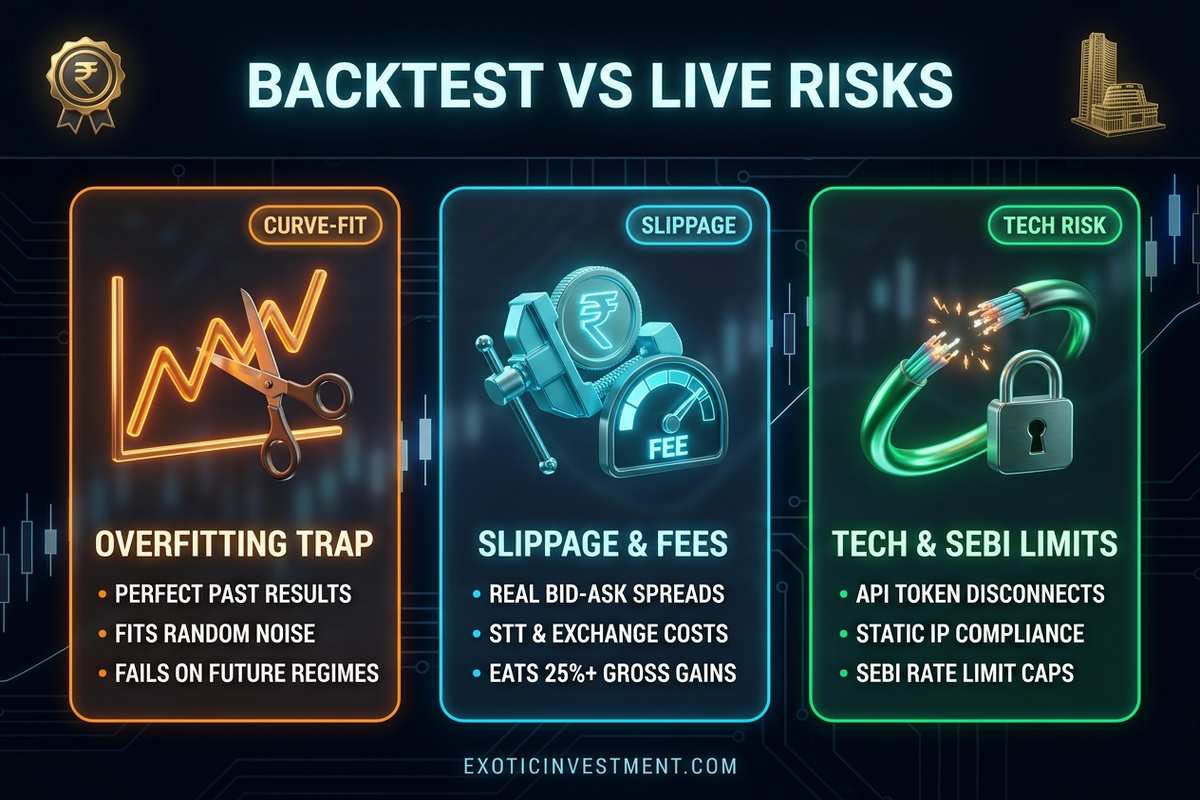
Illustration: Why pristine backtests fail live—curve overfitting, bid-ask slippage, API disconnects, and SEBI compliance limits.
Building a Disciplined Rule Engine: From Hypothesis to Live Monitoring
How do veteran quant desks turn simple market edges into dependable automated systems safely? First, anchor every rule on clear economic behavior—such as post-earnings momentum or volatility compression breakouts—never blind grid curves. Next, freeze rule parameters cleanly using in-sample years and verify untouched out-of-sample history.
Third, trade tiny starter lots for sixty straight live sessions to measure real broker fill slippage versus theory. Simultaneously, track portfolio downside exposure cleanly via our Value at Risk calculator and size stakes sensibly using our Kelly Criterion calculator!
Five Non-Negotiable Safeguards Before Running Any Automated Strategy
Keep this core truth front and center: software simply runs whatever instructions you write—smart OR catastrophic! Enforce these five mandatory safety gates strictly before linking live cash to automated scripts.
First, program a server-side Maximum Daily Loss Kill-Switch that halts trading instantly during freak order loops. Second, inspect option margin buffers regularly inside our SEBI F&O margin guide so sudden volatility spikes trigger zero penalty shortfalls. Third, block trading automatically around illiquid circuit breaks or pre-open market gaps.
Fourth, refuse paid “guaranteed return” black-box Telegram bots banned outright by SEBI circulars. Finally, master manual chart patterns and price action upfront alongside our position size calculator first!
Walk-Forward Validation vs Naive Historical Optimization
Before trusting live rupees to any stock algorithm, institutional quants verify stability using walk-forward validation! Rather than testing one giant five-year dataset together, analysts train rules across two years and score the third untouched year. Repeating that rolling cycle confirms whether core logic adapts smoothly across bull rallies and sudden crashes.
Conversely, curve-fitted retail strategies routinely show stunning smooth equity curves on past charts before collapsing live! For example, optimizing moving-average lengths to exact decimals chases random market noise instead of genuine crowd behavior. Compare healthy risk variance early via our Monte Carlo portfolio simulator cleanly.
In addition, remember Indian markets switch volatility regimes sharply around Union Budgets, elections, and RBI announcements! Therefore, resilient systematic desks halve active contract lots whenever India VIX spikes above normal historical ranges.
Specifically, monitoring real-time strategy drawdown limits protects compounding gains across quiet and choppy quarters alike! When an automated system crosses pre-defined historical loss ceilings, pause execution immediately for deep post-trade review. Consequently, disciplined pause triggers prevent temporary regime shifts from eroding earlier profits.
Latency, API Disconnects, and Practical Broker Architecture
Retail programmers frequently overlook practical engineering failures that interrupt clean automated logic during live sessions! For instance, home broadband drops, cloud server restarts, or sudden broker API token expiries stall open option hedges instantly. Consequently, unmonitored naked positions can bleed heavily within five chaotic minutes.
Professional desks defend capital by running redundant cloud instances paired with automated WhatsApp or Telegram heartbeat alerts! Specifically, a clean reconciliation loop fetches open broker positions every ten seconds to spot unmatched fills right away. In addition, hard server-side stop orders protect accounts even if local execution scripts crash suddenly.
Meanwhile, always inspect exchange order-to-trade ratio penalties before firing rapid modify commands across illiquid strikes! Keeping entry intervals sane slashes unnecessary exchange fees and keeps automated logs clean during SEBI audits. Measure hidden trade execution friction inside our order cost slippage calculator and track option spreads via our NSE option chain tool.
Manual Discretion vs Automated Discipline: Picking Your Best Path
Not every successful Dalal Street participant needs complex automated server stacks to grow savings steadily! Many calm positional investors achieve remarkable returns buying liquid Nifty leaders and tracking weekly breakouts manually. Simply automating price alerts often eliminates 90% of daytime screen stress without coding complexity.
However, if you run strict multi-leg option hedging daily, rule automation stops costly human hesitation at stop levels! Above all, remember clean risk sizing determines survival whether clicking buttons manually or running broker APIs. Calculate exact capital limits upfront via our position size calculator and verify tax audit thresholds inside our F&O turnover calculator cleanly.
Meanwhile, review detailed broker contract notes carefully every single month to confirm real live API fills match clean theoretical backtest benchmarks! Whenever average live fill slippage drifts higher than initially expected, tighten limit order bands immediately before scaling futures or cash lot sizes upward.
🚀 Trade Clean Dalal Street Setups With Institutional Discipline
Bad trading logic simply loses capital faster once automated. Master structured market strategies cleanly alongside Dr. Ashok Kumar N Rao and our 1,300+ active trading community.
- Strengthen trading rules via our Kaliyiri Share Market Book and English bestseller Basics of Indian Stock Market Book.
- Access institutional screeners and pro tools via the MultiBagger Plus Courses & Pro Tools Annual Subscription.
- Master technical precision in our Technical Analysis Course in Kannada or option systems in our Options Buying Course in Kannada.
💡 Frequently Asked Questions (FAQ): Stock Algorithm Trading
1. What is a stock algorithm in simple words?
A stock algorithm is coded rule logic that reads price ticks and fires buy or sell orders automatically. Explore Indian compliance details cleanly inside our SEBI algo rules guide today.
2. Is algorithmic trading legal for retail traders in India?
Yes — retail traders legally run rule automation through SEBI brokers offering approved APIs, static IP checks, and order caps. Estimate broker fee drag upfront using our Indian brokerage calculator first.
3. Do I need to know Python coding to test rule-based strategies?
No — visual strategy builders let non-coders run clear rule logic cleanly without writing Python. However, sizing capital accurately remains vital inside our Kelly Criterion calculator anytime.
4. Can retail trading bots beat institutional HFT desks on speed?
Wait — never compete on microsecond scalping against co-located NSE servers! Instead, retail automation succeeds across hourly or daily trends checked via our live EMA crossover screener cleanly.
5. Why do 99% profitable backtest strategies lose money live?
Backtests routinely over-fit historical noise while skipping real bid-ask spreads, API timeouts, and shifting market volatility! Deduct realistic slippage beforehand using our order slippage calculator cleanly.
6. Should beginners start stock trading using paid third-party algo bots?
No — buying opaque black-box bots blindly leads repeatedly to sudden blown accounts when volatility regimes flip! Master manual stops and position size math cleanly before automating trades.