Kelly Criterion Calculator — Quantitative Position Sizing

Kelly Criterion Calculator — Quantitative Position Sizing

Optimize trade bet sizing, prevent trader risk of ruin, and balance risk-reward using Full Kelly, Half Kelly, and Fractional Kelly algorithms.


QUANTITATIVE POSITION SIZING & RISK OF RUIN ENGINE
🔒 PRO LOCKED
55%
1.80 : 1
Average Profit on Winning Trade ÷ Average Loss on Losing Trade.
₹10,00,000
RECOMMENDED POSITION SIZE (HALF KELLY)
₹1,50,000 (15.0%)
Statistical Edge: +30.0% per trade
Full Kelly Fraction (f*) 30.0% (₹3,00,000)
Half Kelly Size (Recommended) 15.0% (₹1,50,000)
Quarter Kelly (Conservative) 7.5% (₹75,000)
RISK OF RUIN PROBABILITY < 0.1% (Safe)
💡 Why Use Fractional Kelly?
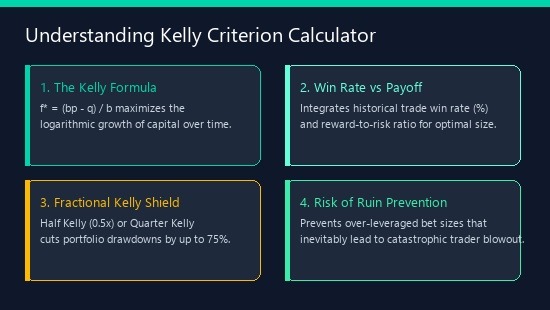
Full Kelly maximizes theoretical mathematical growth but causes brutal 50%+ portfolio drawdowns. Professional quant desks use Half Kelly (0.5x) to retain 75% of growth while cutting drawdowns by half.
⚡ Monte Carlo 1,000-Trade Simulator: Test 10 consecutive loss streaks and compute maximum portfolio drawdown.

How It Works in 4 Steps

1

Input Historical Win Rate

Enter the percentage of winning trades from your verified trading journal.

2

Set Payoff Ratio

Define your average profit per winning trade divided by average loss per loser.

3

Define Account Capital

Input total available trading capital deployed across your brokerage account.

4

Apply Fractional Kelly

View Half Kelly and Quarter Kelly position sizes to optimize capital growth.

Why Quantitative Desks Rely on the Kelly Criterion Formula

Developed by Bell Labs scientist John L. Kelly Jr. in 1956, the Kelly Criterion is a mathematical formula that determines the optimal fraction of capital to allocate to an investment with positive expectancy: f* = (b*p - q) / b.

While Full Kelly mathematically maximizes long-term compounded growth, it induces violent 50%+ equity drawdowns. Consequently, top quantitative hedge funds and proprietary desks deploy Half Kelly (0.5x) to harvest 75% of peak growth while dramatically slashing volatility.
Kelly Criterion Calculator — Quantitative Position Sizing Explainer Diagram


📋 Regulatory References & Data Sources
  • Black-Scholes-Merton (1973) option pricing model
  • SEBI circular SEBI/HO/MRD/DP/CIR/P/2019 — F&O margin framework
  • NSE circular NSE/CMPT/39170 — SPAN margin methodology
  • Securities Contracts (Regulation) Act 1956, as amended

Disclaimer: This calculator is for educational and planning purposes only. It does not constitute financial advice. Consult a SEBI-registered investment advisor for personalised guidance. Tax rules are updated as per the latest Finance Act — verify with a qualified CA before filing.

Frequently Asked Questions — Kelly Criterion Calculator — Quantitative Position Sizing

What is the Kelly Criterion formula in trading?
The formula is f* = (bp - q) / b, where b is the payoff ratio (win/loss), p is the probability of winning, and q is the probability of losing (1 – p).

Why is Half Kelly preferred over Full Kelly?
Full Kelly maximizes geometric growth but introduces extreme drawdowns that cause psychological burnout. Half Kelly delivers 75% of the growth rate with 50% less drawdown.

What happens if Kelly fraction is negative?
A negative Kelly result indicates that your trading strategy has negative mathematical expectancy. Trading with this system guarantees long-term capital depletion.

How do I calculate my strategy’s payoff ratio?
Divide your average profit on winning trades by your average loss on losing trades. For example, ₹3,000 average win ÷ ₹1,500 average loss = 2.0 payoff ratio.

How does Kelly position sizing prevent risk of ruin?
Because Kelly scales bet size as a percentage of current capital, position sizes shrink automatically during losing streaks, preventing complete account blowout.

Can Kelly Criterion be applied to options buying?
Yes. Because option buying typically features lower win rates (35%–45%) but high payoffs (3:1 to 5:1), Quarter Kelly helps prevent rapid theta decay drawdown.

How many trades are required to determine a reliable win rate?
A sample size of at least 50 to 100 executed trades across multiple market regimes is needed for statistically significant input parameters.

Does Kelly sizing factor in transaction costs?
Raw Kelly does not include friction. Traders should deduct brokerage and STT from win/loss amounts using our Indian Stock Brokerage Calculator.

How does Kelly sizing handle correlated open positions?
When holding multiple concurrent trades, total portfolio Kelly allocation across all positions should not exceed 20% to 25% of account equity.

How can crypto traders apply quantitative sizing?
Crypto derivative traders can model leverage risk using the Crypto Margin Trading Calculator on Emintage and scan token momentum with the Crypto Momentum Scanner on Emintage.


AR
Written & Verified By

Dr.Ashok Kumar N Rao

Stock Market Educator & Author | 3,500+ Students Trained

Alternative Investments advisor and author of 'Basics of Stock Market for Beginners' and 'ಕಲಿಯಿರಿ ಶೇರ್ ಮಾರ್ಕೆಟ್'. All financial tools and content on this site are reviewed personally before publication.