📅 Last Updated: July 2026 | Next update: January 2027 (when RBI resets FRSB rate)
Looking for a complete list of government bonds in india? Finding the right investment option is confusing because the single term “government bond” covers everything from a 91-day Treasury Bill to a 40-year Sovereign G-Sec. Each option works completely differently, carries distinct tax rules, and targets specific financial goals. However, most online guides dump a generic list of government bonds in india without telling you which bond actually fits your situation. So today, we break down all seven types from the full list of government bonds in india with real 2026 interest rates, tax rules, and step-by-step buying routes in plain English.
What Is a Government Bond in India?
Listen, boss, here is the basic definition in plain English. A government bond is a debt instrument that the Central or State Government issues when they need to borrow money from the public for infrastructure, roads, or economic development. So in return for your money, the government promises to pay you a fixed or floating interest rate at regular intervals and return your original principal amount when the bond matures.
Because the sovereign guarantee of India backs these bonds, they carry zero default risk. That means the Government of India cannot default on its rupee debt. Consequently, this makes government bonds india the safest fixed-income asset class in the country.
How do they differ from bank fixed deposits? First, unlike bank FDs, you can trade many government bonds on NSE and BSE exchanges before maturity. Second, unlike corporate bonds, you face zero credit risk. Currently, India offers seven distinct types of government bonds. So here is each option from the list of government bonds in india broken down in detail.
Complete List of Government Bonds in India — All 7 Types at a Glance
Before we go deep on each individual bond type in the list of government bonds in india, here is the full picture presented in a master reference table.
| Bond Type | Issuer | Tenure | Current Rate | Tax on Interest | Liquidity | Min Investment | Best For |
|---|---|---|---|---|---|---|---|
| Dated G-Secs | Govt of India | 5–40 years | 7.10–7.45% | Slab rate, no TDS | Exchange tradeable (NSE/BSE) | ₹10,000 | Long-term investors |
| Treasury Bills (T-Bills) | Govt of India | 91 / 182 / 364 days | ~6.85–7.10% (discount) | Slab rate | High — auctioned weekly | ₹10,000 | Short-term liquidity parking |
| RBI Floating Rate Savings Bond | RBI / Govt of India | 7 years | 8.05% (resets Jan & Jul) | Slab rate + TDS | Non-tradeable — locked | ₹1,000 | Conservative investors / retirees |
| State Development Loans (SDLs) | State Governments | 5–40 years | 7.40–7.60% | Slab rate, no TDS | Exchange tradeable | ₹10,000 | Yield-seekers wanting 25–50bps extra |
| Sovereign Gold Bonds (SGBs) | RBI | 8 years | 2.50% + gold price gain | Slab rate on 2.5% coupon | Limited — secondary market only | ~₹4,000 | Gold exposure — legacy holders only |
| 54EC Bonds (REC / PFC / IRFC) | PSU entities | 5 years | 5.25% | Slab rate (no TDS) | Non-tradeable | ₹10,000 | Property sellers saving LTCG |
| Inflation-Indexed Bonds | Govt of India | Variable | CPI-linked | Slab rate | Limited | ₹1,000 | Inflation protection seekers |
So your actual net return from any option in this list of government bonds in india depends directly on your income tax bracket. Therefore, check your exact tax slab using the Income Tax Calculator before committing your capital.
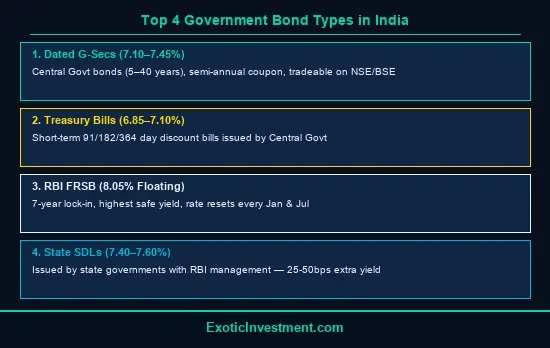
Illustration: Top 4 Government Bond Types in India Overview
RBI Floating Rate Savings Bond — Best in the List of Government Bonds in India
If you want the highest guaranteed interest rate that the Government of India backs today, the RBI Floating Rate Savings Bond (FRSB) is the premier choice in the list of government bonds in india. For instance, the Reserve Bank of India issues this bond on behalf of the Central Government, and it currently offers an impressive 8.05% per annum interest rate.
Now, here is how the floating rate formula works in practice. The RBI benchmarks the interest rate on FRSB directly to the National Savings Certificate (NSC) rate plus a fixed spread of 0.35%. Because the NSC rate is currently 7.70%, your total payout equals 8.05% p.a. also, the RBI resets this rate twice a year — on January 1 and July 1. So if NSC rates rise in the future, your bond payout automatically increases as a result.
The tenure of the RBI FRSB stays fixed at 7 years. Thus, regular investors get no premature exit option, although senior citizens above age 60 can access early exit windows after 4 to 6 years with minor penalty deductions. You can start investing with as little as ₹1,000, and no upper investment limit exists. In addition, the RBI pays interest semi-annually on January 1 and July 1 every year.
Now, let’s look at tax rules. In fact, you pay tax on FRSB interest according to your regular income tax slab rate. Also, the paying bank deducts TDS automatically if your annual interest exceeds ₹10,000. Therefore, this bond suits retirees, conservative investors, and people parking large sums of capital above ₹5 Lakh who want zero credit risk.
Dated G-Secs — Backbone of the List of Government Bonds in India
Dated central government bonds, commonly called G-Secs, form the foundation of India’s debt capital market and represent the largest segment in the list of government bonds in india. When the Indian government raises long-term funds, it issues dated G-Secs with maturities ranging from 5 years up to 40 years. Currently, the 10-year benchmark G-Sec yields around 7.40% to 7.45% per annum.
These bonds pay a fixed semi-annual coupon payment directly into your registered bank account. In addition, one big advantage of dated G-Secs is that the government lists them on NSE and BSE for trading. That means if you need liquidity before maturity, you can easily sell your holding on the secondary market through your broker app.
Here is the thing about bond pricing — bond prices and interest rates move in opposite directions. So when the RBI raises interest rates in the economy, prices of existing G-Secs drop on the secondary market. Conversely, when the RBI cuts interest rates, existing higher-coupon bond prices rise, which creates capital gains opportunities. But if you hold your G-Sec all the way to maturity, daily market price fluctuations do not affect you at all — because you receive your full principal back.
Tax treatment is straightforward. As a result, you add coupon interest to your annual income and pay tax at your slab rate, but banks deduct no TDS for individual investors. However, if you sell your G-Sec on the stock exchange before maturity, you pay Short-Term Capital Gains (STCG) tax at slab rate if held under 12 months, or Long-Term Capital Gains (LTCG) tax at 12.5% without indexation if held for 12 months or longer.
Treasury Bills (T-Bills) — Short-Term Option in Government Bonds India
If you have surplus cash to park for a few months and do not want to lock money in a 1-year bank FD, Treasury Bills are the top short-term entry in the list of government bonds in india. For instance, the Central Government issues T-Bills exclusively in three standard tenures: 91 days, 182 days, and 364 days.
T-Bills are zero-coupon bonds. That means they pay no explicit interest rate. Instead, the government issues them at a discount to face value and redeems them at full face value upon maturity. For example, you might purchase a ₹10,000 face-value 91-day T-Bill for ₹9,830 during the RBI auction. So when 91 days complete, the RBI credits ₹10,000 to your bank account, which gives you a ₹170 profit.
Currently, the annualised yield on T-Bills ranges between 6.85% and 7.10%. also, the tax department classifies the price difference between your buying discount and face value as interest income, which you pay at your regular income tax slab. Therefore, you can buy T-Bills through RBI Retail Direct or your demat broker, so they work perfectly for short-term liquidity management.
State Development Loans (SDLs) — High-Yield State Government Bonds in India
Individual Indian states like Maharashtra, Tamil Nadu, Karnataka, Gujarat, and Uttar Pradesh issue State Development Loans (SDLs) to fund local infrastructure projects. So they form a vital higher-yield segment in the overall list of government bonds in india, with maturities ranging from 5 years to 40 years.
Here is the secret why savvy fixed-income investors love SDLs: they offer a yield premium of 25 to 50 basis points (0.25% to 0.50%) over Central G-Secs of the exact same maturity. So in 2026, while 10-year Central G-Secs yield 7.40%, 10-year SDLs from states like Tamil Nadu or Maharashtra yield 7.55% to 7.60%.
Why do SDLs pay higher yields? First, state governments have slightly lower secondary market trading liquidity, so investors demand a small premium for state-level fiscal variance. Second, here is the safety guarantee — the Reserve Bank of India manages all SDL auctions, interest servicing, and principal repayments directly. Because the RBI holds automatic debit rights on central tax transfers to states, SDL default is practically impossible.
Taxation on SDLs is identical to Central G-Secs — thus, you pay tax on coupon interest at your income slab rate with zero TDS. As a result, you can buy SDLs easily through RBI Retail Direct auctions or your stockbroker demat account.
Sovereign Gold Bonds (SGBs) — Gold Option in Government Bonds India
The RBI designed Sovereign Gold Bonds (SGBs) as a paper alternative to physical gold bullion. In fact, they offer an annual interest coupon of 2.50% paid semi-annually, plus capital appreciation linked directly to the prevailing domestic price of 24-karat gold over an 8-year tenure.
However, we must address a key market update. The Government of India has quietly discontinued fresh SGB issuances — so no new SGB tranche has been offered since February 2024. But if you see SGBs listed on your broker app today, you are looking at existing series trading on the secondary market on NSE and BSE, often at a premium over physical spot gold prices.
And here is the key tax update from April 2026. First, the famous tax-free maturity exemption applies ONLY to original subscribers who bought SGBs during primary RBI tranches and held them for the full 8 years. Therefore, if you buy SGBs on the secondary market today, you pay full tax on any capital gains realized upon redemption or sale like physical gold or debt assets. So do not let anyone sell you secondary market SGBs promising tax-free returns.
54EC Bonds — Tax Saving Option in the List of Government Bonds in India
Government-backed PSU entities including Rural Electrification Corporation (REC), Power Finance Corporation (PFC), and Indian Railway Finance Corporation (IRFC) issue specialized 54EC bonds. Thus, they form a dedicated tax-shelter category within the list of government bonds in india.
If you sell a house, land, or commercial building and incur long-term capital gains, you can reinvest up to ₹50 Lakh of that capital gain into 54EC bonds within 6 months of the sale date. As a result, doing so makes your property LTCG completely tax-exempt. However, 54EC bonds carry a 5-year lock-in period, a fixed 5.25% annual coupon, and remain non-tradeable.
Now, here is the major tax trap that financial advisors rarely mention. While 54EC bonds shelter your original property capital gain from LTCG tax, you must pay full income tax on the 5.25% annual interest at your regular income tax slab rate. So at a 30% tax bracket, your post-tax return on 54EC interest drops to a meager 3.68% per year. Therefore, use 54EC bonds strictly for tax shelter on property sales — never for regular income investments.
Inflation-Indexed Bonds — Inflation Protection in Government Bonds India
Inflation-Indexed Bonds (IIBs) are government securities where the RBI adjusts both the principal value and coupon payments periodically based on the Consumer Price Index (CPI) inflation rate. Thus, they offer real wealth preservation among the options in the list of government bonds in india.
Here is how the inflation adjustment works in practice. For instance, if you invest ₹1,00,000 in an Inflation-Indexed Bond with a 1.5% real coupon rate, and annual CPI inflation rises by 6%, the principal value increases to ₹1,06,000. So the RBI calculates your 1.5% interest coupon on the updated ₹1,06,000 principal. Consequently, this ensures your real purchasing power stays positive.
However, availability of IIBs in India is intermittent. In fact, the RBI launches inflation-indexed bond series periodically based on market demand. When available, you can access them via RBI Retail Direct or institutional market windows. So they suit retirees and long-term conservative investors who worry about inflation eating away their wealth.
Government Bonds vs Corporate Bonds — Comparison in India
When picking fixed-income assets, many investors compare sovereign paper against corporate debentures. Comparing corporate bonds vs government bonds reveals fundamental differences in risk, taxation, and yield expectations. Also, while some investors search for aaa rated government bonds in india, sovereign G-Secs carry a rating tier above AAA because they hold sovereign backing.
| Factor | Government Bond | AAA Corporate Bond | High-Yield Corporate Bond |
|---|---|---|---|
| Default Risk | Zero (sovereign) | Very low (AAA rated) | Moderate to high |
| Typical Yield | 7.0–8.05% | 8.0–9.5% | 10–13%+ |
| TDS | No TDS for individuals | 10% if interest >₹5,000 | 10% if interest >₹5,000 |
| Liquidity | Exchange tradeable | Varies by bond | Often illiquid |
| Credit Rating | Sovereign (above AAA) | AAA — CRISIL/ICRA/CARE | AA and below |
| Who should use | Safety-first investors | Slightly higher yield seekers | High-risk appetite only |
So for most retail investors in India, taking on credit risk for an extra 1.5% yield on corporate bonds rarely makes sense. In fact, AAA-rated PSU bonds from entities like Power Grid or NHAI come close to sovereign safety, but options from the list of government bonds in india remain the gold standard for risk-free investing.
To understand how market volatility impacts risk across asset classes, check out our guide on Beta Calculation for Indian Stocks.
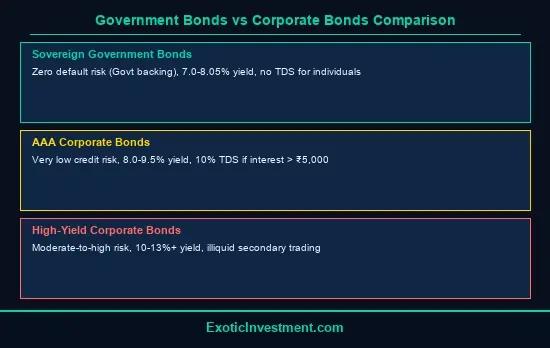
Illustration: Side-by-side comparison of Government Bonds vs AAA Corporate Bonds
Government Bond Mutual Funds — Gilt Funds for Government Bonds in India
If you prefer not to manage individual bond purchases or maturity dates yourself, government bond mutual funds — commonly known as Gilt Funds — offer a hassle-free alternative to buying directly from the list of government bonds in india. By regulatory mandate, Gilt Funds must invest at least 80% of their total assets in sovereign G-Secs and T-Bills.
When you invest in Gilt Funds, a professional fund manager manages portfolio duration and yield curve positioning. So you can start investing via SIP with as little as ₹500 per month, which is impossible with direct G-Sec auctions that require ₹10,000 minimum lots.
However, you must understand duration risk before buying Gilt Funds. For instance, when interest rates rise, long-duration Gilt Fund NAVs fall temporarily. Conversely, when the RBI cuts interest rates, Gilt Funds generate impressive capital gains as underlying bond prices rally.
Taxation on Gilt Funds follows post-April 2023 debt mutual fund rules — so you add all capital gains to your income and pay tax at your applicable income tax slab rate, regardless of how long you hold the fund units.
Post-Tax Returns — Real Yields from the List of Government Bonds in India
The stated coupon yield on any option in the list of government bonds in india is only half the picture. So at a 30% tax bracket, an 8.05% FRSB interest rate turns into a 5.64% net post-tax return. Therefore, comparing gross yields against your tax slab is essential before investing. Here is the complete post-tax breakdown across major income brackets:
| Instrument | Gross Yield | Post-Tax (0% slab) | Post-Tax (20% slab) | Post-Tax (30% slab) |
|---|---|---|---|---|
| RBI FRSB | 8.05% | 8.05% | 6.44% | 5.64% |
| 10-Year G-Sec | 7.40% | 7.40% | 5.92% | 5.18% |
| SDL (avg) | 7.55% | 7.55% | 6.04% | 5.29% |
| 54EC Bond | 5.25% | 5.25% | 4.20% | 3.68% |
| Large Bank FD | 7.10% | 7.10% | 5.68% | 4.97% |
| AAA Corp Bond | 8.80% | 8.80% | 7.04% | 6.16% |
Notice how at a 30% tax bracket, a 10-year G-Sec and a standard bank FD deliver almost identical post-tax returns. But the G-Sec is tradeable on the stock exchange while the bank FD carries premature withdrawal penalties. That exchange liquidity advantage matters greatly when market interest rates shift.
Use our Income Tax Calculator to check your exact tax bracket first, then use the Reverse CAGR Calculator to project your final bond wealth over 10 to 20 years.
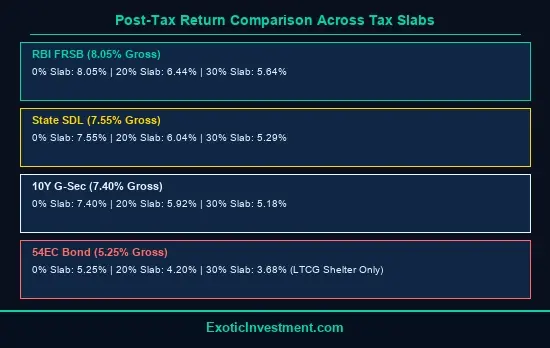
Illustration: Post-tax returns on government bonds across 0%, 20%, and 30% tax slabs
Current Interest Rates: List of Government Bonds in India (2026)
Interest rates shift with RBI monetary policy. Here is the live reference table for government bonds return rate and best interest rate government bonds across the list of government bonds in india as of July 2026. We update this table every January and July when the RBI resets FRSB benchmark rates.
| Instrument | Current Rate | Valid Until | Next Reset |
|---|---|---|---|
| RBI FRSB | 8.05% p.a. | December 31, 2026 | January 1, 2027 |
| 10-Year G-Sec Yield | ~7.40–7.45% | Market-linked (daily) | Continuous |
| 91-Day T-Bill | ~6.85% | Market-linked | Weekly auction |
| SDL (average) | 7.40–7.60% | Market-linked | Quarterly auction |
| 54EC Bonds (REC/PFC/IRFC) | 5.25% | Until issuer revision | Issuer announcement |
| RBI Repo Rate (context) | 5.25% | Latest RBI MPC meeting | Next MPC meeting |
How to Invest in the List of Government Bonds in India — 4 Routes
If you want to buy the best government bonds to invest in india today, you have four distinct routes depending on whether you prefer online auctions, demat apps, mutual funds, or bank branches.
Route 1 — RBI Retail Direct (rdirectrbi.org.in)
The RBI Retail Direct portal allows individual investors to open a free Gilt Account directly with the Reserve Bank of India with zero fees. So you can participate in primary auctions for G-Secs, T-Bills, and SDLs starting from ₹10,000 minimum investment.
To register, visit rdirectrbi.org.in, complete your online KYC using Aadhaar and PAN, and link your savings bank account. Once approved, you can place non-competitive bids in weekly RBI auctions and receive direct bond credits.
Route 2 — Demat Account (NSE/BSE Secondary Market)
If you already have a demat account with Zerodha, Upstox, Groww, or Angel One, you can buy listed G-Secs and SDLs directly on the secondary market. Thus, search the bond ISIN or name on your app and buy units just like buying shares.
This route suits investors who want to buy specific existing bond issuances at current market yields without waiting for fresh RBI auctions.
Route 3 — Gilt Mutual Funds
For hands-off investors, Gilt Funds require no demat account or auction bidding. You can set up a monthly SIP from ₹500 using any mutual fund app like Zerodha Coin or ET Money. So the professional fund manager handles all duration and reinvestment decisions for you.
Route 4 — Bank Branches (FRSB Only)
If you want to buy the RBI Floating Rate Savings Bond (8.05%), you can visit designated branches of SBI, HDFC Bank, ICICI Bank, PNB, Axis Bank, or Bank of Baroda. So bring your Aadhaar, PAN card, and cheque book to complete the physical application form.
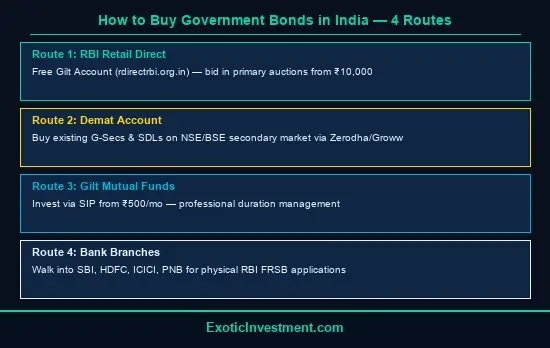
Illustration: 4 Step-by-step routes to buy government bonds in India
Which Option in the List of Government Bonds in India Suits You Best?
Not sure which government bond matches your life stage? Here is our investor persona map matching each profile to the ideal option in the list of government bonds in india:
| Investor Type | Best Bond | Why |
|---|---|---|
| Retiree needing regular income | RBI FRSB (8.05%) | Semi-annual payout, highest safe rate, no market risk |
| Salaried at 30% slab | SDL or 10Y G-Sec | Slightly higher pre-tax yield — no TDS — declare in ITR |
| Property seller with LTCG | 54EC Bonds (REC/PFC/IRFC) | Only legal route to shelter property sale LTCG — invest within 6 months |
| Young investor (25–35) SIP habit | Gilt Mutual Fund | Duration risk manageable long-term — SIP-able from ₹500 |
| Short-term parking (under 1 year) | 91-Day T-Bills | Highest safety + predictable return + auto-renew via RBI Retail Direct |
| Inflation-worried retiree | Inflation-Indexed Bonds | Principal rises with CPI — protects real purchasing power |
| Yield-seeker wanting a little more | State SDL | 25–50bps above G-Sec with same sovereign backing tier |
To figure out your exact financial targets before investing, use our Retirement Corpus Calculator, and then use the Reverse CAGR Calculator to see what bond yield gets you there.
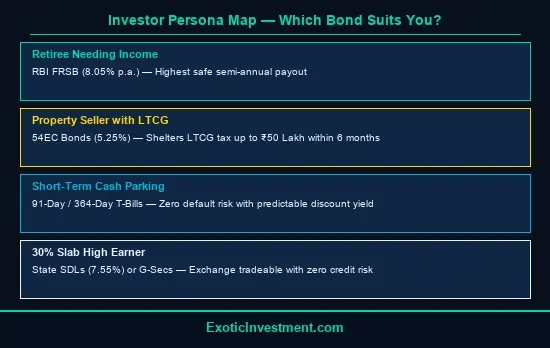
Illustration: Investor persona map matching bond types to investor profiles
Tax Rules on the List of Government Bonds in India Explained
Let’s debunk a major myth right now. There are no tax free government bonds currently available for fresh investment in India in 2026. The famous 8% tax-free bonds issued by NHAI, REC, and HUDCO between 2012 and 2016 have all matured. Every option in the current list of government bonds in india is subject to taxation.
Here is the exact tax rules summary for 2026:
First, you add interest earned on Dated G-Secs, T-Bills, and SDLs to your total income and pay tax at your applicable income tax slab rate. Banks deduct no TDS for individual investors, so you must declare coupon payments in your annual ITR under “Income from Other Sources”.
Second, you pay full tax on RBI FRSB interest at slab rates, and banks deduct 10% TDS automatically if interest exceeds ₹10,000 per financial year.
Third, if you sell G-Secs or SDLs on stock exchanges, you pay Short-Term Capital Gains (STCG) tax at slab rates if held for less than 12 months, or Long-Term Capital Gains (LTCG) tax at 12.5% without indexation if held for 12 months or longer.
Use These Calculators for Your List of Government Bonds in India
Knowing the interest rate is only the starting point. What really matters is calculating how much your capital grows to after tax and inflation over your specific holding period. So we built dedicated financial tools to help you run exact numbers for any option in the list of government bonds in india:
First, use our government bond calculator hook via the Reverse CAGR tool to project what corpus a 7.40% G-Sec builds over 10 to 20 years.
Second, check your exact tax bracket using the Income Tax Calculator so you can read your net post-tax bond yield accurately.
Third, work backwards from your ultimate target wealth using the Retirement Corpus Calculator to determine your exact monthly fixed-income allocation today.
🎓 Master Stock Market Investing — From Basics to Advanced!
Want to understand how bonds fit into your overall investment portfolio, pick stocks with confidence, and build long-term wealth like a professional? Enroll in our top-rated Basics of Stock Market course today!
[🎓 ENROLL IN BASICS OF STOCK MARKET COURSE NOW 🚀]
Ashok Kumar N Rao’s book ‘Basics of Stock Market for Beginners’ covers the complete debt and equity investment framework in plain language — available in English paperback and Kindle on Basics of Indian Stock Market Book Page.
Frequently Asked Questions — List of Government Bonds in India
FAQ 1: What is the complete list of government bonds in india available in 2026?
There are seven main types in the full list of government bonds in india — Dated G-Secs, Treasury Bills, RBI Floating Rate Savings Bonds, State Development Loans, Sovereign Gold Bonds, 54EC Bonds, and Inflation-Indexed Bonds. Each type serves a distinct tenure, yield, and tax profile. To project how your money grows in any of these instruments, use the Reverse CAGR Calculator.
FAQ 2: Which are the best government bonds to invest in india right now?
The best option in the list of government bonds in india depends on your financial objective. For the highest safe rate, the RBI FRSB at 8.05% is currently unmatched. For secondary market trading liquidity, 10-year G-Secs at 7.40% are ideal. Use our Retirement Corpus Calculator to define your financial target first.
FAQ 3: Are tax free government bonds available in the list of government bonds in india in 2026?
Honestly, no fresh tax free government bonds are available in 2026. The classic tax-free bond issues from NHAI and REC have all matured. Every option in the current list of government bonds in india is taxed at your income slab rate. Calculate your net tax impact using the Income Tax Calculator.
FAQ 4: What is the current RBI government bond interest rate?
The RBI Floating Rate Savings Bond currently pays 8.05% p.a., valid through December 31, 2026. It resets semi-annually based on the NSC rate plus a 0.35% margin. Meanwhile, 10-year benchmark Central G-Secs yield around 7.40% to 7.45%. Check our live rates table above for full details.
FAQ 5: What is the difference between central government bonds and state government bonds?
Central government bonds (G-Secs) carry direct sovereign guarantee from the Government of India. State government bonds (SDLs) are issued by individual states but managed and debt-serviced directly by the RBI. SDLs typically pay 25 to 50 basis points higher yield than Central G-Secs. Both can be bought via RBI Retail Direct.
FAQ 6: How do I invest in government bonds in India through RBI Retail Direct?
Visit rdirectrbi.org.in and complete online registration with Aadhaar, PAN, and bank account. Once your free Gilt Account opens, you can place non-competitive bids in weekly primary auctions from ₹10,000. There are zero platform fees or brokerage charges involved.
FAQ 7: What are government bond mutual funds and how do they differ from direct bonds?
Government bond mutual funds, also called Gilt Funds, invest 80% or more of their total assets in G-Secs and T-Bills. Unlike direct bonds, Gilt Funds allow monthly SIPs from ₹500 and offer daily liquidity. For SIP return projections, check our Step-Up SIP Return Calculator.
FAQ 8: What is the difference between government bonds and corporate bonds?
Government bonds carry zero default risk due to sovereign backing. Corporate bonds carry credit risk that varies based on the company’s rating. The higher yield on corporate bonds compensates for that added default risk. For risk comparison across asset classes, see our Beta Calculation page.
FAQ 9: Are Sovereign Gold Bonds (SGBs) still a good investment in 2026?
Fresh SGB issuances have been discontinued by the government since February 2024. If you buy SGBs on secondary market exchanges today, the tax-free maturity exemption does not apply to you. Gold ETFs or Gold Funds are cleaner digital gold options today. Compare gold vs bond compounding using our Lumpsum Investment Calculator.
FAQ 10: What happens to government bond prices when the RBI changes interest rates?
Bond prices move opposite to market interest rates. When the RBI raises rates, existing bond prices fall on the secondary market. When the RBI cuts rates, bond prices rise. This price fluctuation only affects you if you sell before maturity. Evaluate rate scenarios with our Stock Market Rate of Return Calculator.
Choosing the right fixed-income security depends on your income tax bracket, investment horizon, and liquidity needs. Whether you pick the 8.05% RBI FRSB for regular income or a 10-year G-Sec for tradeable stability, checking this complete list of government bonds in india and aligning your choice with your tax slab is the key to maximizing real wealth. Bookmark this page for our bi-annual rate updates, and map your path using the Reverse CAGR Calculator today.