
Knowing what defines a majority stockholder helps retail investors decode promoter power, takeover rules, and minority risks on NSE. Holding over 50% voting shares grants clear authority across corporate boards, cash dividends, and acquisitions. Audit promoter alignment carefully alongside our promoter share pledging guide cleanly.
Wait — can a founder or government institution still control a company without owning 51% stock personally? Yes! Whenever remaining equity scatters across passive public owners, holding even 35% confers strong practical board control.
Yet SEBI enforces strict public shareholding caps, takeover rules, and audit disclosures specifically to defend retail investors! First, examine each statutory ownership tier across Indian corporate law. Next, uncover hidden minority governance risks before buying heavily controlled family stocks.
What Makes Someone a Majority Stockholder on NSE and BSE?
Legally, a majority stockholder owns strictly above 50% of outstanding voting equity shares. On Dalal Street, this commanding position usually sits with founding promoter families, foreign corporate parents, or government ministries. Above all, passing the 50% line enables easy approval of Ordinary Resolutions at Annual General Meetings.
Unlike preference stockholders who trade votes away for steady fixed payouts, equity owners cast one vote per share. Consequently, majority ownership settles board seat appointments, executive hiring, and annual payout ratios directly! Compare security classes clearly inside our equity vs preference share guide anytime.

Illustration: Corporate voting ladder from 10% blocking power up through 25% SEBI Open Offer trigger, 50%+ majority control, and 75% Special Resolution mastery.
Key Ownership Thresholds Under SEBI & the Companies Act 2013
Corporate authority never starts abruptly at 50.1% alone! Instead, Indian law defines crystal-clear shareholding ladders where investor protections and voting power change sharply.
5% Initial Disclosure and 10% Significant Beneficial Ownership
Crossing 5% ownership in any listed Indian firm forces mandatory public exchange reporting immediately under takeover norms. In addition, holding 10% indirect beneficial power classifies individuals legally as Significant Beneficial Owners (SBOs) on MCA filings. Track major institutional threshold entries cleanly via our FII DII data desk daily.
25% Stake — Mandatory SEBI Open Offer Trigger
Under SEBI’s SAST takeover code, any buyer crossing 25% voting control must launch a public Open Offer! Specifically, they must offer to buy an extra 26% stake directly from public shareholders at fair formula pricing. Therefore, small investors gain an instant transparent exit right during hostile takeovers.
50%+1 Share — Ordinary Resolution Control
Holding past 50% gives a majority stockholder smooth control over routine governance, director slates, and auditor picks. As a result, external activist funds almost never overturn board plans without promoter backing.
75% Ceiling — Special Resolutions vs Minimum Public Float
Holding 75% allows passing major Special Resolutions for mergers, name switches, or tender offer buybacks! However, SEBI’s Minimum Public Shareholding mandate caps listed promoter stakes strictly at 75%. Consequently, excess promoter equity must move onto public markets via Offer-for-Sale auctions—check block deal flows carefully.

Illustration: SEBI investor safeguards enforcing the 75% Minimum Public Shareholding cap, SBO transparency, and minority Open Offer exit rights.
Ownership Threshold Table: Legal Power Across Equity Stakes
Bookmark this governance reference sheet when reading quarterly NSE shareholding charts. Immediately checking ownership zones highlights true boardroom power dynamics fast.
| Equity Ownership Level | Statutory Power Granted | SEBI / MCA Disclosure Rule | Retail Investor Impact |
|---|---|---|---|
| 5% Threshold | No direct board control yet | Mandatory SAST disclosure filing | Signals major fund accumulation |
| 25% Threshold | Blocks any 75% Special Resolution | Triggers 26% public Open Offer | Protects minority takeover pricing |
| 50.1%+ (Majority Stockholder) | Passes Ordinary Resolutions & board control | Holding/Subsidiary accounting rules | High alignment OR oppression risk |
| 75% Maximum Cap | Unilateral Special Resolution pass | SEBI 25% Min Public Float cap | Watch OFS dilution & pledges |
Promoter Alignment vs Minority Risks Every Investor Must Audit
Wait — does a hefty 70% promoter holding automatically spell safety for retail shareholders? Often, strong family stakes align promoter net worth cleanly with steady dividends and conservative borrowing. Thus, aligned founders rarely risk reckless acquisitions that destroy equity value.
Yet heavy control creates three grave minority traps whenever corporate governance fails! First, corrupt majority owners can drain profits privately using biased Related Party Transactions. Second, pledged promoter stock faces sudden forced margin selling during corrections—inspect pledges cleanly inside our promoter pledge risk checker.
Third, watch out for tiny public-float smallcaps locked into ASM exchange surveillance stages! Always confirm liquid institutional participation cleanly inside our relative valuation tool before trusting thin order books.
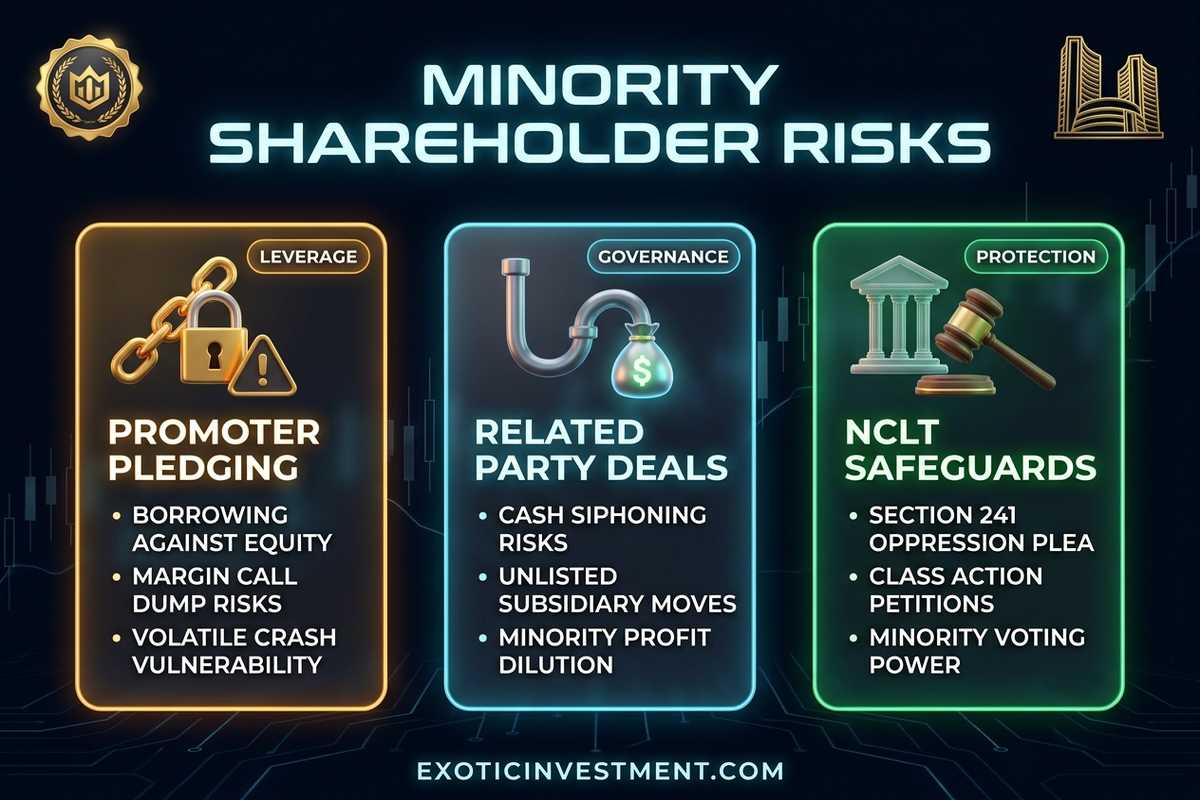
Illustration: Retail governance checklist auditing zero promoter share pledges, fair related-party transactions, and healthy institutional ownership.
Worked Takeover Math: What Happens When Promoters Exceed 75%
Suppose a foreign parent holds 72% of an Indian subsidiary and gains 5% more through corporate restructuring! Immediately, promoter equity touches 77%, crossing SEBI’s strict 75% public-float limit! Within twelve months, rules force cutting that holding back to 75% via an Offer for Sale.
Spotting mandatory upcoming OFS supply keeps retail investors away from temporary low-float rallies at inflated multiples! Test fair intrinsic margins calmly via our PE ratio calculator and DCF valuation calculator first.
How Public Shareholders Monitor Promoter Intent Across Quarters
Tracking a majority stockholder goes far beyond checking one static annual percentage number! Instead, smart Dalal Street investors compare four consecutive quarters of BSE shareholding filings side by side. Specifically, steady promoter buying or declining pledge percentages confirm deep confidence in upcoming cash flows.
Conversely, repeated stealth stake reductions or unexplained holding-company transfers demand immediate caution! For instance, shifting personal equity off-market without clear explanation occasionally foreshadows weaker quarterly profits ahead. Compare ownership behavior calmly alongside institutional flows inside our FII DII data desk and check block deal disclosures cleanly.
In addition, remember institutional DIIs such as mutual funds act as vocal watchdogs inside controlled companies today! Therefore, healthy 15%+ domestic fund ownership alongside an aligned founding family often produces India’s cleanest governance track records. Test business earnings durability inside our operating margin explainer and verify EPS stability first.
Evaluating Majority Ownership Before Long-Term Capital Allocation
Never judge corporate quality solely by promoter holding percentages! For example, tiny public floats often exaggerate upward price swings during quiet sessions before triggering brutal liquidity drops on exits.
Always inspect trading volumes beside ownership charts beforehand. In addition, tracking quarterly institutional shareholding builds confidence before deploying core savings.
Meanwhile, verify whether independent board directors actively question unusual promoter executive salaries or inter-corporate loans at Annual General Meetings cleanly! When minority investors respect clear corporate governance boundaries and track active institutional buying steadily across market cycles, long-term portfolio compounding thrives calmly. Check valuation cushions before investing via our DCF valuation calculator and verify daily institutional interest calmly via our FII DII data tracker anytime.
🚀 Trade Clean Dalal Street Setups With Institutional Discipline
Avoid sneaky corporate governance traps on Dalal Street. Spot clean promoter-backed compounders alongside Dr. Ashok Kumar N Rao and our 1,300+ active trading community.
- Strengthen equity foundations via our Kaliyiri Share Market Book and English bestseller Basics of Indian Stock Market Book.
- Access institutional screeners and pro research via the MultiBagger Plus Courses & Pro Tools Annual Subscription.
- Master price structure in our Technical Analysis Course in Kannada or index strategies in our Options Buying Course in Kannada.
💡 Frequently Asked Questions (FAQ): Majority Stockholder
1. What percentage ownership makes someone a majority stockholder?
A majority stockholder owns above 50% of outstanding voting equity shares, controlling board appointments and Ordinary Resolutions! Compare common voting stock with preference capital inside our security class explainer today.
2. Can a promoter hold 90% in a listed Indian company permanently?
No! SEBI’s Minimum Public Shareholding rule mandates at least 25% non-promoter float, capping promoter stakes at 75%! Watch large public stake sales calmly via our block deal guide.
3. How are minority investors protected if a new buyer acquires 51% control?
Crossing 25% voting control forces a SEBI SAST Open Offer buying at least 26% equity from public holders! Study how SEBI market oversight defends minority rights daily.
4. What is a Significant Beneficial Owner (SBO) under Indian company law?
An SBO is the human individual holding 10%+ indirect voting power through layered trusts or holding companies under MCA rules! Always verify pledge disclosures too inside our promoter pledge guide cleanly.
5. Can a majority stockholder forcibly seize minority retail investors’ shares?
Not arbitrarily! Voluntary delistings demand reverse book-building pricing plus two-thirds approval from public minority voters cleanly. Check formal exit norms inside our share buyback guide anytime.
6. Is high promoter holding above 65% always a positive sign?
Wait — strong founder equity helps ONLY alongside zero share pledges, real free cash flow, and steady institutional buying! Audit valuation safety beforehand via our relative valuation tool first.