Understanding what is block deal in share market mechanics is essential for any retail trader seeking to decipher institutional money flow on Dalal Street. When foreign institutional investors (FIIs), domestic mutual funds, or company promoters exchange massive blocks of equity shares, routing these orders through normal continuous order books would trigger chaotic price slippage. Therefore, the Securities and Exchange Board of India (SEBI) established a dedicated trading mechanism designed to execute large-ticket transactions cleanly without disrupting ordinary market stability.
Every single week on the National Stock Exchange (NSE) and Bombay Stock Exchange (BSE), institutional desks trade thousands of crores through these specialized windows. Because these transactions reflect high-conviction portfolio adjustments, tracking them offers retail investors valuable insights into where smart money is accumulating or distributing equity. In this guide, we break down the latest regulatory frameworks, revised transaction thresholds, window timings, and trading strategies.
What is Block Deal in Share Market? Core Mechanism and Regulatory Purpose
A block deal represents a single, pre-arranged transaction between two institutional or high-net-worth parties involving a minimum order value of ₹25 Crore. Unlike ordinary retail orders that match continuously against available bids and asks, block deals execute through a discrete, independent exchange matching engine. As a result, large institutional rebalancing orders do not wipe out retail market depth or cause artificial price spikes.
Historically, SEBI mandated a minimum ticket size of ₹10 Crore for block transactions. However, following updated market capitalization expansions and regulatory circulars, the minimum order size was officially revised upwards to ₹25 Crore to maintain institutional integrity. Consequently, this elevated barrier prevents smaller speculative syndicates from exploiting the block window for retail manipulation.
In addition, orders placed in the block deal window are 100% firm and non-reversible. Both parties must bring 100% upfront margins, and every executed trade must result in mandatory physical delivery under standard settlement cycles. You can explore how equity settlement frameworks function under exchange clearing houses in our guide on cash delivery and CNC trade execution.
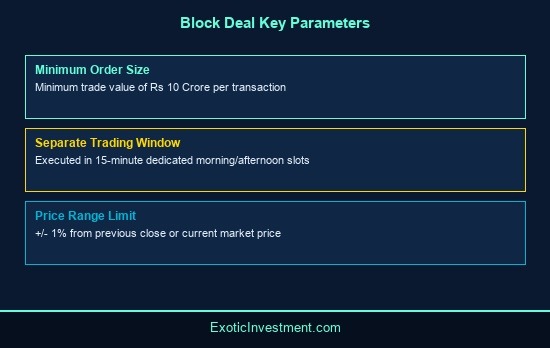
Illustration: Block Deal Institutional Execution Mechanism and SEBI Framework
SEBI Trading Windows and Price Band Regulations
SEBI provides two dedicated 15-minute trading windows during the trading day to facilitate block transactions. Specifically, these windows operate outside normal volatile opening and closing auction minutes to preserve price discovery:
- Morning Block Deal Window (08:45 AM to 09:00 AM IST): This window opens before the normal market pre-open session. The reference price for this window is fixed strictly at the previous trading session’s closing price.
- Afternoon Block Deal Window (02:05 PM to 02:20 PM IST): This secondary window operates during the mid-afternoon session. The reference price is calculated using the Volume Weighted Average Price (VWAP) of all trades executed between 01:45 PM and 02:00 PM.
In addition, SEBI enforces a strict price band of ±3% around the applicable reference price for all block transactions. This ±3% corridor ensures that buyers and sellers negotiate within realistic fair value bounds. Thus, the agreed execution price can never breach the stock’s standard exchange daily circuit filter.
For example, if an F&O underlying stock closed yesterday at ₹1,000, morning block participants can negotiate orders only between ₹970 and ₹1,030. If two institutional counterparties attempt to match an order outside this ±3% corridor, the exchange matching engine rejects the trade instantly. You can model price bands and stop-loss boundaries using our free stock profit calculator.
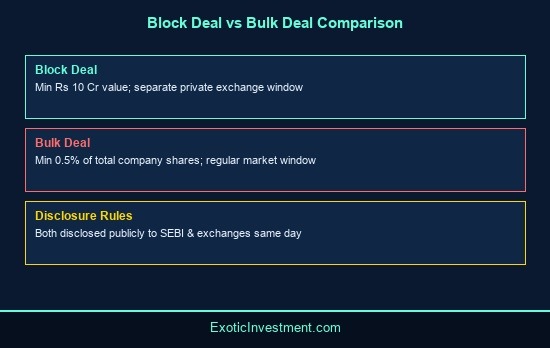
Illustration: Block Deal vs Bulk Deal Regulatory Comparison Matrix
Block Deal vs Bulk Deal: Critical Differences Every Trader Must Know
Many Dalal Street participants mistakenly use the terms block deal and bulk deal interchangeably. In reality, these two transaction classes operate under completely distinct regulatory parameters, order books, and reporting rules:
| Regulatory Feature | Block Deal Mechanism | Bulk Deal Mechanism |
|---|---|---|
| Minimum Order Value / Size | ₹25 Crore minimum single order | 0.5% or more of company listed equity |
| Order Book & Trading Window | Dedicated separate 15-min window | Normal continuous market order book |
| Price Band Constraints | ±3% of applicable reference price | Standard stock daily circuit limit |
| Public Disclosure Timing | Immediate dissemination post-window | Disclosed post-market close by 6:00 PM |
| Intraday Squaring Off | Strictly prohibited (100% Delivery) | Permitted (Can be intraday day-trade) |
| Retail Participation | Not possible due to ₹25 Cr barrier | Possible if capital crosses 0.5% equity |
Because bulk deals execute in the normal trading order book, large market orders can cause sudden intraday candle spikes. In contrast, block deals take place on a private exchange matching engine without altering the live quoted bid-ask spread. To track how institutional participants manage systemic capital movements across both windows, study our in-depth research on FII vs DII institutional market dynamics.
Similarly, all equity delivery transactions arising from block executions attract statutory Securities Transaction Tax (STT) of 0.1% on both the buyer and seller sides. You can calculate the total transactional impact of these multi-crore executions using our free Indian stock brokerage calculator.
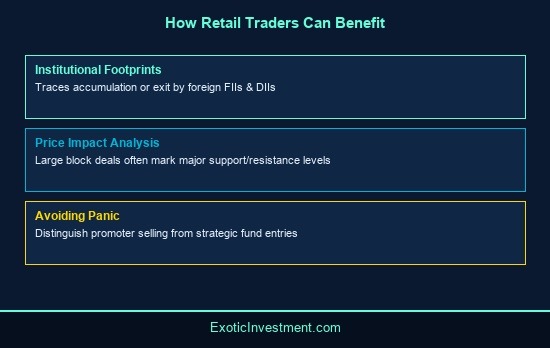
Illustration: Analyzing Institutional Footprints and Retail Trading Strategies
How Retail Traders Can Profitably Interpret Block Deals
While retail traders cannot participate directly in block deals due to the ₹25 Crore barrier, understanding the context behind every executed transaction provides a significant edge. When NSE and BSE release block deal disclosures immediately after each window closes, savvy traders analyze three decisive factors:
1. Buyer Identity and Institutional Credibility: If high-pedigree global sovereign funds or top-tier domestic mutual funds buy shares from an outgoing private equity investor, the market views this as institutional endorsement. Conversely, if company promoters sell significant equity during a market rally, it often signals valuation exhaustion or promoter deleveraging. Therefore, always verify who bought and who sold rather than looking purely at transaction volume.
2. Execution Price Relative to Spot Market: Pay close attention to whether the block executed at a premium or a discount to the previous close. When an incoming institution happily pays a 2% premium above current market price to acquire a ₹500 Crore stake, it reveals urgent institutional demand. In contrast, heavy block transactions executed at a steep 3% discount can create short-term selling overhang on Dalal Street.
3. Post-Block Consolidation and Volume Breakouts: Following a massive block deal, the underlying stock frequently consolidates inside a tight trading range for several days. If the stock subsequently breaks out above the block transaction price with heavy spot volume, momentum traders find high-probability swing long entries. You can calculate your exact position risk and capital protection limits with our free position size calculator.
🚀 Master Institutional Money Flow & Chart Patterns
Stop chasing lagging social media rumors. Learn how to track institutional footprints, read candlestick breakouts, and build systematic swing trading models with high risk-to-reward ratios. Join our flagship MultiBagger Plus Courses & Pro Tools (Plan 5268) to access live market blueprints, automated scanners, and personal mentorship from Dr. Ashok Kumar N Rao.
Practical Trading Rules When Tracking Block Transactions
A classic Kannada proverb provides timeless wisdom for stock investors: “ಆನೆ ನಡೆದದ್ದೇ ದಾರಿ, ಜಾಣ ನಡೆದದ್ದೇ ಊರು” (Aane nadedadde daari, jaana nadedadde ooru — where the elephant walks becomes the path, and where the wise man treads becomes the village). On Dalal Street, institutional investors and mutual fund giants are the elephants shaping market trends. Rather than fighting them, disciplined retail traders observe their footsteps and position their capital with patience.
First, never enter a stock blindly the exact second a block deal is reported in financial news. Very often, retail traders rush in, only to be trapped as short-term arbitrageurs sell into the initial hype. Instead, wait for the daily candlestick to close cleanly and observe whether institutional support holds.
Second, examine the overall market trend before taking positions based on block news. During strong bull phases, stocks easily digest large promoter exits and continue trending upward.
However, during broad market corrections, even prestigious institutional entries can experience temporary drawdowns. Meanwhile, you can monitor your multi-asset portfolio and track institutional equity holdings seamlessly using the eMintage portfolio tracker.
Finally, build solid technical and fundamental foundations before allocating capital to volatile midcap and smallcap shares. Explore our foundational lessons at the Basics of Stock Market Course, study our bestselling Kaliyiri Share Market Book, and master systematic equity compounding through the MultiBagger Plus Annual Subscription.
💡 Frequently Asked Questions on Block Deals
1. What is the minimum order size for a block deal in India?
Under official SEBI regulations, the minimum single order value for a block deal is ₹25 Crore. Therefore, any transaction below ₹25 Crore cannot be executed through the dedicated block deal window and must route through the normal continuous market.
2. Can retail investors participate directly in block deal windows?
No, retail investors cannot trade directly in the block deal window because of the statutory ₹25 Crore minimum ticket requirement. However, retail traders can track post-window disclosures on NSE and BSE websites to spot institutional accumulation.
3. What are the official trading window timings for block deals?
SEBI provides two dedicated 15-minute windows daily: the Morning Window from 08:45 AM to 09:00 AM IST, and the Afternoon Window from 02:05 PM to 02:20 PM IST. Specifically, both windows operate outside normal volatile continuous trading extremes.
4. How is the reference price determined for the afternoon block window?
The afternoon block deal window reference price is determined by calculating the Volume Weighted Average Price (VWAP) of all trades executed between 01:45 PM and 02:00 PM in the normal market. As a result, the agreed block price must stay within ±3% of this VWAP benchmark.
5. Do block deals affect the live market price of a stock?
In reality, block deals do not directly move the live bid-ask spread because they match in a private, separate order book. However, the subsequent public disclosure can trigger significant bullish or bearish sentiment in the continuous market depending on buyer identity and transaction valuation.