
Listen, boss. Have you ever wondered why ninety percent of retail traders lose money on Dalal Street? You look at a stock chart, spot a textbook breakout, click buy, and boom—the price drops immediately. It happens so often that you start thinking someone is watching your trading terminal. Well, in a way, they are. Over my 12+ years of active trading and mentoring thousands of traders in our community, I have seen the same story play out daily. Retail traders rely on outdated textbooks, while big institutions follow an entirely different rulebook. Before you risk another rupee exploring swing trading in India, you need to understand the real stock market secrets that big funds hide from the public.
👨🏫 Real Market Experience & SEBI Disclosure: Written by Dr.Ashok Kumar N Rao and the Exotic Investment research desk based on 12+ years of active trading in Indian equities. All insights follow SEBI investor education guidelines. Exotic Investment does not provide unsolicited tips or PMS services. In Kannada, there is an old saying: “Hani hani koodidre halla” (ಹನಿ ಹನಿ ಕೂಡಿದರೆ ಹಳ್ಳ — drop by drop creates an ocean). Build your capital through patient discipline, not reckless gambling.
What Are the Seven Stock Market Secrets Big Institutions Hide?
Big institutions manage massive funds across domestic mutual funds, foreign institutional portfolios, and bank trading desks. We are talking about tens of thousands of crores. When you trade 50 or 100 shares on modern stock broker apps in India, your order fills instantly. But when an institutional fund manager needs to buy 20 lakh shares of a mid-cap company, they cannot just click buy. A single market order would push the price up twenty percent instantly, ruining their average purchase price.
Therefore, institutions must play a game of stealth, patience, and liquidity traps. They use mathematical algorithms to disguise their tracks and bait retail traders into selling at the exact bottom. In our research desk, we spend hours analyzing institutional footprints using the proprietary models inside our MultiBagger Plus Courses & Pro Tools Annual Subscription.
Let us look at each of the seven institutional secrets in plain, simple language so you never get trapped again.

Illustration: Institutional order flow mechanisms comparing retail stop hunting, iceberg block execution, and smart accumulation
Secret 1: Institutions Need Your Stop-Loss Orders to Fill Their Big Buys (Stop-Hunting)
Here is Secret One, and it is the biggest eye-opener for retail traders. Institutions do not view support and resistance levels as walls. They view them as pools of liquidity. Every retail trader is taught to put a stop-loss just two rupees below yesterday’s low. What does that create? A massive cluster of pending sell orders waiting at the exact same price point.
When an institutional desk needs to buy 10 lakh shares, where do they get the sellers? They intentionally sell a small chunk of shares to drive the price down through support. The moment the price breaches the low, thousands of retail stop-losses trigger simultaneously. That triggers a flood of panic market sell orders. The institution smiles, steps in, and absorbs every single share at a discount. Within ten minutes, the stock rebounds and shoots higher, leaving you frustrated on the sidelines.
In Kannada, our elders say: “Nodi thili, maadi kali” (ನೋಡಿ ತಿಳಿ, ಮಾಡಿ ಕಲಿ — observe to understand, practice to master). Before jumping blindly into volatile moves, observe how big institutions engineer liquidity traps and master your execution with patience. Stop placing your exits at obvious round numbers. Always calculate volatility buffers and position sizing with our free position size calculator India before taking entries.
Secret 2: Blockbuster Earnings News is Often Used to Dump Shares (Selling the News)
Have you ever seen a quality Indian company post a record 40% jump in quarterly net profit, only for the stock to open green and crash 6% by 11:00 AM? Retail traders rush to buy the morning headlines, thinking the company is flying to the moon. Instead, they get slaughtered.
Here is Secret Two: smart institutions accumulate shares months before the public results. They analyze channel checks, supply chain data, and quarterly GST filings. By the time the news flashes on business channels, the stock is already up 35%. The institution now needs massive liquidity to cash out their profits. Who provides that liquidity? Excited retail buyers chasing the television news. The institution happily dumps their holdings into retail buy orders.
Before you chase high-flying earnings stocks, check whether the current price makes fundamental sense. Use our free PE ratio calculator to verify valuations so you do not buy at the absolute top.
Secret 3: The 5-Depth Order Book on Your Screen is Mostly Fake (Spoofing & Icebergs)
Look at your broker’s market depth window during market hours. You see huge buy bids of 50,000 shares at ₹500 and think the stock has rock-solid support. That is Secret Three: the visible order book is often an algorithmic illusion designed to mislead you.
High-frequency trading algorithms place large phantom orders to make a stock look bullish. The split second real market sellers approach that price, the algorithm cancels those orders in less than ten milliseconds. On the other hand, when an institution genuinely wants to buy, they never show their full size on the screen. They use iceberg orders, splitting an order of 5 lakh shares into tiny slices of 200 shares that execute quietly across the day.
All these shares eventually settle safely into long-term digital depositories under strict Demat account and depository rules. Never make a trading decision solely based on what the top-5 market depth displays. Look at real traded volume and price action instead.

Illustration: Behavioral divergence between emotional retail FOMO chasing and algorithmic institutional accumulation
Secret 4: The 3:00 PM Sudden Volatility is Algorithmic VWAP Rebalancing
Many traders tell me in our coaching sessions: “Sir, I was in good profit till 2:45 PM, and suddenly between 3:00 PM and 3:30 PM the stock went crazy and wiped out my gains!” That brings us to Secret Four: the power hour is ruled by mechanical VWAP algorithms.
Large mutual funds, global pension funds, and passive index trackers must match the official Volume Weighted Average Price (VWAP) or the exact daily closing price. They do not care about your chart patterns, your trendlines, or your RSI indicators. If a global index needs to adjust weightings, automated institutional programs dump or buy crores worth of shares in rapid-fire bursts right before the closing bell.
Fighting this mechanical institutional volume will only drain your capital through unnecessary transaction friction. Always track your execution overhead with our free brokerage calculator, and close intraday positions calmly before the final half-hour rush begins.
Secret 5: True Multi-Bagger Wealth is Built in Boring Sideways Ranges
Retail traders crave daily action. They want green candles every hour. If a stock trades sideways in a boring 3% range for two months, retail traders get irritated, book tiny losses, and jump into hot stocks. That impatience is exactly what smart money counts on.
Secret Five is that real institutional accumulation happens in silent, boring ranges. In Kannada, there is a golden truth: “Nidhanave pradhana” (ನಿಧಾನವೇ ಪ್ರಧಾನ — patience is the supreme virtue). Institutions use weeks of dull consolidation to absorb shares from bored retail holders without driving up the market price. Once the floating supply dries up completely, the stock explodes into a multi-month rally.
To identify these high-conviction accumulation candidates before they launch, our research team tracks institutional bases through the screening models in our MultiBagger Plus Courses & Pro Tools Annual Subscription. You can also project your potential compounding gains with our free Reverse CAGR calculator.
Secret 6: Institutions Sell Options While Retail Gambles on Cheap Calls
Over ninety percent of retail options traders in India buy cheap out-of-the-money (OTM) options. They pay ₹15 or ₹20 for Bank Nifty or Nifty options, treating them like lottery tickets on expiry day. Secret Six reveals that big institutional desks operate on the exact opposite side of this table: they are option sellers.
Institutional desks write options to pocket the decaying time value (theta). As the expiry clock ticks toward 3:30 PM, out-of-the-money options steadily melt toward zero. The institutional seller walks away with the entire premium paid by hopeful retail buyers. To protect yourself from blowing up your capital on derivatives, learn proper options mechanics in our structured Options Buying Course in Kannada or build a solid foundation with our Basics of Stock Market Course.
Never take naked derivative bets based on Telegram tips. Always define your maximum risk upfront using our free stop loss calculator before executing options orders.
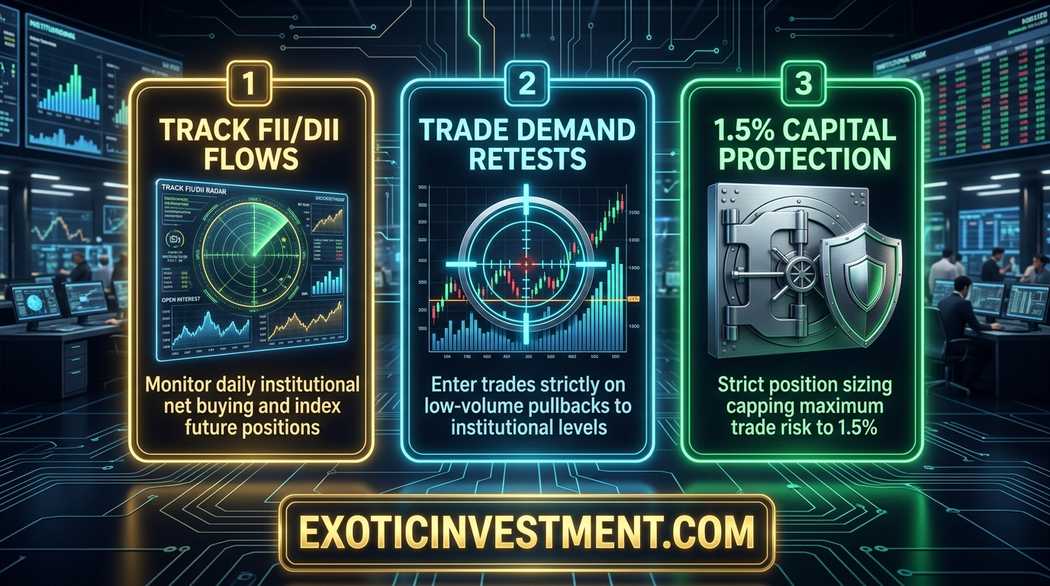
Illustration: Actionable institutional trading framework focusing on volume confirmation, pullback retests, and strict capital defense
Secret 7: The Real Market Truth is Revealed in Evening FII & DII Data
During market hours, price fluctuations can easily fool you. A stock might drop two percent on heavy intraday noise, making amateur traders panic and dump their holdings. Then comes Secret Seven: the real market direction appears in the post-market data published after 6:30 PM on NSE and BSE.
Often, you will find that while retail traders were panic-selling during the day, Foreign Institutional Investors (FIIs) and Domestic Institutional Investors (DIIs) bought thousands of crores in the cash segment. The institutions let retail panic depress prices so they could pick up quality shares at a discount. Tracking evening FII/DII net flows gives you a clear, objective compass for tomorrow’s market trend.
To see how your trades add up after exchange levies and taxes, always measure your real net numbers using our free stock profit calculator. Real profits are what remain in your bank account, not temporary screen green.
How Retail Traders Can Beat Institutions at Their Own Game
Do not feel discouraged by institutional size. As an individual retail trader, you have one massive advantage that billion-dollar funds would kill for: speed and agility. An institutional fund needs three weeks to enter or exit a position without destroying the price. You can get in and out in three seconds with zero market impact.
Here is your three-point action plan to trade with the smart money:
- Never Chase Breakouts Blindly: Wait for the breakout, then wait for the pullback retest on shrinking volume. Buying the retest gives you an institutional entry price with minimal risk.
- Cap Your Risk at 1.5% Per Trade: Never put your entire capital on one idea. Use our position size calculator India to keep every loss small and manageable.
- Master Technical Price Action: Learn to read institutional footprints on candlestick charts through our step-by-step Technical Analysis Course in Kannada or read our signature Kaliyiri Share Market Book.
Recommended Trading Courses & Premium Subscriptions:
- Options Buying Course in Kannada: Options Buying Course in Kannada.
- Technical Analysis in Kannada Course: Technical Analysis in Kannada Course.
- Kaliyiri Share Market Book: Kaliyiri Share Market Book.
- Basics of Stock Market Course: Basics of Stock Market Course.
- Multibagger Stocks Pro Subscription: MultiBagger Plus Courses & Pro Tools Annual Subscription.
💡 Frequently Asked Questions (FAQ)
1. Why do big institutions deliberately hunt retail stop-loss orders?
Big institutions manage massive capital. They cannot enter large positions without finding equivalent sellers. By briefly pushing prices below key support, they trigger retail stop-loss orders to capture the liquidity they need. To protect your capital and discover institutional stock ideas before retail crowds arrive, subscribe to our MultiBagger Plus Courses & Pro Tools Annual Subscription.
2. How can retail traders spot institutional accumulation on a chart?
Institutional accumulation typically happens in tight sideways channels with steadily drying volume over weeks or months. In Kannada, remember “Nidhanave pradhana” (patience is supreme). To ensure you never take oversized bets while waiting for breakouts, calculate your exact trade size with our free position size calculator India.
3. Why does good quarterly news often lead to a sharp stock price fall?
Smart money accumulates shares months ahead of time based on ground reality. When blockbuster quarterly earnings hit television channels, institutions use that retail buying frenzy as their exit door to sell shares at peak prices. Before buying any stock after earnings, verify fundamental value using our PE ratio calculator.
4. What is an iceberg order and why do institutions use it?
An iceberg order is an automated order type that divides a huge block trade into hundreds of small orders. This prevents other traders from seeing the true buying volume on the broker’s depth screen. Once filled, these shares settle into digital custody governed by standard Demat account and depository rules.
5. How does time decay benefit institutional option sellers?
Option premiums lose value every day due to theta decay. Institutional sellers write out-of-the-money options to steadily pocket that decay as expiry approaches. To learn disciplined option strategies and protect your downside risk, use our free stop loss calculator.