
What is forex vs stock market?
👨🏫 Real Market Experience & SEBI Disclosure: Written by Dr.Ashok Kumar N Rao and the Exotic Investment research desk based on 12+ years of active market trading. All insights follow SEBI investor education guidelines. Exotic Investment does not provide unsolicited tips or PMS services. Always test trading setups with disciplined position sizing before risking live capital.
Listen, boss, let’s keep it simple. The forex vs share market comparison comes up again and again among Indian traders. Both are trading spaces. But they are worlds apart.
The stock market is where you buy shares of companies listed on NSE or BSE. When you pick a stock like Reliance or TCS, you own a tiny piece of that business. Prices move based on company results, news, and overall market mood. You trade in INR. Your broker deducts GST and STT. Everything is clear.
Forex means foreign exchange. Here, you trade currency pairs like USD/INR or EUR/USD. You are betting on which currency gets stronger or weaker against another. The forex market runs 24 hours a day, five days a week. It is a massive global marketplace.
Here’s the thing though. In India, retail forex trading has limits. SEBI allows trading only on INR-paired currencies through recognized Indian exchanges like NSE and MCX. Trading pairs like EUR/USD on offshore platforms is illegal for Indian residents. No confusion there.
So the core difference is simple. Stocks = ownership in companies. Forex = trading currency values. Two very different games.
Why forex vs stock market Matters for Indian Stock Traders
Why should you even care about this comparison? Good question.
Most Indian retail traders start with equities. They open a Demat account with brokers like Zerodha, Groww, or Upstox. They learn candlesticks, support-resistance, and basic fundamentals. That is a solid foundation.
But many traders also hear about forex. Big uses borrowed capital on. Round-the-clock trading. Quick profits. Sound exciting, right? It can be. But it can also burn your capital fast if you go in blind.
Understanding the forex vs stock market difference helps you choose your battlefield wisely. It saves money. It prevents stupid mistakes. And honestly speaking, it builds better traders.
Indian regulations matter here too. SEBI keeps a close eye on forex trading. The RBI controls how much USD you can buy under the LRS scheme. FEMA rules govern what you can and cannot do. Stock market trading follows a different rulebook entirely.
Also, tax treatment differs. Equity profit tax in India is straightforward. Capital gains from forex futures and options fall under a separate category. You need to know this before you place your first trade.
Key Concepts Related to forex vs stock market
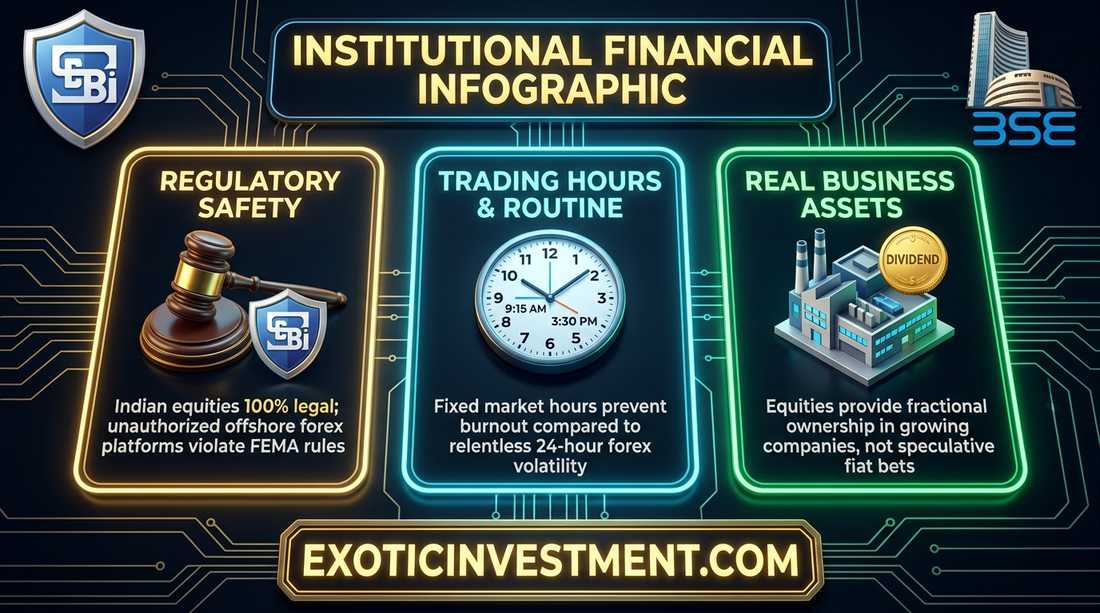
Illustration: Key regulatory, operational, and asset ownership differences between forex and Indian equities
Let me break down the main concepts you need to know cold.
borrowed margin: Forex offers huge borrowed margin, sometimes 100x or more on offshore platforms. IndianNSE FX segments offer lower borrowed margin, usually around 5x to 20x depending on the instrument. Stock market delivery trades have no borrowed margin by default. But intraday equity gives you 5x margin, which means broker borrowed margin is built in already.
Liquidity: Forex is the most liquid market in the world. Over $7 trillion moves daily. Indian stock market liquidity is decent but concentrated in large-cap stocks. Midcaps and smallcaps can be tricky, especially during volatile sessions.
Trading hours: Stock markets in India run from 9:15 AM to 3:30 PM. Forex trades nearly 24 hours. This is a big deal for full-time job holders who cannot sit glued to screens all night.
Cost structure: In stocks, you pay brokerage plus STT plus GST plus stamp duty. If you want to calculate costs accurately, check out a Zerodha brokerage calculator or Upstox brokerage calculator. Forex costs come as spreads and swap charges. Spreads can eat into your profits fast if you trade frequently.
Risk management tools: Stop-loss works in both markets. But in forex, slippage can be severe during major news events. A stop loss calculator helps you plan your positions before entering. For stocks, you have bracket orders and bo orders that automate protection.
Market manipulation: ForexBrokers can manipulate prices more easily than large-cap stocks. Pumps, dumps, and fake breakouts happen regularly in forex. Stock markets have circuit filters and SEBI oversight that reduce (but do not eliminate) manipulation risks.
How to Apply This Knowledge Step by Step
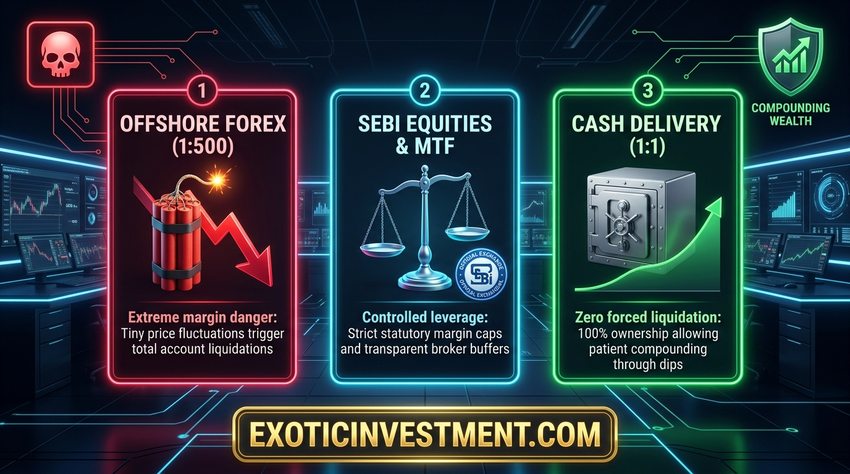
Illustration: Extreme margin liquidation dangers in offshore forex compared to regulated SEBI equity buffers
Now let’s get practical. Here is how you decide between forex and stocks.
Step 1: Assess your background. If you already trade equities, stick to what you know. Learning a new market from scratch while losing money on the first one is a recipe for disaster. Master one game before picking up a second.
Step 2: Check your schedule. Do you have a full-time job? Then stock market intraday or swing trading fits better. Forex 24-hour cycles mean US session trading at night, which messes up sleep and family life. No joke about this.
Step 3: Understand SEBI rules. Only trade forex on NSE, BSE, or MCX through registered Indian brokers. Avoid any offshore platform that accepts Indian clients. It is not just risky. It is illegal.
Step 4: Start with a small amount. Whether you pick stocks or forex, begin with money you can afford to lose. Treat it as tuition fees, not investment capital. Most beginners blow their first account. Learn from it and move forward.
Step 5: Use proper risk management. Never risk more than 1% to 2% of your capital on a single trade. Set a stop-loss on every position. Use tools like our stop loss calculator to figure out exact levels. Keep a profit calculator handy too.
Step 6: Track your results. Maintain a trading journal. Note every trade, reason, outcome, and emotion. Review weekly. This habit separates successful traders from gamblers every single time.
Step 7: Consider long-term investing too. Not everything needs to be active trading. If your goal is wealth creation over years, look at SIP investments and index funds. A SIP calculator shows you how small consistent amounts grow over time. Often, this beats active trading hands down.
Recommended Trading Courses & Premium Subscriptions:
- Options Buying Course in Kannada: Options Buying Course in Kannada.
- Technical Analysis in Kannada Course: Technical Analysis in Kannada Course.
- Kaliyiri Share Market Book: Kaliyiri Share Market Book.
- Basics of Stock Market Course: Basics of Stock Market Course.
- Multibagger Stocks Pro Subscription: MultiBagger Plus Courses & Pro Tools Annual Subscription (Checkout link: Buy Pro Subscription).
Common Mistakes and How to Avoid Them

Illustration: The 3-phase wealth building journey for Indian investors from foundational SIPs to multi-bagger compounders
Let me tell you the mistakes I see again and again among Indian traders.
Mistake 1: Chasing quick riches. Forex ads promise overnight millions. Real trading is slow and boring. If someone sells you a system that guarantees 100% returns monthly, run away. It is a scam. Period.
Mistake 2: Trading without a stop-loss. This is the number one account killer. I cannot stress this enough. Every single trade needs a pre-planned exit point. Use our stop loss calculator to get precise numbers instead of guessing.
Mistake 3: Using excessive borrowed margin. High borrowed margin amplifies losses as much as gains. A 10x move against you with 50x borrowed margin wipes out your entire margin. Keep borrowed margin low until you prove consistency for at least six months.
Mistake 4: Ignoring taxes. Many traders forget about tax on forex profits. Short-term forex profits are added to your income and taxed as per slab. Long-term gains have different rates. Plan your tax outflow early or face surprises during filing season.
Mistake 5: Switching markets randomly. Jumping between stocks, forex, and crypto without mastering any one market leads to scattered learning and consistent losses. Pick one arena. Get good at it. Then explore others later.
Mistake 6: Overtrading. More trades do not mean more profit. In fact, they usually mean more costs and more mistakes. Limit yourself to 2 to 3 quality setups per week. Quality over quantity always wins.
Mistake 7: Not keeping emotions in check. Revenge trading after a loss is deadly. You try to win back quickly and end up losing more. Walk away after two consecutive losses. Come back fresh the next day. Your capital will thank you.
Advanced Trading Tips to Master This Topic
Once you have the basics down, these advanced tips take your edge further.
Tip 1: Combine technical and fundamental analysis. For stocks, look at quarterly results, promoter holding, debt levels, and sector trends alongside charts. For forex, follow central bank policies, inflation data, and GDP figures from both countries in the pair. Pivot point calculators help identify key levels in both markets.
Tip 2: Build a personal trading checklist. Write down your entry criteria, risk limits, and exit rules. Follow it religiously. Discipline beats genius in trading every time.
Tip 3: Use correlation to your advantage. USD/INR often moves opposite to Nifty. When the rupee strengthens, export-oriented stocks like IT and pharma tend to fall. Spotting these correlations gives you extra context.
Tip 4: Trade the session overlaps. If you trade forex, the London-New York overlap (around 2 PM to 6 PM IST) offers the best volatility and liquidity. Avoid thin trading periods where spreads widen dramatically.
Tip 5: Paper trade before real money. Most platforms offer demo accounts. Use them for at least one to two months. Prove profitability on demo before going live. This step alone can save you thousands of rupees.
Tip 6: Study market microstructure. Understand order flow, bid-ask spreads, and how liquidity builds or disappears during the day. This knowledge matters more in forex than in stocks since forex has fewer regulatory guardrails.
Tip 7: Keep learning continuously. Markets change. New instruments arrive. Regulations shift. Follow SEBI updates, read annual reports, and stay curious. The moment you stop learning is the moment you start losing consistently.
Final Summary
So here is the real deal on forex vs stock market for Indian investors.
Stocks give you ownership, structured hours, strong regulation, and a clear path to long-term wealth. Forex offers higher borrowed margin and round-the-clock action but comes with bigger risks and regulatory restrictions in India.
For most Indian traders, starting with equities is the safer and smarter move. Build your skills. Grow your capital. Then consider forex as an optional add-on if you truly understand the risks.
No matter which path you choose, remember these three non-negotiable rules. Always use stop-losses. Never risk more than 2% per trade. Keep learning every single day.
Trading is a marathon, not a sprint. The traders who survive are the patient ones. The disciplined ones. The ones who respect the market and never get cocky.
Start small. Stay consistent. Protect your capital above all else. Profits will follow naturally over time.
Keep grinding, keep learning, and let your compounding work its magic. That is the Indian trader’s winning formula.
💡 Frequently Asked Questions (FAQ)
Is forex trading legal for individual retail traders in India?
Retail forex trading in India is legal only when executed on domestic exchanges (NSE, BSE, MSE) paired against the Indian Rupee (INR). Trading non-INR pairs on offshore platforms violates the Foreign Exchange Management Act (FEMA). To trade compliant domestic equities, check your costs with our brokerage calculator.
Which is better for beginners with small capital: forex or Indian stocks?
The Indian stock market is far safer and more rewarding for beginners. Equities offer real company ownership, clean SEBI regulatory protection, and patient compounding. To uncover vetted compounding businesses, explore the MultiBagger Plus Courses & Pro Tools Annual Subscription.
How does leverage differ between forex and the Indian stock market?
Offshore forex platforms offer dangerous 1:500 leverage that wipes out beginner capital in minutes. In contrast, SEBI caps intraday and MTF leverage strictly, preventing forced ruin. Always size your positions before entering any trade using our position size calculator.
What are the tax implications of stock trading compared to forex in India?
Stock trading profits qualify for clear capital gains tax treatment (20% STCG or 12.5% LTCG on delivery). You can calculate your net returns with our free stock profit calculator and plan liabilities with our stock market tax rules calculator.
Can I hold Indian stocks overnight without paying overnight swap fees?
Yes. When you buy delivery equities, they settle directly into your Demat account under standard delivery and CNC trading rules. Unlike forex rollover swaps, you can hold shares for years without continuous carrying fees.