
What is how budget affects stock market?
👨🏫 Real Market Experience & SEBI Disclosure: Written by Dr.Ashok Kumar N Rao and the Exotic Investment research desk based on 12+ years of active market trading. All insights follow SEBI investor education guidelines. Exotic Investment does not provide unsolicited tips or PMS services. Always test trading setups with disciplined position sizing before risking live capital.
Listen, boss. The Union Budget is basically the government’s spending plan for the coming financial year. It shows where India will invest money and which taxes it will change. Now, here’s the thing—every single announcement in that budget speech can shake up the stock market.
When the Finance Minister takes the stage on July 1st or February 1st (depending on the new schedule), traders across the country hold their breath. Why? Because budget decisions directly impact sector profits, company margins, and investor sentiment. That means your portfolio feels it too.
For example, if the government decides to increase infrastructure spending, you’ll see construction and cement stocks surge the very next day. On the flip side, if corporate tax goes up for a particular industry, those stocks tend to fall. Simple, right?
But honestly speaking, the relationship is not always black and white. Sometimes the market reacts in the opposite direction of what you expect. Traders call this “buy the rumor, sell the news.” The budget effect plays out in phases—before the speech, during it, and weeks after. We’ll cover all of this in detail below.
The budget affects stocks through three main channels: fiscal policy changes, sector-specific announcements, and changes in taxation rules. As a result, understanding these links gives you a real edge over casual investors who just guess blindly.
Why how budget affects stock market Matters for Indian Stock Traders
Here is the real deal. Indian traders who ignore the budget do so at their own risk. The budget sets the tone for the entire financial year ahead. Sectoral policies announced during this time determine which industries get a tailwind and which face headwinds.
Take the railway budget component, for instance. Every year, the allocation for Indian Railways gets massive media coverage. When the rail allocation increases, stock prices of companies like IRFC, RVNL, and IRCON go up fast. Smart traders watch this closely and position themselves accordingly.
Also, capital gains tax rules and dividend distribution tax changes announced in the budget affect your actual returns. A small percentage change in tax can mean thousands of rupees extra in your pocket or from your pocket. No confusion there.
SEBI has also made it clear that budget-driven volatility is real and frequent. They monitor abnormal trading activity around budget dates carefully. So as a responsible trader using platforms like Zerodha, Upstox, or Groww, you need to be aware of these shifts before they hit your account.
Finally, institutional investors like mutual funds and foreign portfolio investors adjust their allocations after reading the budget. Their moves influence liquidity and price action in ways retail traders often miss. That means staying informed puts you on the same page as the big players.
Key Concepts Related to how budget affects stock market
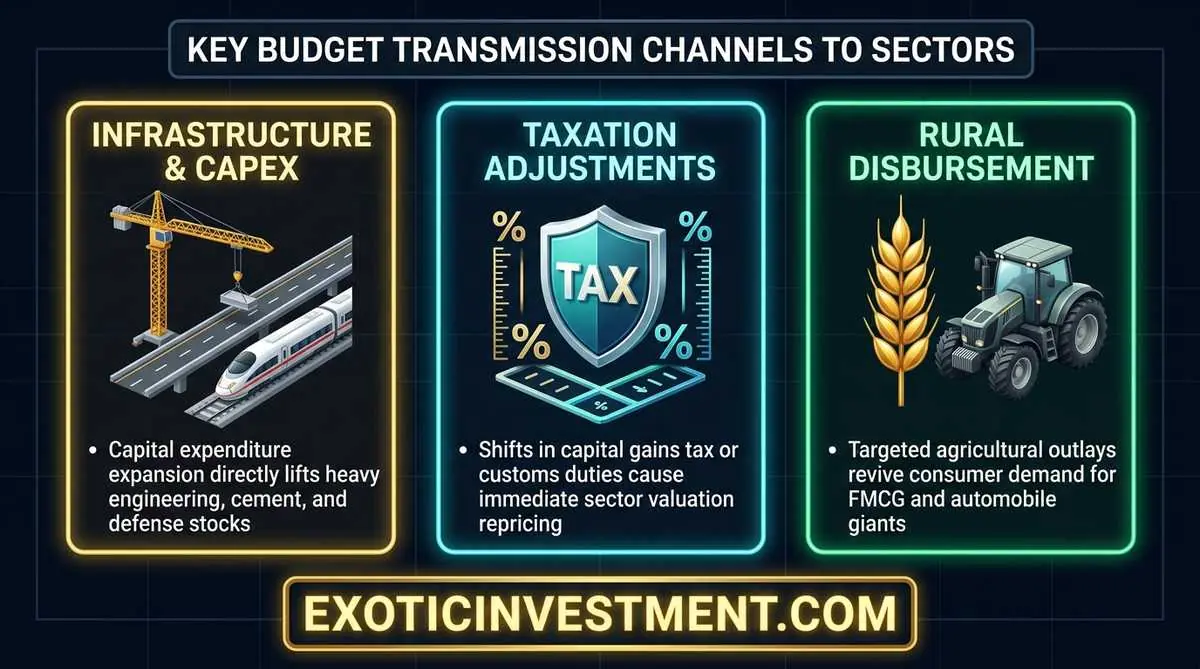
Illustration: Key Budget Transmission Channels to Sectors
Let’s keep it simple. There are several key ideas you need to understand before you start making budget-based trades.
Budget allocation and fiscal deficit: When the government increases its spending allocation for a sector, it signals growth plans. Higher allocation usually means more contracts, more revenue for companies in that space, and ultimately higher stock prices. The fiscal deficit number also matters—it tells you whether the government is borrowing heavily, which can push interest rates up and slow down the economy.
Direct and indirect tax changes: Income tax slabs, corporate tax rates, customs duty changes, and GST revisions all flow directly to stock prices. For example, when import duties on copper were reduced in recent budgets, metal stocks jumped. When excise duties on cigarettes increased, ITC and other tobacco stocks dipped slightly. Watch these numbers closely.
Sectoral focus areas: Each budget highlights specific sectors—like renewable energy, manufacturing under Make in India, or digital infrastructure. These priority sectors often see sustained buying interest from both domestic and foreign investors.
Market expectation versus reality: This is where many traders lose money. If the market has already priced in a positive budget announcement, the actual news might not move stocks much. In fact, profits can get booked quickly. Use tools like our pivot point calculator to identify key support and resistance levels around budget dates.
Risk management and stop loss: Budget periods are highly volatile. You should always use proper stop-loss strategies to protect your capital. Never trade without one, especially when news-driven volatility is high.
Institutional flow tracking: Watch FII and DII data released by NSE and BSE after each budget. Heavy buying or selling by institutions tells you the smart money’s direction.
How to Apply This Knowledge Step by Step
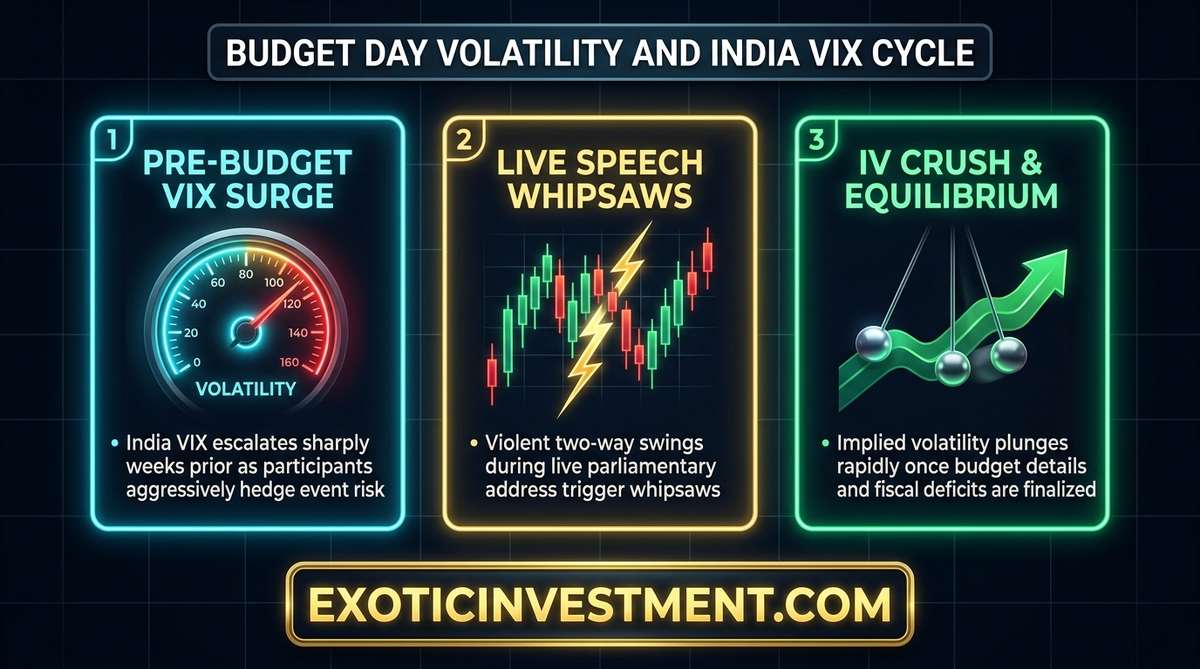
Illustration: Budget Day Volatility and India VIX Cycle
Now let’s talk practical steps. Here’s exactly how you can use budget knowledge to make better trading decisions:
Step 1: Read the budget before it happens. Track pre-budget reports from newspapers and financial sites starting two months before the speech. Note which sectors analysts expect to benefit. This prepares your mind and your watchlist early.
Step 2: Build a sector watchlist. Keep a list of top stocks in sectors likely to be affected—banking, infrastructure, IT, pharma, auto, and renewables. Update this list after reading the full budget document. For example, if the budget promises ₹10 lakh crore in capital expenditure over five years, check out infrastructure and power stocks immediately.
Step 3: Wait for the market reaction phase. Do not rush in the first hour of trading after the budget. Markets often overshoot initially and then correct. Wait for 30 to 60 minutes to see the true direction. Use our profit calculator to plan your entry and target levels before placing any order.
Step 4: Trade the confirmed trend. Once the initial volatility settles, look for breakouts or breakdowns with strong volume. Use technical tools like moving averages and RSI alongside your budget analysis. Combine fundamental insight with technical timing—that’s the winning formula.
Step 5: Review and adjust weekly. Budget impacts unfold over weeks, not just one day. Review your positions every Friday. If a sector you bet on starts falling against the budget narrative, exit cleanly. Don’t fall in love with a losing trade.
Step 6: Track your P&L properly. If you’re also trading crypto portfolios, use tools like our crypto tax calculator and Bitcoin profit calculator to stay on top of your overall tax liability and net returns across all markets.
Step 7: Plan your long-term investing too. Not everything has to be trading. Many investors use SIP-based strategies to build wealth in budget-beneficiary sectors over time. This reduces the stress of timing the market perfectly.
Recommended Trading Courses & Premium Subscriptions:
- Options Buying Course in Kannada: Options Buying Course in Kannada.
- Technical Analysis in Kannada Course: Technical Analysis in Kannada Course.
- Kaliyiri Share Market Book: Kaliyiri Share Market Book.
- Basics of Stock Market Course: Basics of Stock Market Course.
- Multibagger Stocks Pro Subscription: MultiBagger Plus Courses & Pro Tools Annual Subscription (Checkout link: Buy Pro Subscription).
Common Mistakes and How to Avoid Them
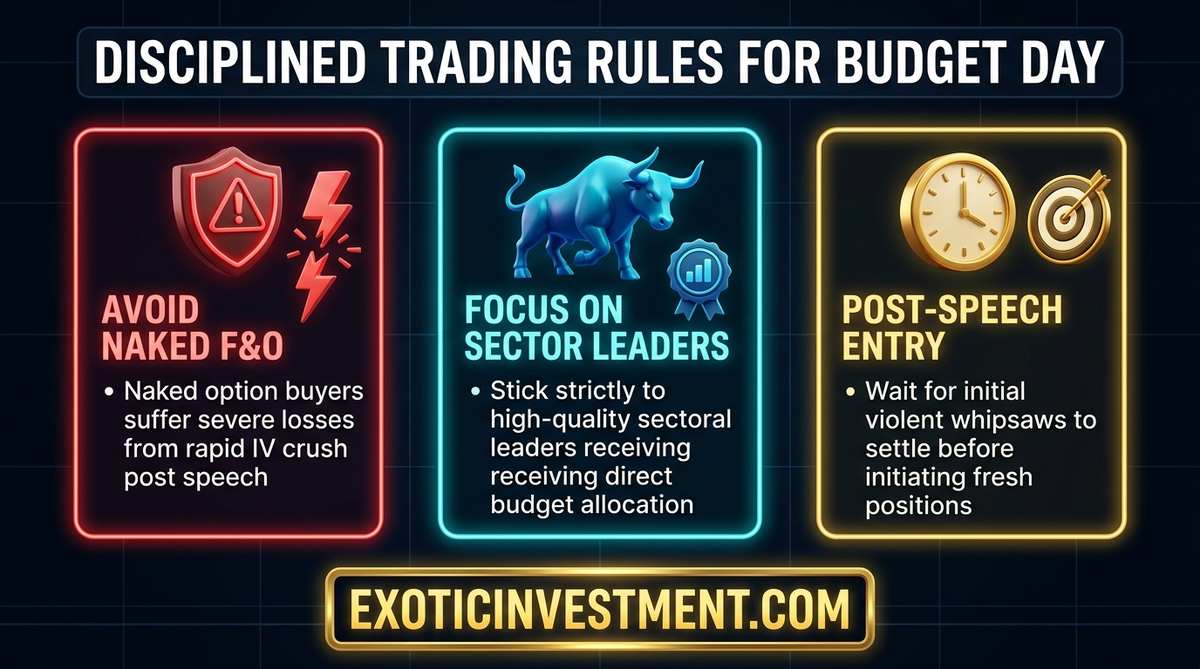
Illustration: Disciplined Trading Rules for Budget Day
Let me tell you about the mistakes I see traders make again and again during budget season. Avoiding these will save you a lot of pain.
Mistake 1: Buying on hype without a plan. Many traders see a stock gap up after the budget and buy instantly out of fear of missing out. This is dangerous. Always wait for a pullback or a clear breakout confirmation. Use our brokerage calculator to understand your costs before entering any trade.
Mistake 2: Ignoring the broader market trend. Even if a sector looks great after the budget, the overall Nifty or Sensex might be falling. Trading against the major index trend is a fast way to lose money. Always check the wider market context first.
Mistake 3: Not using stop loss. This is probably the biggest error. Budget days can see 3 to 5 percent swings in individual stocks within minutes. Without a proper stop loss, one bad move can wipe out weeks of profits. Set your stop loss the moment you enter a trade.
Mistake 4: Overtrading during budget week. Some traders feel they must trade every single day around the budget. This leads to fatigue and poor decisions. Limit your trades. Quality over quantity, every time.
Mistake 5: Forgetting about tax implications. Short-term capital gains tax and STT changes announced in the budget can eat into your profits. Calculate your actual post-tax return before entering any position. Use our profit calculator including tax to get the real picture.
Mistake 6: Blindly following social media tips. Telegram groups and YouTube channels often push stocks right before the budget with no real analysis behind them. Do your own research. Cross-check with official budget documents and SEBI-registered research reports.
Advanced Trading Tips to Master This Topic
If you want to level up, here are some advanced techniques that experienced Indian traders use around budget season.
FII-DII flow analysis: After the budget, track daily FII and DII activity on NSE. If foreign investors are consistently buying while domestic institutions are selling, it often signals a bullish trend continuation. Conversely, heavy FII selling after a budget can mark the start of a correction phase.
Options chain reading: Check the Put-Call ratio and open interest buildup in index options before and after the budget. A sudden spike in put writing at a particular strike level often indicates that big players expect support there. Our platform helps you analyze these patterns effectively.
VIX monitoring: The India VIX typically spikes before the budget due to uncertainty. When VIX drops sharply after the budget speech ends, it usually means the market feels confident about the direction. This is a good signal to start looking for directional trades.
Sector rotation strategy: Instead of betting on one stock, consider rotating across budget-beneficiary sectors. For example, if the budget favors renewables over thermal power, shift your allocation accordingly. Use our Upstox brokerage calculator or Zerodha brokerage calculator to estimate turnover costs during such rotations.
Paper trading before live execution: If you’re new to budget trading, practice with virtual money first. Most broker apps like Groww and Zerodha offer demo modes. Master the timing and risk management in simulation before risking real capital.
Combine with macro indicators: Budget analysis works best when combined with other macro data—like RBI monetary policy, crude oil prices, and global market trends. For instance, if the budget is positive but crude prices are surging, the overall impact may be muted. Stay holistic in your approach.
Use multi-timeframe analysis: Check the daily chart for trend, the hourly chart for entry timing, and the 15-minute chart for precise execution. This layered approach filters out noise and improves your win rate significantly.
Final Summary
So let’s wrap this up clearly. The Union Budget is one of the most important events in the Indian financial calendar. It shapes sector growth, influences tax savings, and drives market sentiment for the entire year ahead.
Understanding how the budget affects the stock market gives you a distinct advantage. You stop guessing and start making informed decisions based on real policy signals instead of rumors and panic.
Remember these core points: prepare before the budget, build a sector watchlist, wait for the market to show its true direction, use stop loss religiously, and never stop learning. Our Options Buying Course in Kannada and Technical Analysis Course can help you sharpen these skills further.
The budget does not predict the future perfectly, but it gives you the strongest clues available. Trade smart, manage your risk, and keep growing your knowledge. That’s how consistent success looks in the Indian stock market.
Good luck, boss. May your trades be sharp and your profits steady.