
What is calculate profit in stock market?
👨🏫 Real Market Experience & SEBI Disclosure: Written by Dr.Ashok Kumar N Rao and the Exotic Investment research desk based on 12+ years of active market trading. All insights follow SEBI investor education guidelines. Exotic Investment does not provide unsolicited tips or PMS services. Always test trading setups with disciplined position sizing before risking live capital.
Listen, boss. Calculating profit in the stock market sounds fancy. But honestly speaking, it’s really simple math. You buy shares at one price. You sell them at another price. The gap between these two prices gives you your profit or loss.
Here is the real deal. Many new traders in India make a big mistake. They look at the share price movement and think they know their profit. But they forget charges. Brokerage, STT, GST, stamp duty — all these eat into your gains. If you don’t factor them in, you will be confused when your account shows less money than expected.
The formula is basic. Profit equals selling price minus buying price, multiplied by the number of shares. Simple, right? But let’s not keep it simple and stop there. Because in India, the government takes its cut too. That means your actual profit will always be lower than the raw difference between buy and sell prices.
Let me give you a quick example. Suppose you buy 100 shares of Reliance at Rs 2,400 each. That’s Rs 2,40,000 total. Later, you sell those same 100 shares at Rs 2,550 each. Your gross profit looks like Rs 15,000. Sounds great. But after brokerage, STT, and other charges, your net profit might be around Rs 13,800 or so. See the difference? That’s why learning how to calculate profit properly matters a lot.
If you want a quick check, you can also use our stock profit calculator to get the exact number in Indian rupees without doing manual math. No confusion, just results.
Why calculate profit in stock market Matters for Indian Stock Traders
Now, here’s the thing. Why should you bother with all this profit calculation? Let me tell you straight. First, without knowing your actual profit, you cannot judge whether your trading strategy works. You might think you are making money. But after all charges, you could be barely breaking even. That is a sad situation for any trader.
Second, proper profit calculation helps you manage risk. If you know your cost per share including all charges, you can set a smart stop loss. You will know exactly where to exit if the trade goes against you. This saves you from huge losses.
Third, it builds discipline. A disciplined trader is a successful trader. When you track every profit and loss, you start noticing patterns. Maybe you lose more on mid-cap stocks. Or maybe your intraday trades give better returns than positional trading. These insights only come when you calculate profit accurately.
Also, SEBI regulations require brokers to show detailed charge breakdowns. So understanding these charges is actually your right as an investor. You should know every rupee that goes to your broker, to the exchange, and to the government.
Another important point. Many beginners confuse paper profit with actual profit. Paper profit is what you see on your screen while the trade is still open. But until you square off, it is not real money. Real profit comes only after you sell and all charges are deducted. Keep this in mind always.
Key Concepts Related to calculate profit in stock market
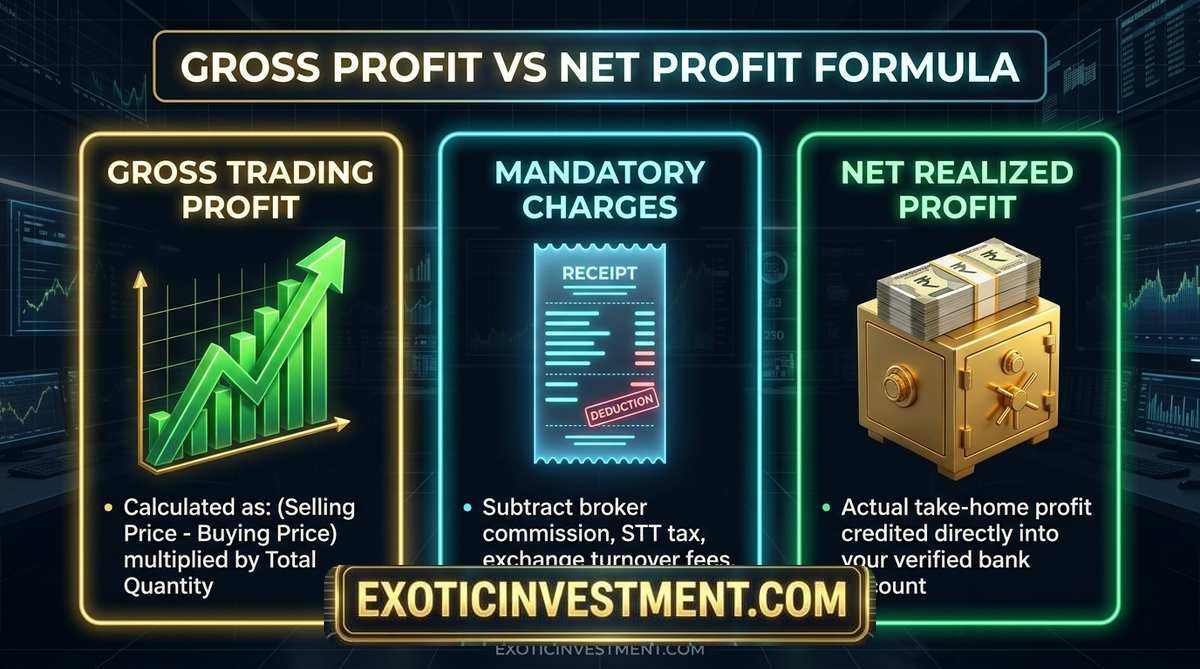
Illustration: Gross Profit vs Net Profit Formula
Let’s break down the important terms you need to know. First up is cost price. This is the price at which you actually bought the shares. It includes the base price plus any brokerage and taxes you paid at the time of purchase. Some people ignore this, which means their calculations are always wrong.
Next is selling price. This is the price at which you sold the shares. Again, the actual amount you receive will be slightly less because of charges deducted at the time of sale. STT is one such charge that applies on the sell side for equity delivery trades.
Then we have gross profit and net profit. Gross profit is the raw difference between your total sale value and total purchase value. Net profit is what remains after subtracting all charges. Always focus on net profit. That is the real money that goes into your pocket.
Brokerage charges vary from broker to broker. Zerodha charges a flat Rs 20 per executed order for intraday. For delivery, Zerodha does not charge brokerage. But Groww and Upstox may have different structures. You should check the Zerodha brokerage calculator or the Upstox brokerage calculator before you start trading. This will help you understand your exact cost structure.
STT, or Securities Transaction Tax, is collected by the government. For equity delivery trades, STT is charged on both buy and sell sides at 0.1%. For intraday, it is only on the sell side at 0.025%. This tax is non-negotiable. It goes directly to the government, and you cannot avoid it.
GST is charged at 18% on brokerage and other charges. Stamp duty is another small charge that varies by state and exchange. For NSE trades, it is currently 0.003% for equities. Exchange transaction charge is around 0.002955% on both buy and sell sides.
Last but not least, understanding SIP calculations is also useful if you are investing in mutual funds alongside stocks. Many Indian investors do both, so knowing how to calculate returns across different instruments is very helpful.
How to Apply This Knowledge Step by Step
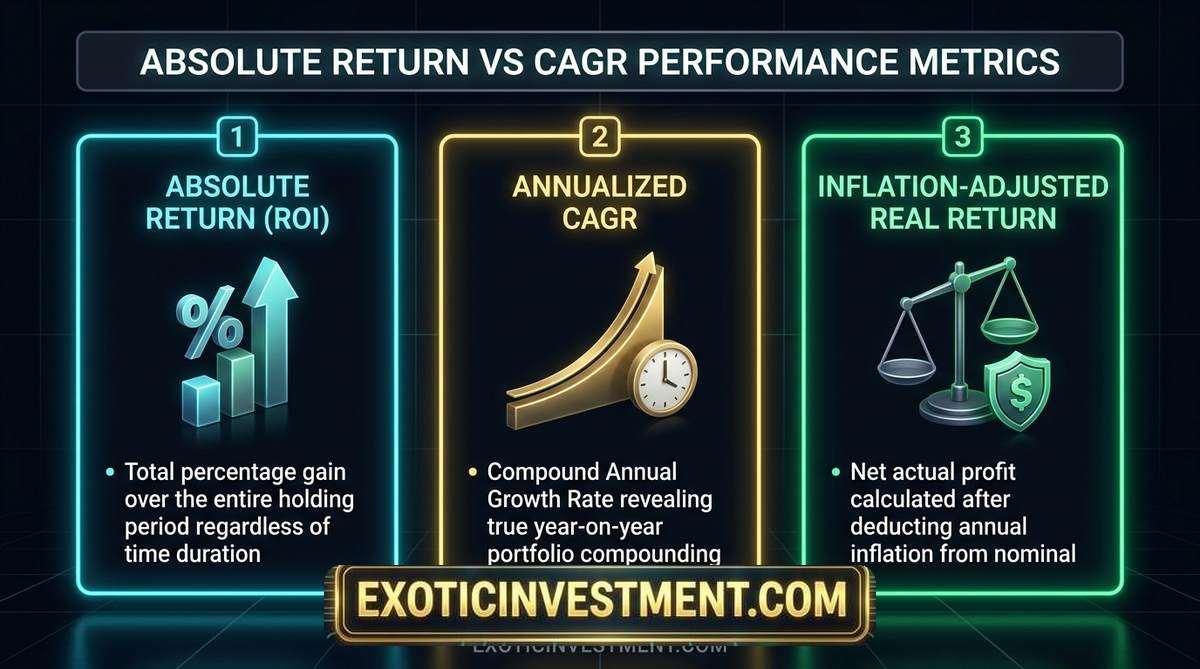
Illustration: Absolute Return vs CAGR Performance Metrics
Alright, now let’s get practical. I will walk you through a complete example so you can see exactly how profit calculation works in real life. Let us say you decide to buy 50 shares of TCS on NSE. The current market price is Rs 3,800 per share. Here is the step-by-step process.
First, calculate your total purchase cost. Multiply 50 shares by Rs 3,800. That gives you Rs 1,90,000. This is your base purchase value. Now add the brokerage. If you are using Zerodha for delivery, brokerage is zero. But you still need to add STT at 0.1%, which comes to Rs 190. GST on zero brokerage is also zero. Stamp duty on NSE equities at 0.003% equals Rs 5.70. Round it to Rs 6. So your total cost price becomes Rs 1,90,196 approximately.
Now, let us assume after 15 days, you decide to sell these 50 shares at Rs 4,050 per share. Your total sale value is Rs 2,02,500. But again, you need to deduct charges. STT on sell side is 0.1%, which is Rs 202.50. GST is on zero brokerage, so zero. Stamp duty is Rs 6.08, round it to Rs 6. Your total sale proceeds after charges equal Rs 2,02,291.50 roughly.
Finally, calculate your net profit. Subtract total cost from total sale proceeds. That is Rs 2,02,291.50 minus Rs 1,90,196. Your net profit is Rs 12,095.50. Not bad at all. But notice something important. Your gross profit was Rs 12,500. After charges, it dropped to Rs 12,095. So charges ate away about Rs 405. Over many trades, this adds up significantly.
If you want to skip all this manual calculation, our profit calculator tool does everything instantly. Just enter your buy price, sell price, quantity, and broker type. You get the exact net profit in Indian rupees within seconds. No confusion, no mistakes.
Also, if you trade futures and options, the calculation changes completely. F&O profits involve margin money, not the full contract value. You should learn options buying concepts carefully before entering that space. One wrong move and your entire capital can vanish.
For swing traders who hold positions for days or weeks, using pivot points can help you identify better entry and exit levels. This indirectly improves your profit calculation because you enter at better prices and exit smarter.
Recommended Trading Courses & Premium Subscriptions:
- Options Buying Course in Kannada: Options Buying Course in Kannada.
- Technical Analysis in Kannada Course: Technical Analysis in Kannada Course.
- Kaliyiri Share Market Book: Kaliyiri Share Market Book.
- Basics of Stock Market Course: Basics of Stock Market Course.
- Multibagger Stocks Pro Subscription: MultiBagger Plus Courses & Pro Tools Annual Subscription (Checkout link: MultiBagger Plus Courses & Pro Tools Annual Subscription).
Common Mistakes and How to Avoid Them
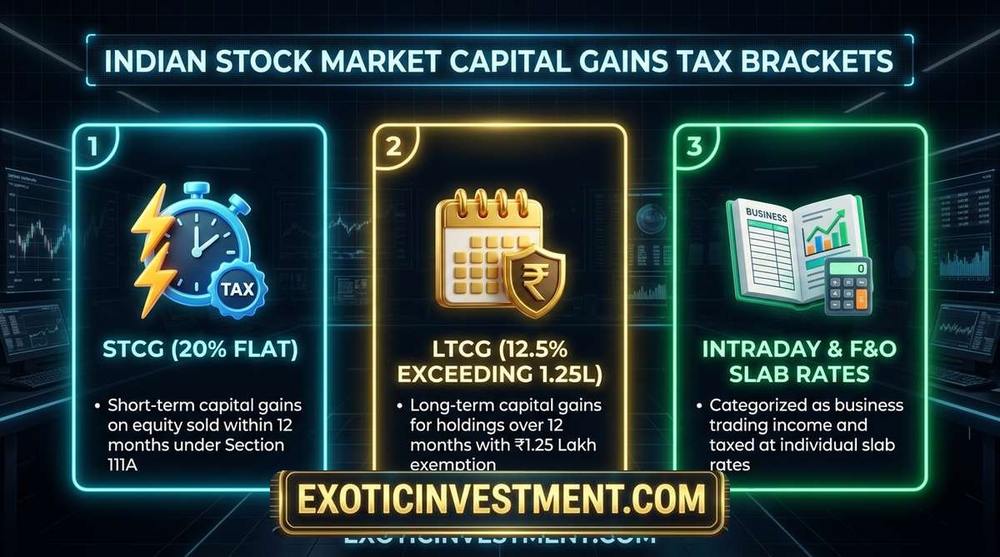
Illustration: Indian Stock Market Capital Gains Tax Brackets
Let me share some mistakes I have seen again and again among Indian retail traders. First and most common, they forget to include charges in their profit calculation. They see a green P&L on their trading app and celebrate. But that green number is usually gross profit, not net profit. Always double-check whether your broker shows net or gross numbers.
Second mistake, traders mix up intraday and delivery calculations. Intraday borrowed margin changes everything. If you take 5x borrowed margin on Zerodha, you only pay 20% of the total value. But your profit and loss also get multiplied by five. Many traders miscalculate this and end up shocked when their broker sends the actual statement.
Third mistake is ignoring the impact of slippage. Slippage means the price at which your order actually gets executed is different from the price you saw on your screen. In fast-moving markets, this can be significant. If you were expecting to sell at Rs 4,050 but got filled at Rs 4,040, your profit drops by Rs 500 on 50 shares. Nothing wrong with that. But if you did not plan for it, you will feel cheated.
Fourth mistake, traders do not keep proper records. They forget what price they bought at. Or they confuse one trade with another. This makes profit calculation impossible at the end of the month. Maintain a simple Excel sheet or use a journal. Even a notebook works fine in the beginning.
Fifth, some traders chase huge profits without calculating risk-reward properly. They put all their money into one stock hoping for a multibagger return. This is gambling, not investing. SEBI has warned repeatedly about such behavior. Always diversify and never risk more than 2% of your capital on a single trade.
To avoid these mistakes, practice first. Open a demo account on platforms like Zerodha Varsity or use paper trading apps. Calculate profit manually for at least 20 hypothetical trades. Once you feel comfortable, switch to real money with small quantities. Progress slowly, not fast.
Advanced Trading Tips to Master This Topic
Once you are comfortable with basic profit calculation, here are some advanced tips that will seriously improve your trading results. First, always calculate your breakeven point. This is the minimum price at which you need to sell to cover all your charges. If your breakeven for a trade is Rs 3,810, then selling below that means you are losing real money even if the raw price looks okay.
Second, track your profit percentage, not just absolute profit. Making Rs 2,000 on a Rs 10,000 investment is a 20% return. But making Rs 2,000 on a Rs 1,00,000 investment is only 2%. The second one looks bigger in rupees but is actually much worse in percentage terms. Focus on return on capital, not just rupee profit.
Third, learn to read your broker’s consolidated statement. Every broker like Zerodha, Groww, or Upstox provides a monthly or yearly statement. Go through it carefully. You will see every single charge broken down. This is the best way to learn where your money goes. Most traders never bother reading their statements. Do not be like them.
Fourth, build a personal profit and loss tracker. At the end of every month, sum up all your wins and losses. Calculate your win rate, average win size, and average loss size. These three numbers tell you everything about your trading performance. If your average loss is bigger than your average win, you need to fix your strategy immediately.
Fifth, use the stop loss tool wisely. Set your stop loss based on technical levels, not based on how much you can afford to lose. A stop loss placed randomly near your buy price will hit too often. Place it where the market structure tells you the trade idea is invalid. This improves your overall profit ratio dramatically.
Also, if you are exploring other assets alongside stocks, tools like our crypto portfolio tracker can help you monitor your entire investment across different asset classes from one place. Whether you hold Bitcoin, Ethereum, or Indian stocks, having everything visible helps you make better decisions.
And remember, tax planning matters too. If you trade frequently, your profits fall under business income in India. You need to pay tax accordingly. Use a crypto tax calculator or consult a CA to understand your exact tax liability. Many traders ignore this and face trouble during income tax filing season.
Final Summary
So there you have it. Calculating profit in the stock market is not rocket science. But it is also not something you can ignore. Every rupee counts. Every charge matters. And every mistake in calculation can lead to wrong trading decisions over time.
Start simple. Learn the basic formula. Add charges one by one. Practice with small amounts. Track your results honestly. Gradually, you will develop a strong instinct for what a real profit looks like. That instinct is what separates profitable traders from gamblers.
Do not rush. The stock market will always be there. There is no hurry. Learn properly first. Then trade with confidence. And always, always use the tools available to you — calculators, journal sheets, and good education materials from trusted sources like ExoticInvestment.
Remember this one thing. Profit is not about how much you earn on a single trade. Profit is about consistent, calculated returns over many trades. Keep your emotions in check. Keep your calculations sharp. And your account will grow steadily. All the best, boss. Trade smart.