Marginal Relief Calculator

Marginal Relief Calculator — Income Tax Surcharge Relief India

Calculate statutory marginal relief on income tax surcharge under Old and New tax regimes for taxable incomes exceeding ₹50 Lakh, ₹1 Crore, and ₹2 Crore.


STATUTORY INCOME TAX SURCHARGE ENGINE (FY 2024-25 / AY 2025-26)
🔒 PRO LOCKED
₹51,00,000
Threshold Tests:
10% Surcharge (Above ₹50 Lakh)
MARGINAL RELIEF BENEFIT
₹64,250
Direct reduction in statutory surcharge liability
🛡️ Statutory Surcharge Protection:
Without marginal relief you would pay ₹14,76,750 in tax + surcharge. Marginal relief saves you ₹64,250!
Base Tax (Before Surcharge) ₹13,42,500
Surcharge (Normal Rate) ₹1,34,250
Net Tax after Relief ₹14,12,500
Health & Education Cess (4%) ₹56,500
TOTAL TAX PAYABLE ₹14,69,000
EFFECTIVE TAX RATE 28.80%
⚡ High-Net-Worth Surcharge Shield & HUF Tax Solver: Model combined STCG/LTCG surcharge limits and optimize bonus income timing.

How Marginal Relief Is Calculated in 4 Steps

1

Enter Taxable Income

Input your annual taxable income or salary above ₹50 Lakh after standard deductions.

2

Choose Tax Regime

Select either the New Tax Regime (Section 115BAC) or the Old Slab Regime.

3

Compute Surcharge

Evaluates the statutory surcharge slab (10%, 15%, 25%, or 37%) applicable to your bracket.

4

Claim Marginal Relief

Caps total additional tax liability so your tax increase never exceeds your extra income.

What Is Marginal Relief in Income Tax & Why Does It Matter?

When your taxable income crosses specific statutory thresholds in India—such as ₹50 Lakh, ₹1 Crore, ₹2 Crore, or ₹5 Crore—the Income Tax Department levies an additional surcharge on your basic tax liability. However, this creates a severe mathematical dilemma known as the surcharge cliff.

For instance, if your net taxable income is ₹51 Lakh under the Old Regime, you cross the ₹50 Lakh threshold by exactly ₹1,00,000. Without statutory protection, a 10% surcharge on your entire basic tax would add over ₹1,34,000 in extra tax. Consequently, you would pay ₹1.34 Lakh more in taxes just to keep ₹1 Lakh in gross earnings!
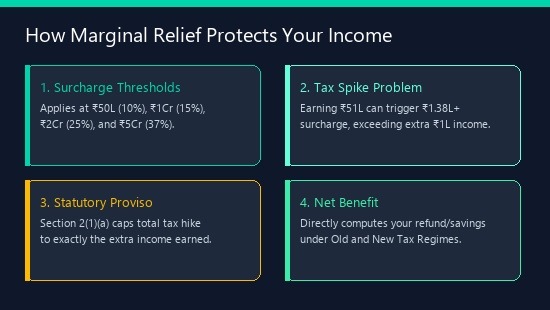
Marginal Relief in Income Tax Calculator Flowchart

The Statutory Proviso to Section 2(1)(a)

To resolve this unfair anomaly, the Finance Act provides Marginal Relief. Under the proviso, the total amount payable as income tax and surcharge cannot exceed the total tax payable on the threshold income plus the amount of income that exceeds that threshold.

$$\text{Marginal Relief} = (\text{Tax} + \text{Surcharge}) – \text{Tax at Threshold} – (\text{Taxable Income} – \text{Threshold})$$

Under the New Tax Regime (Section 115BAC), marginal relief operates similarly, with the added advantage that the top surcharge rate is capped at 25% (compared to 37% in the Old Regime). This delivers substantial relief to high-net-worth individuals earning above ₹2 Crore.


📋 Regulatory References & Data Sources
  • Income Tax Act 1961, Proviso to Section 2(1)(a) — Statutory Marginal Relief on Surcharge
  • Finance Act 2024 — Surcharge slabs for FY 2024-25 / AY 2025-26 under Section 115BAC
  • Central Board of Direct Taxes (CBDT) Circular No. 04/2024 on TDS and surcharge thresholds
  • Income Tax Department of India Notification on Section 87A rebate and surcharge parity
  • Proviso to Section 115BAC(1A) — marginal relief under the new tax regime

Disclaimer: This calculator is for educational and planning purposes only. It does not constitute financial advice. Consult a SEBI-registered investment advisor for personalised guidance. Tax rules are updated as per the latest Finance Act — verify with a qualified CA before filing.

Frequently Asked Questions — Marginal Relief

What is marginal relief in Indian income tax?
Marginal relief is a statutory tax concession ensuring that the additional income tax payable (including surcharge) does not exceed the extra income earned above statutory thresholds (₹50 Lakh, ₹1 Crore, ₹2 Crore, or ₹5 Crore). You can evaluate broader tax liability using our Income Tax Calculator Old and New Regime.

Who is eligible to claim marginal relief?
Any individual, HUF, or Association of Persons (AOP) whose taxable income marginally exceeds ₹50 Lakh, ₹1 Crore, ₹2 Crore, or ₹5 Crore is legally eligible for marginal relief. Both salaried professionals and business proprietors can claim it in their ITR filing.

Is marginal relief available under the New Tax Regime (Section 115BAC)?
Yes. Marginal relief is fully applicable under the New Tax Regime as per the proviso to Section 115BAC(1A). Furthermore, the highest surcharge rate under Section 115BAC is capped at 25%, whereas the Old Regime levies up to 37% on incomes above ₹5 Crore.

How does marginal relief work at ₹51 Lakh taxable income?
At ₹51 Lakh under the Old Regime, basic tax plus 10% surcharge equals ₹14,76,750. However, tax at ₹50 Lakh is ₹13,12,500. The extra tax (₹1,64,250) exceeds your excess income (₹1,00,000) by ₹64,250. Marginal relief subtracts exactly ₹64,250, ensuring you keep your full after-tax income.

What are the surcharge slabs for individuals in FY 2024-25?
Surcharge rates are 10% for income between ₹50 Lakh and ₹1 Crore; 15% between ₹1 Crore and ₹2 Crore; 25% between ₹2 Crore and ₹5 Crore; and 37% above ₹5 Crore (Old Regime only). For derivative and equity traders, check net transaction costs on our Indian Stock Brokerage Calculator.

Can marginal relief be claimed on Capital Gains tax?
Yes. While short-term capital gains under Section 111A and long-term capital gains under Section 112A have their surcharge capped at 15%, marginal relief still applies if your total income pushes your standard income into higher surcharge bands.

Does marginal relief reduce the 4% Health and Education Cess?
Indirectly yes. The 4% Health and Education Cess is calculated on the net tax payable after deducting marginal relief. Because your net tax base is lower, your final cess liability is also reduced.

What happens if a performance bonus pushes income just above ₹50 Lakh?
If an annual bonus pushes your taxable income from ₹49.5 Lakh to ₹50.8 Lakh, marginal relief automatically caps your additional tax so you never lose more money than the bonus amount itself.

Do I need to submit separate forms to claim marginal relief?
No separate form is needed. The official Income Tax Department utility and online ITR-1/ITR-2/ITR-3 portal automatically calculate and populate your marginal relief benefit based on the numbers declared in your return.

How do multi-asset investors handle digital asset gains alongside salary?
Digital currency gains are taxed separately under Section 115BBH at a flat 30% without slab exemptions. High-net-worth investors track their virtual assets using the Crypto Portfolio Tracker on Emintage and estimate tax using the Crypto Tax Calculator on Emintage.


AR
Written & Verified By

Dr.Ashok Kumar N Rao

Stock Market Educator & Author | 3,500+ Students Trained

Alternative Investments advisor and author of 'Basics of Stock Market for Beginners' and 'ಕಲಿಯಿರಿ ಶೇರ್ ಮಾರ್ಕೆಟ್'. All financial tools and content on this site are reviewed personally before publication.