
Stock Market for Teens in India: Demat Rules & Early Investing
👨🏫 Real Market Experience & SEBI Disclosure: Written by Dr.Ashok Kumar N Rao and the Exotic Investment research desk based on 12+ years of active market trading. All insights follow SEBI investor education guidelines. Exotic Investment does not provide unsolicited tips or PMS services. Always test trading setups with disciplined position sizing before risking live capital.
Listen, boss. The share market for teens is not some scary, complex thing reserved for old men in suits. It is simply buying and selling small pieces of companies through exchanges like NSE and BSE. Teens can learn it, start it, and grow with it.
Here is the real deal. In India, SEBI allows anyone above 18 years to open a Demat and trading account in their own name. That means if you are 18 or older, you are legally eligible. Below 18, you can still learn everything and keep track using a parent’s joint account. No confusion at all.
Now, why do so many young Indians feel scared of stocks? Honestly speaking, because nobody explained it simply. Nobody sat down and said, “Beta, here is how it works.” That is exactly what we are doing today. This guide breaks down everything step by step. You will understand what a stock is, how prices move, and what you need before you place your first buy order on platforms like Zerodha or Groww.
Let’s keep it simple. A stock is just ownership. When you buy one share of Reliance, you own a tiny piece of that company. If the company does well, your piece becomes more valuable. If it struggles, the value drops. That is the whole game right there. The rest is just learning the language.
Why Starting as a Teenager Creates an Unbeatable Compounding Edge
Start early, win big. That is the truth every successful trader knows. If you begin learning the stock market at 16, 17, or 18, you have something older traders do not have. Time. And time is the most powerful thing in investing.
First, let me tell you about compounding. Albert Einstein called it the eighth wonder of the world. Here is an example. Say you start investing ₹5,000 every month in a good index fund at age 18. By the time you are 40, even with a modest 12 percent annual return, you could have over ₹1.1 crore. That means your money literally works for you while you sleep. Think about that.
Second, you build financial habits early. Most Indian teens spend money on phones, games, and outings. But if you shift even 10 percent of that spending toward learning about stocks, you are setting yourself up for life. You will understand budgeting, risk, and patience long before your college friends figure it out.
Third, the Indian stock market is booming. Nifty 50 crossed 25,000 levels in recent years. More young Indians are opening accounts on Groww, Zerodha, and Upstox than ever before. This is not a bubble. This is a generation changing how India saves and invests. You want to be part of that wave, or left behind watching from the shore?
Also, the government has made it easier. Paperless KYC through Aadhaar, instant account opening, zero brokerage on equity delivery through brokers like Zerodha. That means starting is cheaper and simpler than it ever was. So why wait?
Finally, being financially literate sets you apart. In India, most people still think saving in fixed deposits is the only smart move. But FDs barely beat inflation. The stock market, when approached correctly, can actually multiply your money. That difference matters a lot over 10, 20, or 30 years.
Minor Demat Accounts, Guardian KYC & Permissible Investments
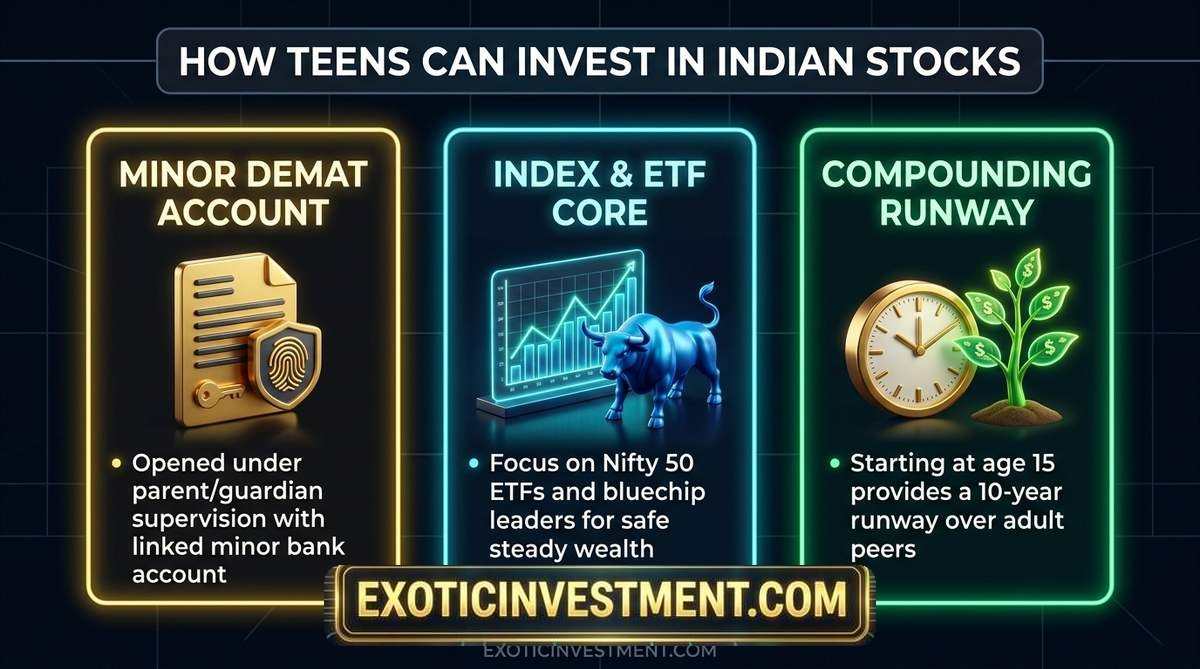
Illustration: How Teens Can Invest in Indian Stocks
Before you touch a single buy button, you need to know these core ideas. They apply to every trade you will ever make. Let us go through them one by one without any jargon.
Demat Account: This is like a digital locker for your shares. Just as you keep gold or documents in a bank locker, your shares live in a Demat account. You can open one with Zerodha, Groww, Angel One, or any SEBI-registered broker. You will need your PAN card, Aadhaar, and a bank account linked to it. Simple.
Trading Account: This is connected to your Demat account and lets you actually buy and sell shares. Both accounts work together. When you sell a share, the trading account handles the order, and the Demat account updates your holdings. Got it?
Index (Nifty 50 and Sensex): These are like report cards for the whole market. Nifty 50 tracks the top 50 companies on NSE. Sensex tracks the top 30 on BSE. When the Nifty goes up, most stocks tend to follow. When it falls, fear spreads. You should always check the index before placing any trade.
Delivery vs Intraday: Delivery means you buy a share and hold it. Days, months, or years. No pressure. Intraday means you buy and sell on the same day. It is faster but riskier. As a teen beginner, start with delivery. Learn the ropes. Then maybe explore intraday later. Intraday is not for everyone, honestly.
Candlestick Charts: These show price movement visually. Each candle tells you the open, high, low, and close price for a time period. Green candles mean price went up. Red candles mean it went down. Learning to read them is like learning to read a language. Once you know it, the market starts talking to you.
Support and Resistance: Support is a price level where buying usually kicks in. Resistance is where selling usually happens. Think of support as a floor and resistance as a ceiling. Prices bounce between them. We have a great pivot point calculator on our site that helps you find these levels quickly. Use it.
Stop Loss: This is your safety net. A stop loss automatically sells your share if the price drops to a certain level. It protects you from huge losses. For example, if you buy a stock at ₹500 and set a stop loss at ₹470, you limit your loss to ₹30 per share. Never trade without one. We also have a handy stop loss calculator to help you figure out the right level.
SIP in Stocks: Yes, you can do SIP in the stock market too. Instead of investing a lump sum, you invest a fixed amount every month. This smooths out your average purchase price over time. Our SIP calculator can show you exactly how much you might grow with monthly investments.
How to Apply This Knowledge Step by Step

Illustration: Compounding Advantage for Teen Investors
Okay, now the fun part. Let us put everything into action. Follow these steps in order. Do not skip ahead. Patience builds wealth, not speed.
Step 1: Educate Yourself First. Before putting in a single rupee, watch free videos on YouTube, read articles, and understand basics. Do not trust random tips from WhatsApp groups. That is how beginners lose money. Spend at least 30 days learning before you trade.
Step 2: Open Your Demat and Trading Account. Go to Zerodha, Upstox, or Groww. Complete KYC online using Aadhaar and PAN. The whole process takes 24 to 48 hours. Zero charges on Zerodha and Upstox for account opening. Check their brokerage calculator beforehand to understand costs.
Step 3: Link Your Bank Account and Start Small. Link your bank account to the trading platform. Transfer only what you can afford to lose. If you have ₹10,000, do not put all of it into one stock. Divide it. Start with ₹2,000 or ₹3,000 in one solid company. Learn how the screen looks, how orders work, and how emotions feel during a trade.
Step 4: Pick Your First Stock Wisely. Choose large-cap companies with stable history. Think names like TCS, HDFC Bank,Infosys, or Reliance. Do not touch penny stocks or tips you get from Telegram channels. Large caps are safer and less volatile. Use our profit calculator to estimate potential gains before you buy.
Step 5: Set a Stop Loss on Every Trade. This is non-negotiable. Before you buy, decide your exit point. If the stock drops 5 percent, do you exit? Write it down. Execute it. Emotions will try to change your mind. Discipline keeps you alive in the market.
Step 6: Keep a Trading Journal. Write down every trade. What stock? Why did you buy? At what price? Did you use a stop loss? What was the outcome? Review it weekly. Patterns will emerge. You will see your mistakes clearly. This single habit separates winners from gamblers.
Step 7: Keep Learning and Scaling Up Gradually. After 3 to 6 months of consistent small trades, you will feel more confident. Then slowly increase your capital. But never rush. The market rewards patient learners and punishes impatient gamblers every single time.
Recommended Trading Courses & Premium Subscriptions:
- Options Buying Course in Kannada: Options Buying Course in Kannada.
- Technical Analysis in Kannada Course: Technical Analysis in Kannada Course.
- Kaliyiri Share Market Book: Kaliyiri Share Market Book.
- Basics of Stock Market Course: Basics of Stock Market Course.
- Multibagger Stocks Pro Subscription: MultiBagger Plus Courses & Pro Tools Annual Subscription (Checkout link: MultiBagger Plus Courses & Pro Tools Annual Subscription).
Common Mistakes and How to Avoid Them
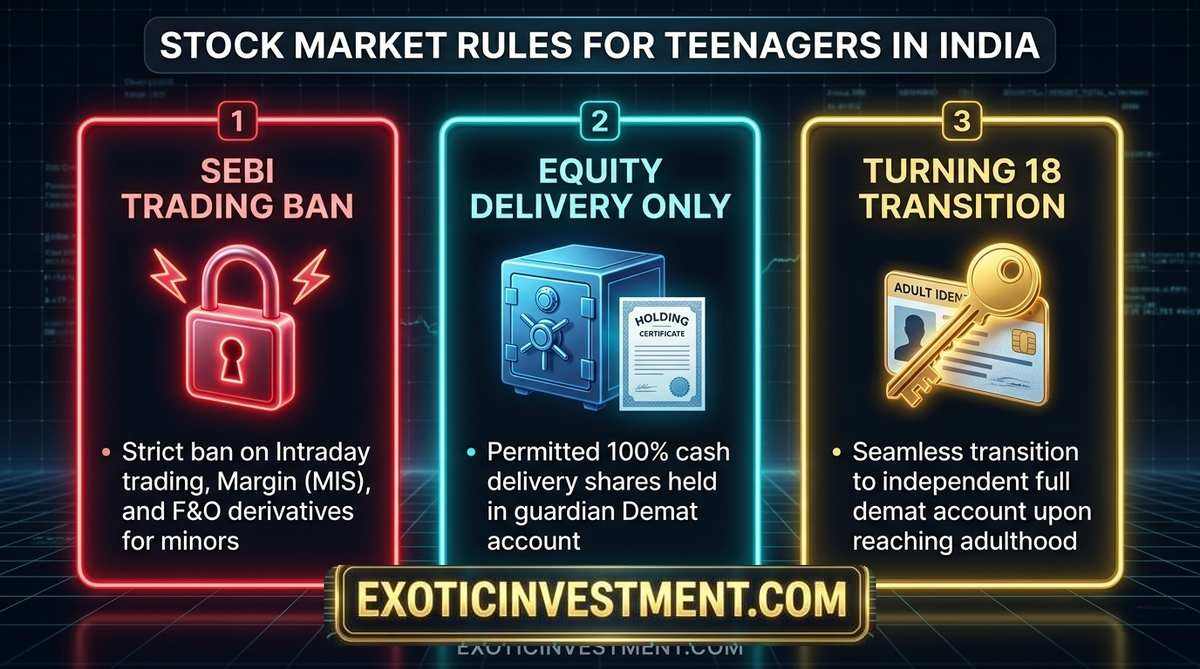
Illustration: Stock Market Rules for Teenagers in India
I have seen countless new traders blow up their accounts. Most mistakes are the same ones repeated again and again. Let me save you that pain.
Mistake 1: Following Tips Without Research. Anyone on Telegram or Instagram can give you a stock tip. But they are not responsible for your losses. Always do your own research or follow verified educators. Ask why a stock is recommended. Check the fundamentals and chart before buying.
Mistake 2: No Stop Loss. This is the biggest killer of young traders. You buy a stock, it goes red, and you tell yourself “it will come back.” Sometimes it does. Sometimes it does not. Set a stop loss every single time. Use our stop loss tool to calculate the exact level based on your risk appetite.
Mistake 3: Trading with Emotion. Fear and greed will destroy your account. When a stock is falling, fear makes you panic sell at the bottom. When it is rising fast, greed makes you hold too long and then watch it crash. Stick to your plan. Remove emotion from the equation.
Mistake 4: Overtrading. New traders think more trades equal more profit. Wrong. Every trade costs brokerage and GST. Overtrading eats your capital slowly. Quality over quantity. Wait for good setups. Be patient.
Mistake 5: Chasing Multibaggers Blindly. Everyone talks about finding the next Tata Motors or Apollo Hospitals. But for every multibagger, ten stocks go zero or stay flat forever. Do not gamble on hope. Build a portfolio of solid companies first. Small caps and micro caps can wait until you are experienced.
Mistake 6: Ignoring Taxes and Charges. STT, brokerage, GST, stamp duty — these add up. A ₹10,000 trade is not a ₹10,000 trade after charges. Use our profit and loss calculator to understand your real returns after all deductions.
Mistake 7: Trying to Recover Losses Quickly. Lost money? Do not revenge trade. That is how losses turn into disasters. Take a break. Review your journal. Come back with a clear head. The market will always be there tomorrow.
Advanced Trading Tips to Master This Topic
Once you are comfortable with the basics, here are advanced strategies that separate good traders from great ones. Remember, advanced means you already know the basics well. Do not jump here too early.
Tip 1: Master One Strategy at a Time. Do not mix swing trading, intraday, and positional trading all at once. Pick one style. Learn it deeply. Trade it consistently for three months. Then explore another. Depth beats breadth in trading.
Tip 2: Use Pivot Points and Support Zones. Advanced traders rely heavily on pivot points to identify likely reversal zones. Our pivot point calculator helps you find key levels quickly. Combine pivot points with volume analysis for stronger signals.
Tip 3: Understand Market Breadth. Nifty might be green, but are most stocks actually going up? Check the advance-decline ratio. If the index is rising but most stocks are falling, that is a warning sign. The rally is weak. Watch for divergence between index and individual stocks.
Tip 4: Position Sizing Is Everything. Never put more than 5 to 10 percent of your total capital in a single stock. If you have ₹50,000, no single trade should exceed ₹5,000. This way, even a bad trade cannot hurt you badly. Risk management is not optional. It is survival.
Tip 5: Track Your Psychology. Keep a notes section in your trading journal about your mental state during each trade. Were you anxious? Overconfident? Tired? Emotional trading is the silent account killer. Recognize your patterns and fix them.
Tip 6: Use Limit Orders, Not Market Orders. Market orders execute instantly at whatever price the seller asks. Limit orders let you set your price. If you want to buy at ₹490, set a limit order at ₹490. It might not execute immediately, but you control the price. This simple habit saves real money over time.
Tip 7: Diversify Across Sectors. Do not put all your money in IT stocks or all in banking. Spread across 3 to 4 sectors. If IT crashes, your banking exposure may balance it out. Diversification reduces risk without reducing returns significantly.
Tip 8: Review Monthly, Not Daily. Checking your portfolio every hour creates anxiety and leads to impulse trades. Review once a week or once a month. Long-term wealth is built by holding good companies, not by staring at screens all day.
Final Summary
Let me wrap this up cleanly. The stock market for teens in India is not a dream. It is a skill you can learn, practice, and master. Start young. Start small. Stay disciplined.
Here is what you take away from this guide. First, open your Demat account with a trusted broker like Zerodha, Groww, or Upstox. Second, learn the basics thoroughly before risking real money. Third, always use stop losses and position sizing. Fourth, keep a trading journal and review it regularly. Fifth, never stop learning.
The Indian stock market gives equal opportunity to everyone who respects it. It does not care about your age, your background, or your connections. It only cares about your discipline, your patience, and your willingness to learn. If you bring those three things, the market will reward you. If you bring greed and impatience, it will teach you a painful lesson.
So, start today. Watch a free video. Read a book. Open that account. Place your first small trade. Make mistakes. Learn from them. Grow. That is the journey. And honestly speaking, there is no better journey to be on at your age. The compound interest of knowledge and capital working together for 20 years will make you untouchable financially.
All the best, future trader. See you at the top.
💡 Frequently Asked Questions (FAQ)
Can a teenager under 18 open a Demat account in India?
Yes. A minor under 18 years can open a Demat account operated by a natural parent or legal guardian. The account holds shares safely with NSDL or CDSL. Learn how your depository account works in our Demat account terms and DP BO ID guide.
Can teenagers participate in intraday trading or F&O derivatives?
No. SEBI regulations strictly prohibit minors from trading intraday, equity derivatives (F&O), or using margin leverage. Minors can only take delivery of equity shares and mutual funds through registered stock broker apps in India.
How does compounding help teenagers build long-term wealth?
Starting in your teens gives your money 30 to 40 years to compound uninterrupted. You can project your potential future corpus with our SIP return calculator or calculate annual required growth with our Reverse CAGR calculator.
How are profits taxed on a minor’s Demat account in India?
Any capital gains or dividends earned by a minor are clubbed with the parent who has a higher total income under Section 64(1A) of the Income Tax Act. Check your net tax liability using our stock market tax calculator.
What is the best way for a teenager to learn fundamental stock analysis?
Begin with structured educational books and foundation courses rather than social media stock tips. Explore our beginner-friendly Basics of Stock Market Course, read the Kaliyiri Share Market Book, and access our pro tools through the MultiBagger Plus Courses & Pro Tools Annual Subscription.