
Every retail investor securing an allotment wonders can i sell sme ipo on listing day to lock in substantial listing gains. The Indian primary market has experienced unprecedented retail participation across both mainboard and small-and-medium enterprise (SME) public issues. However, the regulatory mechanics governing SME platforms differ radically from standard mainboard listings on the National Stock Exchange (NSE) and Bombay Stock Exchange (BSE).
In fact, while selling shares on listing morning is entirely permissible for both segments, SME issues operate under stringent trading restrictions. If you attempt to exit an SME allotment using standard equity market orders, your broker terminal might reject the trade. In this detailed guide, we break down SME lot size mandates, Trade-to-Trade (T2T) rules, pre-open auction timelines, and taxation realities.
Can I Sell SME IPO on Listing Day? The Definitive Answer
To answer plainly: yes, you can sell your SME IPO shares on listing day. If the exchange has credited the allotted shares to your Demat account, you are fully authorized to sell them as soon as continuous trading opens at 10:00 AM IST. However, you must execute the sell order strictly in the original allotted lot size.
For example, if your SME allotment consists of 1,200 shares, you must place an order to sell all 1,200 shares in a single trade transaction. Unlike mainboard equities where you can sell a single individual share, SME platforms strictly prohibit odd-lot trading during normal market hours. Consequently, retail participants cannot partially sell half their lot to recover their initial investment while holding the rest.
| Listing Parameter | Mainboard IPO (NSE / BSE) | SME IPO (NSE Emerge / BSE SME) |
|---|---|---|
| Minimum Selling Quantity | 1 single share allowed | Strictly 1 Full Lot (e.g. 1,000–3,000 shares) |
| Settlement Category | Rolling Settlement (EQ Segment) | Trade-to-Trade (T2T / ST Segment) |
| Intraday Buying & Selling | Permitted on listing day | Strictly Prohibited (No intraday squaring) |
| Pre-Open Auction Window | 09:00 AM to 09:45 AM IST | 09:00 AM to 09:45 AM IST |
| Continuous Trading Open | 10:00 AM IST | 10:00 AM IST |
| Upfront Margin Requirement | Standard VaR + ELM margins | 100% upfront cash margin |
| Price Circuit Filter | Dynamic price bands (or 20%) | Strict 5% or 20% hard circuit limits |
In addition, SME stocks are placed in the Trade-to-Trade (T2T) category for a mandatory cooling period post-listing. Because T2T requires compulsory gross delivery of shares, you cannot buy additional shares in the morning and sell them later in the afternoon. You can calculate the exact statutory fees and net profits from your IPO allotment using our free stock profit calculator.
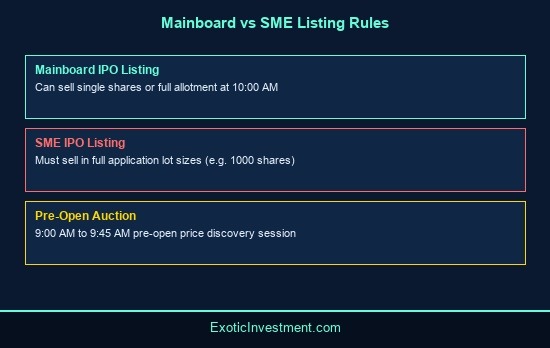
Illustration: Structural Comparison Between Mainboard and SME Listing Mechanisms. In addition, always review pre-open order books.
The Listing Day Timeline: Pre-Open Session to Continuous Trade
Understanding exchange timing is essential to executing your listing day exit at the best possible price. On the listing date, both mainboard and SME IPOs follow a dedicated pre-open call auction framework rather than standard market timings:
- 09:00 AM to 09:45 AM (Order Collection Period): Investors can enter, modify, or cancel orders. The exchange matching engine continuously calculates the indicative equilibrium listing price based on aggregate supply and demand.
- 09:45 AM to 09:55 AM (Order Matching Period): The order book freezes completely. The exchange determines the official opening price and matches corresponding buy and sell orders.
- 09:55 AM to 10:00 AM (Buffer Period): A mandatory transition interval that allows trading terminals to prepare for normal trading.
- 10:00 AM to 03:30 PM (Continuous Trading): Regular trading commences. Retail participants can enter market or limit orders in full lot multiples.
Therefore, if you wish to exit during the pre-open auction, you must place your order between 09:00 AM and 09:45 AM. If your order price matches or is lower than the discovered equilibrium price, your shares execute right at the opening bell. You can compute full round-trip brokerage costs across discount brokers using our Indian stock brokerage calculator.
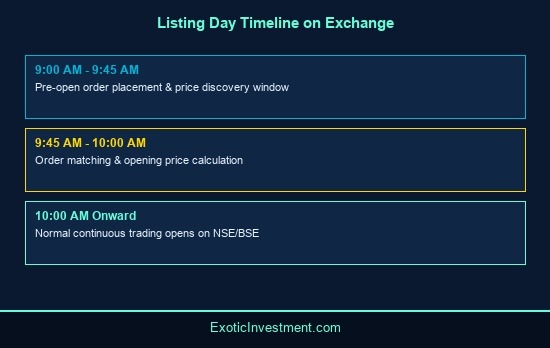
Illustration: Official NSE Emerge and BSE SME Listing Day Timeline. In addition, note that circuit limits apply post-10:00 AM.
Liquidity Risks and Circuit Limit Locks on SME Platforms
While mainboard stocks usually enjoy deep retail and institutional liquidity, SME stocks can suffer from severe illiquidity. Specifically, because buyers must commit upwards of ₹1 Lakh to ₹1.4 Lakhs per lot, retail buyers are far fewer in number. If an SME stock opens at a lower circuit limit, you might find zero buy orders waiting in the exchange depth.
In contrast, when an SME stock lists at an upper circuit, massive demand locks the order book with buy orders only. Under SEBI rules, SME listings typically operate with strict 5% or 20% price circuit bands from their discovered listing price. Therefore, if market sentiment reverses, an investor unable to exit on day one may remain trapped through consecutive falling circuit sessions.
Because of this asymmetric liquidity, disciplined allottees often choose to book listing gains immediately during the pre-open discovery window. You can track your overall multi-asset net worth and audit SME equity gains using the eMintage portfolio tracker. In addition, reinvesting listing windfalls systematically compounds your wealth over multi-year horizons through our free SIP wealth calculator.
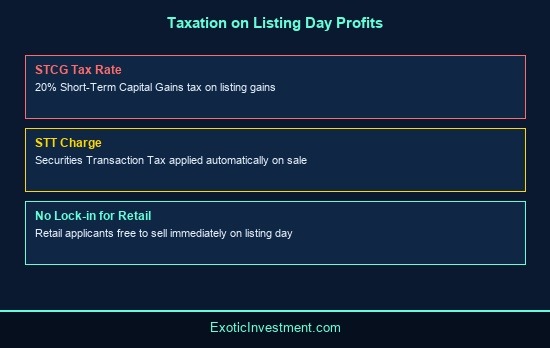
Illustration: Short-Term Capital Gains (STCG) Taxation on Listing Profits. In addition, verify your annual tax liability.
Short-Term Capital Gains (STCG) Tax on Listing Day Gains
Selling your SME or mainboard IPO shares on listing day triggers Short-Term Capital Gains (STCG) under Indian tax law. Following the Union Budget 2024 revisions to Section 111A of the Income Tax Act, STCG on listed equities subject to Securities Transaction Tax (STT) is taxed at a flat rate of 20%. Consequently, earlier 15% rate assumptions no longer apply to current listing profits.
For instance, if you secure an SME allotment for ₹1,20,000 and sell the lot on listing day for ₹2,00,000, your net capital gain is ₹80,000. Under Section 111A, your statutory tax liability equals ₹16,000 (plus applicable education cess and surcharge). You can review official regulatory tax updates in our detailed what is STT in share market guide.
To master primary market analysis and spot genuine multi-bagger opportunities, study our foundational Basics of Stock Market Course. In addition, explore our bestselling Kaliyiri Share Market Book, and elevate your investing skills with the MultiBagger Plus Pro Annual Subscription.
💡 Frequently Asked Questions on Selling SME IPO on Listing Day
Can I sell only half of my SME IPO lot on listing day?
No, exchanges strictly prohibit partial or odd-lot sales for SME shares during normal continuous trading. You must trade the exact minimum lot size specified by the exchange, meaning you must sell either the entire lot or keep holding it.
What happens if an SME stock hits lower circuit on listing day?
If an SME stock hits its lower circuit limit, all available buyers disappear and trading freezes at that price band. In this scenario, any sell order you place will remain unexecuted in the order queue until fresh buy orders enter the market.
Can I do intraday trading in SME IPO shares on listing day?
No, SME shares are placed under the Trade-to-Trade (T2T) settlement segment upon listing. Because T2T requires 100% compulsory physical delivery, intraday buying and selling to square off positions is strictly forbidden.
Which brokers support selling SME IPOs on listing day?
All major SEBI-registered brokers including Zerodha, Upstox, Groww, and Angel One support selling SME IPOs on listing day. However, ensure your allotted shares reflect in your Demat holdings before the 10:00 AM market opening.

Trackbacks/Pingbacks