
Searching for high-potential penny stocks to buy on the National Stock Exchange and BSE remains one of the most popular pursuits among Indian retail traders. However, pursuing low-priced shares without institutional due diligence frequently turns promising trading capital into painful market losses. In real trading desks, professional investors never purchase a micro-cap counter simply because its share price trades under ten rupees.
Specifically, genuine wealth creation in the penny stock space demands identifying fundamentally sound turnaround candidates before the broader crowd catches on. In addition, recognizing whether a rally represents operator manipulation or organic volume expansion protects your primary capital. Therefore, establishing a disciplined screening framework is vital before placing any live market orders.
Core Fundamental Filters for Screening Penny Stocks
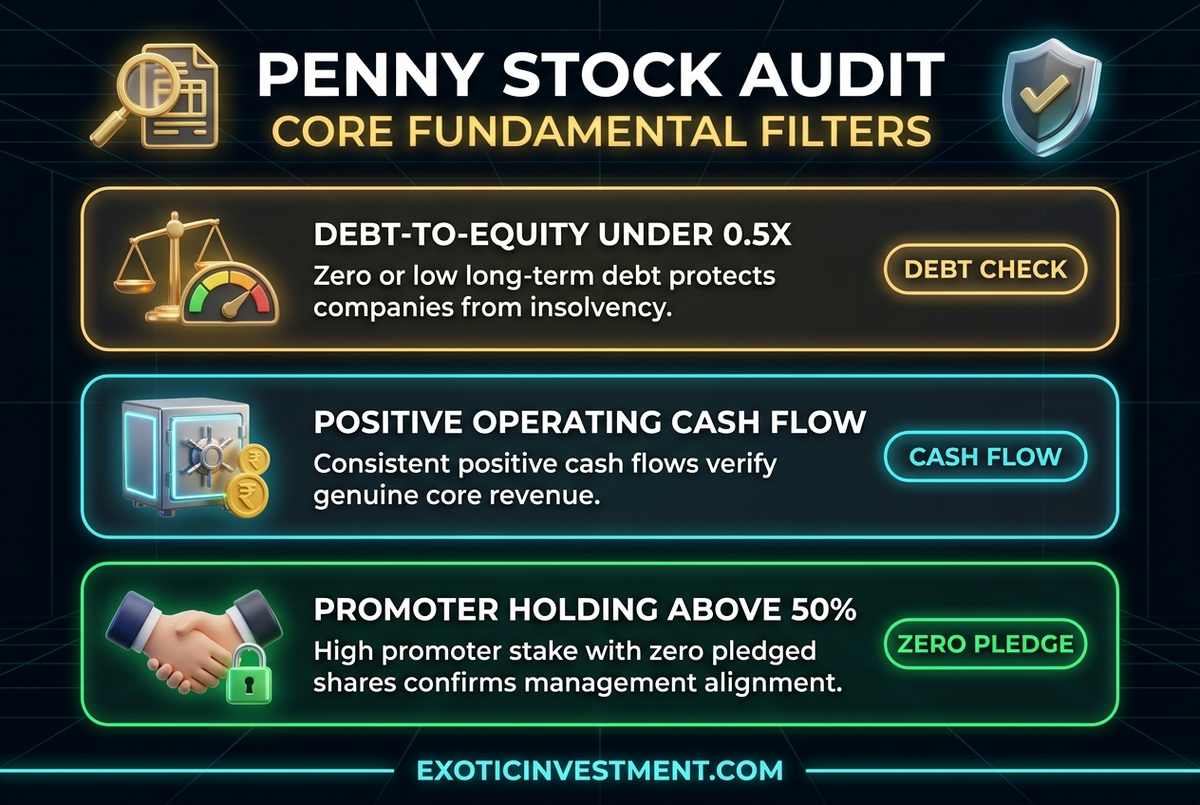
Listen closely, because this basic checklist eliminates 90% of micro-cap wealth destroyers before you risk a single rupee. First, always inspect the company balance sheet to verify that the long-term debt-to-equity ratio remains strictly under half of equity. In reality, heavily indebted penny companies rarely engineer successful turnarounds because rising finance costs swallow their operating cash flows.
Second, demand consistent positive operating cash flow across consecutive reporting quarters. For instance, companies that report paper accounting profits while showing negative cash flow from operations often mask aggressive revenue recognition. You can evaluate corporate valuation multiples using our free PE ratio calculator to ensure you never overpay for speculative turnover.
Finally, examine exchange shareholding filings to confirm high promoter ownership with zero pledged shares. When company promoters maintain skin in the game, their long-term interests remain completely aligned with minority shareholders. You can verify essential quoting mechanics using our guide on stock price terms before committing delivery capital.
Circuit Limit Traps and Exchange Surveillance Rules
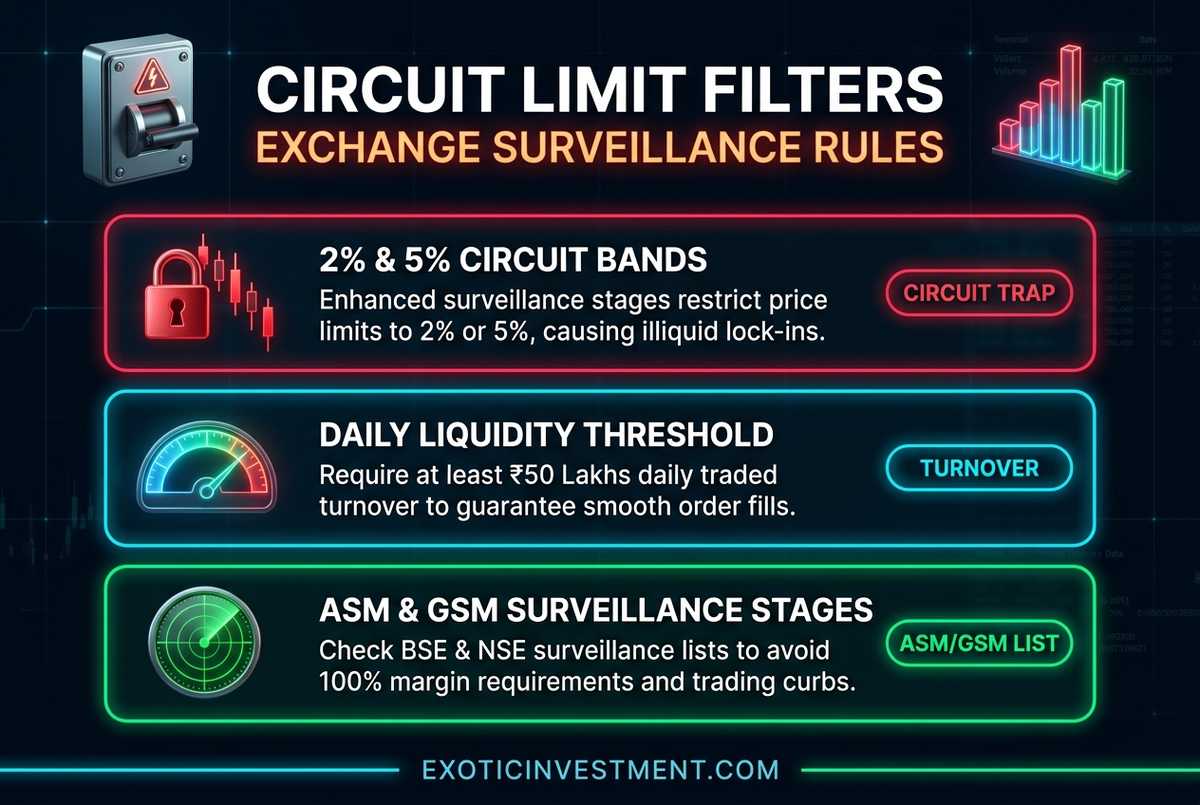
One of the most dangerous hazards in low-priced equity trading is encountering illiquid exchange circuit bands. Because SEBI enforces enhanced surveillance measures like ASM and GSM on volatile securities, price bands often get narrowed to tight 2% or 5% limits. Consequently, when panic selling hits a micro-cap counter, zero-buyer lower circuits lock retail traders inside falling positions for weeks.
Therefore, always check daily traded turnover before pressing the buy button on your terminal. Specifically, demand a minimum daily traded volume of at least ₹50 Lakhs to guarantee smooth order fills when you decide to exit. In fact, studying how exchange price filters function in our guide on upper circuit vs lower circuit rules helps you avoid costly liquidity traps.
| Evaluation Parameter | Ideal Safety Threshold | Red Flag Warning | Desk Action Plan |
|---|---|---|---|
| Debt-to-Equity Ratio | Strictly Under 0.5x | Heavy Borrowing (>1.5x) | Immediate Rejection |
| Daily Trading Volume | >₹50 Lakhs Turnover | Erratic Under ₹5 Lakhs | Avoid Illiquid Traps |
| Promoter Pledging | 0% Shares Pledged | Pledged Above 20% | High Involuntary Dump Risk |
| Position Allocation Rule | Max 1% to 2% Portfolio Cap | All-in Gambling | Strict Capital Shield |
Disciplined Capital Allocation and Exit Strategy
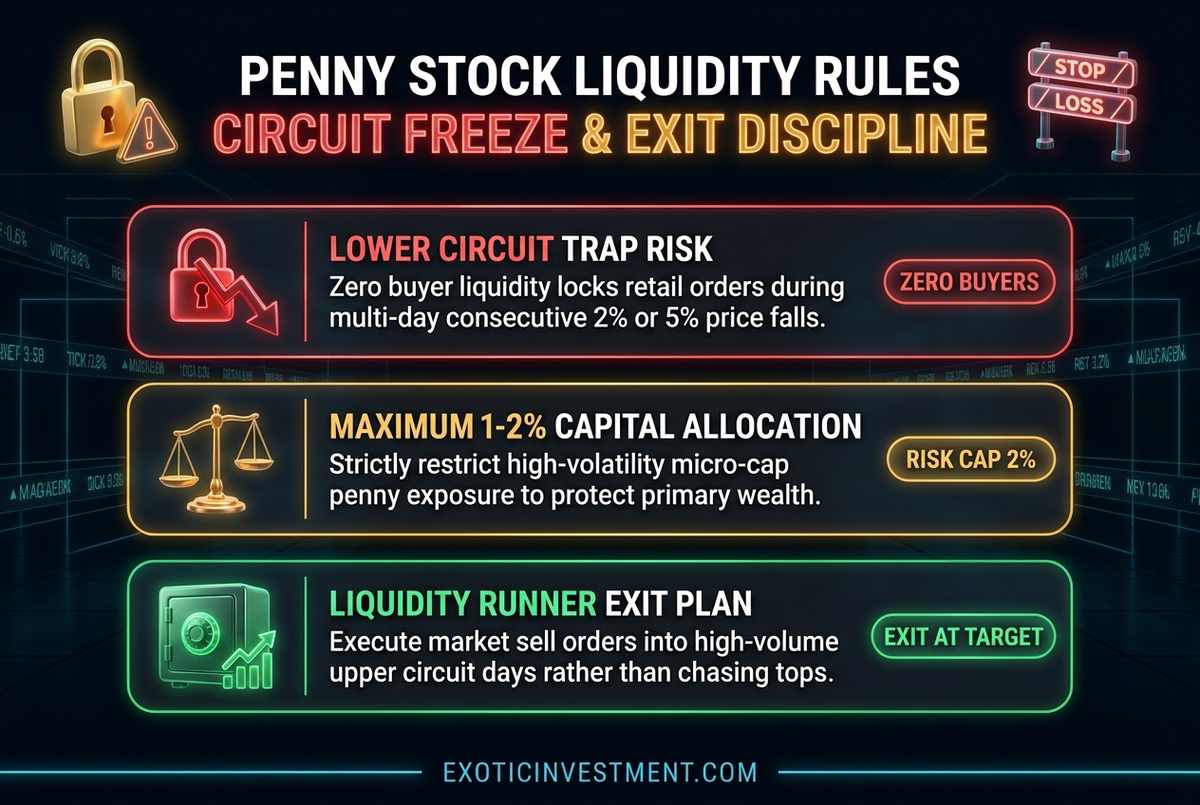
Here is the real deal about long-term survival when trading micro-cap equities. Never allow speculative penny bets to exceed 1% or 2% of your total equity portfolio. Because high volatility can wipe out small companies, confining them to a modest risk bucket ensures total peace of mind.
In addition, calculate your exact share quantities before entering market orders using our free position size calculator. When a turnaround story plays out and the stock hits consecutive upper circuits, harvest initial capital into strength. Never let an unrealized multi-bagger turn into an avoidable loss because of greed.
Similarly, remember to account for brokerage charges, STT, and exchange turnover fees on every transaction. Many retail participants overlook trading costs that eat into net compounding. You can review exact charges across Indian brokers with our Zerodha brokerage calculator.
🚀 Master Global Portfolio Allocation & Compound Wealth
Build an all-weather investment portfolio combining Indian market leaders with global tech compounders. Learn directly from Dr. Ashok Kumar N Rao.
- Master foundational stock market principles with our book Kaliyiri Share Market Book and our English handbook Basics of Indian Stock Market Book.
- Accelerate your research with institutional screeners through the MultiBagger Plus Courses & Pro Tools Annual Subscription.
- Master chart setups by enrolling in our structured Technical Analysis Course in Kannada or options mechanics in our Options Buying Course in Kannada.
Strategic Compounding Beyond Speculative Picks
Ultimately, treating Dalal Street like an enduring business means anchoring your wealth in high-quality compounders while managing penny stocks prudently. Instead of betting your life savings on uncertain turnarounds, construct a solid financial foundation with diversified blue chips. For instance, you can model steady wealth creation trajectories using our SIP calculator online to track progress toward your financial milestones.
In addition, study delivery trading execution rules to understand how holding settlement timelines operate on Indian exchanges. Reviewing our detailed guide on delivery and CNC trading rules helps you manage clearing cycles without unexpected penalties. Maintaining rigorous risk discipline ensures you stay profitable across every market phase.
💡 Frequently Asked Questions (FAQ)
What is the single most important fundamental filter when evaluating penny stocks?
The most vital filter is confirming low corporate debt (debt-to-equity below 0.5x) coupled with positive operating cash flows. In reality, heavily leveraged companies rarely engineer turnarounds because interest overheads drain cash. Learn how exchange pricing terminology operates by reading our guide on stock price terms.
Why do penny stocks frequently get trapped in lower circuit declines?
Because micro-cap stocks feature low free-float liquidity, minor selling waves quickly exhaust buyers and freeze prices at circuit limits. Learn how exchange surveillance mechanisms operate by reading our guide on upper circuit vs lower circuit rules.
How much capital should an investor allocate to penny stocks?
Disciplined trading desks strictly limit speculative penny stock exposure to no more than 1% to 2% of total portfolio capital. You can calculate precise trade quantities with our free position size calculator to avoid over-leveraging.
How can traders estimate long-term compounded growth from turnaround stocks?
Traders should model required earnings growth rates and valuation multiples over 3 to 5 year periods. You can easily project compounding scenarios using our free reverse CAGR calculator to test turnaround assumptions.