Introduction to Long-Term Portfolio Building
Welcome to our comprehensive guide on how to build a long term investment portfolio India. If you want to achieve true financial independence, learning to construct a diversified investment portfolio is essential. In fact, long-term compounding in the Indian stock market remains one of the most effective paths for wealth creation.
Before building your portfolio, ensure you understand basic valuation metrics. For instance, read our guides on how to get into the Indian stock market and what to look for in stocks to invest. Furthermore, you will need to analyze corporate financial health. Specifically, check our guides on how to read a balance sheet and understanding P/E ratio valuation. These fundamental tools help you select undervalued, high-quality businesses.
Understanding Long Term Investment Portfolio India
Firstly, let us define asset allocation. Asset allocation is the process of dividing your capital among different asset classes, such as equities, debt, gold, and real estate. Specifically, building a balanced long term investment portfolio India requires aligning this asset mix with your age and risk tolerance.

Illustration 1: Asset Allocation Pie Chart India Investment Portfolio
In addition, proper asset allocation protects your capital during market downturns. Because different asset classes react differently to economic events, diversification reduces portfolio volatility. Consequently, you can sleep peacefully during market corrections, knowing your wealth is protected.
Master Technical Analysis & Trading: Recommended Courses & Books
For investors seeking structured share market education, we offer dedicated training resources. In addition, these courses provide practical, step-by-step wealth creation masterclasses:
Recommended Trading Courses & Premium Subscriptions:
- Kaliyiri Share Market Book: Learn stock market fundamentals and wealth creation in simple Kannada: Kaliyiri Share Market Book.
- Technical Analysis in Kannada Course: Learn chart reading, support/resistance mapping, and volume analysis: Technical Analysis in Kannada Course.
- Basics of Stock Market Course: Build your stock market foundation from scratch: Basics of Stock Market Course.
- Options Buying Course in Kannada: Master Nifty and Bank Nifty option buying setups: Options Buying Course in Kannada.
- Multibagger Stocks & Pro Subscription (Product 2739): Access premium stock picks, research reports, and pro trader alerts: MultiBagger Plus Courses & Pro Tools Annual Subscription (Direct checkout: Buy Pro Subscription Product 2739).
The Power of Compounding and Systematic Investing
Secondly, compounding is the process where your investment returns generate their own returns over time. In fact, compounding requires time and consistency. Therefore, starting to invest early is far more important than investing large sums later in life.
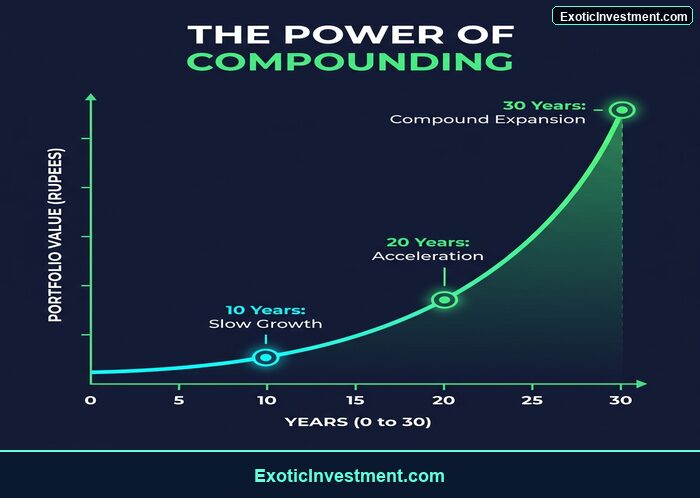
Illustration 2: Compounding Interest Growth Wealth Curve India
Furthermore, systematic investment plans (SIPs) help you take advantage of rupee cost averaging. Specifically, by investing a fixed amount monthly, you buy more shares when prices are low and fewer shares when prices are high. As a result, you compound your wealth steadily without trying to time the market. Learn how compounding works over decades in our guide on why stock market investment is better than other investments.
Selecting Quality Stocks for Long-Term Growth
Furthermore, selecting individual stocks requires a rigorous screening process. Specifically, focus on blue-chip companies with strong competitive moats and low debt-to-equity ratios. In fact, companies that consistently grow their market share are highly likely to reward shareholders over the long term.
Therefore, look for businesses with high return on equity (ROE) and consistent dividend histories. In addition, you should diversify your stock holdings across multiple sectors. Consequently, you protect your portfolio from industry-specific downturns. For instance, check our guide on moving averages for trend confirmation to identify technical entry points.
Understanding Debt Allocation and Fixed Income Assets
Furthermore, a portion of your portfolio should always be allocated to debt and fixed-income assets. Specifically, debt assets include Public Provident Fund (PPF), debt mutual funds, and fixed deposits. In fact, these assets provide steady, predictable returns during volatile stock market phases. Consequently, they act as capital shock absorbers, allowing you to rebalance your portfolio efficiently.
Therefore, maintain a balanced exposure to debt based on your age and financial goals. In addition, fixed income assets provide liquidity during emergency situations. Because you do not want to liquidate your equities during a market crash, keeping a debt buffer is highly recommended. Ultimately, debt allocation ensures overall portfolio survival and stability.
Gold and Alternate Assets as Portfolio Shock Absorbers
Furthermore, allocating a small portion (5% to 10%) of your capital to gold acts as an excellent portfolio shield. Specifically, gold historically shares an inverse correlation with equity markets. In fact, during periods of economic crisis or high inflation, gold prices tend to rise significantly. Consequently, holding gold mutual funds or Sovereign Gold Bonds (SGBs) protects your overall wealth from severe stock market drawdowns.
Therefore, systematic allocation to alternate assets is highly recommended. In addition, gold acts as a reliable liquid asset during currency devaluation events. Because you want a diversified portfolio that stands strong in any macro environment, gold must not be ignored. Ultimately, physical or digital gold ensures global purchasing power stability.
Understanding Equity Mutual Funds vs Direct Stock Investing
Furthermore, decide whether to invest through direct stocks or mutual funds. Specifically, direct stock investing offers higher potential returns but requires continuous research and portfolio tracking. In fact, selecting individual stocks carries significant company-specific risks. Conversely, equity mutual funds pool capital from thousands of investors to buy a highly diversified portfolio of 50 to 100 stocks. Consequently, mutual funds are an excellent vehicle for retail investors who lack the time to conduct detailed fundamental analysis.
Therefore, a combination of both approaches is often the best strategy. Specifically, invest in broad-market index funds for core wealth compounding. In addition, allocate a satellite portion of your capital to high-quality individual stocks to capture outperformance. Ultimately, this core-and-satellite strategy balances diversification with return potential.
Portfolio Rebalancing and Risk Management
Thirdly, portfolio rebalancing is the process of restoring your portfolio to its target asset allocation. Specifically, because equities grow faster than debt, your asset mix will shift over time. In fact, if you do not rebalance, your portfolio will become excessively risky.
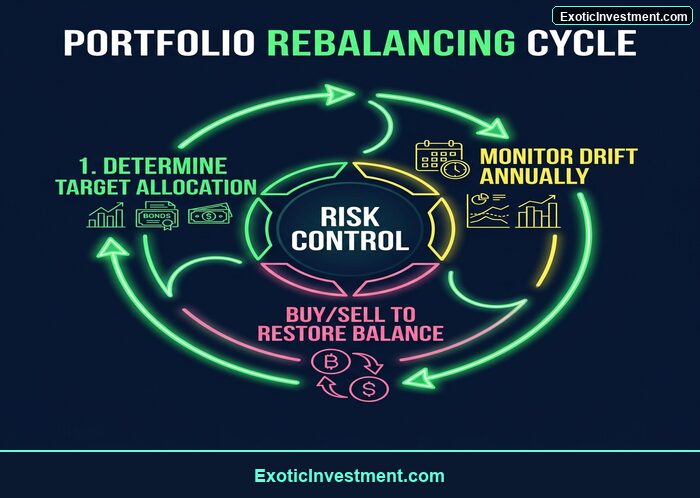
Illustration 3: Annual Portfolio Rebalancing Risk Management India
Therefore, review your asset allocation at least once a year. For example, if your target allocation is 60% equity and 40% debt, and a bull market pushes equity to 70%, sell 10% of your equity and buy debt. Consequently, you lock in profits and buy safer assets when the market is high. To manage your short-term trading risk alongside your long-term portfolio, use our automated Stop Loss Calculator. Furthermore, you can analyze your stock exits using the RSI relative strength index guide.
Tax Efficiency and Long-Term Capital Gains (LTCG)
Finally, when rebalancing your portfolio in India, you must consider the tax implications. Specifically, Long-Term Capital Gains (LTCG) on equity investments are taxed at a flat rate of 12.5% on gains exceeding ₹1.25 lakh per financial year. In fact, capital gains tax can significantly drag down your portfolio returns if not managed carefully.
Therefore, implement a tax-harvesting strategy. Specifically, realize up to ₹1.25 lakh in capital gains each year to utilize the tax-free limit. Consequently, you raise your portfolio cost basis tax-free. In addition, consult a professional to structure your family accounts for tax optimization.
Integrating Calculators to Project Your Wealth
To plan your financial journey accurately, you should use interactive investment calculators:
- Project SIP Returns: Estimate your future corpus using the Groww SIP Calculator.
- Calculate Passive Cash Flow: Project your annual dividend yields using our guide on dividend investing in India.
- Calculate Trading Costs: Estimate transaction charges with the Zerodha Brokerage Calculator or Upstox Brokerage Calculator.
If you maintain digital assets alongside traditional equities, manage your global net worth using a crypto portfolio tracker from Emintage inline. In addition, calculate your tax obligations with a crypto tax calculator or project returns with a bitcoin profit calculator.
Frequently Asked Questions
Q: What is the best asset allocation for a 30-year-old?
A: A common rule of thumb is “100 minus your age” in equity. Therefore, a 30-year-old should allocate roughly 70% to equities and 30% to safer debt assets.
Q: How often should I rebalance my long-term portfolio?
A: Once a year is generally sufficient. In fact, rebalancing too frequently increases transaction costs and tax liabilities.
Q: Where can I get premium stock research in Kannada?
A: Read our bestselling Kaliyiri Share Market Book or subscribe to our MultiBagger Plus Courses & Pro Tools Annual Subscription.
In summary, building a robust long term investment portfolio India requires patience, asset allocation, and annual rebalancing. Furthermore, always focus on consistent systematic investing to achieve your long-term financial goals.
Furthermore, keep transaction fees low by selecting high-quality discount brokers. Specifically, high brokerage charges can eat up a significant portion of your compound returns over time. In fact, many retail investors ignore the impact of transactional friction on their capital. Consequently, checking fees beforehand is highly recommended. Therefore, you can optimize your long-term returns and accelerate your wealth compounding journey.
In addition, review your portfolio holdings periodically. Specifically, ensure that the fundamental reasons for investing in a particular stock are still valid. For instance, if a company’s profit margins deteriorate consistently over three quarters, it may be time to exit. Consequently, reallocating that capital to stronger companies keeps your portfolio healthy and growing.