
Determining exactly how much to invest in Indian equities is the most critical decision separating disciplined wealth builders from stressed retail traders. Many newcomers on Dalal Street commit arbitrary sums based on social media euphoria or fear of missing out. However, deploying capital without structured budgeting rules, emergency reserves, and asset allocation guidelines invites severe emotional distress during market corrections.
Listen, boss, investing is not about how much surplus cash sits in your bank account on a single fortunate day. In reality, sustainable wealth creation depends entirely on cash flow consistency, risk tolerance, and keeping essential living expenses insulated from market drawdowns. When you establish a clear monthly investment framework, market dips transform from panic events into premier accumulation opportunities.
Before committing personal savings to volatile equities, establishing baseline financial literacy ensures your expectations match reality. We explore these fundamental trading and valuation principles in our beginner guide to basic stock market terms.
Here is the real deal: following proven allocation frameworks like the 50-30-20 budget rule removes emotional guesswork from your financial life. In addition, knowing how to balance monthly SIPs with opportunistic lumpsum deployments accelerates your compounding journey toward a ₹1 Crore milestone. You can simulate your customized long-term wealth milestones directly using our interactive sip calculator.
The 50-30-20 Rule: The Foundation of Monthly Capital Allocation
The time-tested 50-30-20 budgeting framework provides an intuitive roadmap for dividing your net monthly take-home salary. Specifically, allocate 50% of your earnings toward essential survival needs, including home rent, groceries, utility bills, and term insurance. Keeping fixed living costs within this boundary ensures unexpected expenses never force you to liquidate long-term equity investments.
Next, designate 30% of your income toward discretionary lifestyle spends, such as weekend dining, family travel, and personal hobbies. Maintaining this guilt-free lifestyle allowance keeps your financial journey psychologically enjoyable and sustainable across decades. Consequently, you avoid burnout and prevent impulsive revenge spending that derails disciplined savings.
Finally, direct the remaining 20% of your net income into productive wealth compounding vehicles without compromise. By transferring this capital automatically on salary day into index funds, equity mutual funds, and direct blue-chips, you pay yourself first. To project how this 20% savings habit expands over 10 to 20 years, test our online compound interest calculator.
A classic Kannada proverb wisely reminds us: “ಹಾಸಿಗೆ ಇದ್ದಷ್ಟೇ ಕಾಲು ಚಾಚು” (Hasige iddashte kaalu chaachu — stretch your legs only as far as your bed extends). Similarly, investing strictly within your genuine financial capacity protects you from overextending into reckless debt. Therefore, respecting this boundary guarantees enduring peace of mind across all market cycles.
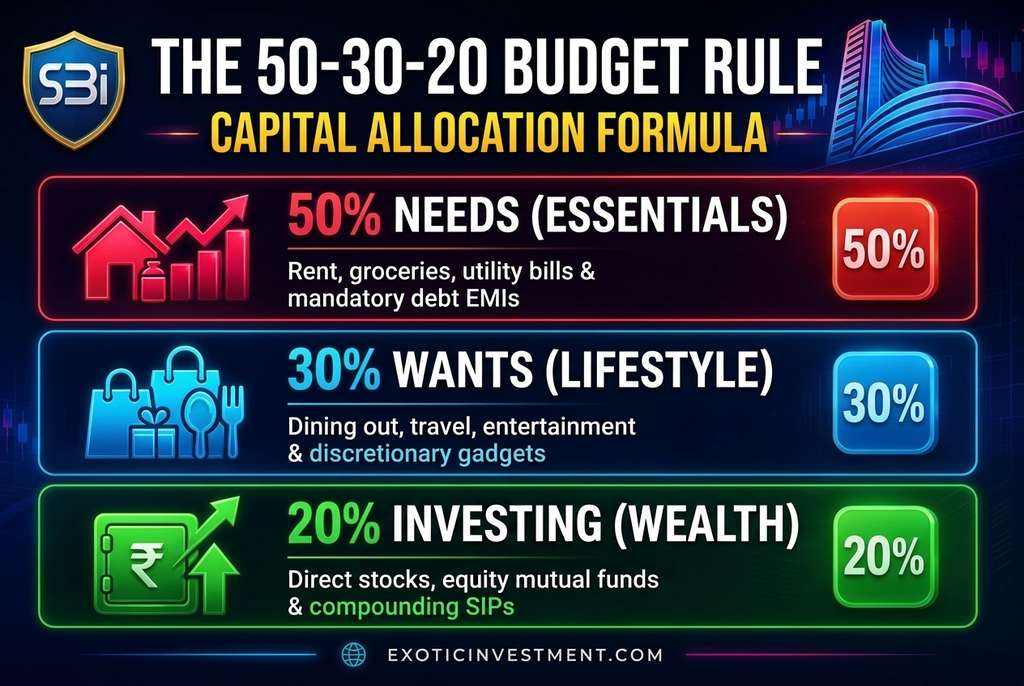
Illustration: The 50-30-20 Wealth Allocation Blueprint for Disciplined Monthly Compounding
Non-Negotiable Prerequisites Before Putting a Single Rupee in Stocks
Before allocating investable funds into market-linked instruments, every investor must establish three protective shields. First, build a dedicated liquid emergency fund covering six months of basic household expenses. Park this reserve strictly in high-yield bank savings accounts or sweep-in fixed deposits, never in volatile equities.
Second, secure adequate pure term life insurance and family health insurance coverage. A single unexpected hospitalization can wipe out years of accumulated stock portfolio gains if you lack extensive medical cover. By transferring catastrophic risks to insurance providers, you protect your growing equity investments from forced distress selling.
Third, completely eliminate all high-interest toxic consumer debt, especially revolving credit card balances and personal loans. Credit card interest rates in India typically range from 36% to 42% annually, dwarfing any realistic stock market return. Therefore, eliminating expensive debt delivers an immediate, guaranteed risk-free return on your money.
| Monthly Income Bracket | Emergency Reserve Target (6 Mo) | Monthly Equity SIP (20% – 30%) | 10-Year Projected Wealth at 12% |
|---|---|---|---|
| ₹50,000 / month | ₹1,50,000 | ₹10,000 / month | ₹23.23 Lakhs |
| ₹1,00,000 / month | ₹3,00,000 | ₹25,000 / month | ₹58.08 Lakhs |
| ₹2,00,000 / month | ₹6,00,000 | ₹60,000 / month | ₹1.39 Crore |
| ₹3,00,000 / month | ₹9,00,000 | ₹1,00,000 / month | ₹2.32 Crore |
Notice how disciplined monthly contributions steadily compound into formidable crore corpuses over ten-year holding periods. In addition, tracking your multi-tranche purchases ensures you monitor true entry valuations accurately. For investors building direct stock positions, explore our guide on how to calculate share average price.
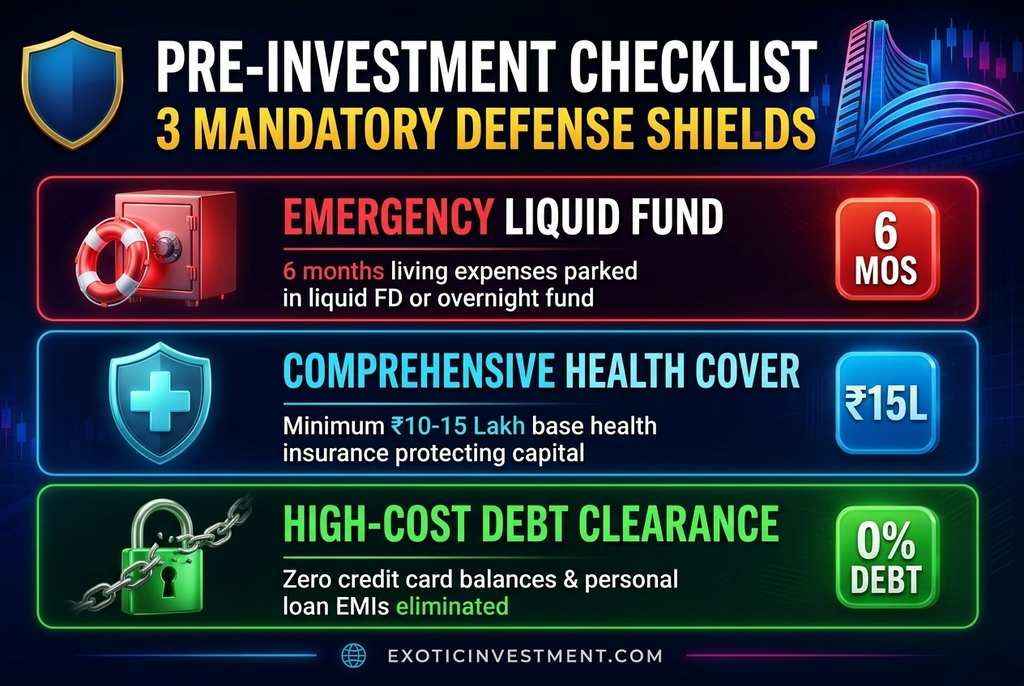
Illustration: 3 Essential Prerequisites Mandatory Before Deploying Capital on Stock Exchanges
Asset Allocation by Age: The 100-Minus-Age Rule Explained
Your ideal equity exposure should reflect both your time horizon and your emotional tolerance for market drawdowns. A classic guideline followed by institutional planners is the 100-Minus-Age rule. Under this formula, subtract your current age from 100 to determine the maximum percentage of your portfolio to allocate into equities.
For example, a 25-year-old investor can comfortably allocate 75% of their investable assets into equities, with the remaining 25% parked in debt and gold. Because young professionals have decades of earning potential ahead, they can easily ride out multi-month bear markets to capture superior long-term compounding. In contrast, a 55-year-old approaching retirement should reduce equity exposure toward 45%, shifting the balance into capital-preservation assets.
In addition, diversifying across market capitalizations prevents single-sector shocks from devastating your portfolio. For instance, pairing Nifty large-caps with fundamentally sound mid-caps and high-yield dividend stocks creates balanced resilience. We examine top dividend performers in our curated guide to dividend yield stocks in india.

Illustration: Equity Asset Allocation Roadmaps Across Age Milestones and Career Horizons
Lumpsum vs SIP: How to Deploy Sudden Windfalls or Bonuses
When investors receive sudden annual bonuses, tax refunds, or inheritance windfalls, they frequently wonder whether to invest all at once. If market valuations appear historically reasonable based on price-to-earnings multiples, deploying a lumpsum can accelerate compound returns. You can evaluate current valuation multiples across Indian equities using our interactive pe ratio calculator.
However, deploying a massive lumpsum near cyclical market peaks exposes investors to painful drawdown anxiety. To eliminate timing risk, institutional planners employ Systematic Transfer Plans (STPs). Under an STP framework, you park your lumpsum in a liquid debt fund and transfer fixed tranches into equity schemes weekly or monthly over 6 to 12 months.
In addition, upgrading your regular contributions through a step-up SIP allows your wealth engine to scale automatically with career promotions. Comparing regular plans against step-up contributions demonstrates how minor annual increments double ultimate corpuses. We conduct an exhaustive comparison in our dedicated study on step up sip vs regular sip.
Pro Tools, Technical Courses, and Books for Serious Investors
Mastering capital allocation and technical chart setups requires structured mentorship from seasoned market professionals. Kannada-speaking investors eager to master swing breakouts and momentum patterns can enroll in our hands-on Technical Analysis Course in Kannada. In addition, derivative traders can sharpen directional option strategies in our specialized Options Buying Course in Kannada.
Beginners taking their initial steps on Dalal Street will gain practical clarity from our structured Basics of Stock Market Course. To access institutional-grade stock screeners, live chart setups, and proprietary valuation models year-round, subscribe to the MultiBagger Plus Courses & Pro Tools Annual Subscription.
You can also absorb Dr. Ashok Kumar N Rao’s bestselling insights in physical print through our popular books, Kaliyiri Share Market and Basics of Indian Stock Market Book. These resources equip retail participants with actionable frameworks tested over full market cycles.
In addition, global crypto market participants can examine quantitative models and algorithmic tracking tools at Emintage to diversify modern portfolios. Meanwhile, equity traders can explore delivery execution mechanics in our dedicated guide on delivery and CNC trading rules and analyze price action on the day chart.
💡 Frequently Asked Questions About How Much to Invest
How much money should a beginner start investing with in India?
Beginners can start investing with as little as ₹500 per month through mutual fund SIPs or fractional share purchases. Starting small builds consistency and emotional discipline, which you can track alongside brokerage fees using our zerodha brokerage calculator.
What percentage of savings should I keep in cash versus stocks?
Maintain 10% to 20% of your total net worth in liquid cash equivalents for emergencies and tactical market dips. Deploy the remaining balance across diversified equities and debt instruments, which you can model with our online cagr calculator.
Should I invest in direct equity shares or mutual funds first?
Beginners should allocate their initial capital toward broad index mutual funds to achieve instant diversification. As your market research skills mature, you can allocate a portion toward high-conviction direct stocks, as explained in our review of stock broker apps.
How do I calculate how much to invest to reach ₹1 Crore?
Assuming an annualized equity return of 12%, a monthly SIP of ₹10,000 reaches ₹1 Crore in approximately 20 years. If you increase your monthly contribution to ₹25,000, you achieve the ₹1 Crore milestone in under 13 years, which you can verify with our sip calculator online.