
Investing through an indian adr provides international investors and global Non-Resident Indians (NRIs) seamless access to India’s fastest-growing blue chips without opening a domestic Demat account. Listed directly on the New York Stock Exchange and Nasdaq, these dollar-denominated certificates mirror the equity performance of premier Dalal Street corporations. However, many foreign participants fail to evaluate depositary conversion ratios and currency fluctuations.
Listen, boss, global capital allocators love Indian growth, but understanding foreign exchange regulations and local market taxes can feel overwhelming. American Depositary Receipts bridge this gap by enabling trading in US Dollars during regular Wall Street market hours. Before initiating cross-border trades, reviewing fundamental market terminology in our guide to basic stock market terms ensures proper technical execution.
Here is the real deal: companies like Infosys, ICICI Bank, HDFC Bank, and Wipro maintain highly liquid ADR listings in the United States. In addition, tracking ADR price action often provides early directional clues for the next morning’s 9:15 AM opening gap on the NSE. You can calculate projected long-term compounding growth across blue-chip portfolios using our interactive lumpsum investment calculator.
What is an Indian ADR and How Does the Depositary Mechanism Work?
An American Depositary Receipt represents a negotiable certificate issued by a major US depositary bank representing a specified number of shares in an Indian corporation. Specifically, the Indian company issues ordinary equity shares and deposits them with an authorized domestic custodian bank in Mumbai. Consequently, the US depositary bank (such as BNY Mellon, Citibank, or JPMorgan) issues corresponding dollar-denominated ADRs to American investors.
Each ADR represents a pre-determined ratio of underlying domestic shares, known as the ADR depositary ratio. For example, one Infosys ADR on the NYSE represents exactly one equity share on the NSE, creating a straightforward 1:1 price relationship. To evaluate systematic monthly capital accumulation strategies, explore our sip calculator.
A venerable Kannada proverb wisely notes: “ಬೇರು ಬಲವಾಗಿದ್ದರೆ ಮರಕ್ಕೆ ಭಯವಿಲ್ಲ” (Beru balavagiddare marakke bhayavilla — when the roots are strong, the tree has no fear). Similarly, Indian corporate leaders with pristine governance standards attract global capital through institutional ADR programs. Therefore, investing in top-tier Indian ADRs offers exposure to world-class balance sheets backed by resilient domestic consumption.
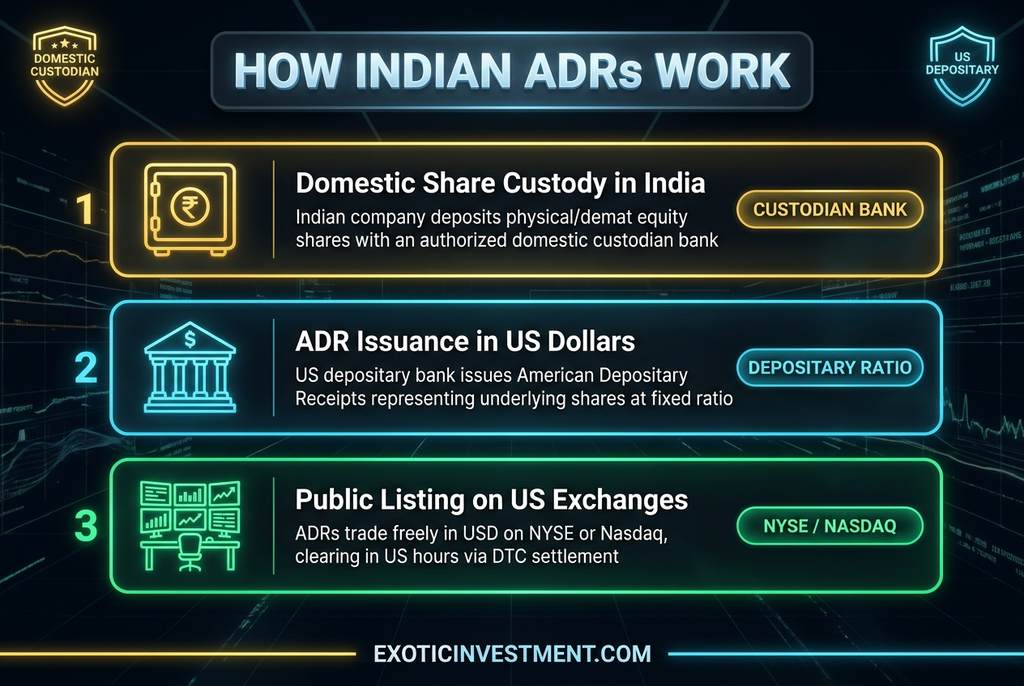
Illustration: 3 Step Cross-Border Architecture Showing How Indian ADRs Are Created and Traded
Top Indian Companies Listed on US Stock Exchanges (NYSE & Nasdaq)
Several of India’s largest private enterprises maintain high-profile ADR listings on Wall Street. These listings provide deep liquidity for US retail accounts, mutual funds, and university endowments.
Let’s keep it simple: technology giants Infosys (NYSE: INFY) and Wipro (NYSE: WIT) paved the way for Indian IT dominance on global exchanges. Meanwhile, leading financial powerhouses ICICI Bank (NYSE: IBN) and HDFC Bank (NYSE: HDB) provide direct exposure to India’s retail credit expansion. In addition, pharmaceutical leader Dr Reddy’s Laboratories (NYSE: RDY) offers international investors exposure to low-cost generic medicine manufacturing.
To evaluate corporate financial health and debt sustainability across these corporate giants, review our educational guide on how to read a balance sheet. In addition, you can compare equity valuation multiples across competing banking stocks using our dedicated pe ratio calculator.
| Company Name | US Ticker | ADR Ratio (ADR : Shares) | Core Industry Sector |
|---|---|---|---|
| Infosys Ltd | NYSE: INFY | 1 : 1 | Information Technology & Digital Services |
| ICICI Bank Ltd | NYSE: IBN | 1 : 2 | Private Banking & Financial Services |
| HDFC Bank Ltd | NYSE: HDB | 1 : 3 | Retail Banking & Mortgage Lending |
| Wipro Ltd | NYSE: WIT | 1 : 1 | Global Technology Services & Consulting |
First, holding ADRs eliminates the need for foreign retail investors to manage complex Indian RBI repatriation paperwork. Second, international institutions can easily pledge these liquid NYSE securities as margin collateral. Therefore, ADRs serve as the primary institutional vehicle for Western portfolio managers allocating capital to Indian equities.

Illustration: Prominent Indian Blue-Chips Listed as American Depositary Receipts on the NYSE
ADR Pricing Mechanics: Currency Risk and the Arbitrage Premium
The price of an Indian ADR is determined by two simultaneous dynamic variables: the domestic share price in Indian Rupees and the real-time USD/INR currency exchange rate. Specifically, when the Rupee depreciates against the US Dollar, the dollar value of the ADR naturally adjusts downward, even if the domestic share price remains flat.
In addition, ADRs often trade at a distinct premium or discount relative to their converted domestic price. For instance, high foreign institutional demand for Indian banking stocks frequently drives HDB ADR to trade at a 10% to 15% premium over its NSE equivalent. To model annualized capital return requirements when analyzing cross-border spreads, use our reverse cagr calculator.
Meanwhile, domestic Indian day traders watch overnight ADR price movements to anticipate opening gap-up or gap-down levels. Review how circuit filters restrict runaway momentum in our guide on upper and lower circuit limits. Therefore, understanding dual-currency pricing dynamics protects investors from currency-induced portfolio losses.
🚀 Master Global Market Intermarket Analysis
Discover how currency fluctuations, bond yields, and cross-border arbitrage drive Indian market trends. Learn directly under Dr. Ashok Kumar N Rao.
Taxation Rules for Indian ADRs: Capital Gains and DTAA Relief
The taxation of Indian ADRs involves coordination between United States IRS guidelines and Indian income tax rules under the Double Tax Avoidance Agreement (DTAA). Specifically, US-resident investors are subject to US capital gains tax rates depending on their holding period.
When an Indian company distributes dividends on its ADRs, the Indian government levies dividend distribution withholding tax at statutory treaty rates (typically 25% or 20%). In addition, US investors can claim a Foreign Tax Credit (FTC) on IRS Form 1116 to offset this withholding tax against their US federal tax liabilities. To calculate trading and statutory expenses on domestic broker platforms, check our zerodha brokerage calculator.
In fact, Indian domestic residents can also calculate their local tax obligations using our interactive stock market tax calculator. In addition, examining trade settlement rules in our guide on delivery and CNC trading rules ensures full regulatory compliance. Therefore, proper tax structuring prevents double taxation on cross-border dividend flows.
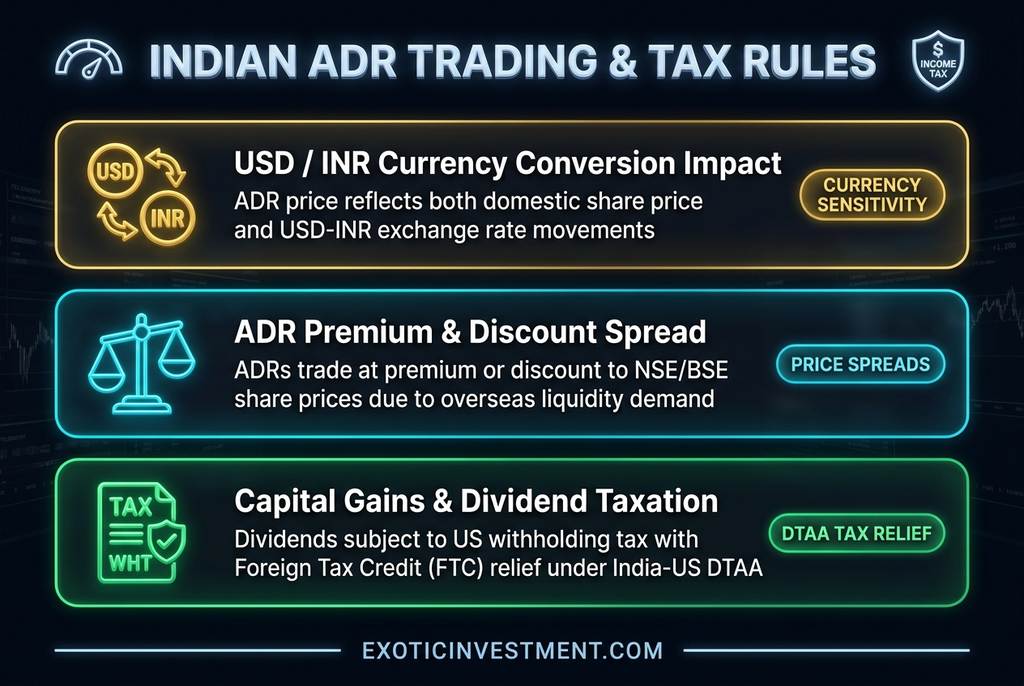
Illustration: 3 Core Pillars of Indian ADR Currency Impact, Arbitrage Spreads, and DTAA Tax Rules
How Indian Retail Investors Can Invest in US Stocks via LRS
While American investors buy Indian ADRs to gain domestic exposure, Indian retail participants frequently seek two-way portfolio diversification. Under the Reserve Bank of India’s Liberalized Remittance Scheme (LRS), resident Indians can remit up to $250,000 per financial year for overseas investments.
Consequently, Indian investors can invest directly in US tech giants like Apple, Microsoft, and Alphabet through authorized international brokerages. To manage trade risk effectively when trading high-volatility global stocks, calculate position sizing with our position size calculator. In addition, you can compare discount broker fee structures using our groww brokerage calculator.
Finally, understanding Demat account mechanics and depository custodial structures from our guide on demat account terms helps you manage domestic and foreign assets smoothly. In fact, calculating realized net trading profits with our stock profit calculator keeps your annual tax returns completely accurate. Therefore, international portfolio diversification reduces dependence on single-country macroeconomic cycles.
💡 Frequently Asked Questions (FAQ)
Can resident Indian citizens buy Indian ADRs on US stock exchanges?
Resident Indians can legally purchase Indian ADRs using the RBI Liberalized Remittance Scheme through international brokerages, although buying underlying shares directly on the NSE or BSE is far more cost-effective. You can evaluate domestic brokerage fees using our upstox brokerage calculator.
Why do Indian ADRs trade at a premium to their domestic share price?
Indian ADRs often trade at a premium due to strong foreign institutional demand, restricted overseas share availability, and foreign ownership limits on domestic equity. In addition, investors can evaluate historical valuation metrics across competing firms with our pe ratio calculator.
How are dividends on Indian ADRs paid to US investors?
The Indian company declares dividends in Rupees, which the US depositary bank converts into US Dollars and credits directly to the investor’s brokerage account after deducting applicable withholding taxes. You can project long-term compounding dividend returns using our lumpsum investment calculator.
What happens to an Indian ADR if the company delists from the US exchange?
If an Indian company delists its ADR program, investors can either convert their ADRs into underlying domestic shares or allow the depositary bank to liquidate the shares and distribute net cash proceeds. To review depository terminology and custody transfer rules, explore our guide on demat account terms.
How do traders calculate net realized profit on cross-border stock trades?
Traders must deduct foreign broker commissions, currency conversion charges, withholding taxes, and domestic capital gains liabilities. In fact, you can calculate exact net realized returns after statutory deductions using our free stock profit calculator.