Indian Stock Market Timings in 2026
Welcome to our complete guide on Indian stock market timings. Knowing the exact market hours is a small step, but it makes a huge difference to your trading day. In fact, the National Stock Exchange (NSE) and the Bombay Stock Exchange (BSE) follow a fixed schedule that every trader must plan around.
If you are brand new to investing, first read our beginner guide on how to get into the Indian stock market. That guide explains the basics. Today, we focus purely on the clock. We cover the pre-open session, the regular session, the new Closing Auction Session (CAS), and the post-close session.
A Quick Look at the Regular Market Hours
Let us start with the simple version. On every trading day, the equity cash segment opens at 9:15 a.m. and closes at 3:30 p.m. In addition, F&O derivatives trade a little longer, until 3:40 p.m. Most retail traders only need to remember the 9:15 a.m. to 3:30 p.m. window for cash stocks.
Before the main session starts, the exchange runs a pre-open auction from 9:00 a.m. to 9:08 a.m. This window sets the opening price for the day. Therefore, you should place your opening orders before 9:00 a.m. so they are ready. For a deeper dive into price discovery, revisit our post on mastering chart patterns in stock trading.
The Pre-Open Session Explained
The pre-open session is a short auction that runs from 9:00 a.m. to 9:08 a.m. During this window, the exchange collects orders, matches them, and fixes the opening price. Afterward, regular continuous trading begins at 9:15 a.m. As a result, the opening tick of most stocks comes from this pre-open auction.
- 9:00 a.m. – 9:08 a.m. — order entry for the opening auction.
- 9:08 a.m. – 9:12 a.m. — order matching and price discovery.
- 9:15 a.m. — regular continuous trading starts.
Many day traders watch the opening auction closely. In fact, the first fifteen minutes often set the direction for the whole day. If you want to trade the opening move, use an Intraday Breakout Stock Scanner to spot fast movers.
The Closing Auction Session (CAS) Timings
Here is the big change. From 3 August 2026, SEBI introduced the Closing Auction Session (CAS) for stocks that have Futures & Options contracts. This session runs from 3:15 p.m. to 3:30 p.m. After the auction, the official closing price is finalised between 3:30 p.m. and 3:35 p.m.
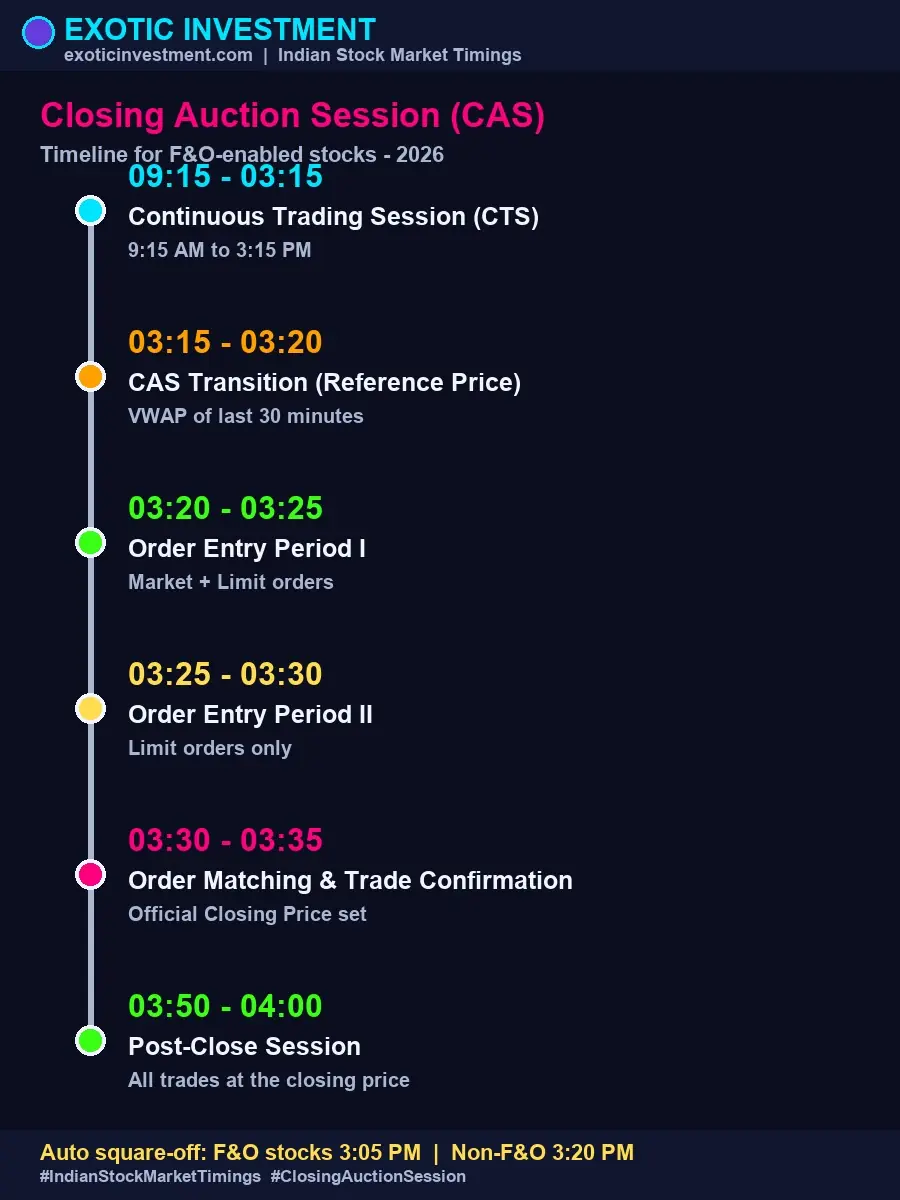
Illustration 1: Indian Stock Market Timings and the Closing Auction Session
The CAS uses a simple auction method. First, the exchange collects buy and sell orders during the auction window. Next, it matches them at a single equilibrium price. Finally, that price becomes the stock’s official closing price. Therefore, the close now reflects the whole market’s demand and supply, not just a few last-minute trades.
CAS Timings for F&O-Enabled Stocks
The exact CAS schedule has four stages. Each stage has a clear purpose. If you trade F&O stocks, remember these five windows:
- 3:15 p.m. – 3:20 p.m. — transition from Continuous Trading to the auction.
- 3:20 p.m. – 3:25 p.m. — Order Entry Period I, for market and limit orders.
- 3:25 p.m. – 3:30 p.m. — Order Entry Period II, for limit orders only.
- 3:30 p.m. – 3:35 p.m. — order matching and trade confirmation.
There is one helpful detail to know. The order entry window closes at a random time between 3:28 p.m. and 3:30 p.m. This random close stops last-second order placement. Consequently, the process stays fair for everyone.
How the Exchange Sets the Closing Price: A Simple Example
Let us consider the following buy and sell orders during the Closing Auction Session. This simple example shows how the exchange finds one fair closing price.
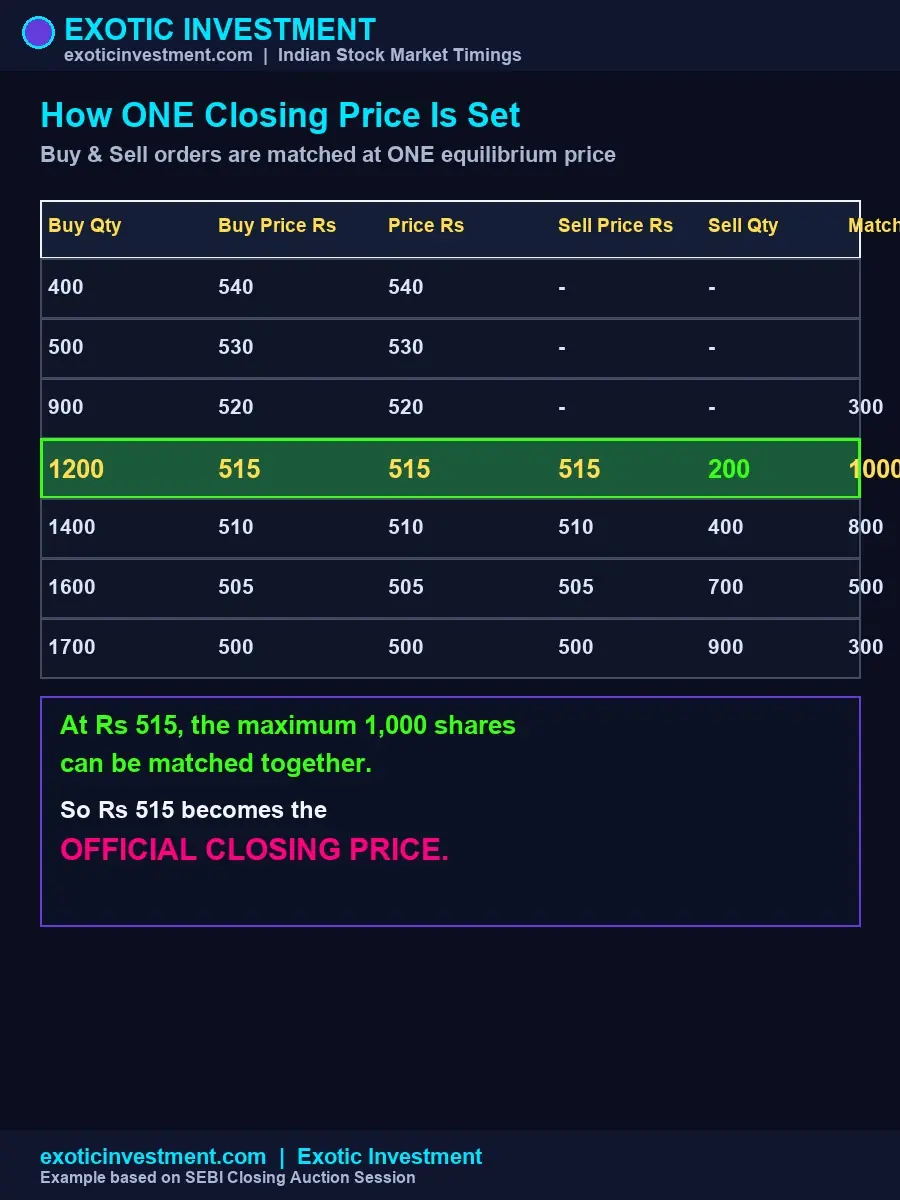
Illustration 2: Closing Auction Order Book and the Equilibrium Price at Rs 515
Here is what these orders mean:
- A buyer willing to pay Rs 520 will also buy at Rs 518, Rs 515, Rs 512, or Rs 510, because these prices are lower than their limit.
- A seller willing to sell at Rs 510 will also sell at Rs 512, Rs 515, Rs 518, or Rs 520, because these prices are higher than their asking price.
The exchange then checks each possible price one by one, to see how many shares can actually be matched at that price. Market orders do not specify a price, so the exchange treats them as willing to trade at any auction price. As a result, all market buy orders are added to the cumulative buy quantity at every price level, and all market sell orders are added to the cumulative sell quantity at every price level.
Since Rs 515 has the highest executable quantity (1,000 shares), it is selected as the equilibrium price. All eligible trades are then executed at Rs 515, and this becomes the stock’s official closing price for the day. This single price reflects the balance of buyers and sellers at the close.
Market Timings for All Segments
Let us put the full schedule in one place. Different segments close at different times. This table shows the updated timings after the CAS rollout:
- F&O-enabled stocks (cash): 9:15 a.m. to 3:30 p.m., close via CAS.
- Non F&O stocks (cash): 9:15 a.m. to 3:30 p.m., close via VWAP.
- Equity derivatives (F&O): 9:15 a.m. to 3:40 p.m.
- Post-close session (cash): 3:50 p.m. to 4:00 p.m., trades at the closing price.
Also, intraday auto square-off now happens at 3:05 p.m. for F&O-enabled stocks and at 3:20 p.m. for other stocks. So if you hold intraday positions, square them off before these cut-offs. If you trade futures daily, review our guide on what time can you trade futures for the detailed derivative schedule.
Master Technical Analysis & Trading: Recommended Courses & Books
For investors seeking structured technical analysis education, we offer dedicated training resources. In addition, these courses provide practical market mastery:
Recommended Trading Courses & Premium Subscriptions:
- Technical Analysis in Kannada Course: Learn chart reading, volume analysis, and candlestick setups in simple Kannada: Technical Analysis in Kannada Course.
- Kaliyiri Share Market Book: Learn stock market fundamentals and wealth creation in simple Kannada: Kaliyiri Share Market Book.
- Basics of Stock Market Course: Build your stock market foundation from scratch: Basics of Stock Market Course.
- Options Buying Course in Kannada: Master Nifty and Bank Nifty option buying setups: Options Buying Course in Kannada.
- Multibagger Stocks & Pro Subscription: Access premium stock picks, research reports, and pro trader alerts: MultiBagger Plus Courses & Pro Tools Annual Subscription.
Why Does the Closing Price Matter So Much?
You might wonder why SEBI changed the closing process. The reason is simple. The closing price is used to calculate the Nifty 50 and the Sensex. It also determines mutual fund and ETF Net Asset Values (NAV). Moreover, it settles F&O contracts and values your portfolio.
Therefore, an accurate closing price is essential. Under the old method, the close used the Volume Weighted Average Price (VWAP) of the last 30 minutes. Now, for F&O stocks, the close comes from the single auction price. As a result, the close better reflects genuine demand and supply. This change also aligns India with global exchanges such as the NYSE and the LSE.
How to Place Orders During the Closing Auction
If you want to buy or sell during the CAS, follow these simple tips. First, log in to your broker platform before 3:15 p.m. Next, place a limit order at your desired price. Finally, wait for the auction to match your order. Bear in mind that only limit orders are allowed in the last five minutes.
- Use limit orders early. Market orders are accepted only in the first window.
- Patch your price. Keep your order close to the reference VWAP for a better fill.
- Avoid the final seconds. The window closes randomly, so do not wait until the end.
For precise risk control around the close, rely on documented methods. Review our article on how to shortlist stocks for short-term trading in India to refine your approach.
Practical Trading Tips for the New Timings
The new timings change your daily routine. Here are three practical tips to stay ahead:
- Plan around 3:15 p.m. For F&O stocks, the last auction starts at 3:15 p.m. Hence, finish your continuous-session trades before that window.
- Respect the auto square-off. At 3:05 p.m. for F&O stocks, your intraday positions close automatically. Therefore, decide your exit before then.
- Use the post-close session wisely. From 3:50 p.m. to 4:00 p.m., trades execute at the closing price. Consequently, you can adjust positions without affecting the close.
Day traders often build their system around these timings. If you trade trend moves, our guide on how to pick stocks for day trading can help you choose the right candidates ahead of the open.
Risk Management and Risk Calculators
No market timing strategy removes risk. Therefore, manage every trade with discipline:
- Calculate Trading Fees: Estimate transaction costs using the Zerodha Brokerage Calculator or Upstox Brokerage Calculator.
- Calculate Net Returns: Calculate net profit targets using our Stock Profit Calculator.
- Plan Steady Savings: Use the Groww SIP Calculator to plan your monthly investing.
If you prefer long-term investing over intraday timing, read why stock market investment is better than other investments, and revisit our complete guide to the pre-opening session of the stock market for the opening side of the day.
Frequently Asked Questions
Q: What are the Indian stock market timings on weekdays?
A: The cash segment trades from 9:15 a.m. to 3:30 p.m. The F&O derivatives segment runs until 3:40 p.m.
Q: What is the Closing Auction Session timing?
A: The Closing Auction Session runs from 3:15 p.m. to 3:30 p.m. The official closing price is finalised between 3:30 p.m. and 3:35 p.m.
Q: Do all stocks use the Closing Auction Session?
A: No. Only F&O-enabled stocks use CAS from 3 August 2026. Other stocks still close using the VWAP method.
Q: When does intraday auto square-off happen?
A: It happens at 3:05 p.m. for F&O-enabled stocks and at 3:20 p.m. for other stocks.
In summary, knowing the Indian stock market timings helps you plan a cleaner and safer trading day. The new Closing Auction Session makes the closing price fairer for everyone. Furthermore, always combine your timing plan with a solid risk management routine before you place a trade.