
So, you are looking at your bank account, and you see your savings growing at a painfully slow rate, right? Aha, you realize that leaving your money in a savings account or a fixed deposit is actually losing value against inflation. Hmm, what do you do then? You look for a systematic way to grow your money over the decades. Today, we are breaking down exactly how to achieve long term wealth building without taking unnecessary risks. Trust me, it is a game of patience and compounding, buddy.
Most retail investors think that wealth building requires a secret formula or complex trading strategies. However, that is a complete myth. Specifically, the most successful investors rely on simple, automated habits rather than timing the market. Before we go into the rules, you should have a solid foundation. Make sure you read our basic guide on how to get into the Indian stock market and learn about the core rules of volume and price action to build your base.
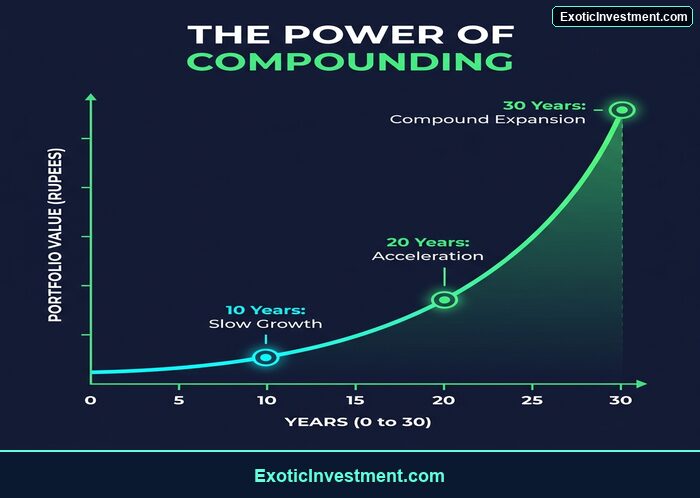
Illustration: [‘term’, ‘wealth’, ‘building’, ‘compounding’]
What is Long Term Wealth Building? — The Core Philosophy
First of all, let’s understand what long term wealth building really means. It is the process of consistently saving and investing your money over 10, 20, or 30 years to achieve financial freedom. Because of this long timeframe, you allow the power of compounding to do the heavy lifting. Consequently, your initial investments multiply exponentially in the later years. Therefore, patience is your greatest asset.
Additionally, you must distinguish wealth creation from trading. While trading focuses on short-term price movements and quick profits, wealth building is about owning high-quality assets for the long haul. Therefore, you do not need to check the stock ticker every five minutes. If you want to calculate the potential compounding returns of your current savings, run your numbers through the Stock Profit Calculator.
📚 Recommended Trading Courses & Premium Subscriptions
- Options Buying Course in Kannada: Options Buying Course in Kannada
- Technical Analysis in Kannada: Technical Analysis in Kannada Course
- Kaliyiri Share Market Book: Kaliyiri Share Market Book
- Basics of Stock Market Course: Basics of Stock Market Course
- Multibagger Stocks Pro Subscription: MultiBagger Plus Courses & Pro Tools Annual Subscription
Rule 1: Start Early for Long Term Wealth Building
Secondly, the most critical factor in compounding interest wealth creation is time. Because compounding is exponential, the money you invest in your 20s has much more time to grow than the money you invest in your 40s. Consequently, even starting with a very small amount early in life yields a much larger corpus than starting with a large amount later. Therefore, do not wait to become rich before you start investing.
For instance, if you start a monthly SIP of ₹5,000 at age 25, your wealth at age 55 will be significantly higher than someone starting a ₹10,000 SIP at age 35. Therefore, start immediately. In addition, automate your monthly investments so you do not get tempted to spend the money. If you want to compare brokerages for your SIP account setup, check out the Zerodha Brokerage Calculator or Upstox Brokerage Calculator.
Asset Allocation: The Foundation of Long Term Wealth Building
Now, let’s talk about where to put your money. Asset allocation for long term portfolios is the key to managing risk. Specifically, you should not put all your capital into a single asset class. A diversified investment portfolio should contain a mix of equities, debt, gold, and cash. Consequently, if one asset class underperforms, the others will balance your returns.
Typically, equities offer the highest long-term growth, but they are volatile. On the other hand, debt instruments like PPF or debt mutual funds provide safety and regular income. Therefore, a common rule of thumb is to subtract your age from 100 to determine your equity allocation percentage. If you want to track your multi-asset portfolio including digital tokens, use the Emintage crypto portfolio tracker, and manage your tax liabilities using the crypto tax calculator.
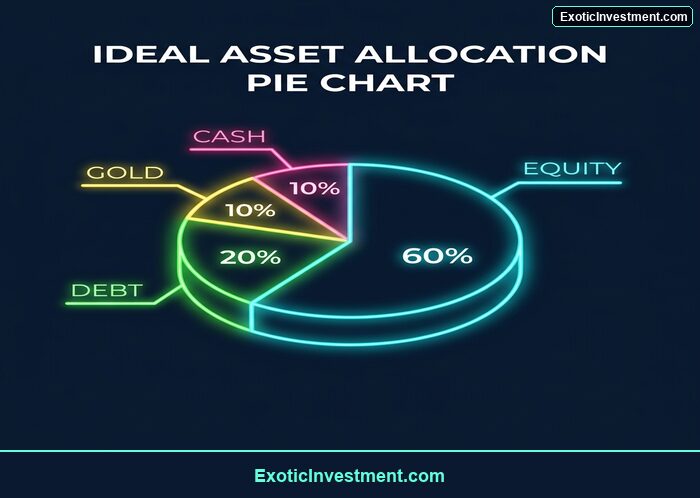
Illustration: [‘term’, ‘wealth’, ‘building’, ‘asset’]
Periodic Rebalancing for Long Term Wealth Building Success
Once you have set your target asset allocation, you cannot just forget about it. Because of market movements, your asset allocation will drift over time. For example, during a strong bull run, your equity allocation might rise from 70% to 85%. Consequently, your portfolio becomes much riskier. Therefore, you must perform periodic rebalancing.
To do this, review your portfolio once or twice a year. Specifically, sell a portion of the outperforming asset (equities) and buy more of the underperforming asset (debt) to bring the ratio back to your target. Therefore, this disciplined approach forces you to buy low and sell high automatically. In other words, you manage your risks without emotional bias. To check support zones for your rebalancing buys, refer to our support and resistance levels guide and verify trends with moving averages.
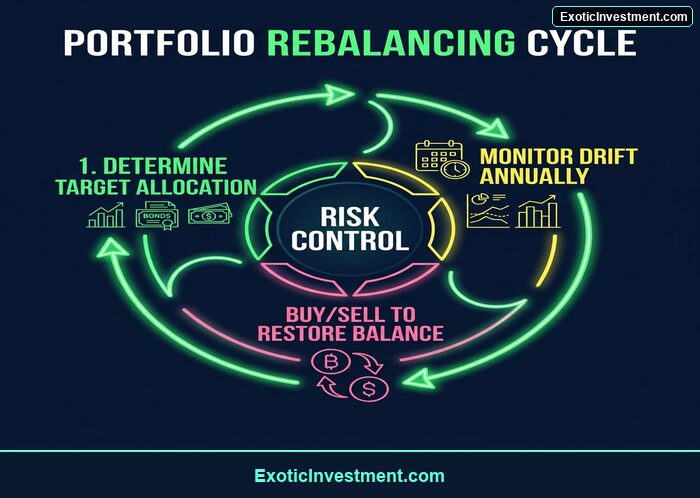
Illustration: [‘term’, ‘wealth’, ‘building’, ‘portfolio’]
Selecting the Right Assets for Your Portfolio
When selecting mutual funds or stocks, focus on consistent compounders. First of all, learn how to read a balance sheet to verify if a company has low debt and strong cash flows. In addition, understand the P/E ratio and valuation metrics to make sure you are not buying overvalued assets at the peak of a bubble.
Secondly, for equity mutual funds, index funds are a great choice because they have low expense ratios. Consequently, they track the Nifty 50 or Nifty Next 50 index directly. Therefore, they offer instant diversification at a minimal cost. Keep tracking market trends using the Momentum Stock Screener and refer to our RSI indicator guide to understand the overall market mood before allocating lump sums. For retirement planning, use the Groww SIP Calculator to model your future returns.
Avoiding Common Wealth Destroyers
Aha, many investors fail in their retirement wealth building guide because they fall into common traps. For instance, they panic and sell their mutual funds during a market crash. Because of this emotional panic, they lock in their losses and miss the subsequent market recovery. Therefore, emotional discipline is the key to wealth building.
Another common mistake is trying to time the market. Speculators wait for the perfect crash to invest, but they end up sitting on cash for years. Consequently, they miss out on compounding returns. Therefore, a systematic investment plan (SIP) remains the safest and most efficient path for retail investors. Stay disciplined, avoid leverage, and focus on the destination.
Comparing Active vs. Passive Funds for Long Term Wealth Building
First of all, when implementing a strategy for long term wealth building, you must choose between active and passive mutual funds. Active funds are run by professional managers who try to beat the market, while passive index funds simply track the index like Nifty 50 or Sensex. Consequently, active funds charge higher expense ratios. Therefore, passive index funds are often the best choice for beginners because they keep costs low. In other words, you keep more of your returns.
On the other hand, some active funds perform exceptionally well in volatile markets by shifting cash allocations. However, finding these funds beforehand is extremely difficult. In addition, historical performance does not guarantee future results. Consequently, a core allocation of 70% in low-cost index funds combined with 30% in high-quality active funds is a balanced approach. Therefore, you get the best of both worlds without paying excessive fees.
Risk Mitigation: Managing Drawdowns in Long Term Wealth Building
Additionally, a critical aspect of long term wealth building is learning to tolerate market drawdowns. During severe bear markets, your equity portfolio can drop by 20% or even 30%. Consequently, panicking and selling at a loss is a massive wealth destroyer. Therefore, you must maintain a cash buffer of at least 6 months of expenses to avoid selling your investments during an emergency. This simple margin of safety keeps your portfolio intact.
Furthermore, this cash buffer (also known as an emergency fund) should be parked in highly liquid instruments like liquid mutual funds or high-interest bank accounts. Consequently, you have instant access to cash when needed. Therefore, you do not have to touch your long-term equity portfolio during a market dip. In other words, it allows your compounding curve to run uninterrupted for decades.
The Role of Tax Optimization in Long Term Wealth Building
Furthermore, taxes can eat into your compounding returns over time. In India, long-term capital gains (LTCG) on equity investments are taxed at 12.5% for gains exceeding ₹1.25 Lakh in a financial year. Consequently, you can optimize your taxes by doing tax harvesting, which involves selling and immediately buying back shares to book ₹1.25 Lakh of tax-free gains every year. Therefore, smart tax planning is crucial to maximize your terminal corpus. Use our stock profit calculator to model your post-tax returns.
Building Financial Discipline for Long Term Wealth Building Success
Finally, the ultimate key to wealth creation is psychological discipline. It is not about how much money you earn, but how much you save and invest consistently. For instance, setting up an auto-debit SIP on your salary day ensures you pay yourself first before spending on discretionary items. Consequently, you build a stress-free investment habit. Therefore, stay focused on your goals, block out the daily market noise, and let time work its magic.
Final Thoughts
To sum up, achieving long term wealth building is not about finding a multi-bagger stock overnight, but about consistent saving, asset allocation, and periodic rebalancing, buddy!
Ready for more advanced investment advice and high-conviction stock research reports? Subscribe to our premium MultiBagger Plus Courses & Pro Tools Annual Subscription today.