
Introduction to Risk Management in Stock Trading
Welcome to our comprehensive guide on risk management in stock trading India. If you want to survive and succeed in the volatile Indian financial markets, protecting your trading capital is far more important than hunting for quick profits. In fact, without disciplined risk rules, even the most accurate trading setup will eventually lead to complete capital wipeout.
Before placing active trades, ensure you have built a strong foundation in market dynamics. For instance, read our guides on how to get into the Indian stock market and intro to technical analysis. Furthermore, you will need to understand trend direction. Specifically, review our guides on volume and price action in trading and moving averages for trend confirmation. These technical indicators help you identify trade entries with high probability.
Understanding Risk Management in Stock Trading India
Firstly, let us define risk. In financial trading, risk represents the probability of losing capital on a trade. Specifically, risk management in stock trading India involves setting strict rules to limit these losses before you enter the market. Therefore, every professional trader knows exactly where they will exit a trade if the market moves against them.

Illustration 1: Position Sizing Formula Stock Trading India
In addition, risk management prevents emotional decision-making. Because the market is unpredictable, a single bad trade can erase months of hard-earned profits. Consequently, you must treat trading as a numbers game where capital preservation is your primary objective. Furthermore, managing your trade entries ensures your long-term success.
Master Technical Analysis & Trading: Recommended Courses & Books
For traders seeking structured technical analysis education, we offer dedicated training resources. In addition, these courses provide practical, step-by-step market masterclasses:
Recommended Trading Courses & Premium Subscriptions:
- Options Buying Course in Kannada: Master Nifty and Bank Nifty option buying setups step-by-step: Options Buying Course in Kannada.
- Technical Analysis in Kannada Course: Learn chart reading, indicators, and volume analysis: Technical Analysis in Kannada Course.
- Kaliyiri Share Market Book: Build your stock market foundation and wealth creation path: Kaliyiri Share Market Book.
- Basics of Stock Market Course: Learn the core fundamentals of stock investing: Basics of Stock Market Course.
- Multibagger Stocks & Pro Subscription (Product 2739): Access premium stock picks, research reports, and pro trader alerts: MultiBagger Plus Courses & Pro Tools Annual Subscription (Direct checkout: Buy Pro Subscription Product 2739).
The Core Pillar: Position Sizing and the 2% Rule
Secondly, position sizing is the most critical element of risk control. Specifically, position sizing determines how many shares of a stock you should buy or sell. In fact, many retail traders make the mistake of investing their entire capital into a single trade. Consequently, a sudden adverse move leads to massive losses.
Therefore, professional traders follow the 2% rule. Specifically, this rule dictates that you should never risk more than 2% of your total trading capital on any single trade. For example, if your trading account size is ₹1,00,000, your maximum risk per trade is ₹2,000. If a stock trades at ₹500 and your stop loss is at ₹480, your risk per share is ₹20. Consequently, you can buy exactly 100 shares. Thus, even if the trade fails, your account balance only drops to ₹98,000.
Setting Stop Losses and Risk-to-Reward Ratios
Thirdly, a stop loss is a pending order placed with your broker to automatically sell a security when it reaches a certain price. In fact, setting a stop loss before entering a trade is mandatory. Because market volatility can spike instantly, a stop loss protects your account from catastrophic events.
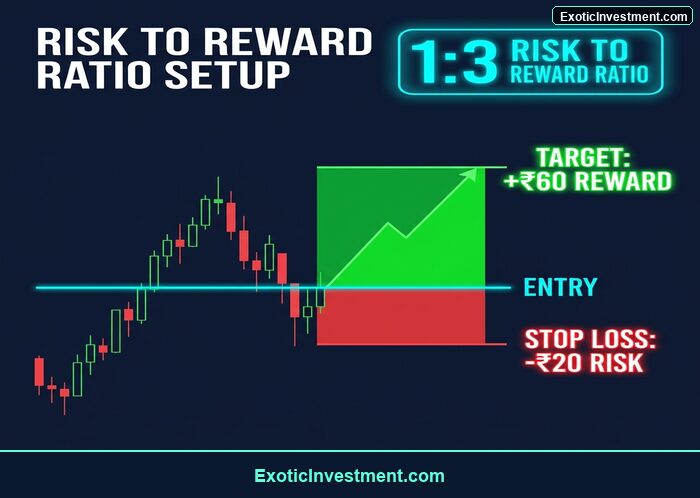
Illustration 2: Risk To Reward Ratio Setup Stock Market India
Furthermore, combine stop loss placement with a healthy risk-to-reward ratio. Specifically, target a ratio of at least 1:2 or 1:3. Therefore, if you risk ₹20 per share, your profit target must be at least ₹40 or ₹60 per share. As a result, you only need a 40% win rate to remain profitable over the long term. Consequently, this mathematical edge keeps your equity curve rising steadily. Use our automated Stop Loss Calculator to calculate your exact position sizing and stops.
Advanced Risk Control: Trailing Stop Loss
Furthermore, once a trade becomes profitable, you should protect your gains using a trailing stop loss. Specifically, a trailing stop loss rises automatically as the stock price climbs. For instance, if you buy a stock at ₹500 and it rises to ₹550, you can trail your stop loss to ₹530. Consequently, you lock in a ₹30 profit even if the market suddenly reverses.
Therefore, trailing stops allow you to capture massive trends without constantly worrying about market tops. In fact, most trend followers rely entirely on trailing stops to maximize their profits. In addition, you should combine trailing stops with key moving averages to confirm exits naturally. For example, check our guide on moving averages for trend confirmation.
Setting a Daily Loss Limit: The Circuit Breaker
Furthermore, setting a daily loss limit is a crucial protective measure for active day traders. Specifically, a daily loss limit acts as a personal circuit breaker for your trading account. For instance, if you decide that your maximum daily loss is 3% of your capital, you must stop trading immediately once that limit is reached. Consequently, you prevent a single bad day from developing into a catastrophic capital disaster.
Therefore, disciplining yourself to close your terminal after hitting your daily limit is essential. In fact, most retail traders fail because they attempt to recover losses by taking impulsive trades. Because revenge trading leads to emotional decisions, walking away protects both your mental state and your account balance.
Practical Case Studies: Risk-to-Reward Setup in Action
Furthermore, let us look at a real-world case study on the Nifty 50 index. Suppose a trader identifies a bullish breakout setup on Nifty at 24,000. Based on the support level, the stop loss is set at 23,900, which represents a 100-point risk. If the target is set at 24,300, the reward is 300 points, offering a perfect 1:3 risk-to-reward ratio.
Consequently, if the trader executes 10 similar trades, and only 4 succeed, they will still make a healthy profit. Specifically, the 4 winning trades generate a gain of 1,200 points (4 x 300). Conversely, the 6 losing trades generate a loss of 600 points (6 x 100). Therefore, the net profit is 600 points despite having a low win rate of 40%. Ultimately, this mathematical math shows why risk-to-reward is the true key to trading success.
Portfolio Diversification Rules
Diversification is the practice of spreading your investments across different sectors and asset classes. In fact, a concentrated portfolio is highly vulnerable to sector-specific crises. For instance, if you invest entirely in banking stocks, a regulatory change can severely damage your capital.
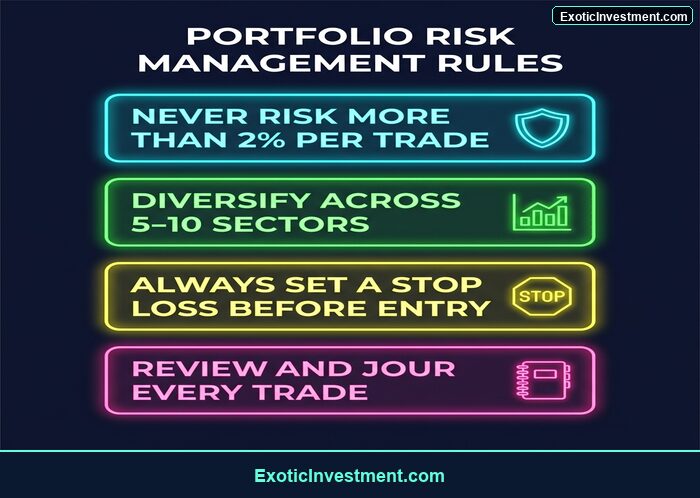
Illustration 3: Portfolio Diversification Risk Rules Trading India
Therefore, distribute your capital across 5 to 10 non-correlated sectors. For example, balance your portfolio with allocations to IT, Pharma, FMCG, and Energy. If you want to understand how sectors rotate dynamically over time, check our guide on the RSI indicator guide. Furthermore, monitoring sector strength helps you allocate capital to outperforming sectors.
The Psychology of Accepting Losses
Finally, a major hurdle in risk management in stock trading India is emotional resistance to taking losses. Specifically, many retail traders refuse to exit losing trades because they hope the price will bounce back. However, this behavior often turns small losses into account-destroying disasters. Because you must learn to lose small to win big, developing an objective mindset is critical.
Therefore, accept that losses are a normal cost of doing business. In fact, even the best trading systems lose 40% of the time. Consequently, the key to survival is ensuring your losing trades remain tiny compared to your winning trades. In addition, you should check our upcoming guide on the psychology of trading to master your emotions.
Risk Management Checklist for Daily Performance Tracking
Furthermore, using a structured checklist before executing any trade ensures consistency. Specifically, verify the following points before placing your order: Is the setup aligned with the daily trend? Is the stop loss level clearly marked on the chart? Is the position size calculated using the 2% risk rule? In addition, is the risk-to-reward ratio at least 1:2?
Consequently, by answering these questions objectively, you remove emotional impulses from your trading decisions. Therefore, keeping a physical copy of this checklist near your trading desk is highly recommended. Ultimately, trading success is built on repeating disciplined risk habits day after day.
Integrating Trading Calculators for Precision Execution
To implement systematic risk management, you must calculate all transaction costs and profit targets accurately:
- Calculate Fees: Estimate your exact entry and exit expenses using the Zerodha Brokerage Calculator or Upstox Brokerage Calculator.
- Calculate Net Returns: Track your net realized profits in Indian rupees with the Stock Profit Calculator.
- Analyze Market Support: Identify intraday key levels using the Pivot Point Calculator.
If you maintain a diversified multi-asset portfolio that includes digital currencies alongside Indian stocks, check the crypto portfolio tracker from Emintage inline. In addition, estimate your tax liabilities with a crypto tax calculator or estimate potential gains with a bitcoin profit calculator.
Frequently Asked Questions
Q: What is the most important rule of risk management in stock trading India?
A: The most important rule is to never trade without a stop loss. Always define your maximum risk before clicking the buy button.
Q: How do I calculate my position size?
A: Divide your maximum account risk (e.g., 1% or 2% of capital) by your risk per share (entry price minus stop loss price).
Q: Should I trade options if I have limited capital?
A: Options buying requires less capital than futures, but has high risk due to time decay. Therefore, master cash segment risk rules first. Enroll in our Options Buying Course in Kannada to learn structured setups.
In summary, implementing disciplined risk management in stock trading India is what separates profitable traders from amateurs. Furthermore, always prioritize capital preservation over return optimization on every trade.