
Knowing all taxes on trading stocks in india protects your net profits from shock tax notices during ITR filing. Many NSE and BSE traders chase chart patterns relentlessly while ignoring STT, STCG, LTCG, and business income slabs. Today, master every tax rule alongside our Indian stock market tax calculator cleanly.
Wait — why does Indian tax law treat an intraday profit completely differently from a two-year delivery gain? Under the Income Tax Act, your holding horizon and market segment switch your tax slab and ITR form automatically! Consequently, knowing these buckets upfront keeps more post-tax rupees compounding every year.
Let us map every transaction levy and direct tax applying to Indian stock traders clearly today. First, check statutory exchange fees collected daily inside every contract note. Next, compare capital gains slabs against speculative intraday and F&O business income rules.
Statutory Transaction Taxes: STT, Stamp Duty, SEBI Fees, and GST
Long before annual net profits tally up, statutory fees deduct small amounts from every buy or sell click! Specifically, your broker collects Securities Transaction Tax (STT) directly on NSE and BSE fills regardless of profit. Review current segment rates inside our STT rules explainer and live STT calculator cleanly.
In addition to STT, contract notes itemize four extra minor transaction charges on every order. Namely, you pay exchange fees, SEBI turnover charges, state stamp duty on buys, and 18% GST on brokerage. Check trade breakeven points cleanly using our stock brokerage calculator before entering.
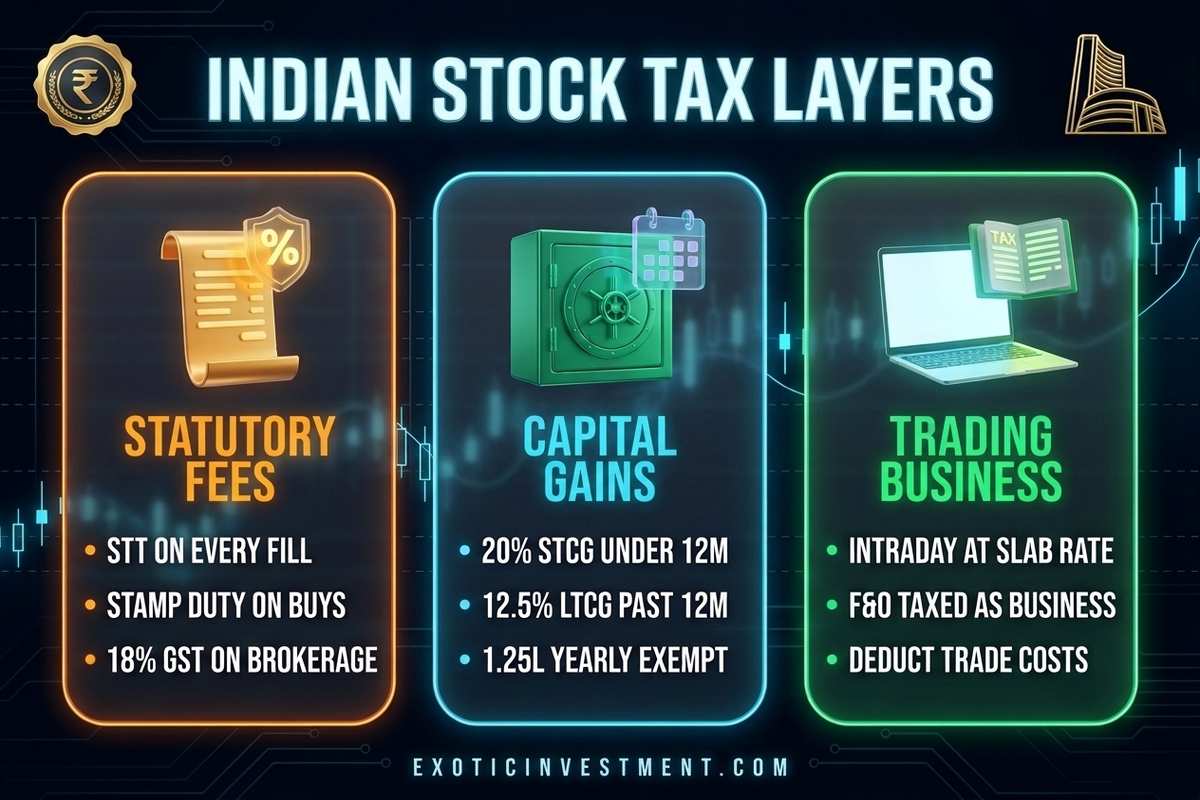
Illustration: Three-layer taxation structure separating transaction levies (STT/GST) from delivery capital gains and active trading business income.
Capital Gains Taxes: STCG vs LTCG for Delivery Investors
Whenever you hold shares inside NSDL or CDSL demat accounts past one session, profits count as Capital Gains. Importantly, the Income Tax Department separates equity gains strictly across a 12-month holding line! Therefore, tracking FIFO buy dates preserves thousands of tax rupees cleanly.
Short-Term Capital Gains (STCG — Under 12 Months)
Selling listed Indian equity shares or equity funds within 12 months triggers Section 111A STCG. Currently, STCG on STT-paid listed equity carries a flat 20% tax plus surcharge and 4% cess. Compute net liability accurately via our STCG & LTCG tax calculator upfront.
Long-Term Capital Gains (LTCG — Over 12 Months)
Meanwhile, holding STT-paid listed stocks past 12 months shifts profits into friendlier Section 112A LTCG territory! Today, the first ₹1.25 lakh of net realized LTCG per year stays completely tax-exempt. Gains above ₹1.25 lakh incur a flat 12.5% tax—check annual savings using our tax harvesting calculator before March 31.
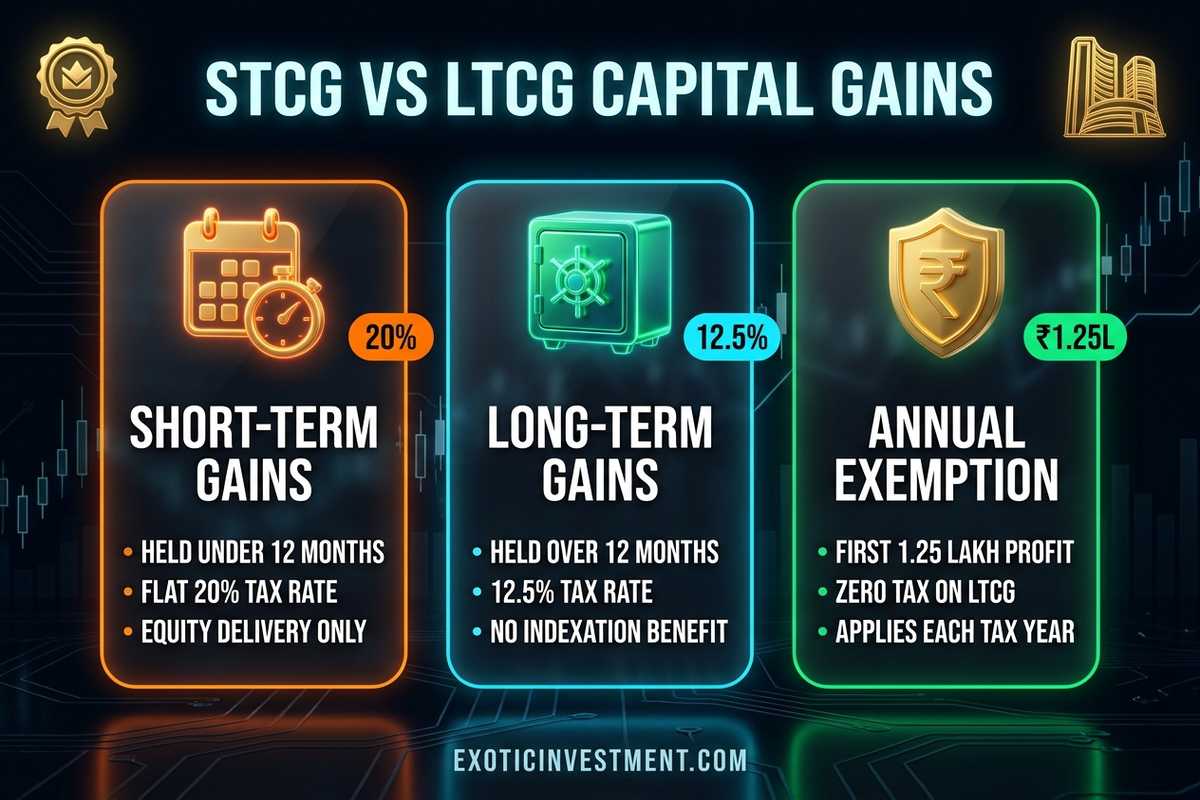
Illustration: STCG 20% short-term slab versus LTCG 12.5% above the ₹1.25 lakh annual exemption for Indian delivery investors.
Intraday Speculative vs F&O Non-Speculative Business Income
Wait — what happens when you buy and sell shares within the same day without demat delivery? Under Section 43(5), intraday equity trades qualify strictly as Speculative Business Income taxed at personal income slabs! Thus, high-bracket salaried earners pay 30% plus cess on intraday cash profits.
By contrast, Futures and Options trading on recognized NSE and BSE segments counts as Non-Speculative Business Income! Why does this label matter heavily for active F&O traders? First, you can claim legitimate deductions for brokerage, internet, VPS, and research tools under ITR-3!
Second, F&O turnover rules govern whether you need a Chartered Accountant tax audit cleanly. Check your statutory audit boundaries anytime using our F&O turnover calculator and stock profit taxation guide.
Complete Tax Reference Table: Indian Stock Trading Segments (FY 2025–26 Rules)
Bookmark this clear tax table before selecting which NSE segment matches your personal income slab best. Checking exact ITR-2 versus ITR-3 obligations early prevents automated tax portal notices.
| Trading Activity | Income Tax Classification | Applicable Tax Rate | ITR Form & Expense Rule |
|---|---|---|---|
| Equity Delivery (> 12 Months) | Long-Term Capital Gain (112A) | 12.5% above ₹1.25L exemption | ITR-2; deduct transfer fees only |
| Equity Delivery (< 12 Months) | Short-Term Capital Gain (111A) | Flat 20% + 4% Health Cess | ITR-2; STT not deductible |
| Intraday Equity Cash | Speculative Business Income | Normal Income Tax Slab (up to 30%) | ITR-3; claim STT & expenses |
| NSE / BSE Futures & Options | Non-Speculative Business Income | Normal Income Tax Slab (up to 30%) | ITR-3; full business deductions |
| Equity Dividends Received | Income From Other Sources | Slab Rate (10% TDS > ₹5,000) | Check AIS & Form 26AS match |
Worked Tax Example: Calculating Taxes on ₹3,00,000 Annual Stock Profit
Let us inspect real rupee math for a 30% bracket salaried investor booking ₹3,00,000 stock gains! Suppose ₹2,00,000 came from delivery stocks held 18 months and ₹1,00,000 came from 4-month swing trades. First, subtract the annual ₹1.25 lakh LTCG exemption cleanly, taxing just ₹75,000 at 12.5% = ₹9,375!
Next, tax the ₹1,00,000 short-term gain at 20% = ₹20,000, setting base tax at ₹29,375 plus cess. Conversely, earning that same ₹3,00,000 via intraday equity or F&O triggers ₹90,000 base tax before deductions! Compare tax slabs cleanly using our Income Tax Regime Calculator and check dividend yields too.
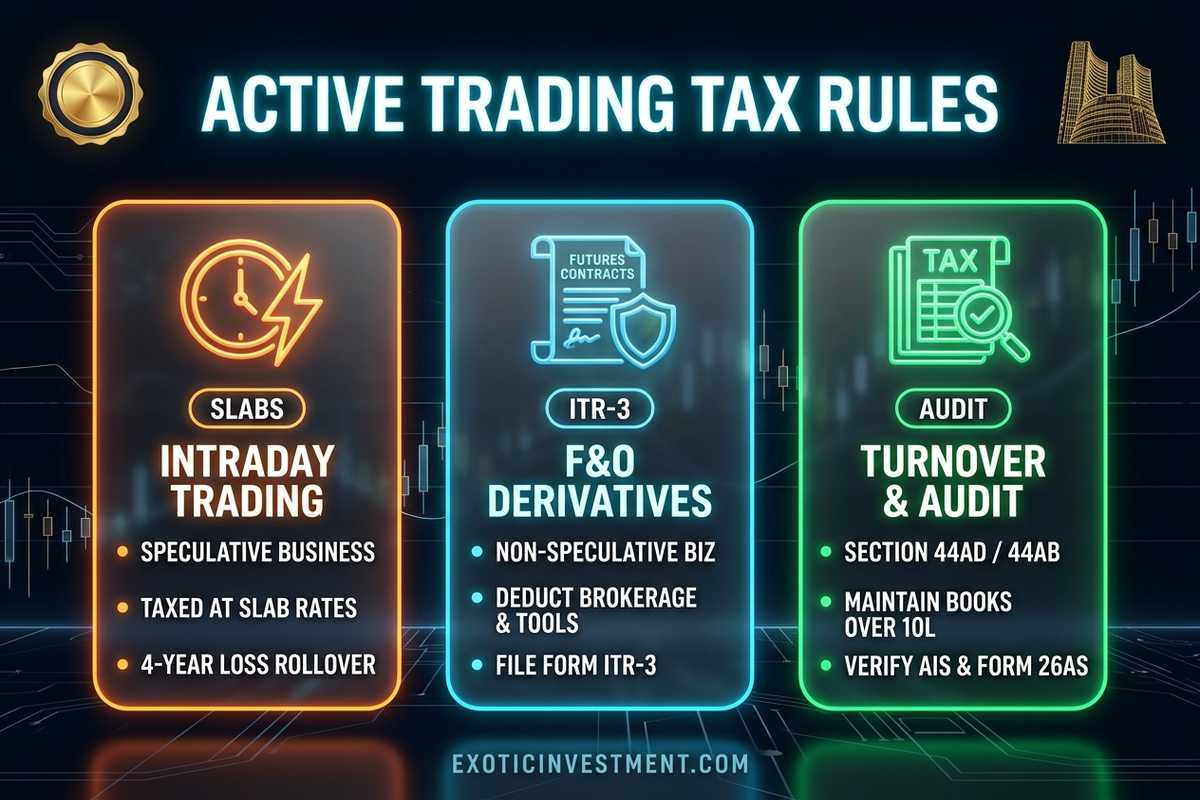
Illustration: Tax filing checklist comparing ITR-2 capital gains reporting against ITR-3 business books, turnover rules, and AIS checks.
Advance Tax Deadlines and Four Costly ITR Mistakes
Every summer, thousands of active traders incur avoidable interest penalties simply for skipping quarterly Advance Tax payments! Whenever total unpaid net tax liability crosses ₹10,000 across the year, quarterly installments fall due June 15, September 15, December 15, and March 15. Even better, set calendar reminders right after major profit bookings to estimate quarterly dues accurately.
In addition, avoid four everyday compliance blunders inside the e-filing portal cleanly! First, never file ITR-1 (Sahaj) after earning even ₹100 of stock profit. Second, always report audited F&O losses cleanly rather than hiding red years.
Third, remember STT stays deductible only inside business income (ITR-3), never under Capital Gains (ITR-2). Finally, check AIS records against broker P&L PDFs before hitting submit—compare crypto tax rules separately via our India crypto tax calculator and profit booking guide.
Smart Year-End Tax Harvesting Tips for NSE Delivery Portfolios
Understanding taxes on trading stocks in india turns March from a stressful scramble into calm savings! Specifically, smart delivery investors harvest their full ₹1.25 lakh annual LTCG tax-free exemption before every financial year closes. Next, booking unrealized short-term losses offsets taxable short-term gains earned earlier cleanly.
However, never sell winning multi-year compounders blindly just to dodge tiny tax percentages! Always weigh brokerage slippage, fresh stamp duty, and new holding clocks before resetting long-term equity positions. Plan clean year-end harvests calmly via our tax harvesting calculator and check T+1 settlement dates first.
In addition, remember Indian tax rules disallow carrying unclaimed exemptions forward into next April! Therefore, execute desired March rebalancing trades at least two trading sessions before March 31 settles cleanly.
🚀 Trade Clean Dalal Street Setups With Institutional Discipline
Keep more of what you earn on Dalal Street. Learn clean position sizing and tax-smart trading habits alongside Dr. Ashok Kumar N Rao and our 1,300+ active community members.
- Master equity foundations with our Kaliyiri Share Market Book and English bestseller Basics of Indian Stock Market Book.
- Access institutional screeners and pro tools via the MultiBagger Plus Courses & Pro Tools Annual Subscription.
- Sharpen chart entries in our Technical Analysis Course in Kannada or index strategies in our Options Buying Course in Kannada.
💡 Frequently Asked Questions (FAQ): Taxes on Trading Stocks in India
1. How much are taxes on trading stocks in India right now?
Delivery profits under 12 months incur 20% STCG while gains past 12 months incur 12.5% LTCG above ₹1.25 lakh. Intraday and F&O profits pay personal slabs; test numbers inside our Indian stock tax calculator.
2. Do I owe income tax if I reinvest stock profits immediately without withdrawing cash?
Yes! Income tax triggers instantly upon selling shares for realized gains, even if cash stays inside broker wallets. Track realized totals cleanly via our stock profit calculator anytime.
3. Is Securities Transaction Tax (STT) deductible against Capital Gains?
No — Income Tax rules ban deducting STT from STCG or LTCG gains, though ITR-3 business traders claim STT. Compute segment STT charges via our STT calculator cleanly.
4. How do I compute F&O trading turnover for tax audit purposes?
Under ICAI guidance, F&O turnover totals absolute positive and negative trade profit differences rather than total notional value. Verify audit limits quickly via our F&O turnover calculator cleanly.
5. Which ITR form should salaried stock investors and option traders file?
Salaried delivery investors reporting STCG or LTCG file ITR-2, while active intraday or F&O traders must file ITR-3! Review tax classifications thoroughly inside our stock taxation guide first.
6. Can I reduce my LTCG or STCG bill legally before March 31?
Yes — investors often harvest ₹1.25 lakh tax-free LTCG yearly or sell losing shares to offset taxable gains. Model exact savings instantly inside our tax harvesting calculator today.