
Knowing the equity and stock difference shields beginner investors from needless confusion whenever brokers and news anchors swap these terms. In casual talk, traders use equity, stocks, and shares almost interchangeably. However, corporate balance sheets separate them sharply across ownership layers detailed in our equity and preference shares guide.
Here is the clearest thirty-second way to picture the financial hierarchy! Think of net ownership across any company or property asset as broad “equity”. Next, picture “stock” as tradable corporate equity, while “shares” count exact individual units inside your demat ledger.
Let us inspect how these three labels work across Indian markets, mutual funds, and brokerage screens. First, review how corporate accounting defines pure equity value. Then, discover when advisors pick stock versus equity across cash trading and portfolio planning.
What Is Equity in Finance and Corporate Balance Sheets?
Equity marks pure residual ownership value left after subtracting total business debt from total company assets. Wait — notice equity also exists inside unlisted family firms and mortgaged real estate outside NSE! Specifically, suppose your apartment is worth ₹1 crore against a ₹40 lakh loan—your home equity equals ₹60 lakh.
Inside corporate finance, shareholders’ equity combines paid-up share capital plus accumulated free profit reserves. In addition, public equity serves as a flagship growth asset class alongside debt, gold, and property. For instance, mutual funds holding “80% equity” invest 80% directly into business ownership rather than bank bonds.
Similarly, Indian brokers place standard cash-settled shares under the EQ trading tag on order screens. Explore cash market rules directly inside our NSE EQ segment trading guide anytime.
What Is Stock on NSE, BSE, and Global Exchanges?
Stock refers specifically to divisible, tradable certificates of corporate ownership bought across regulated exchanges like NSE and BSE. Whenever investors mention “IT stocks” or “banking stocks”, they describe partial business ownership across one or more firms. Importantly, unincorporated proprietorships never sell public stock—only registered corporations issue stock!
Indian company law splits stock broadly into common equity stock and preference stock. Common owners hold AGM voting rights plus full upside alongside corporate profit growth. Conversely, preference owners earn fixed dividends first while forfeiting voting power—compare classes inside our security class breakdown cleanly.

Illustration: Three-tier ownership hierarchy moving from broad Shareholders’ Equity down to listed Stocks and countable individual Shares.
And Where Do Individual Shares Fit In?
While stock describes broad corporate ownership, shares mark the smallest equal-sized countable units carrying fixed face value. For example, owning “150 shares” specifies exact unit count, whereas saying “I hold bank stock” stays general. As a result, corporate EPS divides net profits strictly by total shares—check math via our EPS calculator.
Notice how NSDL and CDSL statements reinforce this clean unit boundary daily! Specifically, your depository ledger multiplies exact share quantities by market prices to show total equity worth. Review holding basics inside our demat depository guide and scrip meaning guide today.

Illustration: Practical NSE/BSE comparison contrasting Equity asset allocation, Stock ownership, and countable Demat Shares.
Complete Comparison Table: Equity and Stock Difference vs Individual Shares
Keep this crisp comparison matrix handy whenever auditing annual reports or broker contract notes. Clearly splitting these three labels sharpens valuation accuracy and tax reporting fast.
| Attribute | Equity (Broad Ownership) | Stock (Tradable Interest) | Shares (Countable Units) |
|---|---|---|---|
| Core Definition | Total net ownership (Assets minus Debt) | Ownership interest across listed firms | Exact individual units inside a firm |
| Applies Outside Listed Firms? | Yes — private startups & real estate too | Typically incorporated businesses only | Strictly divided corporate capital |
| Face Value Assigned? | Measured as net total rupee book value | Aggregate market value across holdings | Exact face value per unit (₹1 to ₹10) |
| Indian Retail Context | “Equity mutual funds” & “EQ segment” | “Buying blue-chip NSE stocks” | “Hold 250 shares in CDSL demat” |
| Risk & Return Profile | Broad growth asset class long term | Company & sector price swings | Exact unit-level gain, tax & dividend |
Worked Balance Sheet Example: How Equity Turns Into Listed Stock
Let us inspect rupee math to lock the equity and stock difference clearly into memory! Imagine a Pune tech firm holds land, cash, and servers worth ₹120 crore total. Meanwhile, it owes ₹20 crore in bank debt, leaving exact Shareholders’ Equity equal to ₹100 crore.
Next, the board slices that ₹100 crore equity evenly into 10 crore ₹10-par shares! Once listed via IPO on NSE, public demand bids those tradable stocks up to ₹250 per share. Measure Price-to-Book multiples and peer discounts quickly inside our relative valuation calculator and PE ratio tool today.
Equity Trading vs Derivatives and Debt on Indian Markets
Knowing pure equity also shields beginners from walking blindly into risky F&O margin bets! Buying NSE EQ delivery shares with 100% cash gives real ownership free from margin calls or expiry dates. By contrast, futures and options are temporary margin contracts where time decay can erase capital rapidly—review rules inside our SEBI F&O margin guide.
Similarly, comparing equity stocks with corporate bonds clarifies repayment priority during market stress. Bondholders collect fixed interest first, whereas stockholders bear initial losses before claiming residual growth. Check safe fixed-income options inside our government bonds guide and CNC delivery explainer.
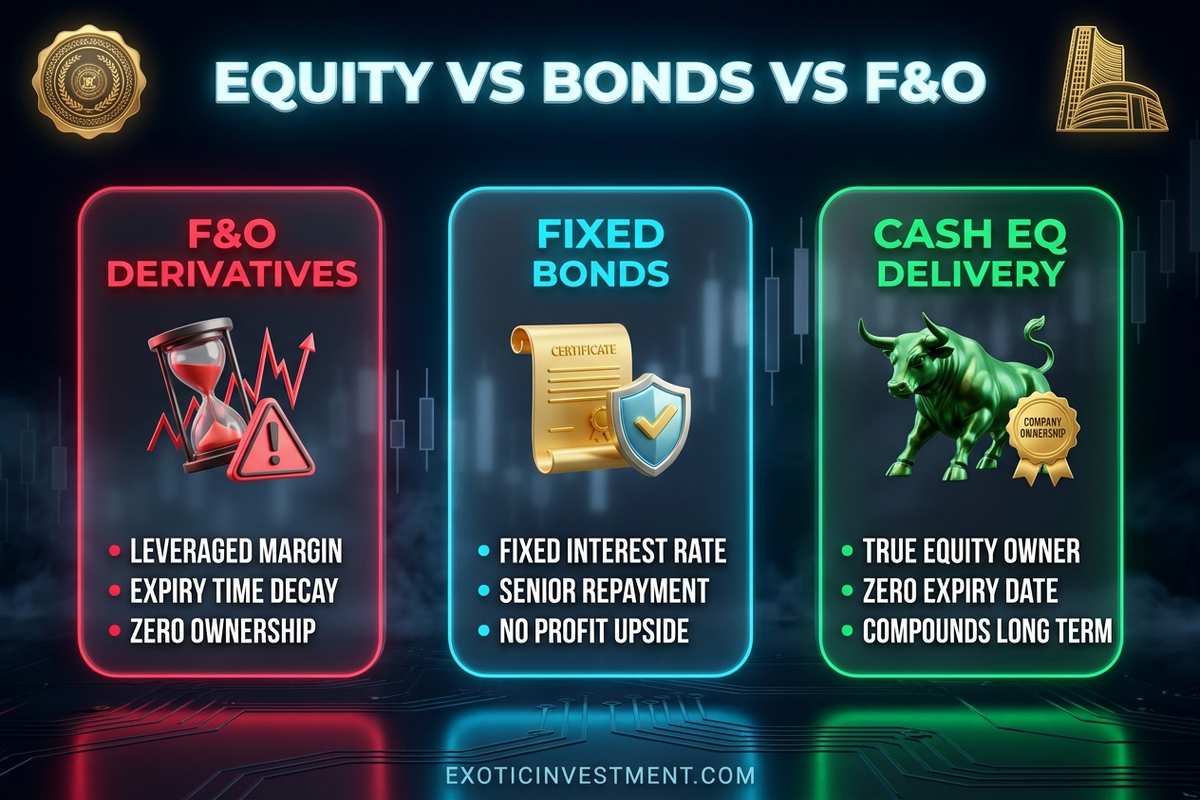
Illustration: Structural contrast across cash Equity delivery ownership, fixed-income Debt bonds, and time-bound Derivatives contracts.
How Retail Investors Use Equity, Stocks, and Mutual Funds Together
Wait — should busy salaried Indians pick individual company stocks or broad equity mutual funds? Working professionals lacking 10 weekly hours for financial audits often build safer wealth via diversified index funds. However, disciplined learners who master valuation ratios and position sizing can allocate portions into direct stocks calmly.
Always estimate compounding goals and fee friction accurately before deploying household capital! Run projections using our SIP calculator and inspect stock brokerage charges across Indian brokers upfront.
Common Beginner Traps Around Equity, Stocks, and Scrips
Understanding the equity and stock difference also stops new investors from misreading corporate announcements on BSE! For instance, many retail traders mistake a company’s “Shareholders’ Equity” figure on balance sheets for current stock market value. In reality, accounting book equity reflects historical net assets minus debt rather than forward market capitalization.
Meanwhile, brokerage screens display confusing shorthand tags such as BE, BZ, or T2T beside cash equities. Consequently, placing margin intraday orders on restricted scrips fails instantly at 9:15 AM! Check cash settlement rules carefully inside our BE series trading guide and ASM surveillance guide first.
In addition, beginners frequently confuse rising share counts after splits with higher fundamental equity ownership! Always verify business profitability, return on capital, and free cash margins instead of chasing cheap-looking share prices. Test intrinsic company fair value cleanly via our DCF valuation calculator and stock return calculator today.
🚀 Trade Clean Dalal Street Setups With Institutional Discipline
Stop guessing on market terminology. Build unshakeable stock market foundations with Dr. Ashok Kumar N Rao and our 1,300+ active Indian trading community.
- Start cleanly with our Kaliyiri Share Market Book and English bestseller Basics of Indian Stock Market Book.
- Access institutional screeners and research via our MultiBagger Plus Courses & Pro Tools Annual Subscription.
- Master price structure in our Technical Analysis Course in Kannada or index setups in our Options Buying Course in Kannada.
💡 Frequently Asked Questions (FAQ): Equity and Stock Difference
1. What is the simplest equity and stock difference?
Equity means net residual ownership across any business or property asset. By contrast, stock means tradable corporate ownership issued on markets; study details in our equity and preference share comparison today.
2. Why do Indian brokers display “EQ” beside stock names?
On NSE, the EQ suffix marks standard cash equity eligible for intraday trading and T+1 delivery. Learn how BE and EQ series behave inside our EQ segment trading guide cleanly.
3. Is buying equity safer than trading stock options?
Yes — unleveraged cash equity stocks carry zero expiry date or sudden margin liquidation risk compared to margin-backed derivatives. Check exact F&O margin exposure first inside our SEBI F&O margin guide anytime.
4. What is the difference between common stock and shareholders’ equity?
Shareholders’ equity represents balance sheet net assets minus debt, covering paid capital plus retained reserves. Meanwhile, common stock denotes tradable ownership shares claiming that net equity; calculate ratios using our relative valuation tool.
5. Are equity mutual funds the same as buying individual stocks?
Equity mutual funds pool money across investors to hold diversified baskets of stocks managed under SEBI oversight. Compare fund SIP growth against direct stocks calmly via our SIP calculator today.
6. How are capital gains taxed when selling stocks or equity funds in India?
Listed Indian stocks and equity funds qualify for lower STCG or LTCG tax rates split across a 12-month window. Compute net taxes quickly inside our STCG LTCG tax calculator right away.