
Evaluating an adr share price requires unpacking cross-border financial mechanics, currency exchange movements, and dual-market liquidity spreads. An American Depositary Receipt trades on United States stock exchanges like the New York Stock Exchange (NYSE) or Nasdaq, denominated in US Dollars. However, because each ADR represents physical shares deposited in an Indian custodian bank, its dollar pricing tracks domestic Dalal Street valuations.
Listen, boss, many retail participants falsely assume that an ADR price moves in exact mathematical lockstep with the Bombay Stock Exchange (BSE) closing quote. In reality, fluctuating foreign exchange rates, foreign institutional investor demand, and separate trading hours create fascinating premium or discount spreads. Before venturing into international dual listings, reviewing core equity fundamentals in our foundational guide to basic stock market terms ensures proper trading discipline.
Here is the bottom line: understanding how depositary receipt quotes are priced allows investors to exploit global valuation mispricings. In addition, dollar-denominated assets provide Indian portfolios with natural currency diversification against long-term Rupee depreciation. You can model structured wealth compounding paths using our interactive sip calculator.
How ADR Share Prices Are Calculated: The Three Essential Variables
Determining the fair theoretical value of an ADR share price involves three interconnected financial components. First, the baseline equity quote on the domestic exchange (BSE or NSE) establishes underlying business valuation. Second, the real-time USD/INR spot exchange rate converts domestic Rupee prices into American Dollars.
Third, the corporate depositary ratio dictates how many domestic ordinary shares are bundled into a single ADR receipt. For example, if Infosys trades at ₹1,500 on the NSE with a 1:1 ratio and USD/INR sits at ₹84, the baseline ADR price equals approximately \$17.85. To understand broader cross-border structures, review our detailed guide on indian adr listings.
A classic Kannada proverb wisely reminds us: “ಅಂಗೈ ಹುಣ್ಣಿಗೆ ಕನ್ನಡಿ ಬೇಕಿಲ್ಲ” (Angai hunnige kannadi bekilla — a wound on your palm needs no mirror to be seen). Similarly, the mathematical relationship between domestic stock prices, foreign exchange rates, and ADR valuations is self-evident once you understand the formula. Therefore, mastering this basic calculation prevents traders from paying excessive premiums during international market rallies.
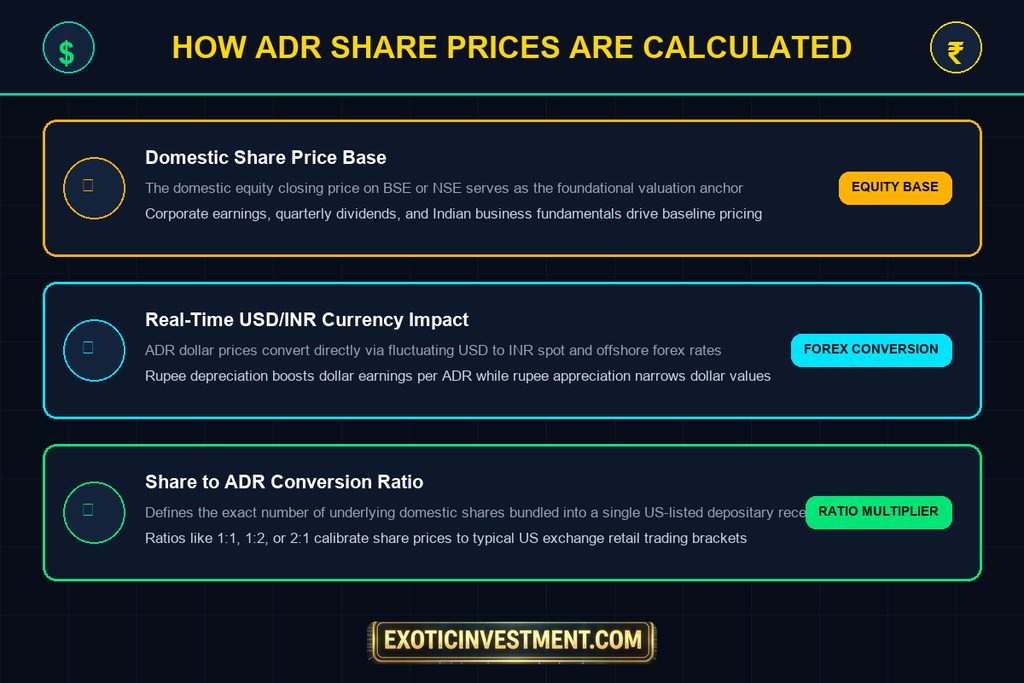
Illustration: 3 Core Variables Determining Real-Time ADR Share Price Formulations
ADR Premiums and Discounts: Why Spreads Occur
Although arbitrage forces constantly pull ADR prices toward underlying parity, significant spreads frequently emerge between New York and Mumbai. Specifically, an ADR trades at a premium when foreign investors bid its dollar price above the converted domestic equity value. Conversely, an ADR trades at a discount when US market sentiment turns pessimistic or when foreign liquidity contracts.
Several distinct market drivers cause these valuation divergences across international financial centres. For instance, global institutional funds facing statutory investment caps on direct emerging market equities often prefer US-listed ADRs, bidding them up. To observe macro Dalal Street volume and price patterns, explore our guide on reading the bazar chart.
In addition, differing trading hours between Mumbai (9:15 AM to 3:30 PM IST) and New York (9:30 AM to 4:00 PM EST) generate time lag spreads. When Wall Street opens, Mumbai has already concluded trading, leaving ADR prices to absorb afternoon geopolitical developments alone. You can calculate historical valuation multiples across global peers with our free pe ratio calculator.
| Pricing Factor | ADR Premium Scenario | ADR Discount Scenario |
|---|---|---|
| Global Institutional Appetite | Surging US demand bids dollar prices above parity | Risk-off sentiment triggers foreign liquidations |
| USD / INR Currency Trend | Rupee depreciation expectations priced into receipts | Rapid Rupee appreciation narrows dollar quotes |
| Arbitrage Speed | Slow conversion creates persistent 2% to 5% spread | Active institutional desks swiftly harvest mispricings |
| Earnings Announcement Impact | Bullish surprise during US trading hours spikes ADR | Disappointing guidance leads to aggressive selling |
First, tracking these historical spreads allows swing traders to identify temporary oversold conditions in quality dual-listed blue chips. Second, sudden spikes in ADR premiums often act as leading indicators for domestic gap-up openings on the NSE the following morning. Therefore, monitoring New York trading sessions provides Indian equity traders with valuable strategic insight.

Illustration: Mechanics of ADR Valuation Premiums, Discounts, and Global Arbitrage Channels
The Cross-Border Arbitrage Mechanism Explained
Arbitrageurs play a vital role in keeping ADR share prices closely aligned with underlying domestic securities. Specifically, institutional market makers constantly monitor price discrepancies between New York and Mumbai in real time. When an ADR trades at a noticeable premium over its converted Indian share price, arbitrage desks initiate two simultaneous transactions.
First, they sell short the overpriced ADR on the NYSE while purchasing the cheaper equivalent shares on the NSE. Next, they instruct the custodian bank to cancel domestic shares and issue fresh ADRs, locking in risk-free spread profits. To evaluate corporate financial strength before trading dual listings, review our guide on how to read a balance sheet.
However, cross-border arbitrage is not entirely frictionless for ordinary retail participants. For instance, currency conversion costs, depositary issuance fees, and regulatory capital controls impose transaction friction that limits small-scale arbitrage. To model expected returns from systematic long-term equity allocations, try our interactive cagr calculator.

Illustration: Detailed Tax Framework Governing US ADR Dividends and Capital Gains
Taxation Rules on ADR Share Price Gains and Dividends
Investing in American Depositary Receipts introduces distinct domestic and cross-border taxation considerations. Specifically, dividend payments declared by Indian companies on their ADRs are subject to US tax withholding at source. Under standard Internal Revenue Service (IRS) regulations, a 25% statutory withholding tax applies to dividend distributions paid to foreign holders.
Fortunately, Indian residents investing through the Liberalised Remittance Scheme (LRS) can claim Double Tax Avoidance Agreement (DTAA) relief under Section 90. By filing Form 67 with their annual Indian income tax return, investors offset foreign taxes paid against domestic liabilities. To estimate wealth accumulation across multiple tax-efficient tranches, apply our online step up sip calculator.
In addition, secondary market capital gains on ADRs held by Indian residents fall under unlisted foreign asset rules. Short-term capital gains are added to total taxable income and taxed at applicable individual slab rates. Conversely, long-term capital gains held beyond 24 months benefit from concessional tax treatment under Indian revenue law.
Technical Analysis on ADR Charts: Reading the Daily Trend
Analyzing technical price action on ADR charts requires combining Wall Street volume trends with domestic Indian moving averages. In particular, swing traders rely on the daily timeframe to eliminate erratic opening volatility. To master daily timeframe execution and chart anatomy, explore our in-depth tutorial on the day chart.
When an ADR share price breaks out above key horizontal resistance on heavy US trading volume, institutional buying conviction is confirmed. For example, prominent dual-listed banking and technology giants frequently stage multi-month technical breakouts that lead the entire domestic Indian index. To forecast expected earnings compounding rates, test our reverse cagr calculator.
In addition, global crypto market investors can access institutional quantitative models and digital currency tools at eMintage to diversify modern portfolios. Meanwhile, equity traders building diversified wealth can also study small-cap manufacturing stocks like aeroflex industries share price and specialty chemical leaders like tgv sraac share price.
Key Differences: Investing Locally vs Buying ADRs
Retail investors often debate whether purchasing domestic Indian blue chips directly or buying their US-listed ADRs delivers better returns. Below is a structured comparison highlighting key practical distinctions between the two investment routes:
- Currency Denomination: Domestic shares trade in Indian Rupees, while ADRs trade in US Dollars, offering direct currency hedging benefits.
- Trading Hours: Indian stocks trade during Asian business hours, whereas ADRs trade during Wall Street afternoon hours.
- Brokerage & Access: Domestic shares require a standard Indian Demat account, while ADRs necessitate an international brokerage account funded through LRS.
- Liquidity & Spreads: Large-cap domestic shares on NSE often offer tighter bid-ask spreads compared to lower-volume overseas ADR tranches.
To calculate exact brokerage costs and statutory turnover charges across your equity trades, employ our free brokerage calculator. In addition, learn how automated equity investing builds disciplined wealth through our guide on what is stock sip.
Frequently Asked Questions About ADR Share Prices (FAQ)
What causes the difference between an ADR price and domestic share price?
The difference stems from real-time USD/INR currency exchange rates, the share-to-ADR conversion ratio, and localized trading demand in New York. In addition, different trading hours create temporary pricing lags between both markets.
Can Indian retail investors trade ADRs directly on US exchanges?
Yes, Indian resident individuals can invest in US-listed ADRs through the Reserve Bank of India’s Liberalised Remittance Scheme (LRS). You simply open an international account with a SEBI-registered broker offering global market access.
How does a falling Rupee affect the ADR share price?
When the Indian Rupee depreciates against the US Dollar, each dollar buys more rupees. Consequently, if domestic share prices remain unchanged, the dollar-denominated ADR share price will adjust downward to maintain theoretical parity.
What is a Level III ADR?
A Level III ADR represents the highest tier of depositary receipt, allowing foreign companies to raise fresh equity capital directly on US stock exchanges. These listings require full registration and compliance with the US Securities and Exchange Commission (SEC).
Are ADR dividends subject to double taxation?
No, because India and the United States maintain an active Double Tax Avoidance Agreement (DTAA). Indian residents claim foreign tax credits by filing Form 67 to offset US withholding taxes against domestic tax liabilities.
Key Takeaways for Global Equity Investors
First, an ADR share price reflects the interplay of domestic equity performance, USD/INR forex movements, and corporate conversion ratios. Second, temporary ADR premiums and discounts offer valuable insights into foreign institutional sentiment and next-day Dalal Street opening trends. Third, understanding DTAA provisions ensures you never suffer unnecessary double taxation on foreign dividend distributions.
Finally, building disciplined wealth requires combining long-term domestic equity ownership with global diversification tools. To plan passive withdrawal cashflows during retirement, explore our interactive swp calculator today. For investors seeking passive index exposure, review our strategic blueprint on how to invest in nifty 50 index fund.