Evaluating the tgv sraac share price trajectory requires an acute understanding of cyclical chemical commodity prices, power costs, and domestic industrial demand. Headquartered in Andhra Pradesh, TGV SRAAC stands as one of South India’s premier chlor-alkali and specialty oleochemical manufacturers. However, retail investors often enter commodity chemical stocks at the peak of pricing cycles, suffering painful multi-year drawdowns.
Listen, boss, commodity chemical investing follows completely different rules compared to steady consumer FMCG stocks. When domestic Electrochemical Unit (ECU) realizations surge, profit margins expand exponentially, driving sharp stock price rallies. Before allocating trading capital, reviewing foundational market mechanics in our educational guide to basic stock market terms ensures proper trading discipline.
Here is the real deal: TGV SRAAC benefits from vertically integrated captive power generation, which protects its energy-intensive electrolysis cells from escalating state power tariffs. In addition, aggressive balance sheet debt repayment over recent quarters provides a substantial margin of safety for long-term investors. You can project structured wealth accumulation trajectories using our interactive sip calculator.
Business Model: Chlor-Alkali, Castor Derivatives & Captive Power
TGV SRAAC operates a diversified industrial manufacturing footprint anchored by its core chlor-alkali chemical complex. Specifically, the company produces caustic soda lye, liquid chlorine, and hydrochloric acid, which serve as foundational inputs for paper, alumina, textiles, and water treatment. Consequently, regional industrial activity directly governs baseline product demand across Andhra Pradesh, Telangana, and Tamil Nadu.
Beyond basic chlor-alkali manufacturing, the company maintains a high-margin castor oil and specialty chemical processing division. For example, it refines technical castor oil into hydrogenated derivatives and 12-hydroxy stearic acid for international export. To examine corporate solvency and asset backing in detail, review our guide on how to read a balance sheet.
A classic Kannada proverb wisely reminds us: “ಉಪ್ಪಿಗಿಂತ ರುಚಿಯಿಲ್ಲ, ತಾಯಿಗಿಂತ ಬಂಧುವಿಲ್ಲ” (Uppiginta ruchiyilla, taayiginta bandhuvilla — nothing tastes better than salt, and no relative equals a mother). Similarly, industrial chemistry relies on salt-based chlor-alkali electrolysis as an irreplaceable building block of modern manufacturing. Therefore, TGV SRAAC’s strategic regional location and captive power infrastructure cement its competitive position.
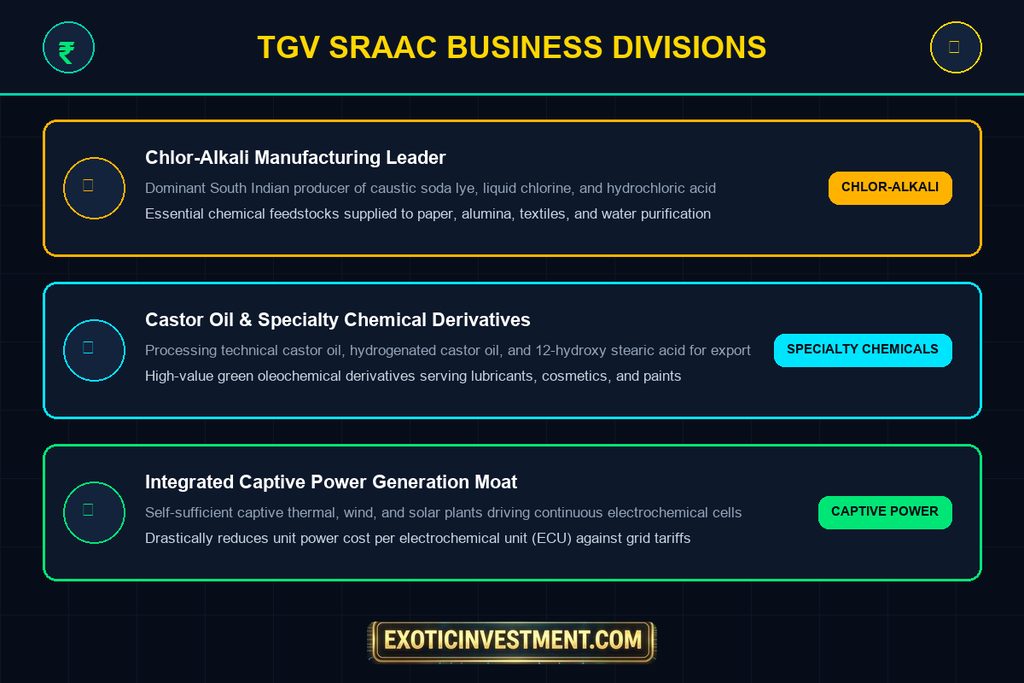
Illustration: 3 Core Business Pillars Driving TGV SRAAC Industrial Operations
Financial Performance: ECU Realizations, Debt Reduction & Margins
Analyzing TGV SRAAC’s financial statements reveals the powerful operating scale inherent in electrochemical manufacturing. Specifically, an Electrochemical Unit measures the combined output of caustic soda and chlorine generated from single-cell brine electrolysis. When international caustic soda prices strengthen, incremental revenues flow directly to operating earnings.
In addition, global supply disruptions and capacity cuts in Europe often create sudden supply deficits across Asian trade corridors. Consequently, domestic manufacturers experience pricing windfalls that dramatically boost quarterly operating cashflows. Tracking these cyclical commodity waves enables disciplined swing traders to enter before broad consensus upgrades occur.
Let’s keep it simple: during peak commodity upcycles, operating EBITDA margins can expand beyond 25% due to fixed cost absorption. In addition, the management team has systematically deployed surplus operational cashflows toward debt reduction. To evaluate historical valuation multiples across chemical peers, explore our dedicated pe ratio calculator.
| Financial Parameter | Operational Trend | Investment Impact |
|---|---|---|
| ECU Price Realizations | Cyclical Swings (₹32,000 to ₹45,000/MT) | Drives rapid quarterly earnings expansion during industry shortages |
| Long-Term Debt Burden | Substantial Debt Reduction | Reduces annual interest outgo and improves credit profile |
| Captive Power Availability | Thermal & Renewable Integration | Shields manufacturing margins from volatile state grid tariffs |
| Dividend Track Record | Steady Payouts During Upcycles | Provides cashflow yield for long-term equity investors |
First, debt reduction lowers fixed financial charges, allowing the business to remain profitable even during sharp commodity downcycles. Second, strong cash flow from operations funds routine plant maintenance without diluting equity shareholders. Therefore, conservative debt management significantly de-risks the investment thesis.
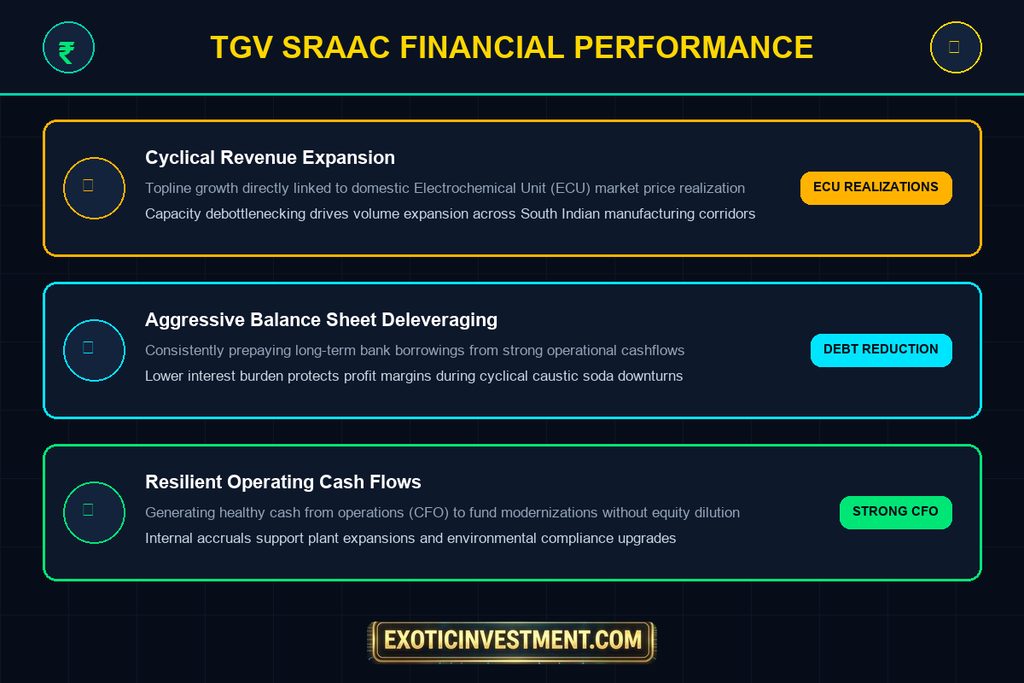
Illustration: Key Operating Metrics and Financial Deleveraging Trend for TGV SRAAC
Valuation Multiples: How to Value a Cyclical Chemical Stock
Valuing cyclical chemical producers requires evaluating Price-to-Earnings ratios against underlying earnings cycles. Specifically, when chemical profits hit cyclical highs, the stock often trades at misleadingly low P/E multiples of 6x to 8x. Conversely, during cyclical troughs, depressed earnings cause trailing P/E ratios to appear artificially high.
In addition, investors should monitor Price-to-Book value and Enterprise Value to EBITDA (EV/EBITDA) to gauge replacement cost valuations. You can calculate required long-term compounding growth rates using our interactive reverse cagr calculator. To project total wealth accumulation from disciplined lumpsum investments, explore our lumpsum investment calculator.
Meanwhile, active swing traders should always manage position sizing when trading small-cap commodity stocks. Calculate stop-loss risk and trade allocation using our free position size calculator. Therefore, combining cyclical awareness with strict position sizing shields capital from brutal drawdowns.
🚀 Master Commodity Cycles & Small-Cap Value Investing
Learn how veteran Dalal Street analysts identify cyclical turnarounds, analyze balance sheet deleveraging, and execute high-reward small-cap setups. Learn under Dr. Ashok Kumar N Rao.
Key Risk Factors: Thermal Coal Prices and Chlorine Disposal Challenges
Despite its cost advantages, TGV SRAAC faces operational challenges common to chlor-alkali producers. Specifically, the production of caustic soda unavoidably co-produces toxic liquid chlorine in a fixed stoichiometric ratio. In fact, if regional demand for chlorine weakens, production must be throttled to prevent storage hazards.
In addition, thermal coal price fluctuations directly impact captive power generation expenses. To evaluate trading transaction fees across major brokerage houses, examine charges with our zerodha brokerage calculator. Similarly, tracking circuit filters using our guide on upper and lower circuit limits prepares traders for high-volatility moves.
In addition, investors holding dividend-paying manufacturing stocks can study passive income strategies in our guide on dividend yield stocks in india. Therefore, monitoring coal costs and chlorine derivative investments provides vital early warnings.
Capacity Expansion and Downstream Derivative Investments
To insulate corporate performance from volatile base chemical prices, TGV SRAAC is actively expanding its downstream portfolio. Specifically, the company is converting raw chlorine into specialized chlorinated paraffin wax and chloromethanes. Consequently, captive chlorine utilization eliminates hazardous bulk storage while capturing superior value additions.
In addition, modernizing membrane cell technology improves power efficiency per unit of caustic output. Lower electricity consumption translates directly into structural cost advantages against regional competitors. To compare trading platform costs across discount brokers, check our groww brokerage calculator.
Similarly, exploring long-term systematic withdrawals helps investors plan dependable retirement cashflows. Review systematic cashflow withdrawal principles in our guide on swp in mutual funds. Therefore, expanding into value-added derivatives strengthens long-term earnings durability.
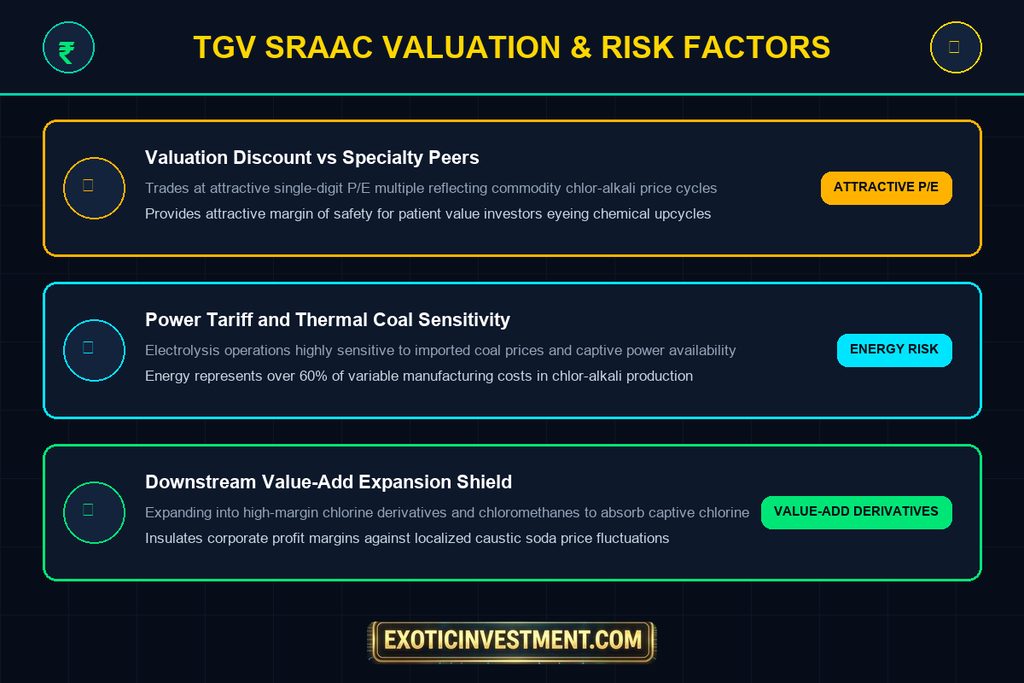
Illustration: Valuation Framework, Growth Catalysts, and Core Risk Monitors for TGV SRAAC
Trading Execution & Tax Planning on Small-Cap Chemical Equities
Executing trades in small-cap equities like TGV SRAAC requires careful attention to liquidity and exchange delivery rules. Specifically, sudden volume surges can cause significant execution slippage on large market orders. Review trade settlement guidelines in our guide on delivery and CNC trading rules.
In addition, compare platform transaction expenses across competing brokers using our upstox brokerage calculator. You can calculate realized net trading profits after deducting STT and turnover levies with our stock profit calculator. Consequently, quantitative cost tracking preserves trading margins.
Finally, investors must compute annual statutory capital gains taxes accurately before closing financial accounts. You can project short-term and long-term tax liabilities using our stock market tax calculator.
In fact, reviewing depository transfer protocols in our guide on demat account terms prevents administrative headaches. Therefore, pairing sound fundamental analysis with precise trade execution builds lasting market success.
💡 Frequently Asked Questions (FAQ)
What are the primary products manufactured by TGV SRAAC?
TGV SRAAC primarily manufactures chlor-alkali products including caustic soda lye, liquid chlorine, and hydrochloric acid, alongside castor oil derivatives and captive power. In addition, investors can evaluate historical valuation multiples across chemical peers using our pe ratio calculator.
How does captive power generation benefit TGV SRAAC?
Because chlor-alkali electrolysis consumes massive electrical energy, captive thermal and renewable power plants lower production costs below state grid tariffs. In fact, you can calculate long-term compounding growth from low-cost industrial producers using our lumpsum investment calculator.
What is an Electrochemical Unit (ECU) in chlor-alkali manufacturing?
An Electrochemical Unit measures the combined market price realization of one metric ton of caustic soda plus approximately 0.886 metric tons of chlorine. To review how commodity cycles impact corporate debt health, explore our guide on how to read a balance sheet.
Is TGV SRAAC reducing its balance sheet debt?
Yes, the company has deployed operational cash flows toward aggressive debt reduction, significantly reducing interest expenses and strengthening shareholder value. You can compare broker transaction expenses across discount platforms using our angel one brokerage calculator.
How do traders calculate net realized profit on chemical stock swings?
Traders must deduct broker commissions, STT, turnover charges, and capital gains tax from their gross sale proceeds. In fact, you can calculate exact net realized profits after all statutory levies using our free stock profit calculator.