
Learning how to become a stock broker in india opens doors to one of the most lucrative and respected professions in Dalal Street. As market participation expands across tier-2 and tier-3 cities, the demand for licensed trading professionals continues to surge. However, building a compliant brokerage firm requires clearing rigorous regulatory hurdles and passing statutory licensing exams.
Listen, boss, many newcomers mistake being an active intraday trader for being a professional stock broker. In reality, a stock broker operates a regulated institutional gateway connecting retail traders and high-net-worth investors directly to exchanges. Before handling live client capital, you must study exchange mechanics through our guide to basic stock market terms.
Here is the real deal: you can either launch a full-fledged primary brokerage or partner with an existing corporate broker as an authorized person. Both paths offer strong commercial margins, but they demand vastly different capital commitments. In addition, mastering brokerage mathematics with our zerodha brokerage calculator helps you evaluate transaction revenue models.
What Does a Stock Broker Do in the Indian Financial Market?
A stock broker is a registered trading member of national exchanges like the NSE and BSE, legally authorized to buy and sell securities for clients. Specifically, brokers act as financial conduits executing delivery trades, intraday positions, derivatives contracts, and currency hedges. Consequently, brokers maintain client ledger balances, enforce initial margin deposits, and handle trade settlements.
Beyond plain order routing, modern brokers provide advanced charting platforms, research recommendations, and margin funding services. For example, brokers facilitate extended buying power through margin trading facility rules. Because regulatory compliance is non-negotiable, every broker must strictly segregate client funds from proprietary corporate accounts.
A respected Kannada proverb wisely states: “ಹನಿ ಹನಿ ಗೂಡಿದರೆ ಹಳ್ಳ, ತೆನೆ ತೆನೆ ಸೇರಿದರೆ ಬಳ್ಳಿ” (Hani hani goodidare halla, tene tene seridare balli — drops of water make a mighty river). Similarly, a brokerage business grows exponentially by accumulating steady brokerage fees and transaction charges across thousands of active trading accounts. Therefore, client retention and execution speed determine long-term business survival.
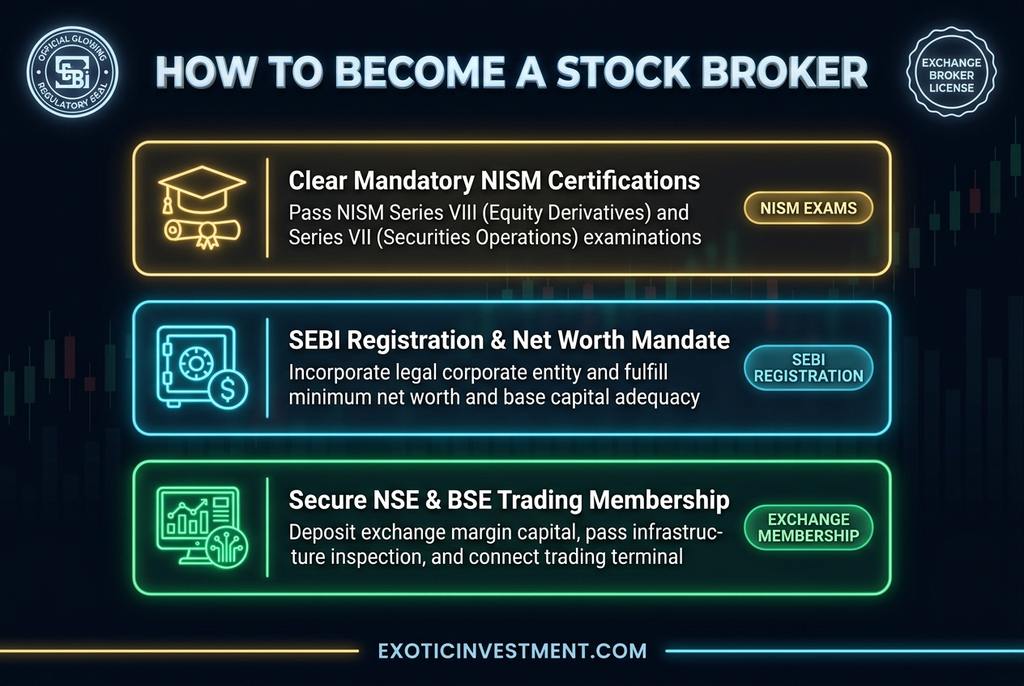
Illustration: 3 Step Roadmap to Becoming a Registered Stock Broker in India
Stock Broker vs Authorized Person (Sub-Broker): Key Differences Explained
Aspiring entrepreneurs must choose between becoming a primary stock broker or registering as an Authorized Person (AP). Previously referred to as sub-brokers, Authorized Persons partner directly with national brokerage powerhouses like Angel One, Motilal Oswal, or Zerodha. In contrast, primary brokers register directly with SEBI and maintain clearing memberships.
Let’s keep it simple: an Authorized Person focuses entirely on client acquisition, onboarding, and advisory support without bearing clearing liabilities. Meanwhile, the parent broker provides trading infrastructure, mobile apps, risk surveillance systems, and exchange deposits. Consequently, starting as an Authorized Person requires minimal upfront capital and zero exchange net worth deposits.
To compare brokerage sharing models effectively, examine trading fee structures using our upstox brokerage calculator. In addition, understanding order routing differences prevents costly operational confusion when advising active market traders.
| Parameter | Primary Stock Broker | Authorized Person (Sub-Broker) |
|---|---|---|
| SEBI Registration | Direct Member Certificate | Affiliated via Sponsor Broker |
| Minimum Net Worth | ₹3 Crore to ₹5 Crore+ | ₹50,000 to ₹2 Lakh Refundable Deposit |
| Clearing Obligations | Direct Settlement with CCIL / NSCCL | Zero Clearing Liability |
| Revenue Potential | 100% of Brokerage & Interest Float | 40% to 70% Revenue Sharing Split |
First, corporate stock brokers bear complete regulatory accountability for margin shortfalls and client payment defaults. Second, Authorized Persons enjoy flexible revenue sharing contracts without risking balance sheet insolvency. Therefore, starting as an Authorized Person is the most practical pathway for solo financial entrepreneurs.
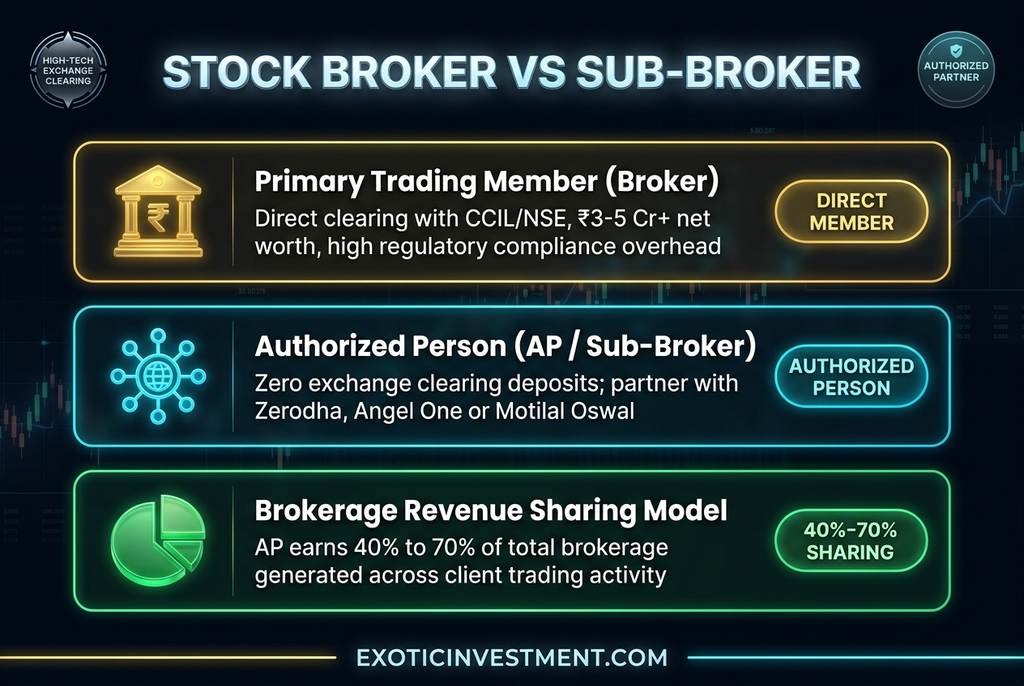
Illustration: Comparing Primary Trading Member Brokerage vs Authorized Person Franchise Model
Eligibility Criteria and Educational Qualifications Required
To enter the stock broking profession, candidates must satisfy mandatory educational and professional criteria set by SEBI. Specifically, the designated directors and key managerial personnel must hold at least a bachelor’s degree from a recognized university. In addition, degrees in finance, commerce, economics, or business administration provide a strong competitive edge.
In addition, candidates must have a clean financial and legal track record. SEBI strictly disqualifies individuals with past bankruptcies, debt defaults, or criminal convictions related to financial fraud. Similarly, understanding depository settlement rules from our guide on demat account terms helps you follow clearing protocols.
Finally, aspiring stock brokers must maintain minimum liquid net worth requirements certified by an independent Chartered Accountant. If you plan to trade client capital responsibly, calculating stop-loss thresholds using our position size calculator protects capital during severe volatility. Therefore, academic preparation combined with quantitative risk skills creates lasting industry trust.
🚀 Master Market Analysis & Options Desk Trading
Gain real-world trading floor expertise, risk management mastery, and proprietary chart setups. Learn directly under Dr. Ashok Kumar N Rao.
Mandatory NISM Certifications for Stock Brokers and Dealers
Every professional executing orders on trading terminals must clear mandatory certification examinations conducted by the National Institute of Securities Markets (NISM). Specifically, these certifications validate your understanding of market rules, contract specifications, and risk mitigation systems. In addition, certifications must be renewed every three years through re-examination or continuing professional education programs.
Here are the three foundational NISM examinations every stock broker and terminal operator must clear. Specifically, preparing for these modules builds deep operational and quantitative knowledge.
- NISM Series VIII: Equity Derivatives Certification: Mandatory for all dealers, relationship managers, and brokers executing client orders in stock futures and index options. Specifically, it covers option Greeks, margin requirements, open interest dynamics, and risk management frameworks.
- NISM Series VII: Securities Operations and Risk Management Certification: Essential for operations staff handling trade clearing, client ledger reconciliation, depository transfers, and compliance audits. Consequently, it ensures seamless post-trade settlement.
- NISM Series I: Currency Derivatives Certification: Required for trading desks offering currency futures and options pairs on USDINR, EURINR, and GBPINR. Therefore, it enables multi-asset trading execution.
In addition, broking dealers must understand how delivery settlements function under the T+1 settlement cycle. To guide your clients through spot execution vs positional holdings, review our educational guide on delivery and CNC trading rules. Consequently, certified professionals inspire confidence among high-net-worth investors.
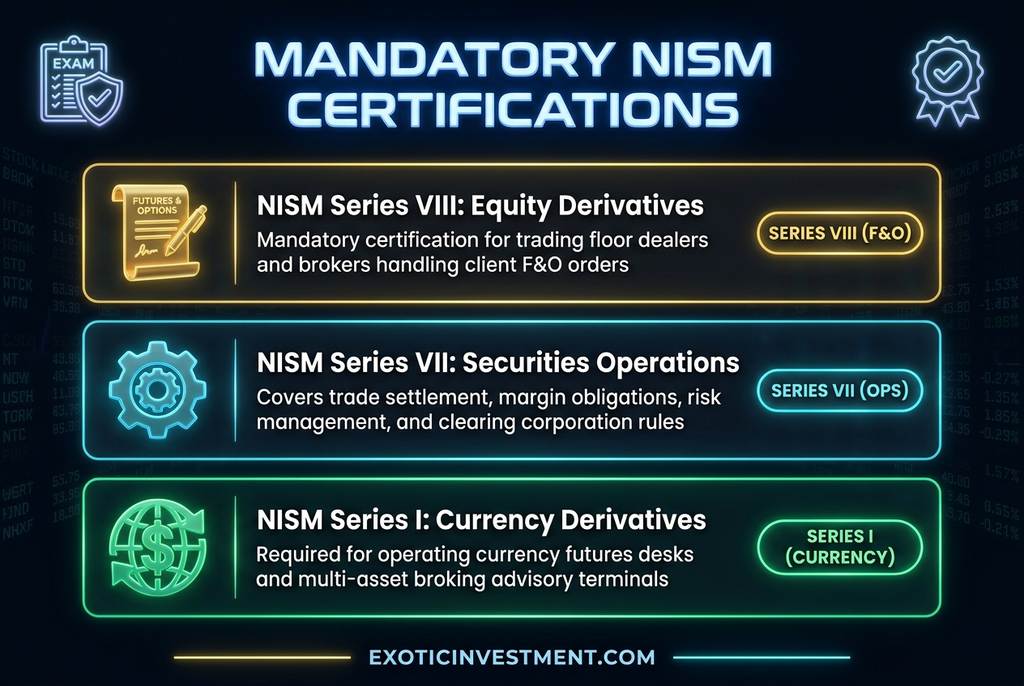
Illustration: 3 Mandatory NISM Certifications Required for Trading Floor Professionals
Step-by-Step Roadmap: How to Become a Stock Broker in India
Establishing an independent brokerage firm involves a disciplined sequence of legal incorporations, regulatory filings, and infrastructure inspections. Follow these structured steps to secure your trading membership:
- Incorporate a Corporate Entity: Form a private limited company or public limited company with the Ministry of Corporate Affairs (MCA). Sole proprietorships and basic partnership firms are no longer permitted to register as primary stock brokers on Indian exchanges.
- Satisfy Minimum Net Worth and Capital Adequacy: Deposit the statutory base minimum capital required by the exchanges. Specifically, establishing a direct trading and clearing membership on NSE or BSE requires a net worth of ₹3 Crore to ₹5 Crore, backed by unencumbered bank guarantees and fixed deposits.
- Hire Certified Key Personnel: Appoint compliance officers, risk managers, and terminal dealers holding active NISM certifications. In addition, ensure all designated directors meet SEBI’s fit-and-proper person standards.
- Submit Membership Application to Exchanges: Apply for membership directly through the NSE or BSE member portal. Exchange inspection teams will evaluate your office premises, server infrastructure, telecommunication lines, and disaster recovery systems.
- Obtain SEBI Registration Certificate: Following exchange recommendation, SEBI conducts final background verifications. Upon clearance, SEBI issues your permanent Stock Broker Registration Certificate, enabling live market operations.
During trading hours, brokers must also safeguard client accounts against violent market swings. Specifically, monitoring exchange volatility safeguards client positions, as detailed in our guide on upper and lower circuit limits. In addition, calculating net realized returns with our stock profit calculator assists clients during tax filing seasons.
Capital Requirements, Deposit Norms, and Infrastructure Costs
Launching a direct brokerage firm demands substantial capital commitments beyond exchange deposits. Specifically, entrepreneurs must budget for enterprise trading software licenses, lease line connectivity, cyber security firewalls, and server rack hosting in exchange co-location facilities. Consequently, initial capital outlays frequently reach ₹5 Crore to ₹10 Crore.
In contrast, launching as an Authorized Person requires between ₹1 Lakh and ₹5 Lakh for office interiors, high-speed broadband, and promotional marketing. Parent brokers typically cover high-end server infrastructure and mobile application development. To compare discount brokerage economics across major firms, check our groww brokerage calculator.
In addition, brokers must help retail clients understand annual statutory taxation on equity trades. You can easily estimate short-term and long-term tax liabilities using our stock market tax calculator. Therefore, offering value-added tax planning tools builds lifelong client loyalty.
Commercial Business Model: How Stock Brokers Make Money
A stock broking business generates diverse revenue streams beyond simple execution commissions. Specifically, successful brokers capitalize on several complementary financial channels:
- Transaction Brokerage Fees: Charged as a fixed fee per order (e.g., ₹20 per trade) or a percentage of turnover on equity delivery, intraday, and derivatives contracts.
- Margin Trading Facility (MTF) Interest: Lending capital to positional traders at interest rates between 12% and 18% per annum, creating predictable non-brokerage interest income.
- Depository Participant (DP) Charges: Levying annual Demat maintenance fees and transaction debit fees whenever clients sell delivery shares from their depository holdings.
- Third-Party Financial Distribution: Earning distributor commissions by offering IPO applications, Sovereign Gold Bonds, corporate fixed deposits, and mutual funds. Review grey market dynamics in our guide on grey market premium in ipo.
- Treasury Float Income: Earning safe overnight returns on idle client cash balances parked in exchange-approved fixed deposits and government treasury bills.
To evaluate trading charges across full-service brokers, explore our interactive angel one brokerage calculator. Because diverse income streams stabilize cashflow during bear markets, leading brokers maintain healthy profitability across all market cycles.
💡 Frequently Asked Questions (FAQ)
Can an individual become a stock broker in India without forming a company?
No, SEBI regulations mandate that all primary stock brokers on national exchanges must incorporate as a corporate entity with minimum net worth adequacy. However, individuals can easily enter the market as an Authorized Person by partnering with registered brokers using our zerodha brokerage calculator to evaluate potential revenue splits.
How long does it take to secure a SEBI stock broker license?
Securing exchange membership and SEBI registration typically takes 4 to 8 months depending on corporate documentation and infrastructure clearance. Meanwhile, aspiring brokers should clear all mandatory NISM examinations and review fundamental concepts in our guide to basic stock market terms.
What is the minimum qualification to become a stock broker dealer?
To operate trading terminals as a certified dealer, candidates must be at least 18 years old, possess a higher secondary education or graduate degree, and pass the NISM Series VIII exam. In addition, dealers must master execution rules described in our guide on delivery and CNC trading rules.
How much money is required to start a sub-broker or authorized person franchise?
Starting an Authorized Person franchise requires an initial refundable deposit between ₹50,000 and ₹2 Lakh payable to the parent brokerage house. In fact, you can compare fee models across platforms using our upstox brokerage calculator to choose the most profitable corporate partner.
Do stock brokers pay taxes on client trading gains?
No, clients are individually responsible for paying capital gains taxes on their trading profits, while brokers pay corporate income tax on brokerage revenues. Clients can easily project their annual capital gains tax obligations using our free stock market tax calculator.