Introduction to Sector Rotation in Stock Markets
Welcome to our comprehensive guide on the sector rotation strategy India. If you want to outperform the broader index, understanding how capital shifts between different industries is essential. In fact, institutional money managers do not invest in all sectors simultaneously. Instead, they rotate capital based on economic cycles.
Before applying sector rotation, make sure you understand technical chart reading. For instance, read our guides on intro to technical analysis and support and resistance levels. Furthermore, you will need to identify market trends. Specifically, check our guides on volume and price action in trading and moving averages for trend confirmation. These indicators help you confirm when a sector is gaining institutional momentum.
Understanding Sector Rotation Strategy India
Firstly, sector rotation is an investment strategy that involves moving capital from one industry sector to another. Specifically, the goal of a sector rotation strategy India is to anticipate which sectors will outperform during the next phase of the economic cycle. Therefore, this active approach allows you to participate in sectors experiencing strong structural tailwinds.
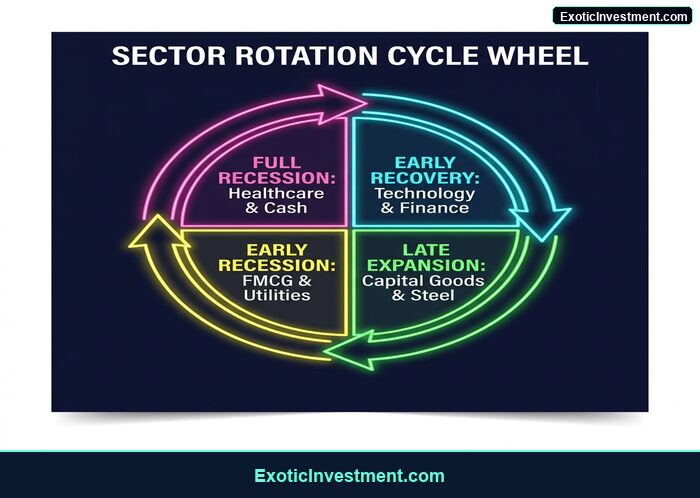
Illustration 1: Sector Rotation Wheel Stock Market Cycles India
In addition, sector rotation helps you avoid declining industries. Because different sectors perform differently at various stages of the business cycle, holding the wrong sectors during a slowdown can lead to severe underperformance. Consequently, active sector tracking is vital for maximizing stock market returns.
Master Technical Analysis & Trading: Recommended Courses & Books
For traders seeking structured market training, we offer dedicated training resources. In addition, these courses provide practical, step-by-step masterclasses:
Recommended Trading Courses & Premium Subscriptions:
- Technical Analysis in Kannada Course: Learn chart reading, support/resistance mapping, and volume analysis: Technical Analysis in Kannada Course.
- Kaliyiri Share Market Book: Learn stock market fundamentals and wealth creation in simple Kannada: Kaliyiri Share Market Book.
- Basics of Stock Market Course: Build your stock market foundation from scratch: Basics of Stock Market Course.
- Options Buying Course in Kannada: Master option buying setups and risk management: Options Buying Course in Kannada.
- Multibagger Stocks & Pro Subscription (Product 2739): Access premium stock picks, research reports, and pro trader alerts: MultiBagger Plus Courses & Pro Tools Annual Subscription (Direct checkout: Buy Pro Subscription Product 2739).
Cyclical vs. Defensive Sectors in India
Secondly, Indian sectors can be broadly divided into cyclical and defensive categories. Specifically, cyclical sectors are highly sensitive to the health of the economy. In fact, these sectors expand rapidly during economic growth but contract sharply during recessions.
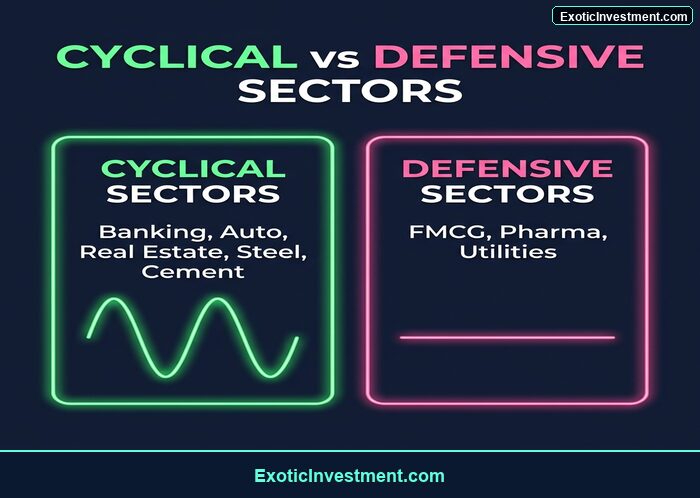
Illustration 2: Economic Cycles Vs Cyclical Defensive Sectors India
For example, cyclical sectors include Banking, Auto, Real Estate, Steel, and Cement. When the economy is growing, consumer spending increases, driving demand for housing and automobiles. Conversely, defensive sectors are relatively immune to economic cycles. Specifically, sectors like FMCG, Pharma, and Utilities provide stable earnings because consumers require basic goods regardless of economic health. Therefore, rotating into defensives during a market peak preserves capital.
Using Technical Screeners to Identify Sector Momentum
Thirdly, you can identify sector momentum by tracking relative strength. Specifically, compare the performance of sectoral indices (like Nifty IT or Nifty Bank) against the Nifty 50. In fact, when a sector index continues to rise while the Nifty 50 consolidates, it indicates sector outperformance.
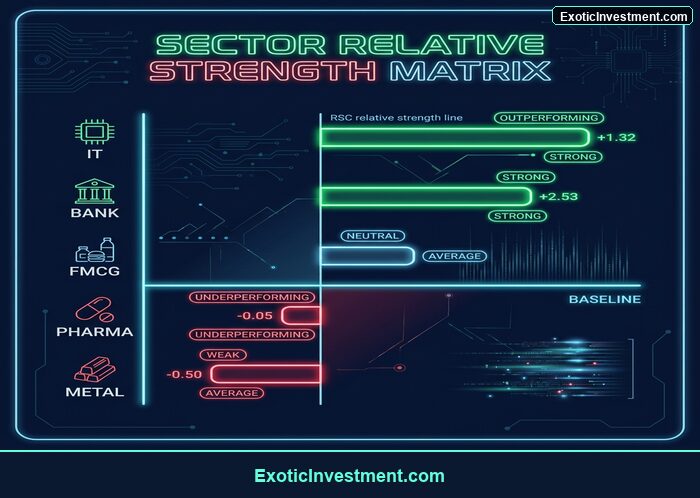
Illustration 3: Sector Performance Relative Strength Matrix India
Furthermore, use technical indicators to confirm momentum. For instance, read our guide on the RSI relative strength index guide to spot overbought and oversold sectors. In addition, you can use our real-time scanners. Specifically, identify leading stocks using the Momentum Stock Screener or find high-volume breakouts with the Intraday Breakout Stock Scanner.
Four Stages of the Sector Rotation Cycle
Furthermore, the economic cycle is divided into four distinct phases: early recovery, full expansion, early recession, and full recession. Specifically, early recovery favors finance and technology sectors. In fact, as interest rates drop, credit demand picks up, boosting banking stocks. Consequently, full expansion shifts demand to capital goods, auto, and infrastructure.
Therefore, early recession requires a defensive posture. Specifically, rotate capital into FMCG, Pharma, and utilities. Because consumers continue to buy essentials, these companies maintain stable earnings. Finally, during full recession, utilities and government bonds outperform, shielding your capital until the cycle resets.
How Interest Rates Drive Sector Rotation Cycles
Furthermore, central bank interest rate policies are a major driver of sectoral trends. Specifically, when the Reserve Bank of India (RBI) cuts repo rates to stimulate the economy, credit-sensitive sectors like Banking and Real Estate receive a major boost. Consequently, lower borrowing costs lead to higher profits and rising stock prices. Therefore, active investors should position themselves in these sectors during rate-cut cycles.
Conversely, when inflation rises, the central bank increases interest rates. Because borrowing becomes expensive, cyclical sectors experience margin contraction. Consequently, capital rotates into defensive sectors like FMCG and Pharma to preserve wealth. Ultimately, monitoring the central bank’s rate trajectory helps you predict the next sector rotation wave.
Rotating from High-Beta Financials to Defensive IT & Pharma
Furthermore, look at a practical rotation example in India. Suppose Nifty has experienced a massive 20% rally led by high-beta financial stocks. However, economic indicators start to suggest rising inflation and interest rate hikes by the RBI. Consequently, financial stocks will begin to face margin pressure and credit growth slowdown.
Therefore, active traders rotate capital away from Nifty Bank constituents. Specifically, they reallocate capital into Nifty IT and Nifty Pharma stocks. Because these sectors generate significant export earnings in US dollars, they are relatively insulated from domestic rate hikes. As a result, your portfolio stays resilient even during domestic market consolidation. Ultimately, understanding these sector dynamics preserves your hard-earned trading capital.
Using Sector Mutual Funds vs Individual Stocks
Finally, investors can implement sector rotation using either sectoral mutual funds or individual stocks. Specifically, individual stocks offer higher returns but carry company-specific risks. In fact, if you select the wrong stock within an outperforming sector, your portfolio may still underperform.
Therefore, sectoral mutual funds are an excellent vehicle for retail investors. Because mutual funds hold a diversified basket of stocks, they reduce stock-specific risks. Consequently, you capture the sector’s performance without worrying about company failures. For instance, check our guide on mastering chart patterns in stock trading to identify technical triggers for sector entries.
Practical Rules for Sector Entry and Exit Checklist
Furthermore, executing sector rotation successfully requires objective entry and exit criteria. Specifically, before committing capital to a new sector, check the following indicators: Is the sectoral index trading above its 50-day and 200-day simple moving averages? Is the sector’s weekly relative strength line pointing upwards compared to the Nifty 50? In addition, is there institutional volume expansion in the sector’s leading stocks?
Consequently, if these three conditions are met, you can enter the sector with high confidence. Conversely, plan your exits when the relative strength line flattens out or when the leading stocks break below their key moving averages. Therefore, following these objective rules prevents you from chasing sectors at their cyclical peaks. Ultimately, disciplined execution protects your capital during sector reversals.
Integrating Calculators and Risk Tools
To execute sector-focused trades successfully, you must implement strict risk management:
- Set Stop Losses: Define your exact stop loss and entry targets using the Stop Loss Calculator.
- Estimate Charges: Calculate brokerage and taxes using the Zerodha Brokerage Calculator or Upstox Brokerage Calculator.
- Compare Investments: Compare active trading returns against passive compounding. For example, read why stock market investment is better than other investments, compound wealth with the Groww SIP Calculator, or build passive dividend returns with dividend investing in India.
If you maintain a multi-asset portfolio that contains digital currencies alongside sectoral equities, monitor your holdings using the crypto portfolio tracker from Emintage inline. In addition, calculate your tax obligations with a crypto tax calculator or project returns with a bitcoin profit calculator.
Frequently Asked Questions
Q: What is a sector rotation strategy India?
A: It is an active investment strategy that involves shifting capital among various sectoral indices (like Banking, IT, Pharma) based on economic indicators and technical momentum.
Q: How do economic cycles affect sector performance?
A: Early expansion favors cyclicals like Banking and Steel. However, late-stage slowdowns favor defensive sectors like FMCG and Pharma.
Q: Where can I get stock picks for sectoral outperformance?
A: You can subscribe to our MultiBagger Plus Courses & Pro Tools Annual Subscription for researched stock recommendations.
In summary, implementing a systematic sector rotation strategy India can significantly boost your portfolio outperformance. Furthermore, always align your sector allocations with technical momentum and macro economic data.
Furthermore, combine sector rotation with macro economic indicators like inflation and GDP growth. Specifically, rising GDP indicates a healthy expansion phase, which favors cyclical sectors like Banking and Auto. In fact, monitoring government capital expenditure announcements reveals which sectors will receive structural support. Consequently, you can position yourself in these industries early and ride major macro trends.
Conversely, during high-inflation environments, FMCG and Pharma companies can pass price hikes to consumers. Therefore, their earnings remain stable compared to cyclical manufacturing companies. Consequently, allocating capital to defensive sectors during inflationary cycles preserves your purchasing power. Ultimately, combining macro data with technical relative strength analysis provides a reliable sector rotation edge.