Claiming every legal stock market loss tax deduction india allows lets smart investors convert market drawdowns into future tax shields. Even experienced Dalal Street participants suffer occasional red years across stocks or derivatives. Fortunately, Indian Income Tax rules permit clean loss set-off and carry-forward when reported properly via our tax harvesting calculator.
Wait — can investors deduct equity trading losses directly out of their monthly corporate salary? Strictly NO under Income Tax Act rules! Instead, every loss type obeys tight cross-head fences across STCL, LTCL, intraday losses, and F&O losses.
Let us map every statutory rule so zero rupees of valid tax shelter go wasted! First, examine same-year set-off matches between short-term and long-term gains. Next, master carry-forward deadlines, CA audit limits, and March tax-harvesting math cleanly.
Current-Year Set-Off Rules: Matching Losses Against Profits
Before shifting unused losses forward, tax law requires matching losses against eligible gains earned inside the same year. Importantly, strict asymmetry splits how Short-Term Capital Loss (STCL) and Long-Term Capital Loss (LTCL) behave! Knowing these pairs upfront prevents painful ITR adjustments later.
Short-Term Capital Loss (STCL) Flexibility
STCL occurs whenever you sell listed shares or equity funds held under 12 months at a net loss. Thankfully, STCL carries India’s widest offset flexibility inside the Capital Gains head! Specifically, you can adjust STCL freely against BOTH Short-Term Capital Gains AND Long-Term Capital Gains.
For example, suppose you earned long-term gains selling mutual funds or residential real estate this year. Immediately, short-term stock delivery losses wipe out taxes on those long-term profits cleanly!
Long-Term Capital Loss (LTCL) Restriction
By contrast, LTCL triggers when equity held past 12 months sells below original cost. Unlike STCL, however, Income Tax rules restrict LTCL strictly against Long-Term Capital Gains! Thus, LTCL can never reduce 20% short-term stock gains—model exact combinations inside our STCG & LTCG tax calculator cleanly.
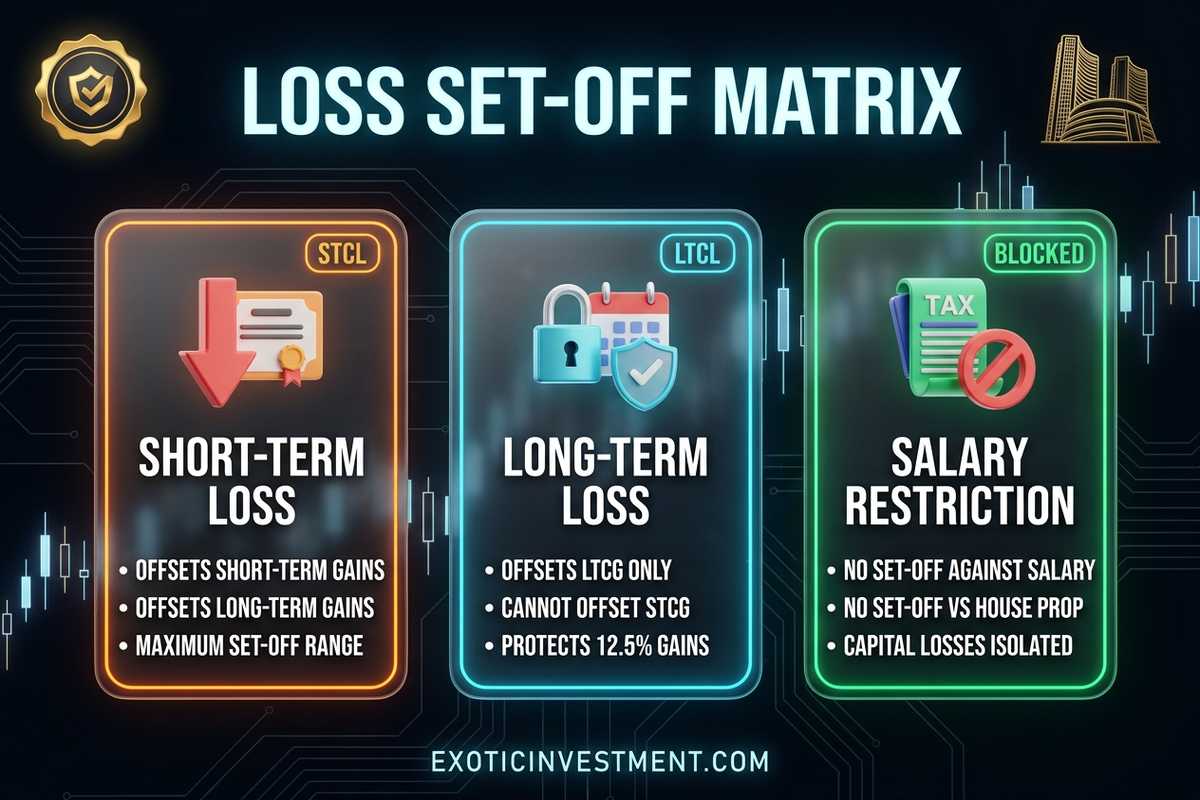
Illustration: Current-year set-off matrix showing how STCL offsets both STCG and LTCG, while LTCL offsets LTCG only.
Carry-Forward Rules: 4 Years vs 8 Years Under the Income Tax Act
What if realized stock losses still exceed current-year gains completely? Thankfully, Sections 72, 73, and 74 let taxpayers carry unused trading losses forward across future years! Note carefully that carry-forward spans vary sharply between delivery, intraday cash, and F&O segments.
First, unadjusted Short-Term and Long-Term Capital Losses carry forward for up to **8 Assessment Years**. Similarly, Non-Speculative F&O business losses carry forward for up to **8 consecutive years** cleanly! In addition, current-year F&O losses can offset rental, interest, or business income (excluding salary) right away.
Conversely, Speculative intraday equity losses carry forward for just **4 Assessment Years** and offset intraday profits only! Measure statutory F&O turnover compliance upfront using our F&O turnover calculator and stock taxation guide.
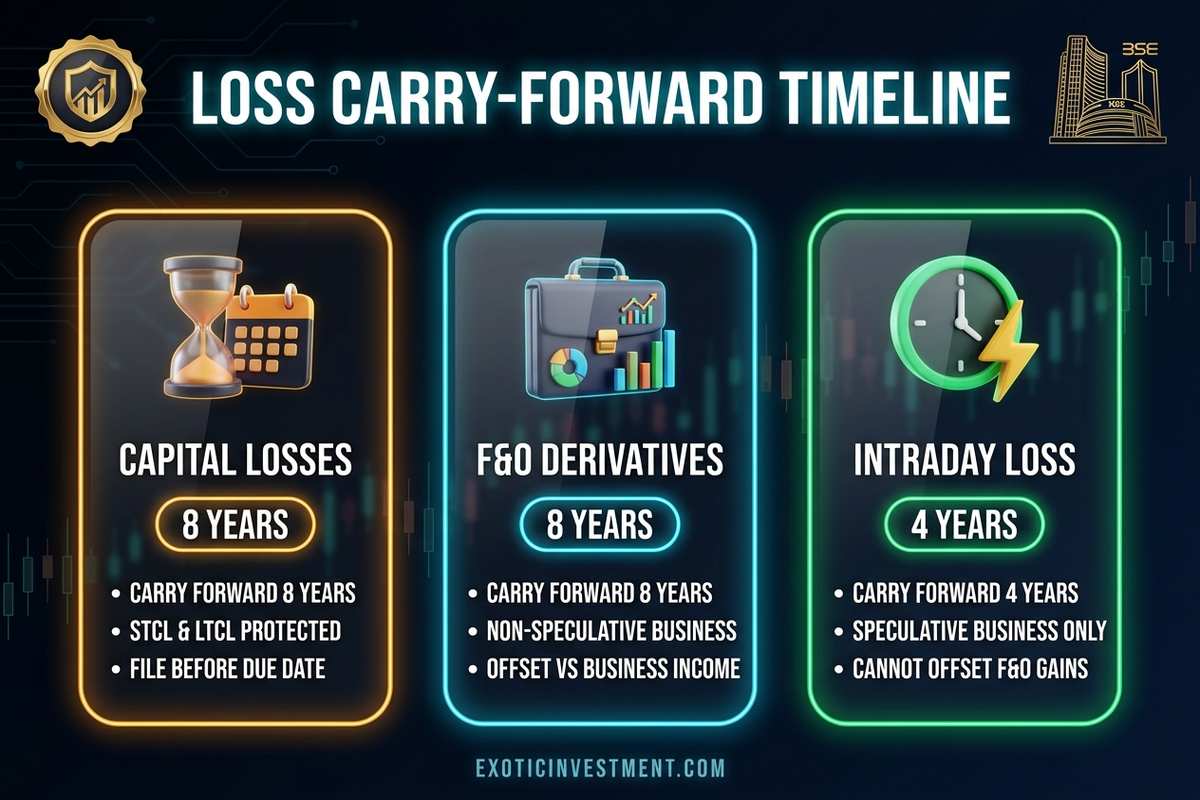
Illustration: Carry-forward horizons contrasting 8-year capital and F&O shields against the tighter 4-year speculative intraday window.
Complete Loss Set-Off Matrix Table (NSE/BSE Segments)
Keep this crisp regulatory checklist open before verifying broker Tax P&L statements each June. Respecting every rule preserves legal tax refunds across bear markets cleanly.
| Type of Trading Loss | Same-Year Set-Off Allowed | Carry Forward Limit | Against Salary? |
|---|---|---|---|
| Short-Term Capital Loss (STCL) | Both STCG and LTCG | Up to 8 Assessment Years | No (Never against salary) |
| Long-Term Capital Loss (LTCL) | Strictly LTCG only | Up to 8 Assessment Years | No (Never against salary) |
| Speculative Intraday Loss | Speculative profits only | Up to 4 Assessment Years | No (Strictly intraday gains) |
| Non-Speculative F&O Loss | Any income except salary (yr 1) | Up to 8 Assessment Years | No (FD, rent & business OK) |
| Mandatory Filing Condition | File BEFORE due date (Sec 139(1)) | Schedule CFL filled in ITR-2/3 | Verify Old vs New Regime |
Worked Example: Tax Loss Harvesting ₹1,50,000 Before March 31
Let us inspect real rupee math showing why proactive March tax harvesting beats passive waiting! Imagine during FY 2025–26 you booked ₹2,00,000 of STCG liable for 20% flat tax—totalling ₹40,000 tax due. Meanwhile, two cyclical stocks held under 11 months carry ₹1,50,000 of unrealized paper losses.
First, sell those losing holdings cleanly before March 31 to book ₹1,50,000 in realized STCL. Next, subtract ₹1,50,000 directly from your ₹2,00,000 STCG—dropping net taxable profit down to ₹50,000! Consequently, your base tax bill drops from ₹40,000 down to ₹10,000, saving ₹30,000 cash legally.
Even better, remember to wait until settlement clears before re-entering desired stocks cleanly! Review sensible position recovery steps inside our loss recovery playbook and estimate savings in our stock tax calculator today.
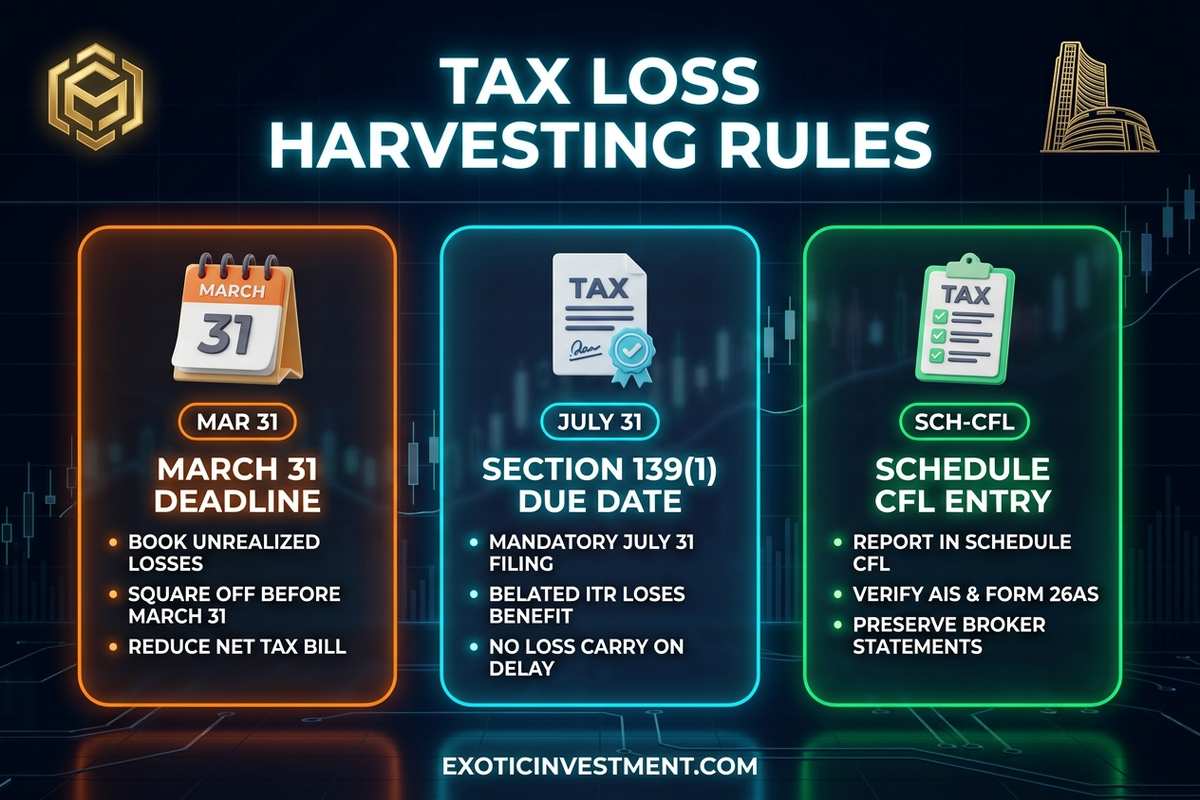
Illustration: Three-step tax loss harvesting workflow highlighting Section 139(1) due-date filing and ITR Schedule CFL compliance.
F&O Tax Audit Rules and Brokerage Deduction Checklist
Wait — active F&O traders frequently ask whether reporting losses triggers an automatic CA Tax Audit! Thankfully, digital transactions enjoy high turnover limits up to ₹10 crore under Section 44AB today. However, traders opting out of Section 44AD presumptive taxation below threshold margins occasionally still need professional audit support.
In addition, remember you can legally deduct trading expenses alongside realized F&O losses inside ITR-3! Specifically, broker charges, STT paid on F&O contracts, internet bills, research subscriptions, and chart tools lower taxable income cleanly. Check how much brokerage and STT drag accumulated across trades using our STT calculator and stock brokerage calculator today.
The Strict July 31 Trap That Cancels Loss Carry-Forward Forever
Finally, watch the deadliest calendar error that wipes out tax shields every July! Under Sections 139(3) and 80, taxpayers MUST file their ITR on or before the statutory Section 139(1) deadline. Filing even one day late as a belated return permanently forfeits carry-forward rights on capital, intraday, and F&O losses alike!
In addition, always fill **Schedule CFL** accurately inside ITR-2 or ITR-3 rather than skipping unused prior-year balances. Check Old versus New Tax Regime rules carefully via our Income Tax Regime Calculator and limit future risk with our position size calculator.
Rebuilding Confidently After Booking Tax Losses
Securing a clean stock market loss tax deduction india shield feels comforting, yet protecting remaining capital matters far more! Never buy back weak falling businesses within hours just to stay busy on trading screens. Instead, step back calmly and inspect why original entry stops or position limits failed.
Specifically, wait until T+1 delivery settlement completes before redeploying capital into stronger sector leaders! Meanwhile, journal every closed losing trade across entry timing, stop width, and emotional bias honestly. Measure breakeven recovery percentages accurately inside our stop-loss calculator and rupee profit calculator today.
Above all, keep organized annual PDF backups of every broker Tradebook and P&L report for eight years! Therefore, tax compliance stays completely stress-free whenever carried-forward losses offset future bull-market gains cleanly.
🚀 Trade Clean Dalal Street Setups With Institutional Discipline
Stop bleeding trading capital to avoidable drawdowns. Protect capital first and compound calmly with Dr. Ashok Kumar N Rao and our 1,300+ active community members.
- Build disciplined risk rules with our Kaliyiri Share Market Book and English bestseller Basics of Indian Stock Market Book.
- Access institutional screeners and pro research via the MultiBagger Plus Courses & Pro Tools Annual Subscription.
- Master stop-loss discipline in our Technical Analysis Course in Kannada or index hedging in our Options Buying Course in Kannada.
💡 Frequently Asked Questions (FAQ): Stock Market Loss Tax Deduction India
1. Can I claim a stock market loss tax deduction India against my job salary?
No! Indian tax law strictly bars deducting capital, intraday, or F&O losses against job salary. Instead, carry unused losses forward cleanly via our tax harvesting calculator today.
2. Can unrealized paper losses in my demat reduce this year’s taxes?
Wait — unsold paper losses in your demat carry zero tax deduction! You must execute an actual sale before March 31; check STT friction first inside our STT calculator.
3. How many years can I carry forward delivery and F&O losses in India?
Delivery capital losses and F&O losses carry forward up to 8 Assessment Years, whereas intraday losses expire after 4 years. Check F&O turnover rules inside our F&O turnover calculator cleanly.
4. Can Short-Term Capital Loss offset Long-Term Capital Gains from mutual funds or property?
Yes — STCL offsets both STCG and LTCG across stocks, mutual funds, gold, and property! Compute exact net tax savings quickly inside our STCG LTCG calculator anytime.
5. What happens if I file my ITR after July 31 when reporting stock losses?
Filing a belated return past July 31 immediately cancels carry-forward rights on capital and F&O trading losses! Always review broker P&L schedules early via our stock taxation guide each June.
6. Does the New Tax Regime block carrying forward stock market losses?
No — individuals selecting the New Tax Regime still carry forward capital and F&O losses across future years normally. Compare both tax regimes side by side inside our Income Tax Regime Calculator right now.