
Identifying which penny stock will boom in 2024 and beyond requires separating genuine micro-cap turnarounds from predatory operator pump-and-dump schemes. On Dalal Street, retail traders constantly hunt for low-priced equities priced under ₹10, hoping to catch the next 10x multibagger surge. However, blindly speculating on micro-cap penny shares without rigorous fundamental forensic screening almost always leads to catastrophic capital wipeouts.
Listen, boss, a stock trading at ₹2 is not automatically cheap, just as a blue-chip trading at ₹2,500 is not inherently expensive. In reality, market price only reflects individual share units, whereas true corporate valuation depends entirely on earnings power, balance sheet debt, and return on capital. When retail buyers ignore these underlying metrics, they walk straight into well-orchestrated operator liquidity traps.
Before deploying personal capital into speculative small companies, establishing a disciplined analytical framework is essential. We explain these core valuation benchmarks and price behavior rules in our beginner guide to basic stock market terms.
Here is the real deal: genuine multibagger penny stocks share specific financial footprints, including falling debt, expanding operating margins, and honest promoter stewardship. In addition, knowing how to screen these gems systematically protects you from losing sleep over frozen lower circuits. You can calculate potential long-term compound growth across disciplined investments using our interactive compound interest calculator.
What are Penny Stocks in India? Market Mechanics and Definitions
In the Indian financial context, penny stocks represent micro-cap public companies typically trading below ₹10 to ₹20 per share on the BSE or NSE. Specifically, these enterprises feature extremely small market capitalizations, frequently below ₹100 Crore, accompanied by thin daily trading liquidity. Consequently, low floating supply makes their market prices exceptionally vulnerable to coordinated operator syndicates.
In addition, many of these small entities have limited institutional ownership, meaning domestic mutual funds and foreign portfolio investors rarely cover them. Because institutional analysts ignore them, published research is practically non-existent, leaving retail participants dependent on unverified social media chatter. To understand how trade settlements and delivery holding rules function, study our detailed guide on delivery and CNC trading rules.
A classic Kannada proverb wisely warns us: “ಹೊಳೆಯಲ್ಲಿ ಹುಣಿಸೇಹಣ್ಣು ಕಿವುಚಿದ ಹಾಗೆ” (Holeyalli hunisehannu kivuchida hage — like squeezing tamarind in a flowing river, where all juice vanishes without trace). Similarly, pouring your hard-earned life savings into debt-laden penny stocks is pure financial waste, as corrupt promoters dilute equity and leave retail investors empty-handed. Therefore, approaching micro-caps demands strict forensic filters and emotional detachment.
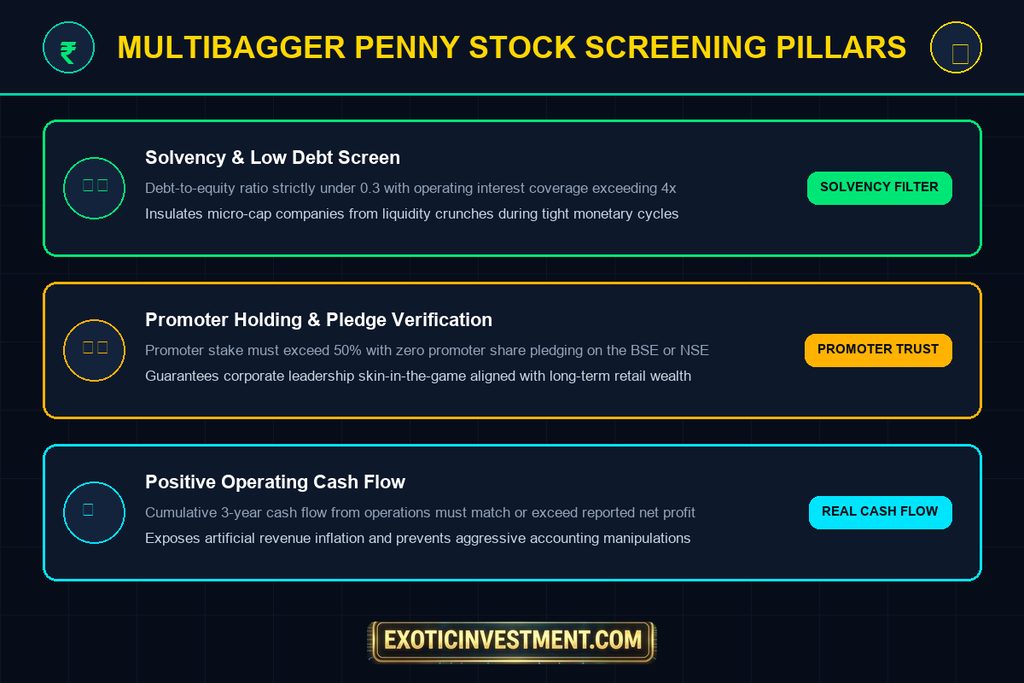
Illustration: 3 Quantitative Screening Filters Identifying Real Multibagger Turnaround Candidates
The 3-Pillar Screening Framework: How to Spot Micro-Cap Turnarounds
Separating genuine turnaround winners from terminal penny traps requires checking three non-negotiable balance sheet pillars. First, verify that the company’s debt-to-equity ratio sits strictly below 0.3, with operating profits covering interest costs at least four times over. Companies operating with manageable debt survive economic slowdowns and possess the agility to expand market share rapidly.
Second, examine promoter shareholding and insider pledging on exchange filings. Specifically, high-conviction turnarounds feature promoter ownership above 50%, with zero shares pledged as collateral to non-banking lenders. In contrast, heavy promoter pledging indicates severe corporate distress, often preceding aggressive stock dumping on Dalal Street.
Third, demand positive operating cash flows across the preceding three financial years. A company reporting paper profits while bleeding operating cash is almost certainly engaging in aggressive revenue recognition or channel stuffing. To master financial statement analysis and balance sheet forensic screening, review our detailed guide on how to read a balance sheet.
| Screening Parameter | Multibagger Turnaround Profile | Dangerous Operator Trap Profile |
|---|---|---|
| Debt-to-Equity Ratio | Under 0.3 (Virtually Debt-Free) | Exceeds 2.0 (Extreme Solvency Risk) |
| Promoter Share Pledging | 0.0% Pledged Shares | Over 30% Pledged to Lenders |
| Operating Cash Flow (CFO) | Consistently Positive and Growing | Negative CFO despite reported profits |
| Auditor Governance History | Reputable Auditor, Clean Audit Reports | Frequent mid-year auditor resignations |
| Daily Trading Liquidity | Active two-way bid-ask matching | Continuous circuit lockouts with 0 volume |
Notice how applying these strict criteria immediately weeds out over 95% of toxic penny candidates trading on Dalal Street. In addition, tracking valuation multiples against industry peers ensures you do not overpay even during turnaround optimism. You can calculate historical valuation multiples using our interactive pe ratio calculator.

Illustration: Anatomy of Malicious Operator Pump-and-Dump Schemes on Indian Stock Exchanges
Operator Red Flags: How Retail Investors Get Trapped in Pump-and-Dumps
Understanding operator psychology is your strongest shield when exploring micro-cap equities. Typically, an operator syndicate quietly accumulates large blocks of thinly traded shares over several dull months. Subsequently, they initiate aggressive buying to trigger consecutive 5% upper circuits, creating artificial momentum and grabbing retail attention.
At the height of the frenzy, unregistered tipsters bombard social media channels and bulk SMS services with bogus multibagger targets. Unsuspecting retail traders, terrified of missing out, place aggressive market buy orders at the upper circuit. Consequently, the operator syndicate dumps their entire accumulated inventory directly into retail bids, abruptly reversing the stock into locked lower circuits.
Once lower circuits begin, trading liquidity completely vanishes because no market participants place buy bids. Retail investors find themselves trapped for weeks, watching their capital diminish by 50% to 80% without any ability to exit. To understand exchange circuit filters and trading collars, review our guide on upper and lower circuit limits.
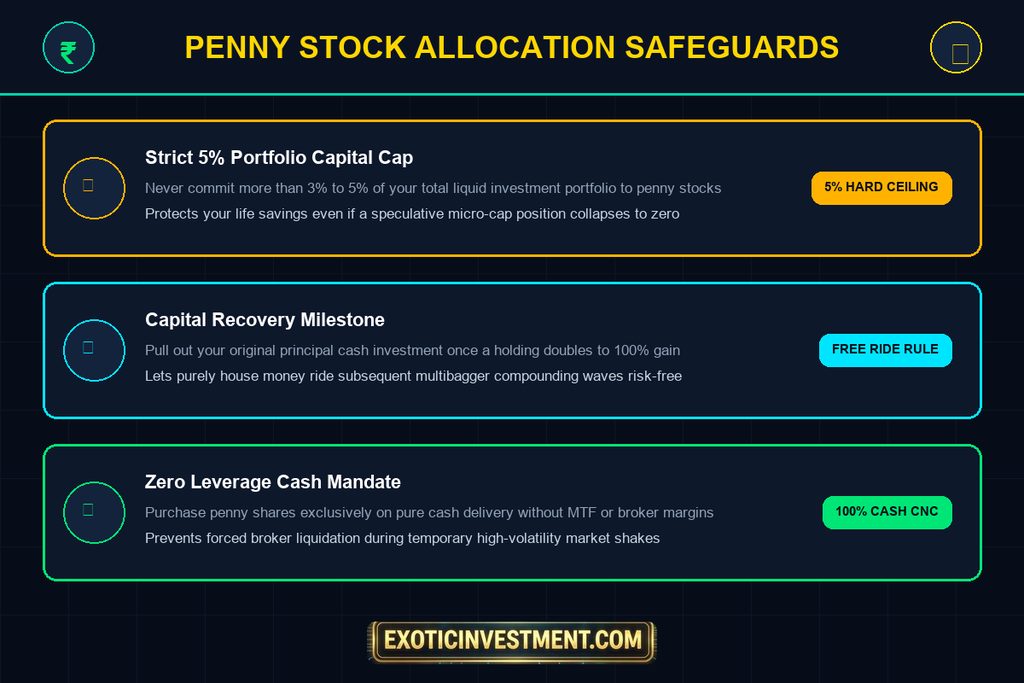
Illustration: Ironclad Risk Management Boundaries and Capital Ceilings for Micro-Cap Investing
Ironclad Capital Allocation Safeguards for Speculative Stocks
If you choose to allocate capital to high-risk micro-cap ideas, strict portfolio sizing rules must be enforced. First, never allocate more than 3% to 5% of your total investable net worth across all penny stock holdings combined. Under this protective rule, even a worst-case corporate bankruptcy cannot damage your core financial foundation.
Second, execute trades exclusively using pure cash delivery on CNC orders, never borrowing margin or using broker credit. Borrowed margin in illiquid shares invites sudden auto-square-off liquidations during rapid volatility spikes. You can evaluate your exact capital limits using our interactive position size calculator.
Third, apply the golden capital recovery milestone without emotional hesitation. Specifically, whenever a speculative position gains 100% and doubles your money, sell exactly half your holding to recover your initial capital. From that moment forward, you ride remaining multibagger upside entirely on house money, eliminating financial risk entirely.
Similarly, calculating your true purchase cost across multiple entries ensures your break-even benchmarks remain mathematically precise. For structured position tracking, explore our guide on how to calculate share average price. This quantitative discipline separates serious market compounders from emotional gamblers.
Pro Tools, Technical Courses, and Books for Dalal Street Traders
Navigating volatile micro-caps and spotting genuine swing setups requires experienced mentorship and proven technical tools. Kannada-speaking investors eager to master price action charts can enroll in our hands-on Technical Analysis Course in Kannada. In addition, options specialists can refine directional momentum strategies in our dedicated Options Buying Course in Kannada.
Beginners building their fundamental footing on Dalal Street will find structured guidance in our practical Basics of Stock Market Course. To access institutional-grade stock screeners, live chart setups, and proprietary valuation models year-round, subscribe to the MultiBagger Plus Courses & Pro Tools Annual Subscription.
You can also absorb Dr. Ashok Kumar N Rao’s bestselling insights in physical print through our popular books, Kaliyiri Share Market and Basics of Indian Stock Market Book. These resources equip retail participants with actionable frameworks tested over full market cycles.
In addition, global crypto market participants can examine quantitative models and algorithmic tracking tools at Emintage to diversify modern portfolios. Meanwhile, equity traders can explore daily trend action on the day chart and examine institutional market participation on the bazar chart.
💡 Frequently Asked Questions About Indian Penny Stocks
Which penny stock to buy today for maximum safety?
No penny stock is completely safe, but prioritizing debt-free companies with positive operating cash flow and high promoter holding offers superior downside protection. Always verify corporate earnings and calculate brokerage fees using our zerodha brokerage calculator.
Can a penny stock turn into a large-cap multibagger?
Yes, legendary Indian giants like Titan, Eicher Motors, and Bajaj Finance once traded at micro-cap valuations before compounding into industry behemoths. However, they succeeded because of exceptional leadership, zero debt, and expanding market share, which you can track alongside face value of shares.
Why do brokers restrict margin on certain penny stocks?
SEBI and leading Indian discount brokers enforce trade-to-trade settlement and 100% upfront cash margins on illiquid scrips under Enhanced Surveillance Measure (ESM) frameworks. This regulatory collar prevents speculative manipulation, as explained in our review of stock broker apps.
How do I exit a penny stock stuck in daily lower circuits?
To exit a lower circuit lock, place an After Market Order (AMO) with your broker at 9:00 AM IST before the pre-open session begins. Because exchange order matching follows price-time priority, early AMO placement gives you the best chance of matching rare buy orders, which you can monitor alongside dividend yield stocks in india.