
Learning how to start sip in zerodha across equity stocks, index ETFs, and Sovereign Gold Bonds is the most effective way for Indian retail investors to build generational wealth. While millions of traders use Zerodha Kite solely for intraday speculation, disciplined investors use its automated toolset for systematic accumulation. Specifically, Zerodha allows you to automate recurring investments with zero delivery brokerage commissions.
Listen, boss, trying to time market tops and bottoms creates emotional exhaustion and guarantees costly mistakes. When you automate your investing schedule through monthly SIPs, you neutralize market noise and capture powerful rupee-cost averaging benefits. Over a ten-year horizon, consistent accumulation of market leaders transforms modest monthly savings into an extraordinary compounding corpus.
In this practical guide, our research desk explains how to buy Gold ETFs, build automated stock baskets, and invest in index funds on Zerodha. Before initiating your first order, understanding foundational market mechanics with our guide to basic stock market terms prevents operational errors. In addition, knowing how orders execute helps you manage your personal demat portfolio with complete confidence.
How to Start a Mutual Fund and Stock SIP on Zerodha Kite
Zerodha provides two distinct portals for systematic investing: Coin for direct mutual funds and Kite for stock and ETF baskets. When you invest through Coin, your money flows directly into direct mutual fund plans, completely bypassing distributor commissions. Consequently, you save between 0.5% and 1.5% in annual management fees, as detailed in our guide on direct vs regular mutual funds.
Alternatively, if you prefer building a custom basket of individual blue-chip companies, you can configure an Equity SIP directly on Zerodha Kite. In fact, you can select whether you want to purchase a fixed number of shares or allocate a predetermined rupee amount every month. In addition, you can project your multi-year compounding growth using our interactive sip calculator.
A classic Kannada proverb reminds us: “ಹನಿ ಹನಿ ಗೂಡಿದರೆ ಹಳ್ಳ, ತೆನೆ ತೆನೆ ಸೇರಿದರೆ ಬಳ್ಳ” (Hani hani goodidare halla, thene thene seridare balla — tiny drops of water gather to form a vast stream, small grains unite to fill a granary). Similarly, investing ₹5,000 every single month into resilient compounders creates enduring financial security. Therefore, automating your contributions ensures discipline regardless of short-term volatility.
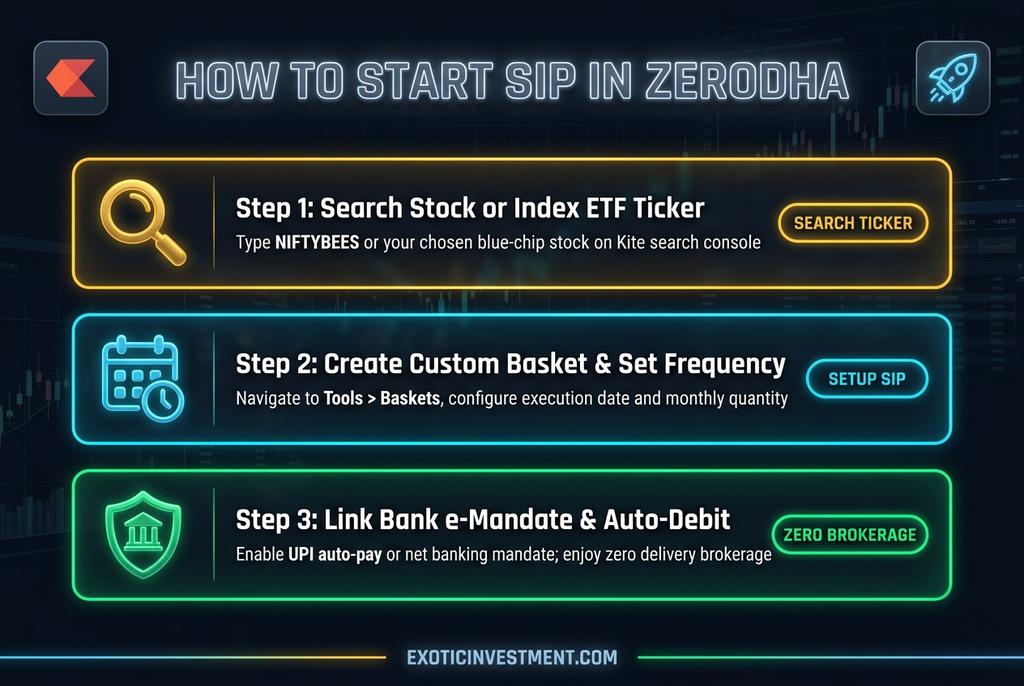
Illustration: 3 Step Operational Blueprint to Configure Systematic Investment Plans on Zerodha Kite
How to Buy Gold on Zerodha: Sovereign Gold Bonds vs Gold ETFs
Indian investors seeking gold allocation on Zerodha have two primary digital vehicles: Sovereign Gold Bonds (SGB) and Gold Exchange Traded Funds (GOLDBEES). Sovereign Gold Bonds are issued by the Reserve Bank of India and offer a guaranteed 2.50% annual interest payout alongside gold price appreciation. Most importantly, capital gains on SGBs held until their full 8-year maturity are 100% tax-free under Section 47 of the Income Tax Act.
On the other hand, Gold ETFs trade live on the National Stock Exchange just like ordinary equity shares. For instance, Nippon India ETF Gold BeES (GOLDBEES) offers instant liquidity, allowing you to buy or sell units in small 1-gram increments during market hours. To compare how precious metals behave relative to equities during market panics, review our analysis on what happens to gold when stock markets crash.
| Gold Investment Feature | Sovereign Gold Bonds (SGB) | Gold ETFs (e.g. GOLDBEES) |
|---|---|---|
| Annual Coupon Yield | 2.50% fixed annual interest | 0.00% (No cash interest paid) |
| Capital Gains Tax | 100% Tax-Free at RBI Maturity (8 Yrs) | Taxed at personal slab rates |
| Liquidity & Trading | Moderate secondary market trading | Very High (Instant execution on Kite) |
| Expense Ratio | 0.00% (Zero ongoing asset fees) | 0.50% to 0.80% annually |
First, purchasing digital gold on Kite completely eliminates physical making charges and storage risks. Second, you can calculate transaction costs before placing orders using our zerodha brokerage calculator. In addition, you can project multi-year returns using our guide on how to calculate cagr in stocks.
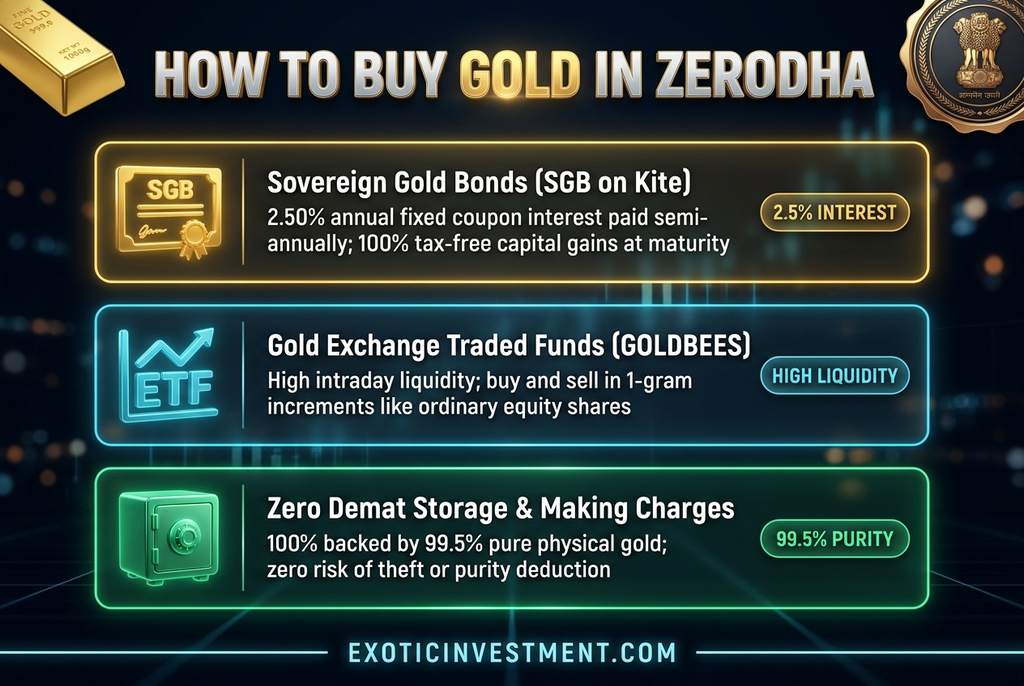
Illustration: Comparing Sovereign Gold Bonds vs Gold ETFs on Zerodha: Yield, Taxes, and Liquidity
Step-by-Step: Investing in Index and Sectoral ETFs via Zerodha Kite
Exchange Traded Funds represent one of the most efficient tools available on Zerodha Kite. Rather than picking single stocks, an ETF allows you to own a proportional basket of index companies with a single click. For example, buying NIFTYBEES grants you instant ownership across the top 50 corporate leaders in India at an annual expense ratio of roughly 0.04%.
Similarly, thematic ETFs allow tactical sector exposure during economic expansion cycles. For instance, you can accumulate banking powerhouses through BANKBEES or tech leaders via ITBEES.
To understand how underlying index weightings are computed before buying, review our detailed guide on how to invest in nifty 50. In addition, disciplined investors who increase their monthly allocation annually can review our guide on step up sip vs regular sip.
🚀 Master Stock Selection & Automated Compounding
Stop guessing market direction. Learn how to construct an all-weather portfolio, time breakout entries, and configure systematic wealth engines directly from Dr. Ashok Kumar N Rao.
- Master stock market fundamentals and compounding laws with our bestselling handbook Kaliyiri Share Market Book and our English edition Basics of Indian Stock Market Book.
- Supercharge your trading performance with institutional screeners through the MultiBagger Plus Courses & Pro Tools Annual Subscription.
- Learn price action and chart setups by enrolling in our structured Technical Analysis Course in Kannada or options mechanics in our Options Buying Course in Kannada.
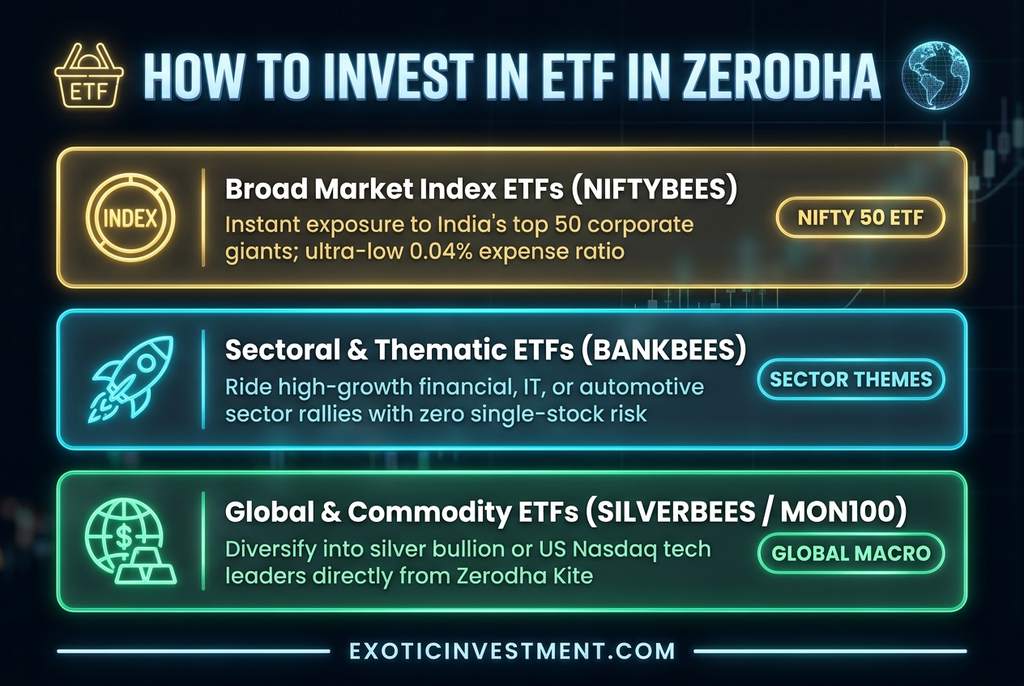
Illustration: Core ETF Asset Allocation Blueprint on Zerodha: Broad Index, Sectoral, and Global Themes
Zerodha Charges and Taxes on Gold ETFs, Stocks, and Mutual Funds
Understanding trading fees and government levies ensures that surprise costs never compromise your investment compounding. Zerodha charges ₹0 brokerage on equity delivery trades and ETF purchases. However, statutory government charges like Securities Transaction Tax (STT), exchange turnover fees, and stamp duty still apply to every executed transaction.
Specifically, delivery equity shares sold within 12 months trigger a flat 20% Short-Term Capital Gains (STCG) tax under revised budget rules. In contrast, investments held beyond 12 months qualify for 12.5% Long-Term Capital Gains (LTCG) tax above the ₹1.25 Lakh exemption limit. Review complete income tax provisions in our guide to stock market profit taxation in india.
In addition, traders balancing commodity futures alongside their long-term equity SIPs can evaluate margin rules using our mcx margin calculator. Similarly, you can compare fee schedules across competing discount brokers using our upstox brokerage calculator. Consequently, calculating trading costs in advance preserves capital for compounding.
Finally, maintaining strict position sizing and capital protection limits prevents catastrophic losses, as outlined in our guide on risk to reward ratio and position sizing. In addition, you can estimate optimal trade sizing allocations using our position size calculator. Therefore, disciplined risk parameters guarantee long-term market survival.
💡 Frequently Asked Questions
1. Does Zerodha charge brokerage for ETF and Stock SIPs?
No, Zerodha charges zero brokerage on equity delivery investments and ETF purchases on Kite. However, standard statutory government levies such as STT, exchange transaction fees, and GST apply. Learn more about trade fee breakdowns with our stock brokerage calculator.
2. What happens if my bank account lacks funds on the SIP date?
If your bank ledger lacks sufficient balance on the scheduled execution date, the automated SIP order will fail without triggering penalty charges from Zerodha. Your order will simply re-attempt during the next scheduled cycle. Learn how to manage cashflow and position allocation using our free position size calculator.
3. Can I buy Sovereign Gold Bonds on Zerodha Kite?
Yes, you can apply for fresh Sovereign Gold Bond tranches when opened by RBI or buy existing tranches from the secondary market on Kite. SGBs provide a fixed 2.50% annual coupon interest and are completely tax-free upon maturity. Track how gold protects wealth during market dips in our guide on what happens to gold when stock markets crash.
4. What is the difference between Zerodha Kite and Coin?
Zerodha Kite is designed for trading equity shares, ETFs, futures, options, and commodity contracts. In contrast, Zerodha Coin is an automated platform dedicated to direct mutual funds without distributor commission drag. Discover how direct funds outperform regular options in our direct vs regular mutual funds guide.
5. How do I modify or pause my SIP on Zerodha?
You can pause, edit, or delete an active SIP at any time by navigating to the Orders section and selecting the SIP tab. Modifying order quantities or execution dates takes effect immediately without any broker penalty fees. Review systematic equity principles in our guide on what is stock sip.